

Your current IT provider doesn't own your company, yet they likely hold the only keys to your digital kingdom. It's an unsettling position to be in, especially when you're facing unresponsive support or a history of surprise bills. You want a partner who enables your growth, not a vendor who keeps you in the dark. If you're hesitant about migrating from one MSP to another because you fear security gaps or losing access to your data, you aren't alone. Most leaders worry that a transition will trigger the very downtime they're trying to avoid.
This 2026 checklist changes that narrative. You'll learn how to execute a clean break that restores full ownership of your passwords and digital assets without risking your operational stability. We'll outline a strategic 30-60-90 day framework that eliminates the threat of unplanned downtime, which currently costs small businesses an average of $25,620 per hour. By following this proactive roadmap, you can shift from a reactive cycle to a steady, secure partnership that actually protects your bottom line. It's time to stop feeling like a hostage and start feeling protected.
Key Takeaways
- Reclaim full ownership of your digital assets, including domain rights and admin passwords, before notifying your current provider.
- Escape the "Break-Fix" trap by choosing a partner that prioritizes proactive threat detection over reactive troubleshooting.
- Use a strategic 30-60-90 day framework for migrating from one MSP to another to eliminate security gaps and unplanned downtime.
- Evaluate new providers based on their ability to provide vCIO leadership and strategic roadmapping rather than just basic helpdesk support.
- Avoid surprise costs during the transition by moving to an all-inclusive retainer model that simplifies your IT budget.
Why Migrating from One MSP to Another is a Strategic Necessity
Migrating from one MSP to another isn't just a technical handoff. It's a strategic reset of your company’s security posture and operational efficiency. Many leaders view this transition as a burden, but it's actually a vital opportunity to audit your digital assets and reclaim control. The modern managed service provider model is built on proactive maintenance and business alignment. If your current provider is simply waiting for things to break, they aren't following this model. They're stuck in a reactive cycle that limits your ability to scale.
The 'Break-Fix' trap is the most common catalyst for a move. In this scenario, you only hear from your IT team when a server is down or a laptop won't boot. This reactive approach creates "IT debt." This is the invisible cost of outdated software, unpatched vulnerabilities, and Band-Aid solutions that eventually fail. Over time, this debt compounds, leading to the high costs of unplanned downtime. To understand what you should actually be receiving from a partner, it helps to review what is a managed service provider in a modern context.
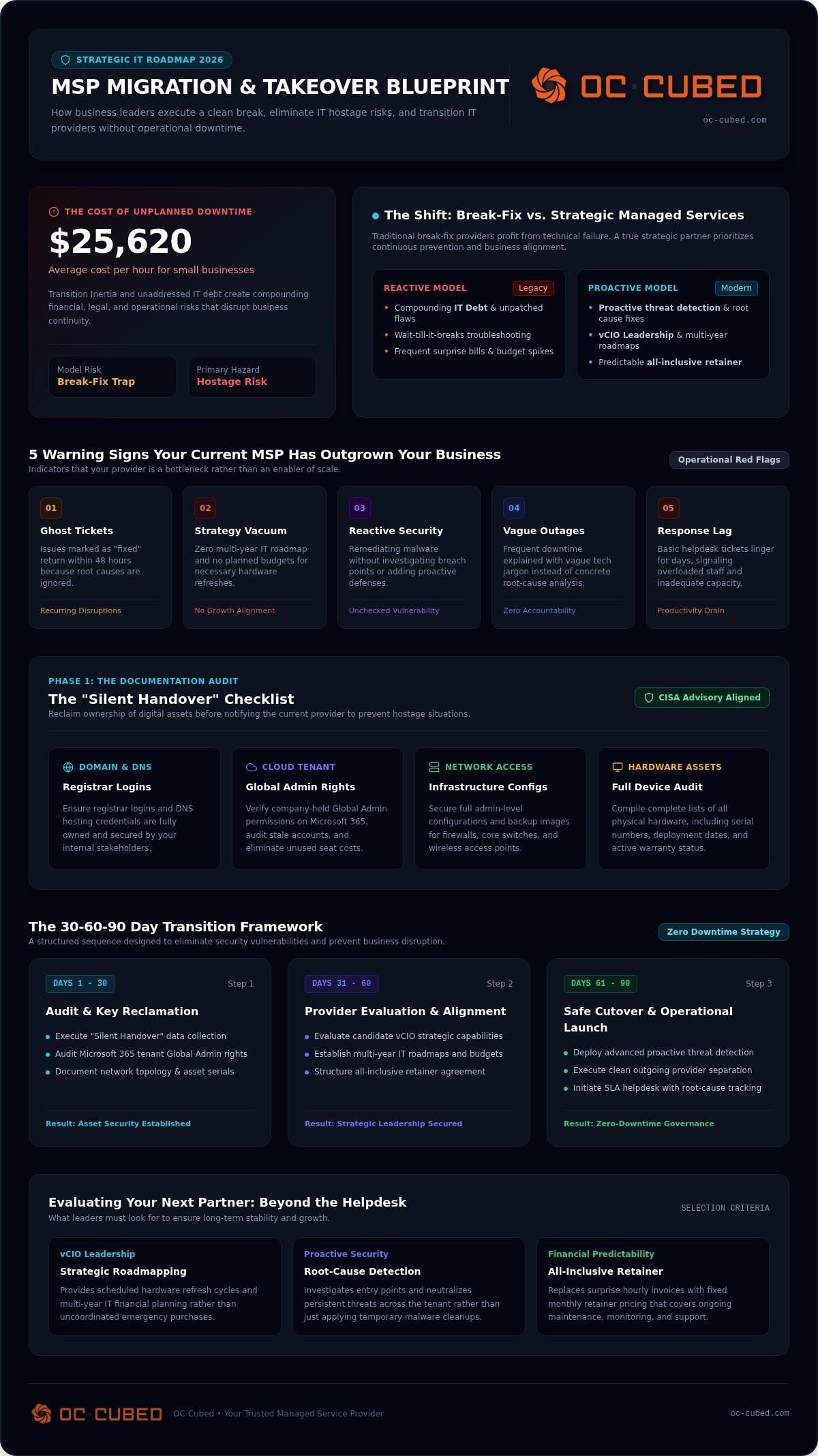
5 Warning Signs Your Current MSP Has Outgrown Your Business
Growth requires a partner who scales with you. If you notice these red flags, your current provider has likely become a bottleneck for your progress:
- Recurring "Ghost" Tickets: Issues that are closed as "fixed" but reappear 48 hours later because the root cause was ignored.
- The Strategy Vacuum: You have no multi-year IT roadmap or predictable budget for hardware refreshes.
- Reactive Security: They remediate a virus but never investigate the breach point or implement advanced threat detection to stop the next one.
- Unexplained Downtime: Frequent outages occur with vague technical explanations instead of a concrete root cause analysis.
- Response Lag: Simple helpdesk requests take days, signaling that their team is overwhelmed or understaffed.
The Risks of Transition Inertia
Transition Inertia is the financial and security cost of delaying a necessary IT leadership change. Staying with a failing provider doesn't just stall your growth; it increases your legal and financial liability. If a cyberattack occurs, staying with a known underperformer is a difficult position to defend to stakeholders or insurance carriers. There is also a significant "hostage" risk. The longer an underperforming MSP manages your data without providing transparent documentation, the harder it becomes to untangle your assets. Reclaiming your digital property is a right, not a favor. Don't let the fear of the process keep you tied to a provider that no longer serves your mission.
Phase 1: The Documentation Audit (Reclaiming the Keys to the Kingdom)
The first step in migrating from one MSP to another isn't sending a termination letter. It's securing your assets. You must establish absolute ownership over your domain, your software licenses, and your data before the outgoing provider realizes a change is coming. This is the "Silent Handover" strategy. By collecting critical credentials quietly, you eliminate the risk of being held hostage by a vendor who has all the passwords but none of the accountability.
A primary focus during this phase is your cloud environment. You need to verify that your business, not the MSP, holds the Global Admin rights to your Microsoft 365 tenant. Poorly managed tenants often have stale administrative accounts that create massive security holes. Following the CISA cybersecurity advisory for MSPs and customers, we recommend a strict audit of these permissions to revoke unnecessary access. Proper Microsoft 365 license management for small business ensures you aren't paying for seats you don't use while maintaining total control over your digital identity.
The Essential Documentation Checklist
Your documentation should be exhaustive. If it isn't written down, you don't own it. Before you announce the transition, ensure you have gathered the following items:
- Domain and DNS: Registrar logins and DNS hosting credentials are your most critical assets.
- Network Infrastructure: Admin-level access to firewall, switch, and wireless access point configurations.
- Hardware Inventory: A complete list of all devices, including serial numbers and warranty status.
- Backup Verification: Current backup schedules and "proof of life" for recent data recovery points.
If you're unsure where to start, our team can help you secure your documentation for a clean transition.
Identifying 'Shadow IT' and Third-Party Vendors
Migration is the perfect time to shine a light on Shadow IT. These are the SaaS subscriptions or hardware tools your employees use without official IT oversight. You need a list of every third-party vendor, from your ISP to your specialized industry software. Having this data ready allows for a smoother transition into modern remote IT management services. When your new partner has a clear view of your entire vendor ecosystem, they can take over management duties immediately. This prevents the finger-pointing that often happens between vendors during a technical outage.
Phase 2: Evaluating Your Next Partner Beyond the Helpdesk
When migrating from one MSP to another, don't focus solely on technical tools. Basic remote IT support has become a commodity in 2026. Almost any provider can fix a laptop or reset a password. The real differentiator is IT leadership. You need a partner who acts as both a protector and an enabler, not just a ticket-taker. During the interview process, screen for a proactive culture. A reactive provider waits for a disaster to happen before they communicate. A proactive partner identifies infrastructure weak points and recurring "ghost tickets" before they cause expensive downtime.
Effective migration requires a partner that offers 24/7 coverage through integrated helpdesk and Network Operations Center (NOC) services. This ensures that network monitoring and threat detection never stop, even after your office closes for the day. You must also evaluate the MSP's internal security protocols. Since they will hold your administrative credentials, you need to know how they secure their own internal environment. Transparency about their internal audits and who "watches the watchers" is a non-negotiable sign of a professional partner. Evaluating these governance capabilities is the most important step when migrating from one MSP to another.
The vCIO and CISO Requirement
Most small to mid-sized businesses don't need a full-time executive to manage technology. However, they absolutely need the strategic oversight that an executive provides. Your next partner should offer fractional leadership through vCIO and Virtual CISO roles. This ensures your technology spend aligns with your long-term business growth. It's the most efficient way to secure enterprise-grade IT leadership without a full-time hire. A vCISO bridges the critical gap between a system that functions and one that is resilient against modern threats.
Security Stack Verification
Ask for a detailed list of the tools included in their standard stack. A professional MSP uses industry-standard solutions like Proofpoint for email security and SentinelOne for endpoint protection. Following the CISA cybersecurity guidelines for managed service provider customers is essential for maintaining trust during a transition. These guidelines emphasize the need for robust logging and account auditing when moving between vendors. Security Stack Maturity is the integration of endpoint, email, and network protection into a single reporting framework. This ensures that your security posture is a unified shield rather than a collection of disconnected software applications.
Phase 3: The Seamless Migration Checklist (30-60-90 Days)
A successful transition requires a structured timeline to prevent security gaps and operational friction. Migrating from one MSP to another shouldn't be a frantic scramble. It's a phased evolution from your old, reactive state to a new, proactive standard. By following a 90-day roadmap, you ensure that every digital asset is accounted for and every vulnerability is closed. This methodical approach is the only way to achieve a zero-downtime cutover while maintaining a robust cybersecurity risk management small business strategy.
The First 30 Days: Stopping the Bleeding
The initial month is about visibility and immediate control. We prioritize stabilization by installing remote monitoring agents and enterprise-grade endpoint protection across every device in your network. This provides the telemetry needed to identify existing issues that your previous provider might have ignored. During this window, we execute a master password reset for all administrative accounts and enforce Multi-Factor Authentication (MFA) across the board. This "Deep Discovery" audit is critical when migrating from one MSP to another. It allows us to find hidden network vulnerabilities and undocumented hardware before they can cause a service interruption.
The 60-Day Mark: Hardening and Integration
Once the environment is stable, we focus on hardening your defenses. This phase involves migrating your email security to Proofpoint to stop advanced phishing and credential theft. We also perform a comprehensive cleanup of your Microsoft 365 tenant settings to ensure your cloud identity is secure. Our team standardizes your firewall and switch management, closing unused ports and revoking stale access credentials. This is also when your staff is introduced to the new helpdesk workflow. By integrating your operations with our 24/7 Network Operations Center (NOC), we ensure that your team has support exactly when they need it, without the typical lag of a reactive provider.
The 90-Day Mark: Becoming Proactive
By the third month, the transition moves from technical setup to strategic partnership. We review the first two monthly reports to identify long-term trends in your network health. This data informs your first Virtual CIO strategy session, where we plan for future growth and hardware lifecycles. The final step is the formal decommissioning of all old MSP access. we revoke their service accounts, uninstall their legacy agents, and ensure no digital "backdoors" remain. At this point, your migration is complete. You have moved from a state of uncertainty to a position of total digital ownership and proactive protection.
How OC Cubed - Your trusted MSP Simplifies the Migration Process
OC Cubed - Your trusted MSP acts as the steady hand that guides your business through the complexities of migrating from one MSP to another. We understand the friction that occurs when an outgoing provider is reluctant to hand over the keys to your environment. Our Transition Management approach ensures you never have to mediate technical disputes or hunt for missing documentation. We act as your advocate, managing the technical handoff directly with your former vendor. From day one, OC Cubed - Your trusted MSP implements 24/7 network monitoring and configuration to catch anomalies that often surface during a provider change. This proactive threat detection and remediation ensures your security posture remains unbroken while we stabilize your infrastructure.
One of the biggest anxieties during a transition is financial unpredictability. Many providers lure clients in with low initial quotes, only to hit them with onboarding fees or migration surcharges later. OC Cubed - Your trusted MSP eliminates this stress with our No-Surprise Retainer model. Your costs remain predictable and all-inclusive, even during the most complex transition months. This transparency allows you to focus on your business goals instead of auditing your IT invoices. We believe that professional support should provide peace of mind, not a list of unexpected expenses.
Taking the Burden Off Your Team
Our team handles the heavy lifting so your staff can stay focused on their daily operations. OC Cubed - Your trusted MSP handles vendor management entirely, serving as the single point of contact for your ISP, software providers, and hardware vendors. Through Virtual Project Management, we keep the migration on a strict schedule and provide regular updates without requiring your constant oversight. A core part of this process involves Microsoft 365 tenant maintenance. We ensure your cloud productivity remains high while we optimize your licensing and secure your tenant against unauthorized access.
Ready for a Steady IT Partner?
Our Quiet Migration philosophy is built on the belief that IT should be heard, not felt. You'll notice our presence through the stability of your systems and the clarity of your monthly reports, not through constant fire drills or service interruptions. By integrating C-suite level IT strategy into your monthly support, OC Cubed - Your trusted MSP provides the leadership necessary to turn your technology into a growth engine. We don't just react to issues; we prevent them. If you're ready to reclaim ownership of your digital assets and partner with a team that values proactive protection, we're ready to step in.
Reclaim Control of Your Digital Future
Switching providers is a strategic reset for your business. By following a structured 90-day checklist, you reclaim your administrative rights and eliminate the "hostage" risk associated with poor documentation. Migrating from one MSP to another shouldn't be a source of anxiety; it's the first step toward a partnership built on steady reliability and growth. You've seen how a phased approach can turn a complex transition into a seamless shift that protects your data and your productivity.
The approach at OC Cubed - Your trusted MSP integrates fractional CIO, CTO, and CISO leadership directly into your support model. We combine this high-level strategy with 24/7 NOC and helpdesk integration to ensure your team is always supported. With proactive Proofpoint and Microsoft 365 security management as our standard, your environment remains protected from day one. OC Cubed - Your trusted MSP takes the burden of vendor management off your shoulders so you can focus on scaling your business with confidence.
You deserve an IT partner that looks forward so you don't have to. OC Cubed - Your trusted MSP is ready to help you build a more resilient foundation for everything your company achieves next.
Frequently Asked Questions
How long does migrating from one MSP to another typically take?
A seamless transition for migrating from one MSP to another typically follows a 90-day framework. The first 30 days focus on discovery and stabilizing your network. The middle 30 days involve hardening your security stack and migrating email protection to Proofpoint. The final 30 days focus on strategic optimization and decommissioning old access. This full window ensures every vulnerability is closed and your team is fully integrated into our 24/7 NOC support without any service gaps.
Will our business experience downtime during the IT transition?
No, your business shouldn't experience unplanned downtime when migrating from one MSP to another using a parallel run strategy. We deploy our remote monitoring and endpoint protection agents alongside your incumbent tools before the official cutover. This allows us to verify system health and backup integrity in the background. We only revoke the old provider's access once we've confirmed your network is stable and your Microsoft 365 tenant is fully under our proactive management.
What happens if my current MSP refuses to provide our passwords?
If a provider refuses to share credentials, we use administrative recovery protocols to reclaim your digital assets. We work with domain registrars and Microsoft to prove your ownership and reset Global Admin rights. This is why we advocate for a Silent Handover where we secure these keys before you issue a termination notice. Our fractional CIO leadership ensures that you maintain legal and technical control over your data, regardless of the outgoing vendor's cooperation level.
How do I tell my current MSP that we are leaving?
You should only notify your current provider after you've secured all critical documentation and administrative passwords. Once your assets are safe, send a formal written notice that aligns with your contract's termination window, which is typically 30, 60, or 90 days. OC Cubed - Your trusted MSP acts as your advocate during this period. We handle the vendor management and technical handoff so you don't have to mediate between the old and new IT teams yourself.
Is it normal to pay for two MSPs at the same time during a migration?
It's common to have a 30-day overlap where both providers are active. This parallel run period is essential for maintaining continuous security telemetry and preventing support gaps. While paying two retainers for one month feels redundant, it's a small investment to avoid the high cost of unplanned downtime. The model at OC Cubed - Your trusted MSP ensures that once the transition is complete, your IT costs remain predictable without hidden onboarding fees or surprise migration surcharges.
What is the most common mistake businesses make when switching IT providers?
The most frequent error is notifying the current MSP before securing administrative access to the network and cloud tenants. This often leads to hostage situations where the provider restricts access or stops responding to tickets. Another mistake is choosing a new partner based only on helpdesk response times. A successful migration requires a partner that provides fractional executive leadership and proactive threat detection rather than just a reactive team that waits for systems to break.
How do I know if the new MSP is actually more secure than my old one?
Look for a partner that integrates advanced security governance into their standard service. A secure MSP uses enterprise-grade tools like Proofpoint for email and SentinelOne for endpoint protection. They should also provide 24/7 NOC monitoring to catch anomalies in real time. Most importantly, they should offer Virtual CISO leadership to oversee your security roadmap. If your new provider can't explain their own internal security protocols or how they watch the watchers, they aren't more secure.
Can a new MSP take over my existing Microsoft 365 licenses?
Yes, we can take over the management and maintenance of your existing Microsoft 365 environment. We perform a thorough audit of your tenant permissions and license usage to eliminate waste and close security holes. Our team handles the transition of your subscriptions to our management stack without any interruption to your email or cloud productivity. This ensures that your Microsoft 365 tenant maintenance is handled by experts who prioritize security hardening and proactive configuration over simple user resets.


