

The traditional "break-fix" model of IT support is a liability disguised as a service. When your technology only gets attention after it fails, you're paying for downtime rather than productivity. This cycle leads many leaders to ask: what is a managed service provider, and how does it actually change the way a business operates? An MSP is an outsourced IT department that shifts the focus from reactive repairs to proactive management. It's the difference between calling a plumber for a flood and having a team that ensures the pipes never leak in the first place.
You probably recognize the frustration of unpredictable monthly bills and the lingering anxiety of modern security threats. Managing multiple tech vendors often steals time that belongs to your core business goals. This guide clarifies how an MSP functions and what services they provide to stabilize your infrastructure. We'll explore how these partnerships offer predictable costs, advanced security threat detection, and strategic roadmaps. By the end, you'll know exactly how to determine if your business needs a managed partner to eliminate technical debt and fuel growth.
Key Takeaways
- Understanding what is a managed service provider starts with moving from reactive repairs to a model that prevents issues before they disrupt your workflow.
- You'll discover how helpdesk integration and endpoint protection provide a multi-layered defense against downtime and cyber threats.
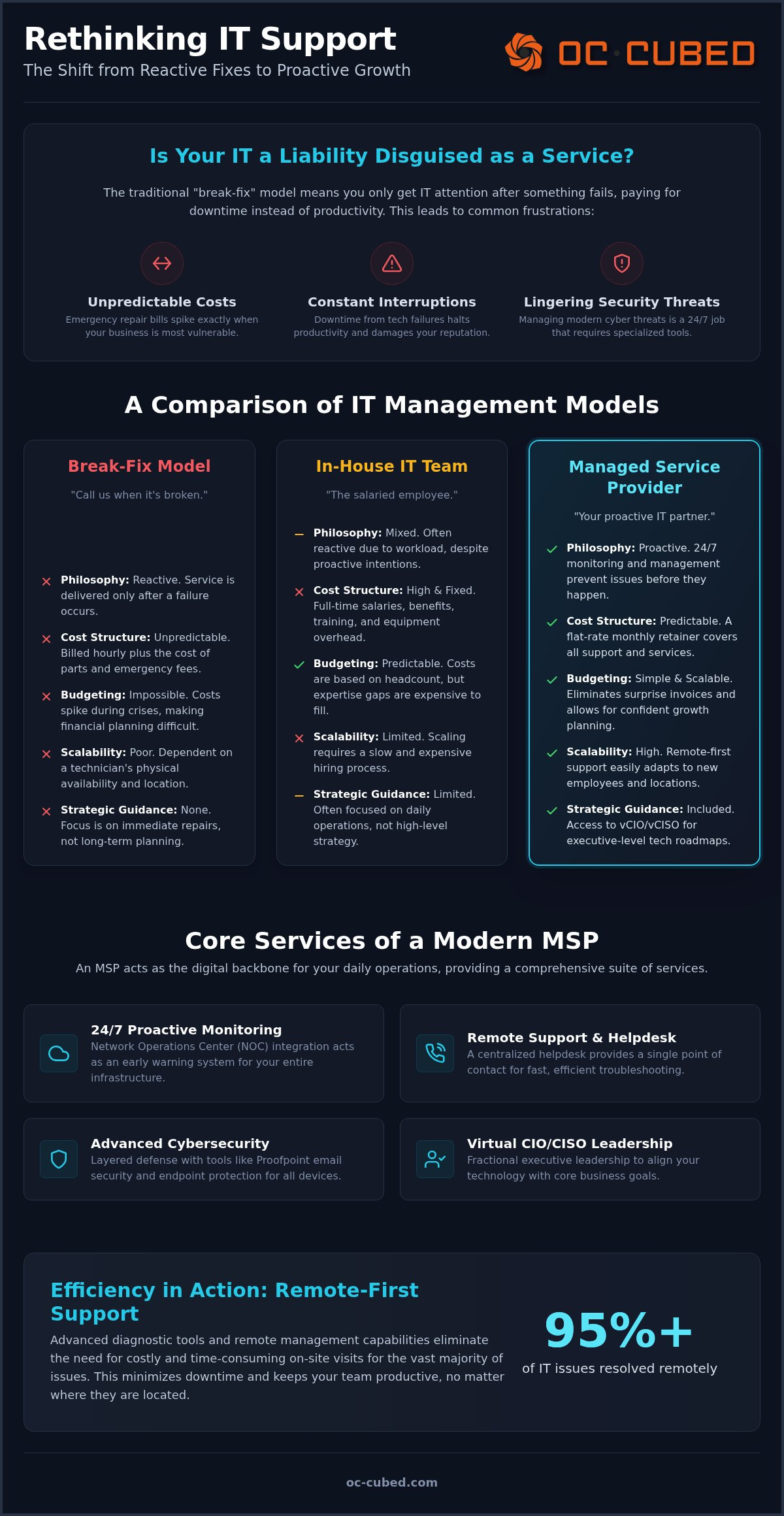
- We compare the predictable flat-rate retainer of an MSP against the hidden costs of break-fix models and the high overhead of in-house IT teams.
- Learn how fractional leadership through a vCIO or vCISO gives your business executive-level tech strategy without the executive-level salary.
- We'll outline how to vet a provider's remote capabilities and their use of industry-standard tools like Proofpoint and Microsoft 365.
What is a Managed Service Provider (MSP)? The Proactive Shift
A Managed service provider (MSP) is a strategic partner that takes 24/7 responsibility for your company's IT health. Unlike traditional support, an MSP doesn't just wait for your call. They operate as an integrated IT department that works behind the scenes to keep your systems stable. When leaders ask what is a managed service provider, they are often looking for a way to exit the cycle of constant technical interruptions. This partnership is built on a subscription-based model, which aligns the provider's incentives with your business success. If your technology works perfectly, the MSP's job is easier; if it fails, they bear the burden of fixing it without extra cost to you.
The Core Philosophy: Prevention Over Repair
Waiting for technology to break before fixing it is the most expensive way to run a modern business. This reactive mindset leads to emergency repair bills and hours of lost productivity. An MSP operates on the philosophy of prevention. We use 24/7 network monitoring to act as an early warning system for your entire infrastructure. This allows us to identify a failing server or a security vulnerability before it causes a shutdown. Automation plays a critical role here. By automating software patches and security updates, we ensure your systems remain hardened against threats without requiring manual intervention every time a new update is released.
Why Modern Businesses Are Moving Away from 'Break-Fix'
The old "break-fix" model is dying because it's inherently unpredictable. When you rely on an hourly technician, your IT costs spike exactly when your business is most vulnerable. The hidden costs of downtime go far beyond the repair bill. You have to account for lost employee hours, potential reputation damage, and the stress of uncertainty. Transitioning to a managed model introduces predictable budgeting. Flat-rate retainers eliminate surprise IT invoices, allowing you to plan your growth with confidence.
Scalability is another major factor in this shift. As businesses expand to include remote teams across the country, a traditional on-site "computer guy" can't keep up. An MSP provides remote-first support that scales with you. Whether you are adding five new employees in a different state or migrating your entire operation to Microsoft 365, the managed model provides the infrastructure to support that growth without the overhead of hiring a full-time, in-house staff for every location. This approach transforms IT from a source of anxiety into a reliable engine for your business.
Core Services: What Does an MSP Actually Do?
Understanding what is a managed service provider requires looking beyond the "fix-it" mentality. An MSP provides a comprehensive overview of MSP services that act as the digital backbone of your daily operations. This isn't just about answering phones. It involves maintaining Microsoft 365 tenants for security and efficiency, managing complex network infrastructure, and overseeing the connectivity that keeps your team online. The goal is to create a seamless environment where technology supports your business instead of hindering it.
Remote IT Support and Helpdesk Integration
Modern support is remote-first. By leveraging advanced diagnostic tools, we resolve over 95% of IT issues without ever needing an on-site visit. This approach eliminates the hours or days of wait time associated with traditional technician dispatch. A centralized Helpdesk provides your employees with a single, reliable point of contact for troubleshooting daily software or hardware glitches.
Behind the scenes, NOC (Network Operations Center) integration ensures backend stability. While your team receives immediate help with an application error, the NOC is monitoring your server health and bandwidth. This dual-layered support model ensures that minor desk issues don't escalate into company-wide outages. If you need a partner that scales with a national workforce, our remote IT support provides the coverage you need without the logistics of on-site staffing.
Advanced Cybersecurity and Email Protection
Security is no longer a "set it and forget it" task. It requires a layered defense that protects your data wherever it lives. Email security with Proofpoint serves as the first line of defense, filtering out sophisticated phishing attacks before they reach an inbox. For remote and hybrid teams, endpoint protection is a necessity. It secures every laptop and mobile device that accesses your corporate data, regardless of the network they use.
We also take full responsibility for firewall and switch configurations. This management blocks external threats and optimizes traffic flow for better performance. By combining threat detection with active remediation, we neutralize risks in real-time. This comprehensive security stack provides the peace of mind leaders need to focus on strategic growth rather than digital vulnerabilities. It's about building a fortress around your data while keeping the doors open for your employees.
MSP vs. Break-Fix vs. In-House IT: A Comparison
Choosing how to support your technology is a critical leadership decision. Most businesses start with a "break-fix" approach, hiring a technician only when something stops working. Others try to hire a full-time IT manager to handle everything internally. However, understanding what is a managed service provider reveals a third, more stable option. An MSP offers a flat-rate retainer that covers everything from security to daily troubleshooting. This model removes the conflict of interest found in break-fix, where the technician only makes money when your business is suffering. It replaces chaos with a partnership focused on uptime.
The Financial Reality: Capex vs. Opex
Managing IT through an MSP shifts your budget from unpredictable capital expenses (Capex) to steady operational costs (Opex). Instead of facing a massive, unexpected bill for a server failure, you pay a consistent monthly fee that includes proactive maintenance. The strategic business benefits of this approach include better risk mitigation and easier financial planning. For companies with fewer than 100 employees, hiring a full-time IT manager is often overkill. You end up paying a full salary plus benefits for one person who may lack the specialized skills needed for modern cybersecurity or cloud migrations.
- Predictable Monthly IT Spend. You replace surprise invoices with a single, flat-rate retainer.
- Enterprise-Grade Security. Access tools like Proofpoint and advanced endpoint protection without the high entry cost.
- Strategic Leadership. Gain fractional vCIO expertise to align your tech with your business roadmap.
- 24/7 Reliability. Systems are monitored around the clock, not just during business hours.
Knowledge Depth and Specialized Tools
MSPs provide access to a team of specialists rather than a single "jack-of-all-trades." Technology is too complex for one person to master every niche. Our team handles everything from Microsoft 365 tenant maintenance to advanced email security. We also leverage enterprise-grade tools for monitoring and threat detection that are typically too expensive for a small business to purchase alone. This collective knowledge makes your business more resilient. If one person is away, the rest of the team is already familiar with your environment.
Availability is where the managed model truly shines. An in-house technician takes vacations, gets sick, and works limited hours. An MSP provides 24/7 network monitoring that never sleeps. There's also a common myth that outsourcing means losing control. In reality, professional management gives leaders more control. With monthly reporting and a clear tech roadmap, you gain total visibility into your infrastructure's health. You aren't just hoping things work; you have the data to prove they do. Understanding what is a managed service provider means recognizing that you are hiring a department, not just a person.
The Strategic Advantage: Virtual CIO and Leadership
Many leaders view IT as a cost center or a necessary evil. A high-quality MSP changes that perception by transforming technology into a growth engine. When you ask what is a managed service provider, you should look for more than a helpdesk. You are hiring a strategic partner that provides executive-level leadership through a Virtual CIO (vCIO), CTO, or Virtual CISO. This fractional model provides the expertise of a seasoned executive without the $200,000 annual salary. It's about moving beyond daily fires to align your technology investments with your three-year business goals.
Virtual CIO/CTO/CISO Advisory
A fractional executive bridges the gap between your business objectives and your technical implementation. On a monthly basis, they conduct risk assessments and budget forecasting to prevent financial surprises. They provide the governance and security leadership necessary for growing organizations to remain compliant. This strategic layer is the defining difference when evaluating what is a managed service provider versus a simple repair shop. It ensures that every dollar spent on technology actually moves the needle for your company rather than just keeping the lights on.
Project and Vendor Management
Managing multiple technology vendors is a significant drain on your internal resources. An MSP acts as your single point of contact for internet providers, hardware manufacturers, and software vendors like Microsoft or Proofpoint. This is the "one throat to choke" principle. If your internet goes down or a software license expires, you don't spend hours on hold with a call center. You call your partner. They handle the logistics, the troubleshooting, and the ultimate resolution while you stay focused on your business.
Virtual project management keeps infrastructure upgrades on schedule and on budget. Whether you're migrating to a new cloud environment or overhauling your network switches, professional oversight prevents scope creep and technical delays. Monthly reporting provides the transparency you need to hold your provider accountable. You get clear data on system performance, security threats neutralized, and progress on your long-term tech roadmap. This level of professional management ensures your data stays protected and meets evolving industry standards for compliance and risk management.
How to Choose the Right MSP for Your Business
Selecting the right partner requires looking beyond the price tag. When you evaluate what is a managed service provider in the context of your own organization, you must look for a provider that prioritizes stability over simple troubleshooting. A high-quality partner functions as an insurance policy against downtime. They should offer a security stack built on industry leaders like Proofpoint and Microsoft 365. This ensures your data is protected by the same tools used by enterprise-level corporations. If a provider cannot clearly explain how they secure your email and endpoints, they aren't prepared to protect your business.
Assess their remote capabilities carefully. A modern workforce isn't tied to a single physical office. Your provider must be able to support your team anywhere in the country without the delays associated with traditional on-site dispatch. This remote-first approach resolves issues in minutes rather than days. You should also look for "business-first" language. If a provider only talks about their servers and technical specifications, they aren't focused on your growth. A true partner discusses how technology removes obstacles and increases your operational efficiency.
Essential Questions for Your Potential Partner
Before signing a contract, you need to understand how the provider operates on a daily basis. Start by asking about their average response time for remote support tickets. Productivity halts when employees are stuck waiting for a fix. Next, ask how they handle Microsoft 365 tenant security and maintenance. This is the heart of your collaboration, and it requires constant oversight to prevent unauthorized access. Finally, ask if they can provide a technology roadmap for the next 12 months. This roadmap is essential for predictable budgeting and ensures your infrastructure scales alongside your revenue. If they only react when things break, they don't understand what is a managed service provider; they are just a repair shop.
The OC Cubed - Your trusted MSP Difference: Steady Reliability
Our remote-first, proactive model is designed for companies that can't afford downtime. We provide steady reliability through integrated NOC and Helpdesk support. This means while our helpdesk resolves your employees' immediate issues, our Network Operations Center is working in the background to ensure your backend systems remain stable. We focus on proactive reporting so you always know the health of your network before a problem occurs. We take pride in being a protector of your data and an enabler of your growth.
Take Control of Your Technical Future
Technology shouldn't be a source of constant friction. Moving from a break-fix mindset to a partnership with a managed service provider turns IT from a liability into a strategic asset. You gain a team that prioritizes your uptime and security through 24/7 proactive monitoring. This shift ensures your business remains resilient against modern threats while providing the stability needed for national scalability. It's about replacing technical debt with a clear, actionable roadmap for your organization's future.
Understanding what is a managed service provider means recognizing the value of executive-level guidance. Our fractional CIO and CISO expertise provides the leadership you need to align technical investments with your long-term business goals. Combined with Proofpoint-powered email security, you can finally focus on growth without the lingering anxiety of a cyberattack or a system failure. You deserve a partner that acts as both a protector and an enabler.
It's time to stop managing tech vendors and start leading your business. We are here to ensure your technology never stands in your way. Your growth is our priority, and steady reliability is our promise.
Frequently Asked Questions
What is the difference between an MSP and a cloud service provider?
A cloud service provider delivers the underlying digital infrastructure, such as virtual servers or storage. A managed service provider is the team that manages and secures the data living within that infrastructure. While a cloud provider gives you the tools, an MSP ensures those tools are configured correctly, patched regularly, and supported for your employees.
How much do managed IT services typically cost for a small business?
Managed IT services are usually structured as a predictable monthly retainer. This fee is often calculated based on your total number of users or devices. This model replaces the financial volatility of hourly repairs with a steady operational expense. The total investment varies depending on your security needs and the level of executive leadership required for your tech roadmap.
Will an MSP replace my current IT person?
Not necessarily. We often work in a co-managed capacity alongside internal IT staff. In this model, the MSP handles the repetitive backend tasks like 24/7 network monitoring and security updates. This frees up your internal person to focus on high-level business projects and immediate on-site needs. We act as a support system that expands your team's capabilities.
Can a managed service provider help with cybersecurity compliance?
Yes. A managed service provider is a critical partner for meeting industry regulations and insurance requirements. We implement the technical controls and security layers needed to protect sensitive data. Through fractional CISO leadership, we also provide the documentation and risk assessments necessary to prove compliance to auditors or regulatory bodies.
Do MSPs provide hardware, or just software and support?
We focus on the management, configuration, and support of your technology environment. While we are not a hardware manufacturer, we handle vendor management to help you source and purchase the right equipment. Once the hardware arrives, we take full responsibility for its setup, security, and ongoing maintenance to ensure it performs as expected.
What happens if my internet goes down and my MSP is remote?
Our monitoring systems detect connectivity issues the moment they occur. When an outage happens, we immediately contact your internet service provider to manage the resolution process on your behalf. We also help leaders implement redundant internet connections. This ensures that if your primary line fails, your business automatically switches to a backup source to prevent downtime.
Is a managed service provider the same as an IT consultant?
An IT consultant is typically hired for a specific project or a short-term strategic goal. When leaders ask what is a managed service provider, they are looking for a long-term operational partner. Consultants provide a plan; an MSP executes that plan and takes 24/7 responsibility for the ongoing health and security of your entire infrastructure.
How does an MSP handle Microsoft 365 security?
We secure Microsoft 365 through active tenant maintenance and advanced threat detection. This involves managing user permissions, enforcing multi-factor authentication, and monitoring for suspicious account activity. We also integrate Proofpoint email security to block sophisticated phishing attacks before they reach your employees. This layered approach ensures your cloud environment remains a safe place for collaboration.


