

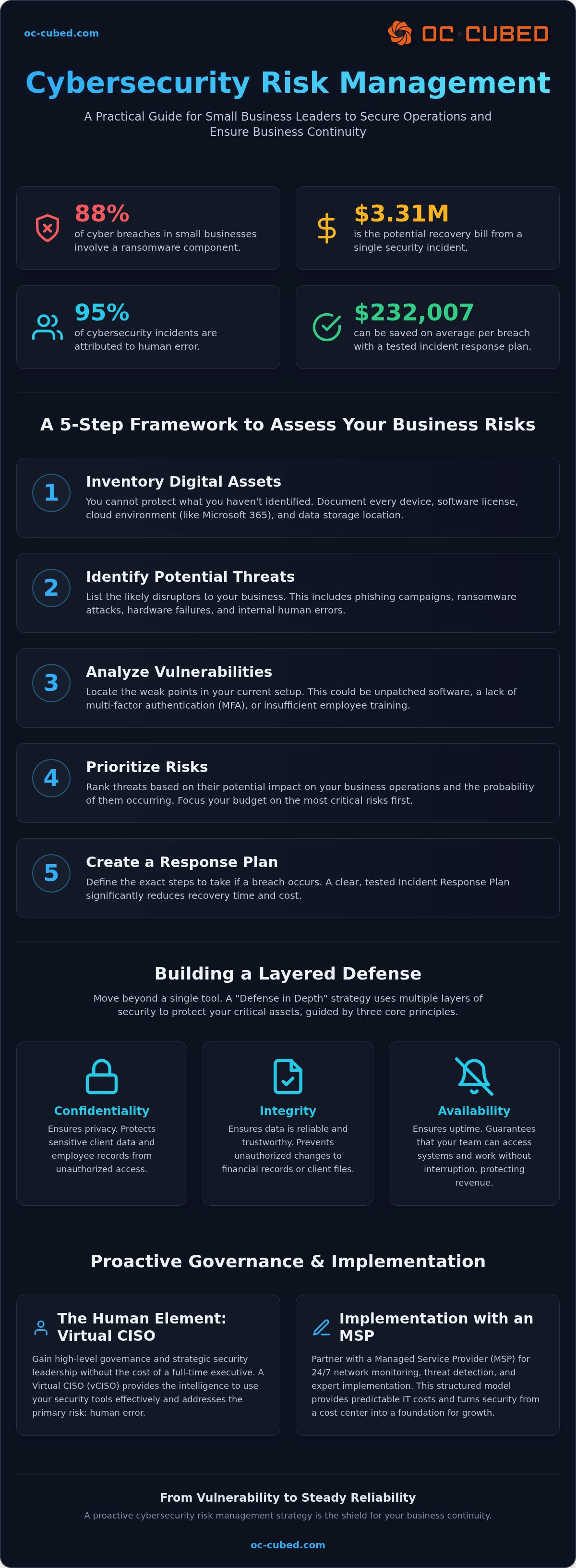
88% of cyber breaches in small businesses now involve a ransomware component, making a dedicated approach to cybersecurity risk management small business leaders can trust more critical than ever. You likely feel the pressure of rising insurance premiums and the constant worry that one wrong click could lead to a $3.31 million recovery bill. It's exhausting to wonder if your current tools are actually protecting you or if you're simply overpaying for a false sense of security. You deserve a strategy that replaces this anxiety with steady, reliable protection.
This guide delivers a practical, executive level approach to securing your assets and ensuring business continuity. We'll move past technical jargon to focus on what matters: predictable IT costs and enterprise grade security leadership. You'll learn how to align with the NIST 2.0 framework, utilize 24/7 threat detection, and implement a roadmap that turns security from a cost center into a foundation for growth. Here's how to secure your 2026 operations with confidence and precision.
Key Takeaways
- Move beyond the "antivirus-only" mindset to adopt a proactive process of identifying and mitigating digital threats.
- Utilize a simplified five-step framework to inventory your digital assets and build a clear roadmap for risk reduction.
- Implement a "Defense in Depth" strategy that uses endpoint protection and email security to stop threats before they reach your network.
- Discover how cybersecurity risk management small business strategies use a virtual CISO to provide high-level governance and address human error.
- Gain peace of mind with 24/7 network monitoring and predictable IT costs through a structured managed service model.
What is Cybersecurity Risk Management for Small Business?
Cybersecurity risk management small business leaders rely on is more than just a defensive posture. It's a continuous cycle of identifying, assessing, and mitigating digital threats to keep your doors open. You can't treat this as a one-time project. It's a strategic framework. Proper IT risk management ensures your digital assets are mapped and guarded according to their actual value to the company. Cybersecurity risk management is the shield that ensures your business continuity remains unbroken.
The old "antivirus-only" approach is obsolete in 2026. Attackers now use sophisticated AI to bypass simple file scanners. If you still use a reactive break-fix IT model, you're essentially waiting for a fire to start before buying an extinguisher. Proactive risk management identifies these sparks early. It moves your business from a state of constant vulnerability to a state of steady reliability.
The Difference Between Security and Risk Management
Security is the collection of tools you own. Risk management is the intelligence that tells you how to use them. Many small businesses become low-hanging fruit because they have tools but no strategy. Automated cyberattacks don't always target you specifically; they target your weaknesses. An unpatched server or a weak password is an open door for a bot. The financial damage of ignoring these risks extends past the ransom. You also face regulatory fines, forensic investigation costs, and the devastating loss of your professional reputation. Using advanced endpoint protection is a great start, but it must be part of a larger plan.
The Three Pillars: Confidentiality, Integrity, and Availability
We simplify complex security goals into three clear pillars. This helps you understand exactly what we're protecting.
- Confidentiality: This is about privacy. It ensures sensitive client data and employee records stay out of the wrong hands.
- Integrity: This ensures your data is reliable. If an attacker changes your financial records or client files, your business loses its foundation.
- Availability: This is about uptime. Your team must be able to work without interruption. If your systems are down, your revenue stops.
A 5-Step Framework to Assess Your Business Risks
Complex industry frameworks often leave business owners paralyzed by choice. You don't need a 500-page manual to begin securing your operations. Effective cybersecurity risk management small business leaders can actually execute starts with a simplified, five-step flow. This process mirrors the core logic of the FTC cybersecurity guide, but we've condensed it for immediate action. It moves you from guesswork to a data-driven strategy.
The framework follows a logical sequence to identify and neutralize threats before they cause damage:
- Step 1: Inventory digital assets. You cannot protect what you haven't identified. Document every device, software license, and data storage location.
- Step 2: Identify potential threats. List the likely disruptors. This includes phishing campaigns, hardware failures, and simple internal errors. 95% of cybersecurity incidents are attributed to human error, so start there.
- Step 3: Analyze vulnerability. Locate the weak points in your current setup. This might be unpatched software or a lack of multi-factor authentication.
- Step 4: Prioritize risks. Not every threat deserves the same portion of your budget. Rank them based on their potential to stop your business.
- Step 5: Create a response plan. Decide exactly what happens if a breach occurs. Having a tested incident response plan can save an average of $232,007 per breach.
If you aren't sure where your biggest gaps are, a professional expert risk assessment can provide the clarity you need to move forward.
Identifying Your Critical Digital Assets
Every business has "crown jewels" that are essential for daily operation. For most modern offices, Microsoft 365 tenant management is the primary asset. It holds your emails, shared files, and communication logs. Beyond your cloud environment, identify your client databases, proprietary software, and financial records. If losing a specific folder would stop your ability to bill clients or pay employees, that asset goes to the top of your list.
Calculating Risk: Probability vs. Impact
We use a simple 1 to 5 scale to measure risk. A "5" in probability means a threat is almost certain to happen, like a phishing attempt. A "5" in impact means the event would result in total business downtime. Multiply these numbers to get a risk score. This data allows you to allocate your security budget where it will have the most significant effect. Focus your spending on high-impact, high-probability events first. This ensures your IT environment remains stable and your costs stay predictable.
Mitigation Strategies: Building a Layered Defense
Small businesses need more than a single lock on the digital door. Effective cybersecurity risk management small business plans utilize a concept called "Defense in Depth." This strategy creates multiple hurdles for an attacker. If one layer fails, the next one is there to catch the threat. It begins with robust firewall and switch management. These tools serve as your first line of defense, controlling exactly what traffic is allowed to enter or leave your network environment.
You also need eyes on your systems at all hours. 24/7 network monitoring provides a specific "NOC integration" advantage for small firms that cannot justify a full internal IT department. It means professional teams are watching your infrastructure while you focus on your customers. This approach aligns with CISA's small business guidance, which emphasizes the need for continuous visibility to detect anomalies before they turn into full scale breaches.
Email Security: The Front Line of Risk
90% of cyberattacks start in the inbox. Phishing has evolved beyond poorly written emails into sophisticated social engineering. Standard Microsoft 365 security settings provide a helpful baseline, but they often need expert tuning to block modern threats. We utilize Proofpoint to filter advanced malicious links and attachments before they ever reach your employees. By stopping the threat at the mail gateway, you remove the opportunity for human error to compromise your business assets.
Endpoint Protection and Threat Remediation
Devices are the new perimeter. Since your team likely works from various locations, every laptop and mobile device is a potential entry point. We have moved far beyond basic antivirus software. Modern endpoint protection uses Endpoint Detection and Response (EDR) to monitor system behavior. EDR catches "zero-day" attacks by identifying suspicious patterns, such as a file suddenly attempting to encrypt an entire drive.
Threat detection is only effective if followed by rapid remediation. This includes automated patching for software and firmware. Vulnerabilities in common applications are often exploited by hackers within hours of being discovered. We handle these updates in the background to ensure your systems remain secure without interrupting your daily workflow. This proactive maintenance keeps your environment stable and your protection levels high.
The Human Element: Governance and the Virtual CISO
Technology is only half the battle. Even the most advanced tools cannot stop a staff member from handing over credentials to a convincing fraudster. Human error and social engineering remain the primary drivers of security breaches. Data shows that 95% of cybersecurity incidents are attributed to human error. This is why effective cybersecurity risk management small business owners implement must include a governance layer. Governance isn't just a set of rules; it's strategic oversight that ensures your protection stays ahead of evolving threats.
A Virtual CISO (vCISO) provides this leadership. Most small businesses don't need a full-time, six-figure Chief Information Security Officer, but they do need that level of expertise. Fractional leadership gives you access to enterprise-grade strategy at a fraction of the cost. Your vCISO ensures your security roadmap aligns with your business goals. They provide regular monthly reporting so you stay informed about your risk profile without needing to learn technical minutiae. This keeps leadership in control and removes the guesswork from IT spending.
Establishing a Culture of Security
Security starts in the corner office. If the CEO ignores security protocols, the rest of the team will follow suit. We follow CISA guidance by encouraging leaders to set a clear tone from the top. This involves more than a yearly seminar. You need ongoing employee training to turn your staff into a "human firewall." When security becomes an everyday activity rather than a quarterly check-in, your risk drops significantly. Your team becomes your eyes and ears on the front lines, catching phishing attempts before they can do damage.
Vendor and Project Management
Your security is only as strong as your weakest partner. Supply chain attacks target third-party vendors to gain access to your network. We manage this risk by auditing vendor access and ensuring they meet your specific standards. Using virtual project management ensures these security implementations actually reach the finish line. It keeps your complex transitions on track and ensures you remain compliant with industry-specific standards. This structured approach prevents security gaps from appearing during growth or system changes.
Implementing Risk Management with an MSP
Execution is the most difficult part of any security strategy. You've identified your digital assets and assessed your threats, but now you need a team to manage the daily defense. Effective cybersecurity risk management small business leaders can actually maintain requires professional execution. A Monthly Managed IT Services Retainer provides this by turning complex security into a predictable utility. You gain a full team of experts without the heavy overhead of internal hiring or training.
Our 24/7 network monitoring and configuration keeps your environment stable around the clock. We watch your firewalls and switches to catch anomalies before they escalate. When a potential threat appears, remote IT support provides an instant response to remediate the issue. This bundled model ensures that security and support aren't separate silos. They work together to protect your business continuity. You get the peace of mind that comes from knowing your environment is being watched by professionals.
Predictable Costs vs. Unpredictable Risks
A data breach for a business with fewer than 500 employees averages $3.31 million. That is a catastrophic, unpredictable risk that can end a company. A flat-rate MSP fee is a manageable, predictable investment that prevents such disasters. This model shifts your IT from a reactive cost center to a proactive growth enabler. Your managed provider acts as a partner in your success. We provide a single point of accountability. You won't deal with finger-pointing between vendors because one team handles the entire security stack.
Next Steps for Small Business Leaders
Don't wait for a security incident to start your journey. Begin with a preliminary self-assessment of your current state. Check your backups to ensure they're off-site and immutable. Verify that Multi-Factor Authentication (MFA) is active on every single account. These two steps alone significantly reduce your immediate risk profile.
Once you have a baseline, schedule a discovery call with a managed service provider. The first 90 days of a professional rollout focus on stabilization. We clean up legacy security gaps, tune your Microsoft 365 environment, and establish your new security baseline. You'll move from a state of constant technical anxiety to a state of steady reliability. This structured approach ensures your 2026 strategy is built on a foundation of control and protection.
Build a Foundation for Resilient Growth
Transitioning from reactive fixes to a proactive strategy is the most significant step you can take for your company's longevity. By implementing a framework that prioritizes your digital assets and utilizes layered defenses, you remove the constant threat of catastrophic downtime. Effective cybersecurity risk management small business leaders use ensures that your expansion isn't derailed by preventable breaches or human error. It turns security from a source of anxiety into a foundation for growth.
You don't have to navigate these complex technical requirements alone. Proactive 24/7 threat detection and remediation provide a shield that never sleeps, while fractional vCISO expertise brings enterprise-grade strategy to small business budgets. This combination results in predictable flat-rate monthly IT support and the steady reliability your operations require. You deserve an IT environment that supports your goals without delivering expensive surprises.
Take control of your digital environment today and focus on the work that matters most. Your business is ready to thrive in 2026 with the right protection in place.
Frequently Asked Questions
Is cybersecurity risk management different for small businesses than large corporations?
The core principles remain the same, but the execution differs in scale and resource allocation. Small businesses are often targeted precisely because they lack the massive internal IT departments found in enterprise firms. While a corporation might manage hundreds of specialized security roles, a small business requires a streamlined approach. Focus on protecting your most critical assets, such as email and cloud data, through a proactive managed model.
How much should a small business spend on cybersecurity risk management?
Your investment depends on your industry and the sensitivity of the data you handle. It's best to view this as a business continuity investment rather than a simple technical expense. Most firms find that a flat-rate managed service model provides the highest value. This approach allows for predictable monthly budgeting while ensuring you have access to enterprise-grade protection. Avoid the reactive trap of only spending money after a disaster happens.
Can we just use cyber insurance instead of a risk management program?
Insurance is a recovery tool, but it's not a prevention strategy. In 2026, many insurers require specific controls like MFA and EDR before they will even issue a policy. If you don't have a solid cybersecurity risk management small business strategy, you might find your claims denied or your premiums unaffordable. Insurance helps pay for the damage, but it cannot restore a ruined professional reputation or lost client trust.
What are the most common cyber threats for small businesses in 2026?
Ransomware and AI-driven phishing remain the primary disruptors for small firms. 88% of small business breaches now involve a ransomware component. Attackers use automated tools to scan for unpatched software or weak credentials. Social engineering has also become more sophisticated. Hackers now use AI to create highly personalized emails that trick employees into bypassing standard security protocols. Constant vigilance and layered defenses are your best protection against these evolving tactics.
Do we need a full-time CISO to manage our security risks?
Most small businesses don't need a full-time executive, but they definitely need that level of expertise. A Virtual CISO (vCISO) provides fractional leadership that fits your budget. This role handles high-level governance, compliance requirements, and your strategic security roadmap. You get the same caliber of leadership as a large corporation without the burden of a six-figure salary. It's an efficient way to get expert guidance on a part-time basis.
How does remote IT support handle a physical security breach?
Remote support focuses on the digital fallout of a physical event. If a laptop is stolen, we can remotely wipe the device to prevent data access. We also monitor for unauthorized logins from new locations and can lock down your Microsoft 365 tenant instantly. While we don't provide on-site security guards, our 24/7 monitoring ensures your digital perimeter remains intact regardless of what happens to your physical hardware.
What is the role of Microsoft 365 in a cybersecurity strategy?
Microsoft 365 is often the central hub of a modern small business. It houses your emails, files, and employee identities. Proper tenant maintenance is essential to ensure that sharing permissions are restricted and security logs are monitored. We often layer additional tools like Proofpoint over your tenant. This provides advanced filtering that standard settings might miss, ensuring your primary communication tool doesn't become a primary vulnerability.
How often should we update our cybersecurity risk assessment?
You should review your assessment at least annually or whenever you make a significant change to your operations. If you add new vendors, adopt new software, or change your service model, your risk profile shifts. Regular monthly reporting from your MSP helps keep these risks in view. This ensures your cybersecurity risk management small business framework stays aligned with the current threat landscape and your specific growth goals.


