

What if the primary bottleneck in your business isn't a lack of tools, but a lack of direction? Many organizations find themselves trapped in a cycle of reactive fixes, relying on technicians who excel at troubleshooting but struggle to architect a long-term growth strategy. It's frustrating to watch your budget disappear into misaligned technology while cybersecurity risks and vendor sprawl keep you up at night.
We understand that you need more than just a helpdesk; you need a partner who ensures your technology serves your business goals. This guide shows you how to secure enterprise-grade IT leadership without full-time hire expenses. You'll discover how to access executive-level strategy, robust security governance, and a clear technology roadmap at a fraction of the cost of a traditional C-suite executive.
We'll break down the 2026 strategy for leveraging fractional CIO and CISO expertise to stabilize your overhead and gain total control over your digital environment. From proactive threat detection to predictable monthly retainers, you're about to learn how to bridge the gap between daily operations and high-level execution.
Key Takeaways
- Distinguish between basic technical maintenance and the strategic leadership required to eliminate technical debt and drive growth.
- Learn how vCIO and vCISO roles provide specialized executive expertise on a fractional basis to bridge your high-level leadership gap.
- Discover how to maintain enterprise-grade IT leadership without full-time hire expenses, saving on salary and benefits while gaining immediate value.
- Identify the five critical signs that your business has outgrown its current technology strategy, including recurring surprise invoices and stagnant roadmaps.
- Explore how a proactive monthly managed IT services retainer integrates executive advisory with remote security monitoring for predictable operational costs.
The Strategic Gap: Why Technical Support Is Not IT Leadership
Many business owners believe that as long as the printers work and the internet is fast, their technology is under control. This is a common misconception. There is a fundamental difference between technical support and strategic leadership. Technical support is reactive; it focuses on keeping the lights on and fixing problems after they occur. Strategic leadership is proactive. It aligns your technology investments with your long-term business goals to drive growth. Without this distinction, your organization remains in a "fix-it" loop that drains resources without providing a return on investment.
A lone technician or a basic helpdesk is designed to solve immediate tickets. They lack the specialized training to architect a three-year technology roadmap or manage complex cybersecurity compliance. This leadership vacuum often leads to technical debt, where short-term fixes create long-term stability issues. It also results in vendor sprawl. Without a centralized strategy, departments often purchase redundant software or services that don't communicate with each other. Securing IT leadership without full-time hire costs allows you to break this cycle by introducing executive-level oversight to your existing operations.
Symptoms of a Leadership Vacuum
If your technology feels like a burden rather than an asset, you're likely facing a leadership gap. Watch for these specific indicators within your organization:
- Frequent surprise IT bills: You encounter large, unbudgeted expenses for hardware replacements or emergency repairs that should have been planned for months in advance.
- ROI-blind decisions: New software is implemented because it "looked good," but it fails to improve efficiency or increase revenue because it wasn't vetted against business objectives.
- Paper-only security policies: You have a handbook that mentions data protection, but no one is auditing your Microsoft 365 tenant or enforcing multi-factor authentication across all endpoints.
The Founder Trap: Why You Should Not Be Your Own CTO
Founders often fall into the trap of managing their own IT vendor relationships to save money. This creates a massive opportunity cost. Every hour a CEO spends troubleshooting a firewall or negotiating a software contract is an hour taken away from business development. Beyond the time lost, "googling the solution" for enterprise-level security is a liability. It often leads to misconfigured systems that leave your data vulnerable to modern threats.
Transitioning from a fix-it mindset to a growth-enablement mindset requires professional guidance. You need a partner who understands how to leverage tools like Proofpoint for email security or managed firewalls to protect your perimeter. By accessing IT leadership without full-time hire overhead, you gain the quiet authority of a seasoned professional who ensures your technology is an accelerator for your business, not a roadblock.
What Is Fractional IT Leadership? (vCIO, vCTO, and vCISO Explained)
Fractional IT leadership is the provision of executive-level technology guidance on a part-time or project-specific basis. It's the most efficient way for growing organizations to secure IT leadership without full-time hire commitments. This model allows you to tap into 20 or more years of industry experience for a fraction of the cost of a traditional C-suite executive. You get the same level of authority and foresight without the overhead of salary, benefits, and equity.
This leadership integrates seamlessly with your existing infrastructure. While your remote IT support team manages the day-to-day tickets, your fractional executives provide the roadmap they follow. It's about moving from a state of constant repair to a state of strategic advancement. If you're ready to see how this fits your organization, you can explore our virtual CIO and CISO services to find the right balance for your budget.
The Virtual CIO (vCIO): Focus on Business Alignment
The Virtual CIO acts as the architect of business-aligned technology strategy. Their primary role is to ensure your IT spend reflects your corporate goals. They focus on:
- Budgeting: Developing long-term technology budgets and roadmaps that eliminate financial surprises.
- Lifecycle Management: Managing the IT lifecycle to prevent hardware-driven downtime before it happens.
- Stakeholder Communication: Acting as a bridge between technical teams and business owners to ensure everyone speaks the same language.
A vCIO ensures your tech stack isn't just a collection of tools, but a cohesive system that supports your bottom line.
The Virtual CTO (vCTO): Focus on Innovation
While the CIO looks at alignment, the vCTO looks at the technical engine. They evaluate how new software and infrastructure can improve your operational efficiency. Their work includes:
- Innovation: Vetting new technologies to ensure they actually add value to your workflow.
- Complex Projects: Overseeing large-scale initiatives like cloud migrations or helpdesk and NOC integration.
- Scalability: Ensuring your technical stack can handle a growing headcount without breaking.
They provide the technical vision required to keep your business competitive in a rapidly changing market.
The Virtual CISO (vCISO): Focus on Risk and Compliance
The vCISO is your protector. They establish security governance and threat detection protocols that go far beyond simple antivirus. This role is critical for:
- Governance: Managing compliance requirements like SOC2 or HIPAA without the cost of a full-time security officer.
- Advanced Protection: Implementing enterprise-grade tools like Proofpoint for email security and endpoint protection.
- Remediation: Creating a structured plan for security threat detection and remediation to minimize impact.
By securing high-level IT leadership without full-time hire constraints, you ensure your data remains safe while your business grows.
Fractional vs. Full-Time IT Executives: A Cost and Impact Comparison
Hiring a high-level executive is a high-stakes gamble for any organization. It often takes six months to find the right candidate and another six months to see a measurable return on that investment. Choosing IT leadership without full-time hire obligations fundamentally changes this timeline. You gain immediate access to senior expertise without the long-term liability of a permanent contract or the friction of a lengthy recruitment cycle.
The primary advantage of the fractional model is the "Speed to Value" factor. While a traditional hire is still navigating onboarding and office politics, a fractional leader is already auditing your security protocols and identifying wasted spend. This model also offers unparalleled scalability. You can dial executive involvement up during a complex merger or a major infrastructure overhaul, then dial it back down once the project stabilizes. This flexibility prevents you from being locked into a high salary when the workload doesn't justify it.
The Real Math: Total Cost of Ownership
The financial commitment for a full-time CIO is significant. In 2026, average base compensation for these roles often exceeds $250,000 annually. Once you factor in health benefits, 401(k) matching, payroll taxes, equity, and performance bonuses, the total cost of employment can easily exceed $400,000. Most mid-market firms simply don't need 40 hours of strategic planning every week; they need high-impact decisions at specific intervals.
Fractional models convert these heavy fixed labor costs into a predictable monthly managed IT services retainer. This improves your cash flow and allows for better long-term budgeting. The ROI becomes clear when you calculate the cost of prevented downtime and the savings from optimized vendor contracts. You're no longer paying for a physical presence in a chair. You're paying for the quiet authority of a professional who ensures your technology drives revenue.
Cultural Integration and Accountability
A common myth suggests that fractional leaders don't care about your company culture because they aren't "part of the team." In reality, results-driven leadership is often more effective because it's detached from internal office politics. A virtual CIO or CISO focuses entirely on your growth and protection. They aren't interested in corporate ladder-climbing; they're interested in executing your roadmap.
Accountability is a core feature of securing IT leadership without full-time hire overhead. Every strategic initiative is tracked and validated through monthly reporting. You receive clear documentation on project milestones, security improvements, and budget performance. This level of transparency ensures that every dollar spent on leadership is directly tied to a business outcome, providing a level of oversight that is often missing with internal hires.
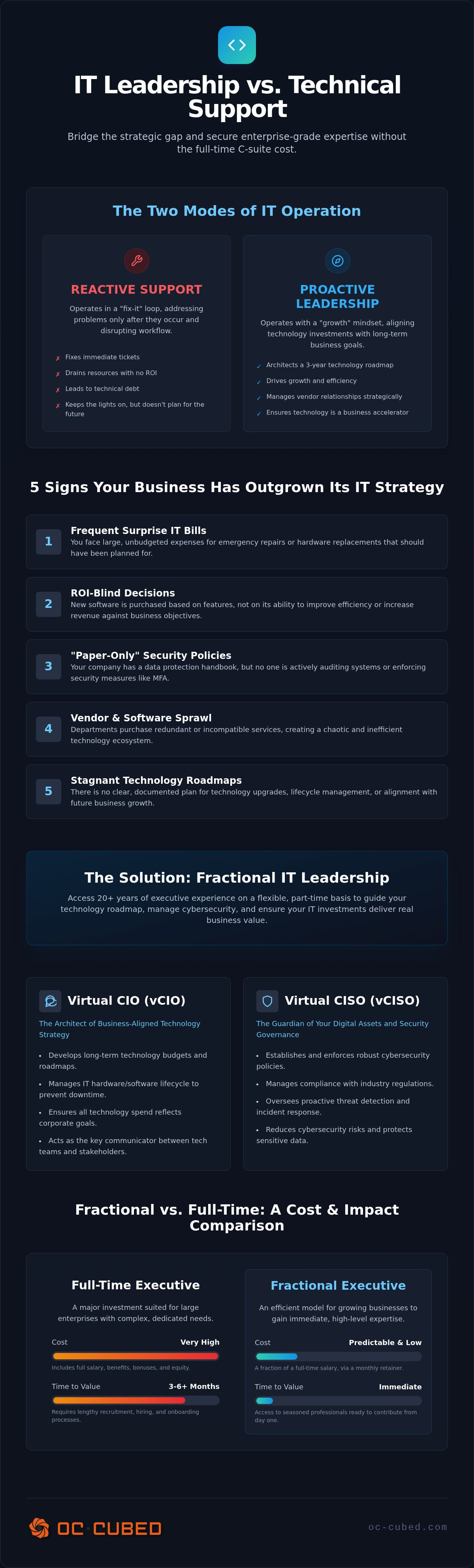
5 Signs Your Business Has Outgrown Its Current IT Strategy
Every growing organization eventually reaches a technical ceiling. The systems and support that worked when you had ten employees often buckle under the weight of a larger team and more complex data requirements. Recognizing these signs early allows you to transition to professional IT leadership without full-time hire costs before a major operational failure occurs. If your technology feels like a hurdle rather than an engine, it's time to evaluate your current trajectory.
One of the most obvious indicators is "Surprise IT Bill" syndrome. If you're receiving unbudgeted invoices for emergency repairs or hardware failures every quarter, your strategy is reactive rather than planned. Similarly, if your security strategy consists only of "we have an antivirus," you're essentially leaving your front door unlocked. Modern threats bypass basic software with ease. You might also notice that critical IT projects are consistently behind schedule and over budget. This happens when there's no executive oversight to manage vendor relationships or set clear milestones.
A growing vendor list often masks stalling productivity. You might have more tools than ever, but your team is slower because those tools don't communicate. Finally, there's the risk factor. If you have no idea if your current technology could survive a major cyberattack, your strategy has a leadership vacuum. Securing IT leadership without full-time hire overhead provides the quiet authority needed to fix these issues before they become catastrophes.
The Security Red Flag: Compliance and Threat Detection
Effective cybersecurity risk management for small business requires more than just installing a program. It demands executive oversight to establish governance and response protocols. Relying on "Endpoint Protection" alone is dangerous without a strategic response plan to handle remediation. A vCISO bridges this gap. They ensure your security policies aren't just words on a page, but active defenses that protect your reputation and your revenue.
The Efficiency Red Flag: Microsoft 365 and Cloud Sprawl
Cloud environments often become cluttered and expensive without proper maintenance. Many businesses pay for licenses they never use or allow "shadow IT" to create security holes. Our Microsoft 365 license management guide explains how to audit your tenant to stop this waste. Beyond licensing, a lack of tenant maintenance leads to data leaks and sluggish performance. Centralized management for firewalls and switches is essential to keep your network secure and fast.
Implementing Fractional Leadership with OC Cubed
Transitioning to fractional leadership isn't just a temporary bridge. It's a permanent shift toward operational maturity. At OC Cubed - Your trusted MSP, we merge high-level executive advisory with the daily execution of proactive remote support. This integration ensures that your strategy doesn't just sit on a shelf. It lives in your network configuration, your security protocols, and your team's daily workflow. We provide the quiet authority needed to turn technology from a cost center into a growth engine.
Our model is built on a predictable monthly managed IT services retainer. This structure is designed to eliminate the anxiety of "Surprise IT Bill" syndrome for good. You gain access to IT leadership without full-time hire expenses, but with the same level of commitment you'd expect from an internal executive. We provide national businesses with 24/7 peace of mind through a remote model that focuses on results rather than office presence. It's a scalable solution that grows alongside your organization.
The onboarding process is deliberate and transparent. We begin with a comprehensive assessment to identify your current vulnerabilities, technical debt, and vendor sprawl. From there, we build a customized strategic roadmap that prioritizes your specific business goals. This isn't a one-time project. It's the start of a continuous improvement cycle where every technical decision is vetted for its return on investment.
Strategic Oversight Meets Proactive Support
Our vCIOs don't work in a vacuum. They work directly with our helpdesk and NOC integration teams to ensure your roadmap is being executed correctly. This synergy means that strategic decisions are validated by real-time data from 24/7 network monitoring. We use evidence, not guesswork, to drive your technology forward. This includes the seamless integration of enterprise-grade tools like Proofpoint for email security and advanced endpoint protection. These services are core components of a secure environment that we manage on your behalf.
Your Next Steps Toward Enterprise-Grade IT
Moving away from reactive IT for good starts with a single conversation. We invite you to schedule a discovery call to identify your specific strategic gaps and security risks. During this call, you can review a sample monthly report to see what true accountability looks like in practice. You'll see how we track every security threat, license update, and infrastructure milestone. It's time to secure the IT leadership without full-time hire overhead that your organization needs to thrive in a competitive landscape.
Securing Your Business Future with Strategic IT
High-level IT strategy isn't a luxury reserved for the Fortune 500. By shifting from a reactive mindset to a proactive executive model, you ensure your technology acts as a catalyst for growth rather than a recurring expense. You now understand how fractional leadership provides the specialized expertise of a vCIO, vCTO, or vCISO without the crushing overhead of a full C-suite salary.
Securing IT leadership without full-time hire commitments gives you the quiet authority needed to eliminate technical debt and secure your digital perimeter. Our all-inclusive monthly managed IT retainer pairs proactive advisory with 24/7 network monitoring and NOC integration. It's the most efficient way to ensure your technology roadmap stays on track while your data remains protected against evolving threats.
You deserve the peace of mind that comes with a stable, secure, and scalable technology environment. Let's build a roadmap that puts you back in control of your business goals and removes the obstacles to your success.
Frequently Asked Questions
What is the difference between an IT consultant and a Virtual CIO?
A consultant usually handles specific projects or one-time problems, while a vCIO provides ongoing strategic guidance and business alignment. The vCIO acts as a permanent member of your leadership team. They focus on long-term roadmaps and budgeting rather than just technical troubleshooting. This distinction is vital for companies seeking consistent executive oversight without the burden of a full-time executive salary.
How many hours a month does a fractional IT leader typically work?
The hours vary based on your organization's specific needs and the complexity of your current infrastructure. Most fractional leaders spend between five and fifteen hours per month on strategic initiatives, reporting, and vendor management. This efficiency is why many businesses choose IT leadership without full-time hire costs. You pay only for the high-level expertise you need, rather than a full salary for idle time.
Can a virtual CISO help my business achieve SOC2 or HIPAA compliance?
Yes, a vCISO is specifically designed to establish the security governance and threat detection protocols required for these certifications. They manage the audit process, enforce security policies, and ensure your technical stack meets regulatory standards. By implementing tools like Proofpoint and endpoint protection, they create a verifiable trail of compliance. This provides the same level of protection as an on-site officer at a lower operational cost.
Does OC Cubed handle the actual implementation of the IT roadmap?
We certainly do. Unlike firms that only provide advice, OC Cubed bridges the gap between strategy and execution through our managed IT services retainer. Our vCIOs design the roadmap, and our helpdesk and NOC integration teams carry out the technical work. This includes 24/7 network monitoring, firewall management, and Microsoft 365 maintenance. You get a single partner responsible for both the vision and the daily results.
Will a virtual CTO manage my existing third-party vendors?
Vendor management is a core responsibility of the vCTO role. They act as your technical advocate when dealing with internet service providers, software developers, or hardware vendors. This ensures that third-party services align with your broader business goals and budget. By centralizing these relationships, a vCTO eliminates redundant software costs and prevents vendor sprawl from slowing down your internal productivity.
How does fractional leadership work with my current Microsoft 365 setup?
Your fractional leader will perform a deep audit of your Microsoft 365 tenant to optimize licensing and security settings. They ensure that your configuration supports your strategic roadmap while preventing data leaks through proper maintenance. This includes managing user permissions, enforcing multi-factor authentication, and ensuring your email security is robust. It's about making your existing tools work harder for your business growth.
Is fractional IT leadership suitable for businesses with under 50 employees?
It is often most beneficial for businesses of this size because they face enterprise-level risks without enterprise-level budgets. Securing IT leadership without full-time hire expenses allows a smaller firm to compete with larger rivals. You gain access to a 20-year veteran who can prevent costly technical debt and security breaches. This level of foresight is critical when your resources for recovering from a disaster are limited.
How do you measure the ROI of a virtual IT executive?
ROI is measured through reduced technology overhead, the elimination of surprise IT bills, and a decrease in unplanned downtime. You should also see measurable improvements in security posture and employee productivity as your roadmap is executed. We provide monthly reporting that tracks these metrics against your business goals. This transparency ensures that every dollar spent on strategic advisory leads to a tangible improvement in your bottom line.


