
Waiting for a server to crash before calling a technician is like waiting for a fire to start before buying an extinguisher. It's a reactive strategy that costs your business more than just money. It costs you time and it costs you peace of mind. You're likely tired of unpredictable bills and the constant anxiety that a single cyberattack could halt your operations. Most business owners share your frustration with slow response times from "break-fix" technicians. Modern remote IT management services provide a different path, replacing the stress of the unknown with steady, reliable protection.
This comprehensive guide from OC Cubed - Your trusted MSP shows how proactive management transforms your technology into a strategic asset. You'll discover how to achieve zero unplanned downtime and ensure reliable operations. You'll learn to secure your data while gaining executive-level leadership and professional oversight without the cost of an on-site team. This article explores the transition to continuous monitoring, the value of fractional C-suite leadership, and the path to a predictable monthly budget.
Key Takeaways
- Understand the shift from reactive "break-fix" repairs to proactive remote IT management services that prevent downtime before it starts.
- Learn how a Network Operations Center (NOC) provides continuous oversight to keep your infrastructure stable and your endpoints secure.
- Discover how fractional executive leadership, including vCIO and vCISO services, provides high-level strategy without the cost of a full-time hire.
- Identify the operational bottlenecks and unpredictable expenses that signal your business is ready for a managed IT retainer.
- Explore the essential security layers, from Microsoft 365 maintenance to threat detection, that protect your data and ensure compliance.
What Are Remote IT Management Services? Beyond the Helpdesk
Remote IT management is more than a digital safety net. It is a strategic framework designed to keep your business operational without the need for an on-site technician. These services involve a comprehensive suite of oversight tasks performed via secure digital connections. This approach relies on Remote monitoring and management (RMM) tools to maintain the integrity and performance of your entire network. Remote IT management is the practice of continuous oversight and proactive maintenance of a digital environment rather than a series of on-call repairs triggered by failure.
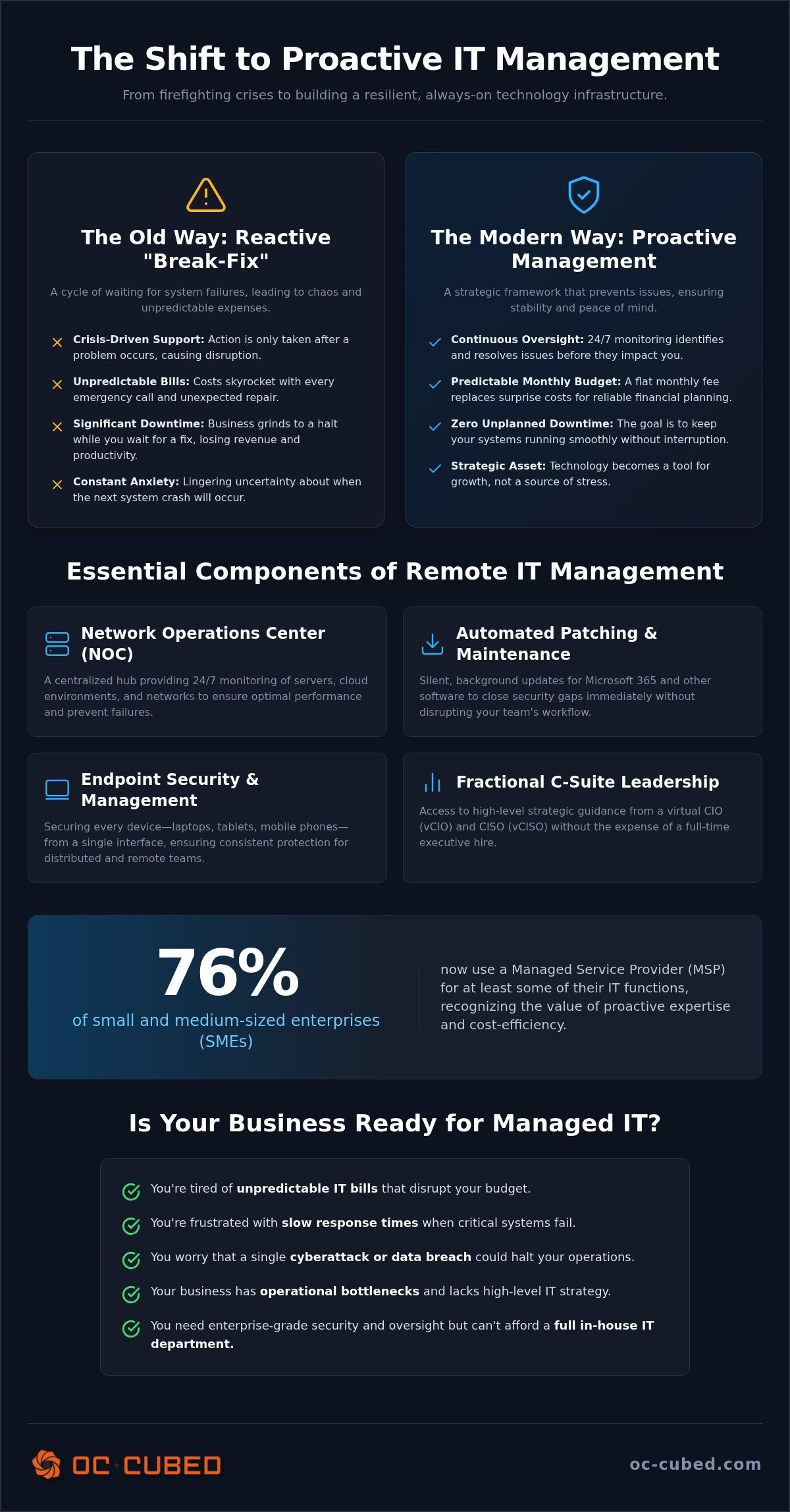
The industry has moved away from the old "break-fix" model. In that reactive system, you only called for help when something stopped working. This led to unpredictable costs and long periods of downtime. Modern remote IT management services operate on a proactive basis. Physical presence is no longer a requirement for enterprise-grade IT health. High-speed connections and cloud-native tools allow experts to secure and optimize your infrastructure from anywhere. This transition ensures that your technology serves as a tool for growth rather than a source of stress.
The Difference Between Support and Management
Support and management are often used interchangeably, but they represent different philosophies. Support is reactive. It focuses on solving a problem that already exists. Management is proactive. It focuses on ensuring the problem never occurs in the first place. Remote management handles the silent tasks that keep a business running. These include automated patching, software updates, and continuous security scans. For businesses without an in-house IT department, this creates a centralized management hub. You gain the benefits of an entire IT department without the overhead of full-time salaries. We focus on the health of your Microsoft 365 environment and endpoint protection so your team can focus on their actual work.
The Role of the MSP in a National Business Landscape
Modern businesses are rarely confined to a single office. You likely manage a distributed team across multiple locations or time zones. Managed Service Providers (MSPs) use cloud-based tools to standardize technology across your entire organization. This eliminates the need for local technicians at every branch. 76% of small and medium-sized enterprises now use a managed service provider for at least some of their IT functions according to 2026 industry data. A monthly retainer model provides cost-efficiency that hourly emergency rates cannot match. It replaces surprise bills with a predictable budget. This model aligns our goals with yours. We both want your systems to run perfectly because we provide steady reliability rather than billing for every crisis.
How Remote Management Works: Proactive Monitoring vs. Break-Fix
Remote IT management relies on a centralized hub known as the Network Operations Center (NOC). This facility serves as your 24/7 eyes on the entire infrastructure. It monitors servers, cloud environments, and local networks without pause. This continuous oversight ensures that performance stays within optimal parameters. RMM software acts as a digital early-warning system by identifying performance anomalies and security vulnerabilities before they escalate into system-wide failures. This technology allows remote IT management services to remain largely invisible to your staff. Most maintenance, such as deep system scans or heavy updates, occurs while your team sleeps. This eliminates the disruption typically associated with IT repairs.
Endpoint management extends this protection to every physical device in your organization. Every laptop, tablet, and mobile device is secured and updated through a single interface. This is critical for distributed teams. We ensure that a remote employee's laptop in another state is just as secure as a workstation in your main office. By applying IT Service Management principles, we create a standardized environment where every device follows the same security protocols. This consistency is the foundation of a stable business network.
Proactive Monitoring: The End of Unplanned Downtime
Unplanned downtime is usually the result of a chain of ignored warnings. Proactive monitoring breaks this chain. We detect hardware failures, such as failing hard drives or overheating processors, before the hardware actually crashes. Automated patching for Microsoft 365 and third-party software happens in the background. This keeps your software current and closes security gaps immediately. Network configuration also plays a vital role. We adjust settings to prevent bottlenecks that would otherwise slow down your staff during peak hours. This level of detail keeps your operations smooth and predictable.
Comparison: Proactive MSP vs. Traditional Break-Fix
The difference between a proactive MSP and a traditional break-fix model is found in the incentives. Break-fix technicians profit from your failure. They bill by the hour, meaning their revenue increases when your systems go down. In contrast, a proactive model uses a flat monthly fee. This aligns our interests with yours. We are incentivized to keep things running perfectly because it reduces our workload. Response time is another major differentiator. Instead of waiting for a technician to drive to your office, remote intervention happens instantly. If you are ready to move away from unpredictable hourly spikes, you can explore a monthly managed IT services retainer that offers steady reliability.
Essential Components of Remote IT Management Services
Effective remote IT management services bundle several critical layers into a single, cohesive strategy. It's not just a collection of disconnected tools. It's a unified shield for your digital operations. We focus on the core areas where businesses are most vulnerable. This includes your cloud environment, your network perimeter, and the individual devices your employees use every day.
Microsoft 365 Tenant Maintenance ensures your cloud environment stays secure and optimized. We manage user permissions, monitor audit logs, and configure security settings to prevent data leaks. Security Threat Detection provides continuous scanning for anomalies. We look for unauthorized access attempts and suspicious patterns that could indicate a breach. Protecting the perimeter is equally vital. Firewall and Switch Management allows us to monitor traffic and block malicious activity before it enters your local network. To secure your communication, we use Email Security with Proofpoint. This tool stops phishing attempts and malicious attachments before they ever reach an employee's inbox.
Endpoint Protection and Security Remediation
Modern antivirus is only one part of a complete strategy. Endpoint protection today requires behavioral analysis to catch threats that don't have a known signature. We monitor every laptop and workstation for unusual activity. When a threat is detected, the process of remediation begins immediately. We don't just send an alert. We isolate the infected device from the network to prevent the spread of malware. Then, we remove the threat and restore the system to a clean state. Managed IT security services provide a layered defense that covers both prevention and recovery, ensuring your data remains safe even when a device is compromised.
NOC and Helpdesk Integration
The power of our model comes from the integration of the Network Operations Center (NOC) and the Helpdesk. The NOC focuses on the health of your infrastructure, such as servers and switches. The Helpdesk focuses on the needs of your people. This combined approach ensures that a hardware failure and a user login issue receive the same level of professional attention. We use tiered support to solve problems efficiently. Basic tasks like password resets are handled quickly by Tier 1 technicians. Complex network reconfigurations or security incidents are escalated to senior engineers. Consistent monthly reporting ties everything together. These reports show the value of your IT investment by documenting every threat blocked and every system update completed. It turns your technology into a measurable business asset.
Signs Your Business Is Ready for Remote IT Management
Financial unpredictability is often the first warning sign. If your monthly budget is frequently disrupted by surprise IT bills for "emergency" repairs, your current support model is failing you. These spikes in spending suggest a reactive approach that only addresses problems after they cause damage. Transitioning to professional remote IT management services replaces these fluctuations with a predictable monthly retainer. This allows you to allocate capital toward growth rather than constant fire-fighting. Steady reliability is the hallmark of a well-managed digital environment.
Productivity loss is another clear indicator. Your team shouldn't lose hours every week to recurring technical glitches or slow system performance. If "restarting the computer" has become a daily ritual for your staff, your infrastructure lacks the proactive care it needs to stay healthy. Many businesses also struggle with Microsoft 365 security. You might be using the platform, but you aren't sure if your security settings are correct or if your data is actually protected. Without a clear technology roadmap for the next 12 to 24 months, you're simply treading water while your competitors move forward.
The 'Invisible' Risks of In-House IT Gaps
Gaps in your IT coverage create hidden dangers. One of the most common is "shadow IT," where employees use unmanaged personal applications or devices to get their work done. This bypasses your security protocols and leaves your data exposed. Compliance risks are also a major concern for businesses handling sensitive client information. Without dedicated oversight or executive-level guidance, you may be falling short of legal requirements. Relying on a "tech-savvy" employee is a liability, not a solution. That individual has their own job to do, and they lack the specialized tools required for enterprise-grade protection.
Evaluating Your Current Support Model
Take a hard look at your current provider. Do they offer proactive network monitoring, or do they only show up when something breaks? Most traditional support models focus on troubleshooting rather than leadership. You should be paying for security strategy and long-term stability, not just a quick fix for a broken printer. Moving to remote IT management services from a national provider gives you access to a broader range of expertise and more sophisticated tools. This transition ensures that your technology remains a strategic asset regardless of where your team is located.
Strategic IT Leadership: Why Management Is More Than Troubleshooting
Professional remote IT management services offer more than just technical support; they provide the strategic leadership necessary to turn technology into a competitive advantage. This goes beyond fixing a slow computer. It involves high-level advisory roles like the Virtual CIO (vCIO). A vCIO works to align your technology investments with your specific business goals. This ensures every dollar spent on IT contributes to your bottom line. We look at your business as a whole to ensure your digital tools are actually helping you grow.
Security governance is equally critical for growing teams. Virtual CISO (vCISO) services provide enterprise-grade protection and compliance oversight. Adoption of vCISO services rose by 319% in 2025 as businesses recognized the need for formal security leadership. This is especially vital as evolving regulatory landscapes and industry standards impose stricter requirements on cybersecurity governance in 2026. We also handle Vendor Management. This means we deal with software providers and internet service providers so you don't have to play "phone tag" with support lines. Virtual Project Management ensures that your migrations and hardware upgrades happen on time and within your budget. We oversee the entire process from planning to execution.
The Fractional Executive Advantage
You gain the benefits of C-level strategy without the $200,000 plus salary of a full-time hire. This fractional model provides expert guidance on long-term planning. We manage your hardware refresh cycles to ensure you aren't running on obsolete equipment. We help you scale your infrastructure efficiently. This bridges the gap between technical needs and business revenue. It's about making informed decisions today that prevent expensive mistakes tomorrow. You get the quiet authority of a seasoned professional who knows exactly how to support your specific industry requirements. This steady reliability allows you to plan for the future with confidence.
Building a Foundation for Growth
Many businesses hit an "IT ceiling" where their current systems can't support more employees or higher transaction volumes. Remote management removes this barrier. We ensure your security and performance remain stable as you hire more people and expand your operations. This provides the peace of mind you need to focus on your core mission. We act as both a protector and an enabler for your business. As you scale, our proactive monitoring and executive guidance ensure that your technology keeps pace with your ambition.
Step Into a More Resilient Future
Technology should be the engine of your business, not the anchor. Moving from a reactive "break-fix" model to professional remote IT management services provides the stability you need to scale. You've seen how proactive monitoring and fractional C-suite leadership protect your operations from both technical failure and strategic drift. Our team ensures your Microsoft 365 environment remains secure while Proofpoint integration blocks threats before they reach your inbox. You gain the quiet authority of a seasoned IT department without the overhead of an on-site team.
Predictable monthly costs. Zero unplanned downtime. Expert guidance. This approach replaces the anxiety of potential cyberattacks with the confidence of 24/7 proactive network monitoring. It converts your technology from a recurring cost into a strategic asset. Strategic leadership ensures your infrastructure evolves alongside your business goals. It's time to trade unpredictable IT expenses for steady reliability.
We're here to help you build a foundation for growth that lasts. Your peace of mind is our results-driven mission.
Frequently Asked Questions
Can remote IT management really handle physical hardware failures?
Remote management handles hardware failures by detecting early warning signs through proactive monitoring. We identify failing components like hard drives or overheating processors before they crash. When a failure is imminent, we coordinate with your hardware vendors to manage replacements and logistics. This ensures your hardware stays operational without you needing to troubleshoot physical parts yourself.
Is it more expensive to have a monthly retainer or pay-as-you-go support?
A monthly retainer is generally more cost-effective than pay-as-you-go support. It replaces unpredictable hourly spikes with a fixed, predictable budget. This model aligns our incentives with your business goals. We're motivated to keep your systems running perfectly because we don't profit from your technical disasters or billable hours spent on repairs.
How do remote IT services keep my business data secure?
We secure your data using a layered defense strategy that includes endpoint protection and Proofpoint email security. Our remote IT management services provide continuous threat detection to identify and remediate anomalies in real-time. This proactive approach stops unauthorized access attempts and malware before they can compromise your sensitive business information.
What is the difference between a helpdesk and remote management?
A helpdesk focuses on solving immediate user problems like password resets or software glitches. Remote management is a broader discipline that maintains the underlying health of your servers, networks, and cloud environments. It's the difference between fixing a single symptom and ensuring the entire system remains healthy and stable.
Do I still need an internal IT person if I use remote management services?
You don't necessarily need a full-time internal IT person when you use our comprehensive management. We provide fractional vCIO and vCISO leadership to handle high-level strategy and security governance. However, if you already have an IT person, we can co-manage your infrastructure to handle routine maintenance while they focus on internal business projects.
What happens if my internet goes down? Can you still manage my IT?
We monitor your connection status in real-time and alert you the moment a site goes offline. While we can't fix a local ISP outage from a distance, your devices remain protected by security policies already installed on the machines. We then act as your advocate to coordinate with the internet provider until your service is restored.
Which businesses benefit most from remote IT management?
Growing businesses and distributed teams benefit most from remote IT management services. Companies that handle sensitive data or must meet strict compliance standards also see significant value. This model is ideal for organizations that want executive-level technology leadership without the high cost of a full-time, on-site IT department.
What kind of reporting should I expect from a remote IT provider?
You should expect detailed monthly reports that document the overall health of your digital environment. These reports cover critical metrics like security threats blocked, software patching status, and network uptime. This transparency allows you to see the tangible results of your IT investment and ensures your systems are always meeting performance standards.


