

What if the IT partner you hired to protect your company is actually the biggest bottleneck to your growth? Most business owners realize too late that their support provider is reactive rather than proactive. You probably already know the frustration of waiting hours for a response or opening a surprise bill that blows your monthly budget. It's a common pain point. Finding the right fit requires knowing the specific questions to ask a potential MSP before you sign a contract.
We've designed this 2026 hiring checklist to give you total control over the vetting process. You'll move beyond surface-level inquiries to uncover an MSP's true technical depth and security posture. We'll show you how to identify a partner who offers expert-level protection and strategic direction without the cost of a full-time executive hire. This guide covers twenty-one critical areas, including NIST CSF 2.0 alignment, response time guarantees, and how to achieve zero unplanned downtime through steady reliability. By the end, you'll have the framework needed to ensure your technology enables your goals instead of obstructing them.
Key Takeaways
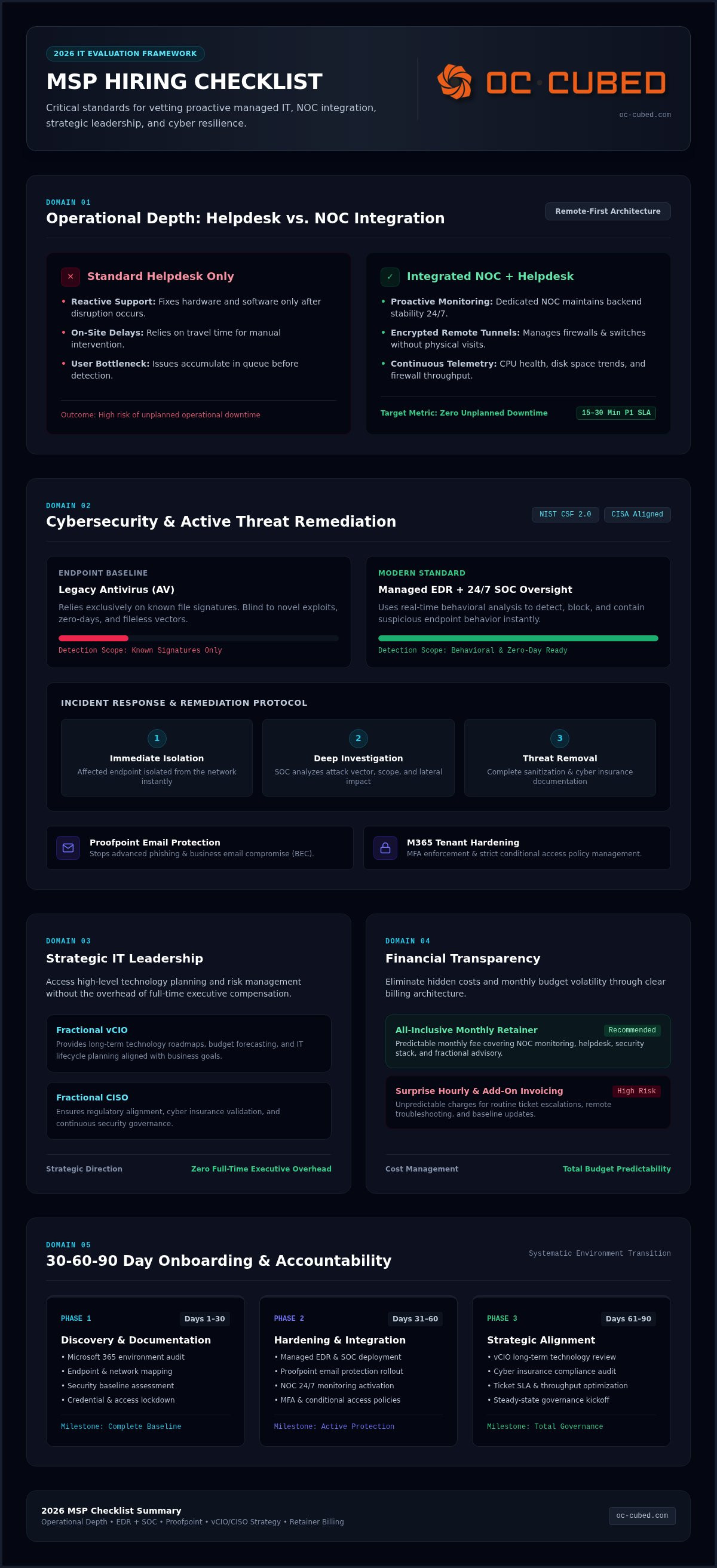
- Learn the essential questions to ask a potential MSP to distinguish between a standard helpdesk and a partner offering integrated NOC services and proactive network monitoring.
- Identify the specific security benchmarks, such as Proofpoint integration and active threat remediation, required to protect your data and satisfy cyber insurance mandates.
- Understand how fractional executive roles like a vCIO or CISO provide strategic technology direction without the overhead of a full-time hire.
- Uncover the financial transparency needed to eliminate surprise IT bills by vetting providers for all-inclusive monthly retainers.
- Master the 30-60-90 day onboarding framework to ensure your Microsoft 365 environment is documented and secured from the moment support begins.
Evaluating Operational Depth: Remote Support and NOC Integration
Operational depth separates a true partner from a simple helpdesk. When vetting providers, the first set of questions to ask a potential MSP should focus on their backend infrastructure. You need to know if they're just answering phones or if they're actively maintaining your environment. A reliable partner uses a remote-first delivery model to ensure efficiency and speed. This approach eliminates the delays inherent in traditional on-site support models. It keeps your team productive without waiting for a technician to drive to your location.
The Helpdesk vs. NOC Distinction
A helpdesk fixes what's broken. A Network Operations Center (NOC) keeps things from breaking. These roles are distinct but must work together. Ask if the provider has a dedicated NOC for backend stability. You want to see Helpdesk and NOC integration that ensures 24/7 coverage. This setup allows for continuous oversight of your infrastructure while technicians handle user-facing issues. Understanding the managed service provider model helps clarify why this dual approach is necessary for modern business. If their remote IT management services are treated as a secondary offering, your stability will suffer.
Uptime and Monitoring Standards
Proactive monitoring is the act of identifying hardware failure before the user notices a glitch. It's the difference between a productive afternoon and a total work stoppage. Ask what tools they use for proactive remote IT management and monitoring. They should track specific metrics in their monthly reporting, such as CPU health, disk space trends, and firewall throughput. These data points provide full transparency into your environment's health.
Effective providers manage firewalls and switches remotely without needing to step foot in your office. They use secure, encrypted tunnels to perform network configuration tasks that prevent downtime before it occurs. You should also inquire about their average ticket resolution time for critical endpoint issues. In 2026, leading providers commit to a 15 to 30 minute first-response window for critical P1 incidents. This level of responsiveness provides the peace of mind you need to focus on growth. Steady reliability isn't an accident; it's the result of rigorous operational standards and a dedicated remote IT dream team.
Cybersecurity and Threat Remediation Capabilities
Cybersecurity isn't a checkbox. It's a constant state of vigilance. When you're interviewing vendors, your questions to ask a potential MSP should focus on their ability to stop threats before they reach your inbox or endpoints. You need a partner who acts as a protector. This means moving beyond basic antivirus to a comprehensive security posture that satisfies modern insurance requirements.
Email and Identity Protection
Most breaches start with a single, deceptive email. You should ask if they provide enterprise-grade email security, such as Proofpoint integration. This provides inbox-level defense against advanced phishing and business email compromise (BEC). Security also requires strict Microsoft 365 tenant maintenance. You need to know how they prevent unauthorized access through conditional access policies and MFA enforcement. Reviewing a cybersecurity risk strategy for small business helps you align these technical tools with your overall growth goals.
The government provides specific CISA guidance on securing managed service provider environments to help businesses avoid supply chain attacks. A quality MSP welcomes this scrutiny. They should demonstrate clear boundaries for remote access tools and identity management.
Incident Response and Remediation
What happens when a threat is detected? You need a step-by-step breakdown of their remediation process. The response should include immediate isolation of the affected device, thorough investigation, and complete threat removal. Inquire about the endpoint protection and antivirus solutions included in their standard stack. Don't settle for legacy software that only checks for known signatures. Modern protection requires behavioral analysis.
Antivirus vs. Managed Endpoint Protection
- Traditional Antivirus: Relies on known file signatures. It's often blind to new, "zero-day" threats.
- Managed Endpoint Protection (EDR): Uses behavioral analysis to stop suspicious activity in real-time.
- SOC Oversight: Includes 24/7 monitoring by security professionals to ensure threats don't sit dormant.
- Tenant Hardening: Involves regular audits of Microsoft 365 settings to close security gaps.
Modern insurance carriers now mandate technical verification of EDR and SOC monitoring. If you want to ensure your environment meets these standards, you can explore our security remediation services for a more resilient posture. We focus on removing obstacles so you can focus on your business.
Strategic IT Leadership and Fractional Executive Roles
Technology should be an engine for growth, not a recurring headache. While operational support keeps the lights on, strategic leadership ensures you're heading in the right direction. One of the most important questions to ask a potential MSP is whether their service includes fractional executive leadership. You don't need a six-figure salary on your payroll to get high-level guidance. A Virtual CIO (vCIO) or CISO provides that expertise at a fraction of the cost. OC Cubed - Your trusted MSP acts as a protector and enabler, removing obstacles so you can focus on building your business.
The Role of the Virtual CIO
A vCIO bridges the gap between technical operations and business objectives. Ask how often they conduct strategic business reviews (SBRs). These meetings shouldn't just be about ticket counts; they should focus on your 12-month roadmap, budgeting, and risk mitigation. Inquire about their experience in security governance and compliance oversight. This high-level oversight is central to enterprise-grade IT leadership without a full-time hire. It ensures your investments align with specific growth goals rather than just maintaining the status quo.
Vendor and Project Management
Managing multiple software and hardware providers is exhausting for any business owner. A strategic partner acts as the single point of contact for all technology vendors. This removes the burden of technical finger-pointing between software providers. When a problem arises, they solve it instead of telling you to call someone else. They should also follow a structured NIST supply chain risk management framework to vet third-party apps for security vulnerabilities. This protects your business from external risks you might otherwise overlook.
Complex migrations or infrastructure upgrades require precise execution. Ask about their virtual project management methodology. You need to know how they handle complex IT projects remotely to ensure they finish on time and within budget. A results-driven provider like OC Cubed - Your trusted MSP uses monthly reporting to show progress and maintain full transparency. They don't just bill you; they demonstrate value through documented outcomes. This level of accountability is what transforms a vendor into a trusted advisor. These are the essential questions to ask a potential MSP to ensure your technology investments actually drive profit rather than just draining it.
Financial Transparency: Retainers vs. Surprise Bills
Surprise IT bills are the enemy of steady growth. You need a partner who values financial transparency as much as technical excellence. One of the most important questions to ask a potential MSP is whether their billing is based on a flat-rate monthly retainer or a per-hour model. Hourly models create a conflict of interest. The provider only earns money if your systems fail. A flat-rate retainer flips this dynamic. It's a model that aligns the provider's goals with yours because they stay profitable by keeping your environment stable and secure. This is why financial clarity is one of the top questions to ask a potential MSP during the vetting process.
Ask for a detailed list of what falls outside the monthly fee. Common surprise costs include hardware project labor, onboarding fees, or out-of-scope after-hours calls. You should also verify if the monthly fee includes all endpoint protection and security licensing. Many providers charge extra for email security or antivirus tools. OC Cubed - Your trusted MSP operates on an all-inclusive retainer to eliminate these variables. This approach ensures you never face an unexpected invoice during a major migration or security update.
The All-Inclusive Retainer Model
A recurring monthly fee provides predictable IT spending. It allows you to view technology as a utility rather than a fluctuating expense. When vetting providers, ask for a list of "commonly excluded" items to check for hidden fees. This list often reveals the true cost of the partnership. If an MSP charges for every remote support call, your budget's going to suffer. A true partner includes Helpdesk and NOC integration in the core fee to ensure your network remains optimized without extra charges.
Predictability and ROI
Strategic budgeting requires looking ahead. Ask how the provider helps you plan for hardware refreshes 12 to 24 months in advance. They should provide monthly reporting that tracks the lifecycle of your equipment. This data prevents emergency purchases that disrupt your cash flow. Consider the return on investment as well. Hiring a single entry-level in-house IT technician costs roughly $96,000 annually when you include benefits. In contrast, an MSP supporting a 15-person business typically costs between $24,000 and $36,000 per year. You'll get a whole team of experts for a fraction of the cost of one employee.
Onboarding and Long-Term Accountability
Transitioning to a new partner is a high-stakes moment for your business. It's an evolution that requires precise execution to avoid downtime. You need to know how the provider manages the handoff from your current support. One of the vital questions to ask a potential MSP is what their 30-60-90 day onboarding process looks like. A structured timeline ensures nothing falls through the cracks. It moves your business from a state of vulnerability to one of steady reliability. Our Remote IT Dream Team uses this window to stabilize your environment and remove existing technical obstacles.
The First 90 Days
Ask for a sample onboarding checklist to see their level of thoroughness. A professional provider audits your endpoint protection and email security on day one. They don't wait for a crisis to check your Proofpoint settings or Microsoft 365 tenant configurations. They document your entire network environment during startup. This documentation serves as the blueprint for all future support and project management. A successful onboarding is a transition where the client feels more in control, not less. It replaces the anxiety of the unknown with the confidence of a clear, documented strategy.
Ongoing Reporting and Communication
Accountability must be a permanent fixture of the partnership. You need to know how they handle the transition from your previous IT provider to minimize disruption to your staff. Inquire about the frequency of technical vs. strategic meetings. Technical meetings focus on ticket trends and immediate network health. Strategic meetings involve your vCIO to discuss long-term growth goals and compliance oversight. This ensures your technology investments stay aligned with your business trajectory.
Demand full transparency through monthly reporting. These reports should clearly show network health, threats blocked, and uptime achieved. If a provider cannot provide these metrics, they aren't monitoring your environment effectively. These are the final questions to ask a potential MSP to ensure long-term accountability. You aren't just buying support; you're investing in a protector who shows up and delivers results. This checklist ensures you hire a team that acts as a true enabler for your business, providing expert-level security and predictable IT spending every single month.
Secure Your Business Growth with Strategic IT Partnership
Selecting a technology partner is a decision that impacts your company's long-term stability and profit. You now have the essential questions to ask a potential MSP to ensure they offer more than just basic fixes. A true partner provides the technical depth and proactive oversight needed to prevent downtime before it starts. This level of vigilance is what protects your data and maintains your reputation.
Strategic alignment is just as vital as technical depth. With fractional executive leadership, you gain high-level direction without the burden of a full-time hire. This approach transforms IT from a cost center into a growth enabler. You deserve predictable monthly spending and the peace of mind that comes from steady reliability. OC Cubed - Your trusted MSP focuses on results-driven support so you can stop worrying about your infrastructure and start focusing on your clients.
Your business is ready for its next phase of growth. We're here to remove the technical obstacles standing in your way so you can move forward with confidence.
Frequently Asked Questions
How much should a Managed Service Provider cost in 2026?
Industry benchmarks for small-to-midsize businesses typically fall between $125 and $200 per user per month. Some premium plans for high-compliance industries can exceed $400. It's one of the essential questions to ask a potential MSP to ensure their fee includes all endpoint protection and security licensing. We use an all-inclusive monthly retainer to eliminate surprise bills. This model aligns our goals with yours by prioritizing network stability over billable hours.
Do I really need a Virtual CIO for a small business?
Yes, a Virtual CIO is necessary if you want to align technology with your growth goals without hiring a six-figure executive. Small businesses often struggle with long-term strategy and vendor management. A vCIO provides high-level security governance and compliance oversight at a fraction of the cost. They remove the burden of technical decision-making from the business owner. This ensures your IT roadmap supports your 12-month objectives instead of just reacting to daily problems.
What is the difference between an MSP and a break-fix technician?
A break-fix technician only earns money when your systems fail, which creates a reactive and expensive relationship. In contrast, a Managed Service Provider (MSP) uses a proactive model based on a flat-rate monthly retainer. We focus on prevention through 24/7 network monitoring and configuration. Our goal is to ensure zero unplanned downtime rather than just billing you for repairs. This shift in accountability moves your business from constant crisis management to steady operations.
How long does it take to switch to a new MSP?
A professional transition typically follows a structured 30-60-90 day onboarding roadmap. The first 30 days focus on discovery, documentation, and stabilizing your Microsoft 365 environment. By day 60, we audit your security posture and implement threat detection tools like Proofpoint. The final 30 days ensure full alignment with your strategic goals. This approach prevents downtime during the handoff from your previous provider and ensures you feel more in control of your technology.
Will an MSP replace my internal IT person?
Not necessarily. Many businesses use a co-managed model where the MSP handles backend tasks like NOC integration and advanced security while the internal person manages daily user needs. This allows your internal staff to focus on business-specific software and high-value projects. We provide the enterprise-grade tools and 24/7 monitoring that one person cannot manage alone. It's a partnership that expands your technical depth without the cost of adding a full-time executive hire.
What happens if my network goes down after hours?
Our 24/7 network monitoring and NOC integration identify outages the moment they occur, often before you notice a glitch. Remote support teams work to remediate the issue immediately to ensure your business is ready for the next workday. We provide continuous oversight of firewalls and switches to prevent downtime before it occurs. This steady reliability means you don't have to worry about after-hours emergencies disrupting your productivity or creating an unexpected IT bill.
Can an MSP manage my Microsoft 365 licenses and security?
Yes, Microsoft 365 tenant maintenance is a core part of a modern managed service. We handle everything from license optimization to advanced security hardening. This includes enforcing multi-factor authentication and conditional access policies to prevent unauthorized access. Regular audits of your tenant settings help close security gaps that could lead to data breaches. It's a key part of the questions to ask a potential MSP to ensure your cloud identity is fully protected.
What is Proofpoint and why is it included in managed IT?
Proofpoint is an enterprise-grade email security platform that blocks advanced phishing and business email compromise threats. Most cyberattacks start in the inbox, so standard antivirus isn't enough. We include Proofpoint integration to provide inbox-level defense for every user. This proactive threat detection stops malicious links and attachments before they reach your employees. It's a critical layer of protection that satisfies modern cyber insurance requirements and ensures your business data remains secure and private.


