

When presenting an IT security plan to the board, focus less on tools and more on decisions. Directors don’t need a tour of every technical control. They need to understand which business risks matter, what management is doing about them, and where their input or approval is needed.
That can be harder than it sounds. Technical detail can obscure the impact of a risk, while requests for people, time, or budget can feel disconnected from business priorities. A useful presentation shows what’s at stake, how progress will be measured, and who is accountable for the next steps.
This guide explains how to turn cybersecurity concerns into a focused, board-level discussion. You’ll learn how to describe material risks in plain language, connect security priorities to business goals, and explain resource needs and expected outcomes without overpromising. It also covers ownership, useful measures, and follow-up decisions so the meeting ends with alignment and documented next steps.
Key Takeaways
- Frame presenting an IT security plan to the board around prioritized business risks, not a catalogue of tools or vulnerabilities.
- Base recommendations on verifiable evidence, clear impact assessments, and named owners.
- Explain what each proposed investment is expected to change, what risks remain, and which figures still need validation.
- Use a concise presentation structure, with technical detail available in an appendix for questions.
- Turn approval into documented decisions, assigned ownership, sequenced work, and ongoing oversight.
Presenting an IT Security Plan to the Board Starts With Business Risk
A security plan is more than a list of tools to buy or technical weaknesses to fix. It’s a prioritized set of actions tied to business risks, with an accountable owner and a clear reason for each priority. This framing makes presenting an IT security plan to the board a discussion about protecting operations and supporting business goals, not a technical status update.
Start with what the organization needs to keep running: customer services, access to sensitive information, reliable operations, and strategic commitments. For example, if a system that supports customer orders became unavailable, explain the possible effect on service and business continuity rather than describing the system’s configuration. Present consequences as scenarios, not predictions.
Set a clear purpose for the meeting. Are you informing directors about a material risk, asking them to choose between priorities, seeking approval for resources, or agreeing on how progress will be overseen? Information security governance connects security oversight with broader corporate governance. A clear purpose helps directors see where their input is needed and what should happen after the discussion.
What should a board understand about cybersecurity?
Separate material business risks from routine technical findings. A missed software update is a technical observation. It becomes board-relevant when evidence shows it could expose a business-critical system or sensitive information. Keep the explanation brief and measured. Define terms such as “vulnerability,” a weakness that could be exploited, when they first appear. Distinguish known facts from uncertain outcomes.
Explain the possible operational consequence without presenting the worst case as certain. “An outage could delay customer orders” is more accurate than “customer orders will stop.” This gives directors enough context to assess the issue without overwhelming them with technical detail.
What decisions can the board make?
Boards can set priorities, establish risk tolerance, approve or direct resource decisions, and clarify executive accountability. Management remains responsible for carrying out the work, selecting implementation steps, and reporting progress. Make that boundary explicit: board oversight guides direction and monitors accountability; it doesn’t require directors to choose technical configurations.
For each item requiring board action, write one direct request. For example:
- “Approve making protection of customer records a top security priority.”
- “Confirm the executive owner responsible for reporting progress.”
- “Agree on how often management should return with a risk and progress update.”
These requests keep the meeting focused and make it easier to record decisions, open questions, and next steps accurately.
Build the IT Security Plan Around Evidence, Priorities, and Accountability
A credible plan starts with a concise, evidence-based picture of the organization’s security position. It might draw on recent assessments, incident patterns, priority assets, and documented control gaps. The aim isn’t to include every finding. It’s to give directors a dependable basis for understanding which risks deserve attention and why.
Be clear about what the evidence does and doesn’t show. Label assumptions, incomplete information, and confidence levels instead of presenting estimates as facts. If an assessment hasn’t covered a system, say so. Avoid unsupported comparisons with other organizations, breach forecasts, or claims that a proposed control will guarantee protection.
Which evidence belongs in a board security plan?
Choose evidence that helps explain business exposure. An inventory may show which systems support essential operations; an assessment may identify a gap in access controls; incident records may reveal a recurring pattern. Summarize each finding in terms directors can use: what’s affected, what could happen, and what is known or still needs validation.
The NIST Cybersecurity Framework (CSF) 2.0 can provide a consistent structure for discussion. Its Govern function emphasizes integrating cybersecurity with organizational risk management. Use the framework where it fits, not as a substitute for evidence or as proof that the organization is secure. The Director's Handbook on Cyber-Risk Oversight can also help keep the discussion focused on board oversight and governance.
How should security priorities be ranked?
Rank proposed actions using documented business consequences, urgency, and the strength of the evidence. Explain why one issue comes first, which safeguards already reduce exposure, and what risk may remain after the planned work. Make dependencies on other projects, vendors, or management decisions visible. If a likelihood assessment relies on assumptions, don’t present the ranking as precise.
Make each priority actionable by naming an accountable executive or team, a target date, and how progress will be reported. A useful summary can include:
- Risk: The business activity or information that could be affected.
- Action and owner: The planned response and the person or team responsible.
- Dependency and residual risk: What must happen first and what exposure may remain.
- Progress measure: What management will report and when.
This evidence-led structure makes presenting an IT security plan to the board more consistent and easier to review over time. Organizations seeking help with security priorities and governance can consider virtual CIO, CTO, and CISO advisory.
Show the Board What Security Investment Changes, and What It Cannot Promise
A funding request is stronger when it shows the change directors are being asked to support. Compare the current exposure with the proposed action, the risk it is expected to reduce, and the limitations that will remain. For example, improving endpoint protection may strengthen defenses on covered devices, but it won’t remove every path an attacker could use. Controls reduce or manage risk; they can’t guarantee that an incident won’t occur.
Separate confirmed costs and resource estimates from assumptions. For each estimate, identify its source, the period it covers, what it excludes, and where uncertainty remains. Validate figures with the responsible teams or vendors before presenting them. When comparing options, use the same assumptions and time period for each. Don’t present an investment as guaranteed savings or promise that it will prevent every loss.
How can you explain security investment without overstating ROI?
Lead with the operational need and decision rationale, then explain the estimate. Describe what the proposed work enables or protects, and the trade-offs involved in delaying it or choosing another option. Financial estimates can inform the decision, but they shouldn’t replace a clear account of business impact. When presenting an IT security plan to the board, be explicit about what the evidence supports and what remains uncertain.
A compact comparison can keep the discussion grounded. Adapt the examples below to verified facts about your organization:
| Initiative | Business rationale | Owner | Progress measure |
|---|---|---|---|
| Improve endpoint protection coverage | Address a documented gap on priority devices | Named IT or security lead | Coverage against the agreed device scope |
| Remediate a high-priority control gap | Reduce exposure affecting a critical business activity | Named executive or team | Remediation status and remaining risk |
Which measures help boards track progress?
Choose a small set of indicators tied to approved priorities and a defined reporting period. Measures might include remediation status, protection coverage, incident trends, or overdue actions. Define each measure, name its data source, and explain its limitations. A coverage figure, for instance, is only useful if the organization has a reliable inventory showing what should be covered.
Keep measures consistent from one update to the next, and pair them with context. A change in incident counts may reflect reporting practices as well as changes in risk. Monthly reporting can support ongoing oversight when its contents and scope align with board-approved priorities. The goal is to show what has changed, what still needs attention, and whether approved work is moving forward, not to suggest certainty.
Present the IT Security Plan in a Clear Boardroom Narrative
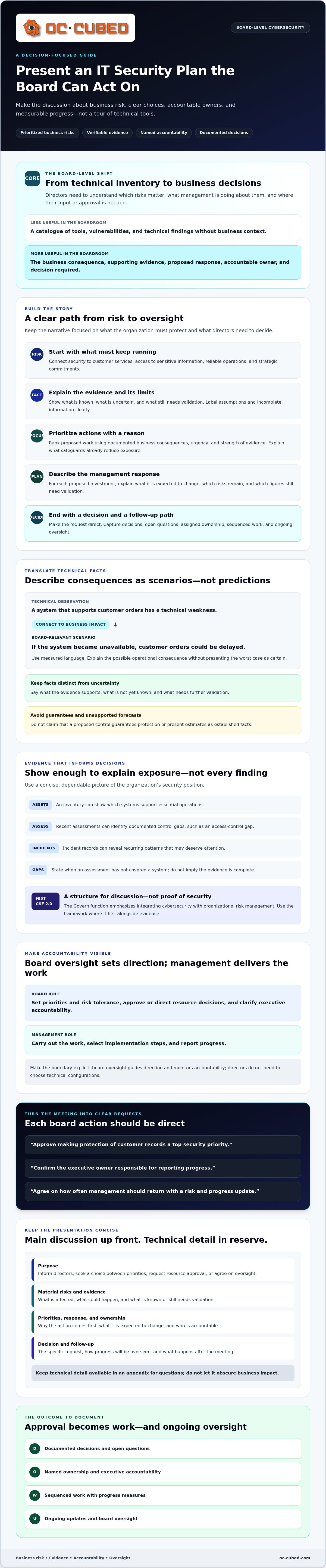
A clear presentation takes directors from business context to action. Open with a short executive summary, then cover priority risks, recommended actions, decisions requested, and follow-up. State what you need from the board early. Keep technical detail in an appendix, ready for questions but out of the main narrative.
When presenting an IT security plan to the board, use a focused visual to show each priority, its status, accountable owner, and next action. Pair it with a plain-language scenario tied to a business service or operational dependency. For example, explain how losing access to a system could delay a key process, while making clear that this is a possible consequence, not a prediction. Avoid fear-based language, unexplained acronyms, and long vulnerability lists.
How do you make security risks understandable to directors?
Connect each risk to something directors recognize: a service the organization must deliver, information it needs to protect, or an operational dependency. Use the visual to show what needs attention and who is moving it forward. Keep labels simple. If a technical term is essential, define it briefly. Directors should be able to explain the concern and its business relevance after a quick review.
Prepare for questions about cost, disruption, responsibility, evidence, and remaining exposure. Answer directly. Separate confirmed facts from estimates and uncertainty, and don’t defend a figure that hasn’t been validated. If you need to check an answer, say what you’ll verify and when you’ll follow up. That’s more credible than guessing under pressure.
How should you answer difficult board questions?
For cost questions, explain the assumptions behind the estimate and describe the options being compared. For risk questions, summarize current safeguards, what they address, what exposure remains, and who owns the response. If directors ask whether a proposed action eliminates a risk, be clear about its limits. A measured answer gives the board a sound basis for discussion without implying certainty.
Close by restating each requested decision and confirming who owns the next action. Record the decision owner, any follow-up needed, and when management will report back. If the board accepts a risk or defers a choice, document that clearly too. This gives the next update a defined starting point and connects the discussion to accountable work.
Turn Board Approval Into Security Work and Ongoing Oversight
Approval starts execution; it doesn’t finish it. Record what was approved, declined, or deferred, who owns each action, and which risks the organization has chosen to accept. Capture any conditions attached to a decision. Clear notes prevent teams from leaving the meeting with different interpretations.
Translate approved priorities into sequenced work. Identify milestones, dependencies, accountable owners, and how management will track progress. If a task depends on a vendor or another project, show that dependency rather than treating it as an isolated commitment. Set a reporting cadence that fits the organization’s governance process and gives directors visibility into progress, material changes, overdue actions, and unresolved decisions.
What should happen after the board meeting?
Distribute decision notes and action owners while the discussion is still current. Review priorities when business needs, threat conditions, or key assumptions change. If an action becomes overdue or a material exception arises, bring it back through the agreed governance process. A short update should explain what changed, why it matters to the business, who is accountable, and whether a decision is needed.
Keep the record useful over time. For each priority, track status against the approved milestone and note changes in scope or remaining risk. This connects board oversight with management’s implementation work without turning every update into a repeat of the original presentation.
When can outside security leadership help?
Organizations without dedicated security leadership may use virtual CISO advisory to support security planning, governance, and vendor oversight. Virtual CIO or CTO advisory may help connect technology decisions to business priorities. These roles provide strategic guidance, but they don’t replace internal accountability, management’s responsibility for implementation, or the organization’s own evaluation of compliance needs.
For related perspectives, see managed cybersecurity for small business and enterprise-grade IT leadership. As you move from presenting an IT security plan to the board to ongoing oversight, keep reporting tied to the decisions directors made and the work management owns.
Turn Board Decisions Into Steady Security Progress
Presenting an IT security plan to the board works best when it leads to clear choices and accountable follow-through. Frame the plan around business risks, support priorities with verified evidence, and explain what each proposed investment can change without promising that it will prevent every incident.
Keep the discussion focused: make requested decisions clear, document owners and accepted risks, then track approved work through milestones and regular updates. Consistent reporting helps leadership see what has progressed, what remains unresolved, and where a new decision may be needed.
OC Cubed provides virtual CIO, CTO, and CISO advisory, along with monthly reporting and managed IT services that include remote support, network monitoring, endpoint protection, and Microsoft 365 tenant maintenance. These services can support organizations connecting board-approved priorities with ongoing IT and security oversight.
With a clear plan and steady follow-through, cybersecurity can support confident business decisions and lasting progress.
Frequently Asked Questions
How do you present cybersecurity risks to a board?
Start with the business services, information, or operations at risk. Explain what the evidence shows, the possible consequences, current safeguards, and any uncertainty in plain language. Then identify the recommended action, its accountable owner, and the decision needed. Keep technical details available in an appendix or for questions. Present scenarios as possibilities, not predictions, unless evidence supports a stronger conclusion.
What should an IT security plan include for a board presentation?
Include a concise summary of material risks, supporting evidence, current safeguards, proposed actions, resource assumptions, accountable owners, and progress measures. State which decisions the board is being asked to make. Identify limitations, unresolved questions, and risks that may remain after planned work. Keep technical configurations and detailed assessment findings outside the main presentation unless directors request them. This lets the board focus on business priorities and oversight.
How long should a cybersecurity presentation to the board be?
There’s no universal ideal length. Match the presentation to the meeting agenda, the decisions required, and directors’ familiarity with cybersecurity. Confirm the allotted time in advance, then use a brief executive summary to focus on the issues that need discussion. Put supporting evidence, technical detail, and assessment methods in an appendix. Leave enough time for questions and decisions rather than filling the full meeting slot with slides.
Should the board approve the IT security plan?
Whether the board approves a security plan depends on the organization’s governance structure, delegated authority, and applicable obligations. The board may be asked to approve priorities, resources, or risk decisions when those responsibilities sit within its authority. Management remains accountable for implementation and reporting. Don’t assume every board has the same approval duties. Confirm the organization’s responsibilities with qualified legal or governance advisers before defining the decision request.
Which cybersecurity framework should a board use?
The right framework depends on the organization, its obligations, and existing practices. NIST Cybersecurity Framework 2.0 is one reference that can help organize risk and governance discussions, but it isn’t automatically a legal requirement for every business. Explain why a framework fits the organization and how it informs priorities. Check whether industry, regulatory, or contractual requirements also apply, and verify their applicability before presenting them to the board.
How often should an IT security plan be presented to the board?
Set a reporting cadence that fits the organization’s governance calendar, risk profile, and oversight needs. Provide regular progress updates, and use agreed escalation channels for material changes, incidents, or decisions that can’t wait for the next scheduled review. Revisit the plan when important assumptions or business priorities change. There’s no single schedule that fits every organization, so document the cadence leadership approves and clarify what events trigger an interim update.


