

What if the strongest case for an IT investment is the cost of leaving things as they are? If you’re figuring out how to justify IT spending to CEO, you may already know the challenge: a proposal built around systems, licenses, or technical fixes can sound like overhead when the business impact isn’t clear.
Your CEO needs to see what the investment protects, enables, or improves. Connect the request to business continuity, risk management, productivity, or growth, and be clear about which benefits can be measured. Avoided downtime, for example, may be an estimate. Show the assumptions behind it instead of presenting it as a guaranteed saving.
This guide explains how to build an evidence-based case that compares an investment with the risks and costs of doing nothing. You’ll learn how to present costs, alternatives, assumptions, and measurable outcomes in business terms, then clarify the decision, ownership, and review process. The result is a conversation about business priorities, not technology for its own sake.
Key Takeaways
- Frame IT spending around business priorities such as continuity, risk management, productivity, and growth.
- Build a credible case with internal evidence, visible assumptions, options, and measurable outcomes.
- Compare the proposed investment with maintaining the current setup, delaying, or taking a phased approach.
- To understand how to justify IT spending to CEO, prepare a concise proposal that states the decision, scope, recommendation, and review plan.
- After approval, assign an owner, track agreed measures against a baseline, and review results on a defined date.
Justify IT Spending to Your CEO as a Business Decision
A CEO is accountable for growth, reliable service, cash flow, and control. An IT proposal earns attention when it addresses those priorities, not just systems that need updating. Start by naming the business capability the investment supports: keeping work moving, managing exposure, or helping staff serve customers effectively.
Separate the problem from the proposed solution. Repeated delays or service interruptions are business problems; new equipment, security tools, or ongoing support are possible responses. Explain who or what the problem affects, then state how you’ll assess whether the change helped. As a neutral overview, build a compelling business case by laying out costs, benefits, risks, and alternatives.
An IT expense pays for technology; an IT investment earns approval by connecting that technology to measurable business outcomes. The distinction isn’t about calling every purchase a growth initiative. It’s about stating the intended outcome, the evidence behind the request, and how results will be reviewed.
Start with the business problem, not the technology
Describe the operational issue in terms executives recognize: customer-facing delays, interrupted work, repeated manual effort, or exposure that could affect operations. Identify who or what is affected, then support the claim with available evidence such as service records, incident logs, staff feedback, or vendor documentation. For example, point to a documented pattern of interruptions before recommending a specific product or using technical acronyms.
Connect the request to an executive priority
Link the issue to a company objective or operational responsibility, such as reliable service or controlled spending. Explain what could happen if action is delayed, using measured language rather than treating a worst-case scenario as certain. End with a clear decision request and identify the business owner accountable for the outcome. That makes the proposal a choice about priorities and responsibility, not simply a request for technology.
Keep the opening case concise: state the problem, its business relevance, and the decision needed. Put the technical approach in the options that follow. This lets the CEO assess the business need before weighing tools, vendors, and costs.
Build an IT Business Case With Evidence, Assumptions, and Outcomes
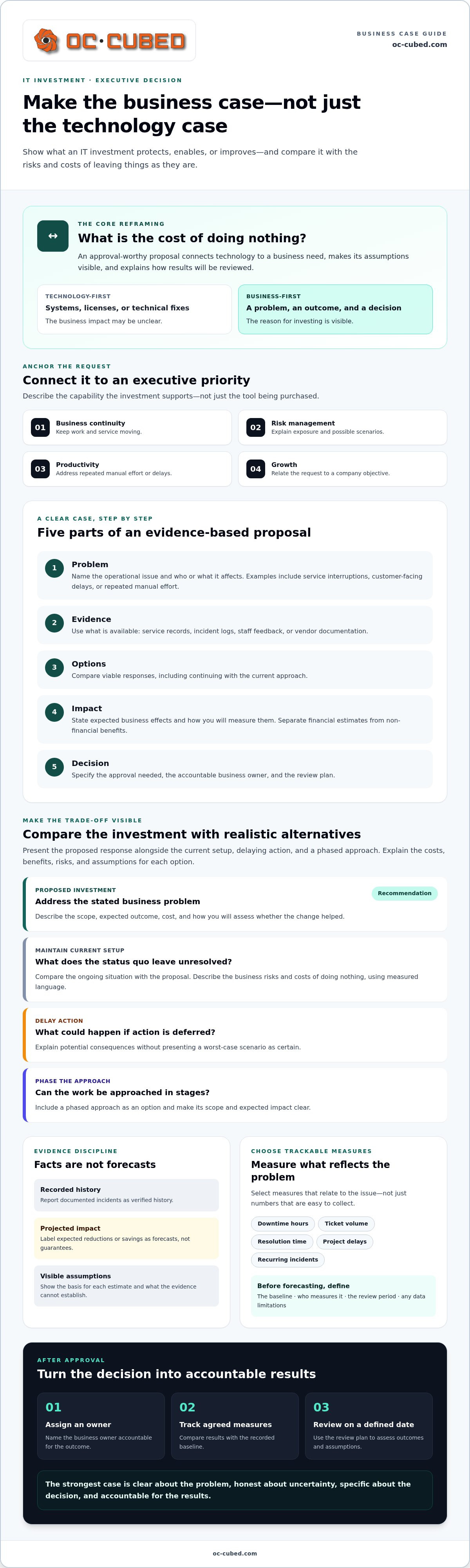
A strong case helps the CEO assess the request, rather than simply giving them a reason to approve it. Use a clear sequence: problem, evidence, options, impact, and decision. Bain & Company’s guidance on aligning IT projects to business goals also emphasizes connecting technology choices to business priorities. Keep that connection visible throughout the proposal.
- Problem: State the operational issue and who or what it affects.
- Evidence: Support it with service records, incident logs, staff feedback, or vendor documentation where available.
- Options: Compare viable responses, including the current approach.
- Impact: Describe expected business effects and how you’ll measure them.
- Decision: Specify the approval needed, the accountable owner, and the review plan.
Separate historical facts from estimates. Report recorded incidents as verified history, for example, but label projected reductions as forecasts. Show the basis for each forecast, including which records or time period informed it, and note what the evidence cannot establish. This transparency is essential when explaining how to justify IT spending to CEO without implying more certainty than the data supports.
Choose measures the business can actually track
Select measures that reflect the stated problem, not numbers that are easy to collect but hard to interpret. Depending on the request, useful measures could include downtime hours, ticket volume, resolution time, project delays, or recurring incidents. Before forecasting a change, record the baseline, who will measure it, the review period, and any limitations, such as incomplete records or inconsistent reporting.
Estimate benefits without overstating ROI
Use documented inputs and explain the calculation behind any estimated savings or productivity gain. If you project staff time reclaimed, show the time assumption and how it relates to the affected work. For security or continuity requests, describe risk reduction as a scenario or exposure analysis, not as a guaranteed avoided loss. Keep financial estimates separate from non-financial benefits such as operational resilience, clearer governance, or defined accountability.
Credible IT business cases disclose their assumptions and explain how outcomes will be measured. This gives decision-makers a fair basis for weighing expected impact against uncertainty. If your team needs help evaluating technology priorities or shaping the case, virtual technology leadership and advisory may be relevant.
Compare IT Spending Options, Including the Cost of Doing Nothing
A proposal is easier to assess when it includes realistic alternatives instead of presenting one option as the only reasonable choice. Compare the current setup, delaying action, a smaller phased approach, and the recommended investment. Use the same cost categories for each: implementation, ongoing support, staff time, and transition effort. Mark costs as confirmed, estimated, or unmeasured so the comparison remains honest.
Make the cost of the status quo visible
Review support effort, recurring incidents, downtime records, and duplicated vendor or tool spending. These can reveal costs or pressures that don’t appear as a single budget line. Describe opportunity costs carefully: show which work is delayed or interrupted, but don’t assign a dollar value to lost productivity without reliable inputs and a transparent calculation. A practical way to justify IT spending to CEO is to make both known costs and information gaps visible.
Evaluate internal, outsourced, and phased approaches
Compare delivery options based on required expertise, coverage, accountability, and your team’s capacity. A managed provider may supplement internal staff with ongoing support, monitoring, or security capabilities. It does not replace internal ownership of priorities and decisions. A phased approach can limit the initial scope, but may involve repeated transition work or leave some needs unresolved. For more context on remote delivery models, see this remote IT management guide.
Use a consistent comparison like this, then replace the prompts with documented findings for your organization:
| Option | Costs to assess | Potential benefits and trade-offs | Dependencies and uncertainties |
|---|---|---|---|
| Maintain current setup | Ongoing support, staff effort, recurring tools | Avoids immediate transition; existing issues may continue | Future incident frequency and workload may be uncertain |
| Delay the decision | Current operating costs, later transition effort | Preserves near-term capacity; may defer needed improvements | Timing and consequences depend on business conditions |
| Invest in phases | Implementation by phase, support, staff time | Allows staged review; partial scope may not address every need | Later phases may depend on results, resources, or vendor input |
| Use internal or external delivery | Staff capacity, provider support, transition effort | Matches delivery to available expertise; accountability must be defined | Coverage, responsibilities, and required expertise need confirmation |
Don’t present operational or security risks as certainties. State what could happen, what evidence supports the concern, and what remains unknown. This helps the CEO weigh trade-offs without relying on worst-case claims.
Prepare a CEO-Ready IT Proposal and Answer the Hard Questions
A CEO-ready proposal should be quick to scan and specific enough to support a decision. Put the requested decision first, then summarize the business problem, evidence, options, recommendation, and review plan. State exactly what approval covers, what is out of scope, and which internal teams or vendors need to contribute. This keeps expectations, scope, and accountability clear.
Prepare for questions about affordability, urgency, disruption, and proof of value. Show the cost categories and assumptions behind the request, explain what a smaller or phased option would change, and identify dependencies that could affect timing or results. If the proposal involves outsourced support, clarify how responsibilities would be shared with internal staff. The managed service provider guide offers further context on that model.
Answer common CEO objections with evidence
Give each concern a direct, evidence-based answer. For “Why now?”, point to the documented trigger and explain the plausible consequences of postponing without presenting them as certain. For “Can we do less?”, compare a smaller scope or phased rollout against the same business objectives. For “How will we know?”, name the success measures, accountable owner, and review dates. If a result cannot be measured reliably, say so and identify the missing information.
Make the recommendation easy to approve
End with a clear request: what decision is needed, by when, who will sponsor the work, and what the next milestone is. Summarize important assumptions and dependencies in plain language. For example, a recommendation may depend on staff availability, vendor input, or confirmation of the project scope. These conditions help the CEO understand what could change the plan.
When a proposal needs ongoing strategy, governance, or vendor oversight, virtual technology leadership may be relevant. OC Cubed provides virtual CIO, CTO, and CISO advisory, while the virtual IT leadership strategy guide explores executive technology oversight. A business-first approach to justifying IT spending to CEO does not promise every forecast will come true. It offers a transparent recommendation with a defined scope, owner, and process for reviewing results.
Turn an Approved IT Investment Into Accountable Business Results
Approval is the start of accountability, not the finish line. Before work begins, name the person responsible for the business outcome, agree on implementation milestones, and set a date to review expected benefits. Track the agreed measures against the baseline established in the business case. If operations, priorities, or other assumptions change, document the change and revisit the plan instead of treating the original forecast as fixed.
Set governance and review expectations
Make ownership practical. Document who can approve scope changes, coordinate vendors, and report progress to leadership. Agree on how often the team will share status, how risks or delays will be raised, and when results will be reviewed. Monthly reporting may help provide a regular view of activity and progress where appropriate. Define what information the business needs rather than assuming a particular report format.
At each review, compare actual results with the baseline and the measures chosen for the proposal. Record what has changed, what remains uncertain, and whether the investment still addresses the original business need. This creates a useful record for course corrections and future spending decisions.
Choose support that matches the business case
Ongoing support or monitoring needs may fit a managed service arrangement. OC Cubed provides monthly managed IT services that bundle support, monitoring, endpoint protection, and Microsoft 365 tenant maintenance. Project-based IT management can support scoped technology projects and deliverables. Virtual CIO, CTO, or CISO advisory may suit organizations that need strategic direction, governance, or vendor oversight without a full-time executive hire.
Match the service model to the approved scope and keep business ownership clear. A provider can deliver defined services, while internal leaders remain responsible for priorities, decisions, and reviewing whether agreed measures are being met. The right arrangement depends on the need identified in the case, internal capacity, and the responsibilities assigned to each party.
Disciplined follow-through also strengthens future requests. You can show what was approved, who owned delivery, how progress was reviewed, and where assumptions held or changed. That evidence makes how to justify IT spending to CEO a repeatable business process rather than a one-time pitch.
Make Your Next IT Decision Business-Ready
A persuasive technology proposal starts with the business need, not the tool. Show how the request supports continuity, risk management, or growth, then back it with evidence and clearly labeled assumptions. Compare the recommendation with maintaining the current setup, delaying, or taking a phased approach so your CEO can see the trade-offs.
Approval is only the beginning. Assign an accountable owner, agree on milestones, and review results against a baseline. This turns how to justify IT spending to CEO into a repeatable decision process grounded in transparent evidence and measured outcomes, not promises.
OC Cubed offers remote IT support, monitoring, helpdesk, and Microsoft 365 tenant maintenance. Virtual CIO, CTO, and CISO advisory can also support strategy, security governance, and vendor oversight. The right option depends on your business priorities and the needs identified in your case.
A clear business case gives leaders a stronger basis for action and a practical way to review results. Start with the need, make the decision measurable, and move forward with a defined plan.
Frequently Asked Questions
How do I convince my CEO to invest in IT?
Lead with a documented business problem, then connect it to a company priority such as reliable service, growth, or cash-flow control. Use records to show who or what is affected, and compare the proposal with maintaining the current setup or taking a smaller, phased approach. Explain costs and uncertainties plainly. Close with a specific request: what approval is needed, who owns the result, and when progress will be reviewed.
How do you calculate ROI for an IT project?
Calculate ROI by comparing documented benefits with the full project cost over a stated period. A common formula is (net benefit divided by total cost) multiplied by 100, but the result is only as reliable as its inputs. Include verified costs and explain how benefits were estimated. Disclose assumptions, choose a baseline for comparison, and label forecasts clearly. Don’t present uncertain savings or risk reduction as guaranteed returns.
What should an IT business case include?
An IT business case should explain the business problem, evidence supporting it, options considered, and the recommended approach. Include relevant costs, risks, expected outcomes, and assumptions, distinguishing verified information from estimates. Name the business owner accountable for the result and explain how progress will be measured against a baseline. A clear decision request helps executives understand what approval covers, what remains out of scope, and when results will be reviewed.
How can I justify cybersecurity spending to a CEO?
Connect the proposed security measures to documented risks and business priorities, such as protecting operations or reducing exposure to disruption. Use available incident records, assessments, or vendor documentation to explain the concern and why the requested controls may help. Describe risk reduction as a reasoned expectation, not a guarantee that incidents won’t occur. State the scope, remaining uncertainties, accountable owner, and how the organization will review whether the measures address its identified needs.
How do you explain IT costs to non-technical executives?
Use plain language to describe the business need before naming tools or technical terms. Explain operational effects with concrete examples, such as interrupted work, recurring delays, or time spent resolving repeated issues, and support them with internal records where available. Present cost categories consistently, including implementation, ongoing support, staff time, and transition effort. Tie each proposed measure to a business priority, and label estimates and assumptions so executives can distinguish facts from projections.
What if my CEO says the company can postpone IT spending?
Assess postponement against evidence, timing, exposure, and dependencies rather than relying on worst-case claims. Explain what is known about current incidents or operational constraints, what remains uncertain, and how delay could affect the business. Then compare proceeding now with a smaller phased option or a later review point. Identify conditions that would prompt reconsideration, such as changing business needs or new evidence, and make the trade-offs clear.
How can a small business fund IT support without hiring a full-time IT executive?
Compare the work your business needs with internal capacity, managed services, and virtual technology leadership. Managed support may suit ongoing support, monitoring, or security needs, while virtual CIO, CTO, or CISO advisory can provide strategic direction, security governance, or vendor oversight without a full-time executive hire. OC Cubed offers these services alongside remote IT support and Microsoft 365 tenant maintenance. Choose based on defined responsibilities and priorities, not assumed savings.


