

What if the cost of handling IT internally isn’t just the support bill, but also the hours your team loses when technology interrupts the workday? Unplanned issues can pull employees away from their roles, while security and vendor decisions still need someone’s attention. The business case for managed IT services starts with those operational realities, not a generic promise of savings.
It’s reasonable to want more predictable support and a clearer view of what technology spending delivers. A sound decision, though, depends on your company’s workload, risks, and current support model. This guide shows how to compare those factors, account for downtime and leadership time, and build a transparent case using your own records. You’ll also see what a managed provider may handle, from helpdesk support and network monitoring to endpoint protection, Microsoft 365 maintenance, vendor coordination, and strategic guidance, as well as which decisions and responsibilities remain yours.
Key Takeaways
- Define what a credible business case for managed IT services needs to demonstrate, including costs, risks, and operational outcomes.
- Compare the full cost of your current approach with the proposed service scope, accounting for support effort, tools, projects, and interruptions.
- Assess the value of prevention, detection, recovery readiness, and strategic oversight, even when IT issues are infrequent.
- Build your case from company-specific evidence, then document assumptions and transition needs so decision-makers can review them.
- Use clear proposal criteria to check service scope, monitoring, security, reporting, escalation, and vendor coordination.
What a Business Case for Managed IT Services Should Actually Prove
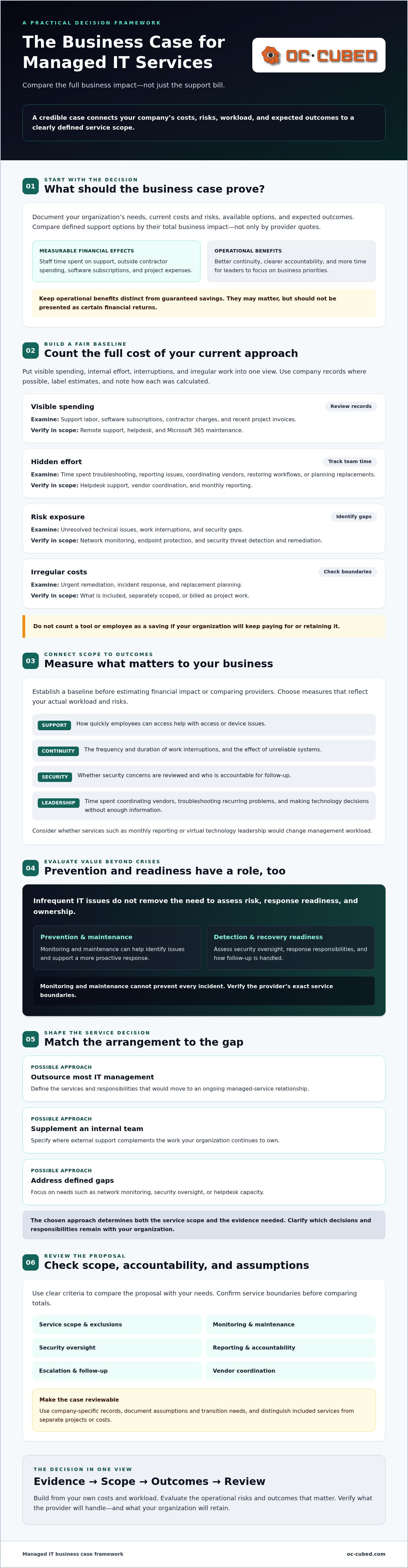
A business case documents your organization’s needs, current costs and risks, available options, and expected outcomes. It should explain why a change makes sense for your business, not just show that one provider’s quote is lower than another’s. The Managed services model generally involves an ongoing service relationship, rather than relying only on break/fix support after an issue occurs.
An MSP business case compares the total business impact of defined support options; a vendor price comparison only compares quotes. Keep measurable financial effects, such as staff time spent on support or spending on outside contractors, distinct from operational benefits. Better continuity, clearer accountability, and more time for leaders to focus on business priorities can matter, but they shouldn’t be presented as guaranteed savings.
Be specific about the decision. Are you considering outsourcing most IT management, supplementing an internal team, or addressing defined gaps such as network monitoring, security oversight, or helpdesk capacity? Your answer determines the service scope and the evidence you’ll need. It also clarifies which responsibilities will remain with your organization.
Which business problems can managed IT address?
Start with recurring friction: employees waiting for access or device issues to be resolved, work slowed by unreliable systems, or technical risks without a clear owner. Monitoring and maintenance can help identify issues and support a more proactive response, but they can’t prevent every incident. For an overview of common service models and responsibilities, see this managed service provider guide.
What outcomes should leadership evaluate?
Choose measures that connect the proposed scope to business needs. Depending on your situation, these could include how quickly employees can access support, the frequency and duration of work interruptions, whether security concerns are reviewed, and who is accountable for follow-up. Establish a baseline before estimating financial impact or comparing providers.
Leadership time is another useful measure. Track how often managers or internal IT staff coordinate vendors, troubleshoot recurring problems, or make technology decisions without enough information. Then consider whether the proposed arrangement, including services such as monthly reporting or virtual technology leadership, would change that workload. Define the measures first, then evaluate providers against them.
Compare the Full Cost of Managed IT With Your Current Approach
A fair comparison looks beyond the proposed recurring fee. Your current approach may involve software subscriptions, internal support labor, contractor invoices, project work, and management time. It may also include less visible costs, such as staff time lost to interruptions or effort spent coordinating vendors. Put these items in one view, but don’t assume every cost will disappear after outsourcing.
Which costs belong in the baseline?
Start with records: invoices, payroll allocations for IT work, software subscriptions, contractor charges, and recent project expenses. Estimate time spent reporting issues, coordinating vendors, restoring workflows, or planning equipment replacements. Label estimates clearly and record how you calculated them. Don’t count a tool or employee as a saving if your organization will keep paying for or retaining it.
| Cost area | What to examine | Potential managed-service scope to verify |
|---|---|---|
| Visible spending | Support labor, software, contractors, and project invoices | Remote support, helpdesk, Microsoft 365 maintenance |
| Hidden effort | Staff time spent troubleshooting or coordinating vendors | Helpdesk support, vendor management, monthly reporting |
| Risk exposure | Unresolved technical issues, interruptions, and security gaps | Network monitoring, endpoint protection, security threat detection and remediation |
| Irregular costs | Urgent remediation, incident response, and replacement planning | Confirm what is included, separately scoped, or billed as project work |
Use the table as an investigation checklist, not as a promise that a provider will absorb every item. Verify the proposal’s service boundaries. Monitoring and security oversight may be part of the proposed scope, for example, while equipment purchases or larger projects may remain separate. Record those distinctions before comparing totals.
How can leaders compare costs fairly?
Compare equivalent scopes. Check support channels, service hours, response expectations, security responsibilities, reporting, and whether project work is included. If your current team or tools will remain, show those costs on both sides. Separate one-time transition needs, such as onboarding or documentation work, from recurring service expenses so the comparison doesn’t mix startup effort with ongoing support.
Provider research can add market context. The Gartner Magic Quadrant may inform a broader vendor review where relevant, but a market position doesn’t establish fit, scope, or total cost for your organization. Use your own requirements and proposal details as the basis for the decision. To see how OC Cubed’s remote support and related services may fit a defined scope, review OC Cubed’s managed IT services.
Address the Main Objection: Is Managed IT Worthwhile Without Constant IT Crises?
A quiet support queue can mean systems are working well. It can also mean employees have learned to work around problems, risks aren’t being tracked, or technical work is happening outside a formal helpdesk. Low incident volume alone doesn’t show whether ongoing support is unnecessary. The better question is whether the organization has the right coverage, oversight, and response processes for the risks it faces.
Separate four potential outcomes in the business case for managed IT services:
- Prevention: Maintenance and monitoring may help identify issues before they disrupt work, but they can’t prevent every incident.
- Detection: Defined monitoring and security oversight can help surface potential problems that might otherwise go unnoticed.
- Recovery readiness: Clear escalation paths and documented responsibilities can help teams coordinate a response when an interruption occurs. Confirm what recovery support a provider actually includes.
- Strategic oversight: Reporting and virtual technology leadership may help leaders make informed decisions without managing every technical detail themselves.
These are distinct benefits, not interchangeable promises. Risk reduction can improve readiness and limit exposure, but it does not guarantee that risks or incidents will be eliminated. The case should also account for onboarding effort, the provider’s service boundaries, responsibilities that stay internal, and the dependency created by handing over parts of IT operations.
How should downtime and security risks enter the case?
Use your own records: incidents, affected workflows, time to restore normal work, and staff effort spent responding. If records are incomplete, label estimates and state the assumptions behind them. Avoid presenting a precise financial loss when the evidence doesn’t support one. For more context on assessing security responsibilities and controls, read this managed cybersecurity guide.
When might managed services be a poor fit?
Fit depends on the work required, not just the desire to outsource. If the business needs on-site coverage, a provider offering remote services alone may not meet that need. The same applies if the proposal doesn’t cover specialized expertise or service expectations the organization considers essential. Confirm service hours, response terms, escalation procedures, and exclusions instead of assuming they’re included.
An existing IT team may need added capacity or specific expertise, not wholesale replacement. A provider can potentially supplement internal staff, but the organization still owns business decisions, access approvals, and accountability for vendor relationships. Define who approves changes, sets priorities, and checks that agreed work is being completed. Clear ownership helps prevent the handoff from creating a gap.
Build a Managed IT Business Case With Company-Specific Evidence
A useful business case for managed IT services should be traceable to your organization’s records, not built on generic savings claims. Use a consistent measurement period, label estimates, and compare options using the same service scope.
- Define the scope. Specify whether you’re evaluating full IT management, added capacity for an internal team, or selected services such as helpdesk, monitoring, or security oversight.
- Establish a baseline. Record current support effort, interruptions, tools, contractor work, and relevant project activity.
- Collect evidence. Review tickets, outage records, security findings, invoices, project backlogs, and staff feedback. Note the measurement period and any missing data.
- Compare options. Assess the current approach, the proposed service, and any practical alternative using equivalent responsibilities and assumptions.
- Review assumptions. Identify who owns each input, when results will be checked, and what evidence could change the recommendation.
What evidence should the business gather first?
Separate confirmed history from estimates and future expectations. A ticket count is historical evidence; an estimate of unreported interruptions is an assumption. Document both, including how each estimate was formed. For operational context on remote support models, see this remote IT management guide.
Use a worksheet to keep inputs visible:
- Support effort: Time spent resolving issues, coordinating vendors, and assisting employees.
- Interruptions: Frequency, duration, affected workflows, and recovery effort.
- Current tools: Subscriptions and support arrangements that would continue, change, or end.
- Proposed scope: Services included, exclusions, internal duties, and any separately scoped work.
- Transition needs: Onboarding tasks, documentation, access changes, and temporary overlap.
For a financial view, use a simple formula: estimated net value = documented financial benefits − recurring service expense − transition expense − retained costs. Enter only organization-specific figures. Count released staff capacity as financial value only if you can explain how it will be used or measured. Keep benefits such as clearer accountability or improved visibility separate if they can’t be credibly monetized.
How should decision-makers present the recommendation?
Summarize the current problem, proposed scope, alternatives, assumptions, and review checkpoints. Include non-financial outcomes and name the person responsible for tracking each one. Test uncertain downtime, incident frequency, and staff-time estimates with low, expected, and high scenarios. Credible ROI depends on documented assumptions and a comparable service scope. If the recommendation changes sharply between scenarios, identify which evidence needs better measurement before deciding.
Evaluate an MSP Proposal and Decide on the Next Step
A proposal is useful only if it answers the needs identified in your business case for managed IT services. Compare providers against the same requirements, not headline features or a low quoted fee. Look for a clear description of what’s included, what’s excluded, how work is reported, and which responsibilities remain with your organization.
What questions reveal whether an MSP matches the case?
Ask each provider to explain its service boundaries in practical terms. Who receives support requests? How are issues escalated? What does onboarding require from your team, and how are service reviews handled? Request a sample report to see whether it would help track the measures identified in your business case.
- Scope: Which support channels, systems, and activities are included? What is handled separately or treated as project work?
- Monitoring and security: What is monitored, how are findings communicated, and who handles remediation? Confirm the exact security responsibilities rather than assuming a tool or service covers every risk.
- Technology coordination: How does the provider manage Microsoft 365 tenant maintenance, endpoint protection, network configuration, and email security within the proposed scope?
- Ownership: Who approves access and changes, coordinates vendors, and makes business-level technology decisions?
- Strategic and project work: How are virtual CIO, CTO, or CISO guidance, virtual project management, and vendor management scoped and reported?
Confirm support hours, response expectations, escalation paths, and the delivery model in writing. If your operations require hands-on, on-site work, check whether remote delivery can meet that need or whether you’ll need another arrangement. A good fit is one whose stated capabilities and limits align with the work your organization actually requires.
How can a business move forward with confidence?
Use your original requirements as the scorecard. For each proposal, mark whether a need is covered, excluded, or unclear. Ask providers to explain gaps before deciding. This makes it easier to compare equivalent scopes and identify responsibilities that could otherwise fall between your team and the provider.
If you proceed, set a review date and preserve the baseline measures from your business case. Review support activity, interruptions, reporting, and agreed service responsibilities together. This gives you a practical way to check whether expected outcomes are emerging, while leaving room to adjust scope or assumptions if they aren’t.
Make Your Next IT Decision With Confidence
A sound business case for managed IT services isn’t built on a low quote or a promise of savings. It compares your current support effort, technology risks, and operational needs with a clearly defined service scope. Company records and transparent assumptions give leaders a practical way to weigh financial effects alongside continuity, accountability, and time reclaimed for business priorities.
Before choosing a provider, confirm what’s included, what remains your responsibility, and how results will be reviewed. OC Cubed offers remote support, helpdesk and NOC integration, monitoring, endpoint protection, Microsoft 365 maintenance, and virtual technology leadership. Match those services to your needs, then verify the boundaries and expectations of any proposed arrangement.
You don’t need to solve every technology challenge at once. Start with clear requirements, a reliable baseline, and the right conversation. That gives your team a steadier foundation for deciding what comes next.
Frequently Asked Questions
What is a business case for managed IT services?
A business case for managed IT services is a documented comparison of your company’s technology needs, current costs and risks, proposed service scope, and expected outcomes. It helps leaders assess options using company-specific evidence rather than a provider’s price alone. Include measurable financial effects alongside operational goals, such as clearer accountability or less management time spent coordinating support. State assumptions and identify what your organization will continue to own.
How do you calculate the ROI of managed IT services?
Estimate ROI by comparing measurable benefits with the full cost of the proposed service, including recurring fees, transition expenses, and costs your business will retain. A common calculation is (measurable benefits minus total costs) divided by total costs, then multiplied by 100. Use your own records for support effort and interruptions, and label estimates clearly. Don’t count hoped-for savings as confirmed benefits or assign a dollar value to outcomes you can’t measure.
Is managed IT cheaper than hiring an internal IT team?
It depends on the work required, the capabilities you need, and which internal costs would actually change. Compare the proposed service scope with the full cost of hiring, including compensation, tools, training, and management time, using your organization’s figures. An MSP may supplement existing employees rather than replace them, so include any retained roles and tools in the comparison. A lower headline cost doesn’t prove equivalent coverage or expertise.
Can managed IT services reduce downtime?
Managed IT services can support efforts to reduce interruptions through monitoring, maintenance, and defined support processes, but they can’t guarantee that downtime will be eliminated. Review your own outage history, affected workflows, and recovery effort to establish a baseline. Then confirm which systems a provider monitors, how issues are escalated, and what recovery responsibilities are included. Track those same measures after implementation to assess whether the service is contributing to improved continuity.
What happens if a business already has internal IT staff?
Managed services can complement an internal IT team by adding support capacity or capabilities that are difficult to maintain in-house. Define the division of work before choosing a provider. For example, the provider might handle agreed monitoring or helpdesk activities, while internal staff retain business context and decision-making. Clarify who approves access and changes, coordinates vendors, and reviews service reports. The goal is a defined partnership, not an assumed transfer of every responsibility.
What should a managed IT services proposal include?
A proposal should clearly state included services, exclusions, support channels, service hours, response expectations, monitoring and security responsibilities, reporting, and escalation procedures. It should also explain onboarding tasks, project handling, vendor coordination, and any work billed or scoped separately. Ask how Microsoft 365, endpoints, networks, and email security fit into the offer. Confirm internal responsibilities in writing, then compare proposals against the same requirements rather than feature lists alone.
How long does it take to see value from managed IT services?
There isn’t one timeline that applies to every business. Some operational changes, such as clearer support ownership or reporting, may become visible after responsibilities are established; broader outcomes require consistent measurement over time. Agree on onboarding steps, a review date, and baseline measures before service begins. Track relevant indicators, such as support activity and interruptions, and account for transition work. Ask the provider to clarify when each proposed outcome can reasonably be evaluated.


