

Most business owners don't realize their IT contract is a liability until a major system failure occurs and the promised support is nowhere to be found. You've likely felt the sting of unexpected downtime or the irritation of "all-inclusive" plans that somehow always result in extra invoices. It's a common trap. Identifying the red flags when choosing an IT provider is the only way to protect your operations from vendors who prioritize their margins over your uptime.
You deserve a partner who offers steady reliability and quiet authority, not just a technician who reacts when things break. We've seen exactly what happens when businesses lack proper strategic oversight; we know how to avoid those pitfalls. This guide outlines the warning signs of a failing partnership and shows you how to find a provider that offers true security and proactive leadership. You'll learn to spot the gaps in technical competence and demand the transparency your business requires for long-term growth. By focusing on strategic governance rather than just basic helpdesk support, you can eliminate surprise bills and ensure your technology actually enables your success.
Key Takeaways
- Stop paying for failures by identifying why reactive "break-fix" models are a major financial liability for your operations.
- Move beyond basic protection by demanding data-driven security standards and real-time threat remediation that actually keeps you safe.
- Spot the red flags when choosing an IT provider who acts as a simple order-taker instead of offering strategic, executive-level leadership.
- Protect your budget from hidden fees by learning how to audit "all-inclusive" contracts for service level gaps and opaque pricing structures.
- Gain a clear path forward with a 5-point evaluation checklist designed to verify a provider's NOC integration and proactive management capabilities.
The Reactive Trap: Why 'Break-Fix' is a Major Red Flag
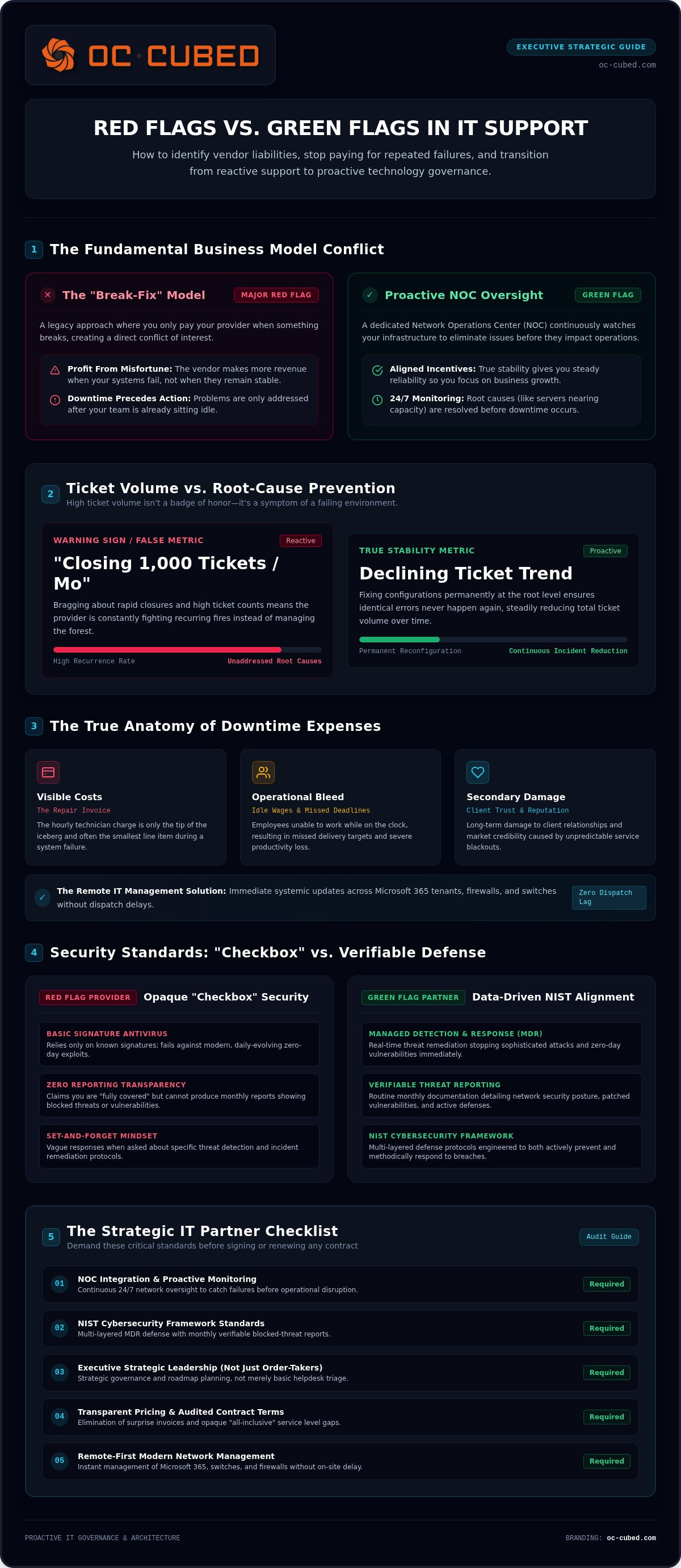
The "break-fix" model is a legacy approach where you only pay your provider when something stops working. While it might seem cost-effective on the surface, it creates a fundamental conflict of interest. Your IT provider makes more money when your systems fail, not when they remain stable. This is one of the most significant red flags when choosing an IT provider because it shifts the focus from prevention to repair. It's a model built on your misfortune.
Waiting for a system to crash is the most expensive way to manage your technology. By the time you notice a problem, your team is already sitting idle. Modern businesses require a managed services model that prioritizes uptime through continuous oversight. A reactive helpdesk simply reacts to your calls; a proactive Network Operations Center (NOC) watches your infrastructure to catch issues before they impact your workflow. The ultimate "green flag" is a provider that uses proactive monitoring to eliminate incidents before they ever start. This steady reliability allows you to focus on growth rather than technical obstacles.
Ticket Volume vs. Incident Prevention
Many vendors brag about their "lightning-fast" response times or the fact that they "close 1,000 tickets a month." This is a warning sign. High ticket volume isn't a badge of honor; it's a symptom of a failing environment. If your provider is constantly putting out fires, they aren't managing the forest. A healthy IT environment should have a declining ticket count over time as the root causes of problems are addressed and removed.
True stability comes from 24/7 network monitoring. This allows for the identification of patterns that lead to failure, such as a server reaching capacity or a security vulnerability being probed. OC Cubed uses proactive maintenance to solve these recurring issues at the root. We don't just fix the error; we adjust the configuration to ensure it doesn't happen again. This approach shifts the focus from "how fast can we fix it" to "how can we ensure it never breaks." It's about control and protection.
The Hidden Costs of Reactive Support
The true cost of downtime is rarely found on the repair invoice. You must calculate the lost wages of employees who cannot work, the missed deadlines, and the potential damage to your client relationships. These secondary costs often dwarf the technical fees. Reactive support leaves you vulnerable to these spikes in operational expense, making your IT budget impossible to predict. You're essentially paying a premium for your own lost productivity.
Implementing remote IT management services is the proven cure for the reactive support cycle. A remote-first model allows for immediate, systemic updates across your entire network without the delay of dispatching physical technicians. This efficiency is vital for preventing systemic failures. By maintaining your Microsoft 365 tenant and managing firewalls and switches remotely, we keep your business moving forward. This model ensures your technology is an enabler of growth, not a recurring obstacle.
Opaque Security Standards: Spotting the 'Checkbox' Provider
Many IT vendors treat security as a set-it-and-forget-it task. This "checkbox" mentality is a dangerous trap for your business. If a provider tells you that you are "fully covered" but cannot produce a monthly report showing blocked threats or system vulnerabilities, they aren't actually managing your risk. They are simply selling you a false sense of security. This lack of transparency is one of the most critical red flags when choosing an IT provider in today's high-risk environment.
Real protection requires data and verifiable protocols. A dependable partner builds their strategy around the NIST Cybersecurity Framework to ensure every layer of your business is defended. When vetting a new partner, ask for proof of their threat detection and remediation protocols. You need to see how they respond to an incident, not just how they prevent one. If the answer is vague or lacks technical depth, your business remains vulnerable to systemic failure.
Endpoint Protection vs. Basic Antivirus
Legacy antivirus is no longer enough to protect a modern network. It relies on known signatures, meaning it only stops threats that have already been identified elsewhere. Modern attacks are more sophisticated and evolve daily. You need Managed Detection and Response (MDR) to stop zero-day exploits in real time. Effective managed cybersecurity services for small business must include endpoint protection that monitors behavior, not just files. This level of oversight ensures that even if a threat bypasses your first line of defense, it is contained before it can spread across your network.
The Proofpoint Standard for Email Security
Email remains the primary entry point for ransomware and credential theft. Relying on generic Microsoft 365 security settings is a common mistake that many checkbox providers make. These default filters often miss advanced business email compromise attempts. A provider who doesn't prioritize advanced email filtering is leaving your front door wide open. We implement Proofpoint email security to stop these attacks before they reach your inbox. This standard provides the protection needed to keep your credentials and financial data safe from theft. If you're concerned about your current defenses, reviewing our security stack can help you identify exactly where your current vendor might be falling short. High-level security should be a baseline, not an upsell.
Lack of Executive Leadership: The 'Order-Taker' Red Flag
An IT provider that always says "yes" is actually a liability. Technical competence is only half the battle. If your vendor simply processes tickets without questioning your strategy, they aren't a partner; they're an order-taker. This is one of the most subtle red flags when choosing an IT provider. You need IT leadership without full-time hire to ensure your technology supports your business objectives. Without a roadmap, budget planning, or security governance, you'll face constant technical debt and surprise expenses.
The Role of the Virtual CIO (vCIO)
Your technology should scale with you. Strategic vendor management: handling partners so you don't have to. This saves you time and frustration while ensuring you get the best value from your software stack. Monthly reporting shouldn't just list uptime percentages. It should provide actionable insights that drive business decisions. A true partner involves themselves in your 3-year growth plan. They ensure your infrastructure is ready for where you're going, not just where you are today.
Virtual CISO and Security Governance
Compliance is not the same as security. Many providers check boxes for insurance forms but fail to implement actual security governance. Effective cybersecurity risk management for small business requires a high-level perspective. By aligning with the NIST Cybersecurity Framework, a fractional CISO provides the oversight needed to identify risks before they become breaches. Fractional executive leadership provides the high-level strategy necessary to prevent security incidents without the overhead of a full-time executive salary. This ensures your protection is active, managed, and aligned with industry standards.
The 'All-Inclusive' Illusion: Pricing and Contract Red Flags
Many business owners choose a provider based on the lowest monthly fee. This is often a mistake. A low retainer usually indicates the provider doesn't include everything in the base price, planning to make their profit through "out of scope" charges and hidden project fees. This pricing structure is one of the primary red flags when choosing an IT provider. It forces you to negotiate every time you need an upgrade or a fix. A true partnership should be built on a flat-rate monthly retainer that covers your essential needs without surprise invoices.
Long-term contracts are another area of concern. If a vendor tries to lock you into a three-year deal without a clear Service Level Agreement (SLA) or an exit clause, they are protecting their revenue, not your business. Understanding these red flags when choosing an IT provider allows you to negotiate from a position of strength. You should always have a clear path to leave if performance doesn't meet the agreed standards. Transparency in pricing and flexibility in terms are the hallmarks of a provider that is confident in the value they deliver.
Hidden Project Fees and 'Nickel-and-Diming'
Infrastructure upgrades shouldn't come as a shock. They should be part of a predictable roadmap developed during your strategic planning sessions. Some providers charge extra for basic remote support during business hours or for standard Microsoft 365 tenant maintenance. This "nickel-and-diming" makes it impossible to manage an accurate IT budget. OC Cubed's bundled model is designed to eliminate these surprise bills. We include the essential management and support services in a single, predictable monthly cost. This allows you to focus on growth instead of auditing your IT invoices.
Data Ownership and 'Vendor Lock-in'
A provider holding your administrative passwords hostage is a critical red flag. You must maintain full ownership of your data and your Microsoft 365 tenant at all times. Some vendors use technical complexity to create "vendor lock-in," making it difficult or expensive for you to switch to a different partner. To avoid this trap, ensure your agreement includes:
- Full administrative access to all cloud tenants and local hardware.
- Ownership of all domain registrations and software licenses.
- Clear offboarding clauses that mandate cooperation during a transition.
This ensures you have total control over your digital assets. We believe in earning your business every month through performance, not through restrictive access to your own systems. Our goal is to be a protector and enabler, removing the obstacles that prevent your team from scaling efficiently.
The IT Provider Evaluation Checklist: Making the Switch
Choosing a partner is about more than technical support. It's about finding an advocate for your growth. Use this 5-point audit to evaluate any IT proposal. A true partner focuses on your business outcomes, not just their technology. They should be able to explain how their monitoring reduces your ticket volume, not just how fast they answer the phone. When asking about NOC integration, inquire about their specific response protocols for firewall and switch management.
- Strategic Roadmap: Can they show you a 3-year growth plan that aligns with your business goals?
- Security Stack: Do they use Proofpoint for email and Managed Detection and Response (MDR) for endpoints?
- Flat-Rate Billing: Is the pricing truly predictable with no hidden project fees for remote support?
- NOC Integration: How do they monitor your network 24/7 to prevent issues before they cause downtime?
- Data Ownership: Do you maintain administrative control of your Microsoft 365 tenant and all local hardware?
Auditing the Onboarding Process
A "fast" onboarding is often one of the biggest red flags when choosing an IT provider. Speed usually comes at the expense of thorough documentation. A comprehensive network discovery phase should take time. It requires a deep dive into your firewall and switch management, your user permissions, and your security vulnerabilities. We assign a virtual project manager to every transition to ensure nothing is missed. This structured approach prevents the common "onboarding lag" where systems break because the new provider didn't understand the existing configuration. We prioritize steady reliability from day one.
Why OC Cubed is the 'Green Flag' Choice
OC Cubed offers national-scale expertise with a remote-first model that prioritizes proactive management. We don't just fix things when they break. We act as your virtual CIO and CISO to ensure your technology is a growth engine, not a liability. We focus on results-driven outcomes like 24/7 uptime and total security threat remediation. By eliminating red flags when choosing an IT provider, we give you the peace of mind to scale your business with confidence. Our quiet authority comes from years of solving complex problems before they reach your staff's desks. We remove obstacles so you can focus on growth.
Secure Your Business Future with Proactive IT
Identifying the red flags when choosing an IT provider is the first step toward reclaiming control of your business operations. You've seen that technical competence is only the baseline for a modern partnership. True value lies in proactive monitoring that stops incidents before they start and strategic leadership that aligns your technology with your long-term growth goals. It's about moving from a reactive "break-fix" cycle to a model of steady reliability.
We specialize in removing the technical obstacles that create downtime and frustration. Our model relies on flat-rate monthly retainers to ensure your IT costs are always predictable. We provide enterprise-grade Proofpoint security to protect your sensitive data and virtual CIO/CISO leadership to guide your executive strategy. This professional oversight gives you the peace of mind to scale your business with total confidence. Your technology should be a silent engine for growth, not a source of constant anxiety.
A dependable partner is ready to help you build a secure and scalable future. Take the next step toward a partnership that prioritizes your results and protects your bottom line.
Frequently Asked Questions
What are the most common red flags in an IT service contract?
The most common red flags in an IT service contract include vague service level agreements (SLAs), hidden project fees, and clauses that don't guarantee data ownership. You should look for a flat-rate monthly retainer that clearly defines the scope of remote support and security remediation. If a contract lacks an exit strategy or doesn't mandate the return of your administrative passwords upon termination, it is a significant risk to your business continuity and growth.
How do I know if my IT provider is actually doing proactive monitoring?
You can verify proactive monitoring by reviewing your monthly reporting for data on blocked threats and system updates. A provider truly performing these services will have a Network Operations Center (NOC) that catches hardware failures or security vulnerabilities before they impact your workflow. If your ticket volume remains high for the same recurring issues, it's a sign they are reacting to problems rather than preventing them through continuous oversight and maintenance.
Is a cheap IT support retainer a red flag for my security?
A cheap IT support retainer is often one of the biggest red flags when choosing an IT provider because it usually signals insufficient security coverage. Low-cost plans frequently rely on basic antivirus rather than modern endpoint protection and Managed Detection and Response (MDR). These providers often skip essential defenses like Proofpoint email security, leaving you vulnerable to credential theft. Quality IT management requires a budget that supports enterprise-grade tools and strategic executive leadership.
What should be included in an 'all-inclusive' managed IT plan?
An all-inclusive managed IT plan should cover remote IT support, Microsoft 365 tenant maintenance, and 24/7 network monitoring. It must also include security threat detection, endpoint protection, and firewall management. At OC Cubed, we bundle these essentials with monthly reporting and virtual CIO services into a single flat-rate retainer. This model ensures you avoid surprise bills while receiving the strategic oversight necessary to scale your operations without technical obstacles.
How can I tell if my IT provider is holding my data hostage?
You are likely being held hostage if you don't have full administrative access to your Microsoft 365 tenant, firewall configurations, and local hardware. A dependable provider ensures you maintain ownership of all domain registrations and software licenses at all times. If your vendor refuses to share your passwords or documentation, they are creating "vendor lock-in." This is a major liability that prevents you from transitioning to a more capable partner when your business needs change.
Why is a lack of vCIO services considered a major red flag?
A lack of vCIO services is a red flag because it means your provider is focused on technical tasks rather than your business outcomes. Without a virtual CIO, you lack a strategic roadmap, budget planning, and security governance. This "order-taker" approach leads to technical debt and missed growth opportunities. High-level leadership ensures your technology stack evolves with your business, providing the fractional C-suite expertise required to manage vendors and complex infrastructure projects.
What are the signs that my IT provider is outgrowing my business?
Signs that a provider is outgrowing your business include declining response times and a failure to offer advanced security like Proofpoint or MDR. As you scale, you need more than just basic helpdesk support; you require sophisticated network monitoring and configuration. If your provider struggles to manage your increasing complexity or fails to provide the executive-level governance your growth demands, it's time to evaluate a partner with national-scale remote support capabilities.
How do I transition to a new IT provider without causing downtime?
Transitioning to a new provider without downtime requires a structured onboarding process and a dedicated virtual project manager. The process begins with a comprehensive network discovery phase to document every firewall, switch, and cloud tenant. By identifying red flags when choosing an IT provider early, you can ensure all administrative credentials are in your control before the switch. This professional approach eliminates the "onboarding lag" and ensures your security remediation and support services continue without interruption.


