

Waiting for technology to break before fixing it isn't an IT strategy; it's an operational hazard. You already know the disruption of unexpected downtime halting business operations, accompanied by erratic invoices from reactive technician visits. Between unpatched endpoint vulnerabilities and escalating cyber threats, waiting for someone to respond only after an outage strikes puts your entire organization at risk. Modern it support solutions must do far more than react; they need to keep your infrastructure running smoothly before issues ever impact your staff.
This executive guide demonstrates how modern IT support solutions eliminate costly downtime, strengthen multi-layered cybersecurity, and deliver predictable operational stability for growing businesses. We examine the essential shift away from chaotic break-fix models toward continuous remote monitoring, transparent all-inclusive retainers, and high-level executive technology guidance that fuels confident growth in 2026.
Key Takeaways
- Modern it support solutions replace unpredictable break-fix disruptions with continuous oversight, resolving network and system anomalies before they impact your team.
- Layered infrastructure protection, combining enterprise email filtering, endpoint defense, and NOC integration, neutralizes active threats quietly in the background.
- Comparing support delivery models shows how all-inclusive monthly retainers eliminate erratic repair invoices and stabilize operational budgets.
- A structured five-step vetting methodology helps executive leadership audit technical vulnerabilities and select the right external technology partner.
- Fractional executive guidance from virtual CIO and CISO leadership aligns hardware lifecycles and cloud strategy with long-term business goals.
What Are Modern IT Support Solutions? Moving Beyond Reactive Break-Fix
Traditional IT management viewed technology assistance as a utility repair service. When an email server failed, a workstation crashed, or a network switch halted operations, leadership placed an urgent call and waited for an outside technician to arrive. Historically, technical support functioned around this reactive model, prioritizing incident resolution only after damage was already done. Today, modern it support solutions operate as integrated digital ecosystems designed to preserve business continuity, secure sensitive data, and protect daily revenue streams.
Business operations cannot afford the operational latency of physical dispatches. When an on-site technician drives out to diagnose a severed server connection or an endpoint glitch, your workforce sits idle. Modern organizations prioritize remote resolution velocity. Enterprise tools allow technical teams to access, diagnose, and remediate anomalous device behaviors instantly through remote IT support. System stability directly governs employee output. When infrastructure runs reliably without friction, employees produce uninterrupted work, projects hit deadlines, and operational revenue remains protected.
The Fundamental Shift from Reactive Repairs to Proactive Oversight
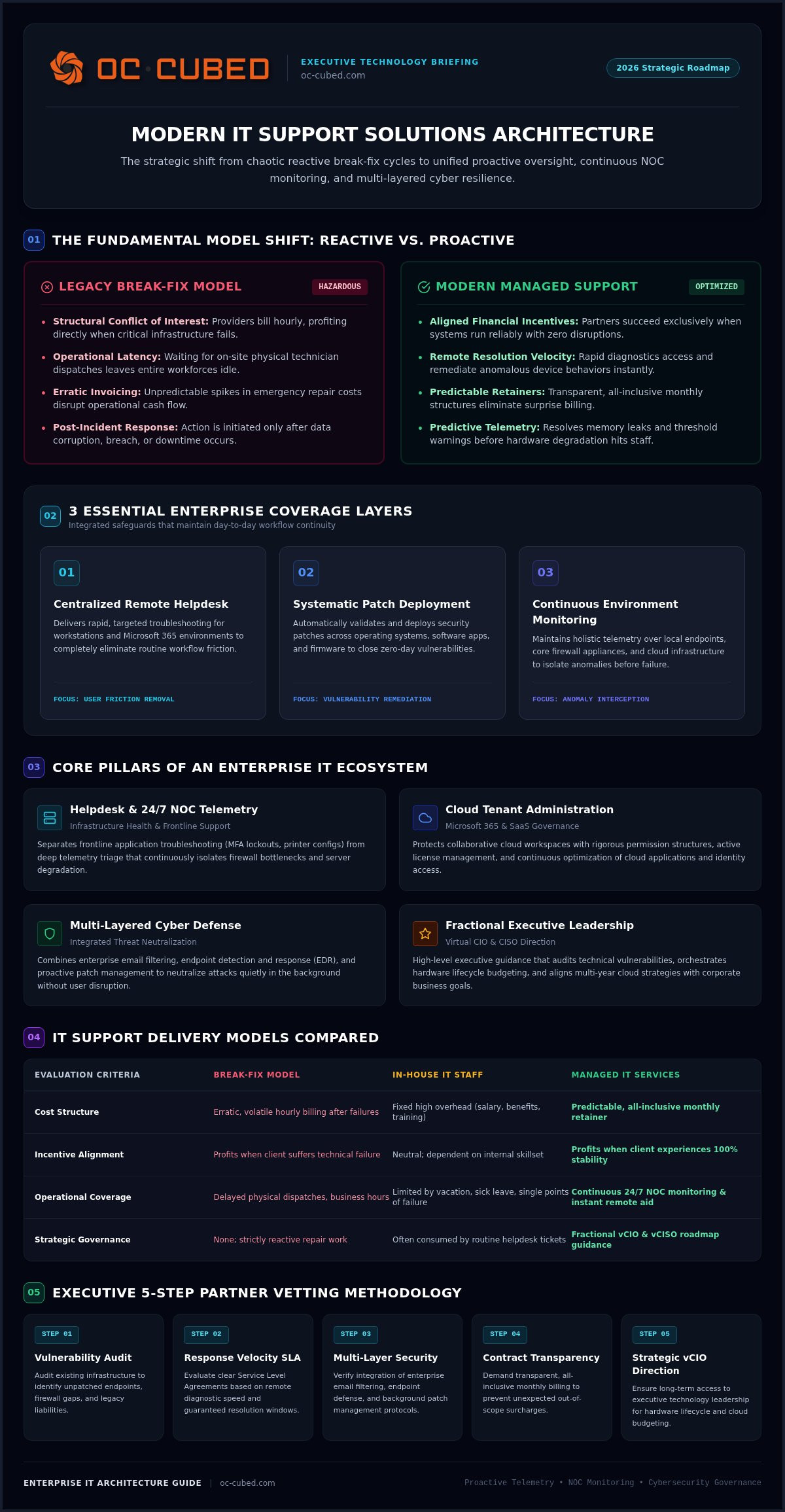
Legacy break-fix relationships contain a structural conflict of interest. The provider bills by the hour, meaning they profit when your operations break down and suffer downtime. In contrast, proactive it support solutions flip this dynamic entirely:
- Misaligned incentives eliminated: Continuous managed agreements mean your technology partner succeeds only when your network runs flawlessly without billable disruptions.
- Predictive telemetry: Network monitoring analyzes device health, memory leakage, and storage thresholds, resolving system warnings before hardware fails.
- Uninterrupted workflows: Background remediation addresses pending operating system conflicts before they force unexpected reboot loops during core business hours.
Essential Coverage Components in Enterprise-Grade IT Architecture
Achieving predictable operations requires multiple technical safeguards working together. Rather than relying on isolated ticketing software, enterprise architecture integrates three critical management layers:
- Centralized remote helpdesk: Provides fast, targeted remote troubleshooting to eliminate day-to-day workflow friction across user workstations and Microsoft 365 environments.
- Systematic patch deployment: Automatically validates and applies security patches across operating systems, third-party applications, and network firmware to eliminate zero-day vulnerabilities.
- Continuous environment monitoring: Centralizes oversight across local endpoints, core firewall appliances, and cloud software infrastructure to detect anomalies early.
Core Pillars of an Effective Business IT Support Ecosystem
Modern it support solutions rely on interconnected operational pillars rather than standalone tools. When these operational layers communicate seamlessly, your organization establishes a resilient defensive barrier against operational drag and security intrusions. Establishing formal IT governance ensures every technical component directly serves strategic organizational objectives rather than operating in isolation.
Achieving this level of resilience requires balancing daily end-user assistance with continuous system oversight, as detailed in our guide to Remote IT Management: Complete Guide for Modern Business. When configured correctly, these core pillars protect operational continuity around the clock.
Integrated Helpdesk and 24/7 NOC Infrastructure Monitoring
A high-performing support structure separates end-user friction from deep infrastructure health. Frontline helpdesk engineers resolve daily application snags, printer mapping errors, and multi-factor authentication lockouts quickly. Operating concurrently, a Network Operations Center (NOC) continuously tracks switch health, firewall integrity, and server performance. This constant telemetry triage isolates bandwidth bottlenecks and hardware degradation behind the scenes, resolving anomalies before staff members ever notice network latency.
Cloud Tenant Administration and Microsoft 365 Optimization
Unmonitored cloud environments invite unnecessary subscription overhead and access vulnerabilities. Structured tenant maintenance enforces strict role-based access controls, ensuring personnel maintain only the precise permissions required for their specific roles. Regular administrative audits also flag idle licenses, orphaned accounts, and insecure external sharing links. To safeguard your cloud footprint and eliminate wasted SaaS spending, follow our practical framework in the Microsoft 365 License Management: Small Business Guide.
Layered Endpoint Protection and Enterprise Email Security
Modern adversaries bypass legacy antivirus using fileless exploits and credential harvesting tactics. Comprehensive it support solutions counter these vectors through synchronized multi-layered protection:
- Advanced endpoint detection: Modern endpoint agents analyze running processes in real time, isolating compromised workstations from the local network instantly to stop lateral movement.
- Enterprise email defense: Integrated email security platforms like Proofpoint filter inbound phishing payloads, malicious macros, and deceptive executive impersonation attempts.
- Centralized firewall management: Continuous rule updates and port filtering ensure your edge routers block unauthorized traffic across all corporate locations.
If your current infrastructure lacks these cohesive safeguards, exploring modern managed services through OC Cubed can help stabilize and protect your operational environment.
Comparing IT Support Models: Break-Fix vs. In-House Staff vs. Managed Services
Selecting the right operational model shapes your overhead, risk profile, and technical agility. Growing organizations generally evaluate three distinct paths: legacy break-fix contractors, internal full-time employees, or comprehensive managed it support solutions. Each model presents distinct tradeoffs across budget predictability, coverage availability, and strategic value.
| Criteria | Hourly Break-Fix | Internal IT Staff | Managed IT Services |
|---|---|---|---|
| Cost Structure | Volatile; high surprise bills during critical failures | Fixed high overhead (salaries, benefits, recruitment) | Predictable; flat monthly retainer model |
| Availability | Reactive; depends on technician dispatch schedules | Single point of failure; gaps during PTO and sick leave | Continuous remote coverage with integrated NOC monitoring |
| Strategic Value | None; focused purely on temporary repair labor | Limited by one individual's narrow skill set | High; includes virtual CIO and security leadership |
| Operational Focus | Emergency triage after outages occur | Internal end-user ticket management | Proactive prevention and risk surface reduction |
The Hidden Financial Drain of Break-Fix Technical Retainers
Hourly support contracts create conflicting financial incentives. Break-fix contractors profit when client systems fail. Emergency troubleshooting rates spike during major incidents, placing sudden strain on cash reserves. Between emergency calls, no continuous maintenance occurs. Unmonitored network congestion and deferred updates trigger repeated micro-outages throughout the workweek, quietly eroding employee focus and compounding hidden operational losses.
Full-Time In-House Hiring vs. Scalable Managed IT Support
Hiring internal technical staff introduces rigid financial and functional limits. A single in-house administrator cannot maintain deep expertise across firewall architecture, cloud directory administration, regulatory compliance, and day-to-day helpdesk tickets. If that person takes time off or leaves the company, institutional knowledge vanishes instantly, creating dangerous operational bottlenecks.
Partnering with a specialized provider eliminates coverage gaps entirely. Multidisciplinary it support solutions give executive teams access to network engineers, security analysts, and cloud administrators simultaneously under an all-inclusive monthly retainer. Your organization secures enterprise-grade protection, continuous system oversight, and strategic technology direction without the compounding overhead of expanded payroll.
How to Evaluate and Select the Right Business IT Support Solution
Selecting an external technology partner directly impacts your daily operational stability. Executives must look beyond basic marketing claims to evaluate how potential providers handle threat mitigation, infrastructure scaling, and everyday technical friction. Reviewing What Is a Managed Service Provider? A Guide for Leaders helps establish baseline partner expectations before entering formal vendor evaluations.
A rigorous five-step vetting methodology keeps leadership focused on measurable operational capabilities:
- Perform an infrastructure audit: Catalog current hardware, cloud directories, and network appliances to establish an accurate baseline of operational complexity.
- Review threat management capabilities: Verify how the provider handles security patching, perimeter filtering, and endpoint containment.
- Examine contractual commitments: Scrutinize Service Level Agreements (SLAs) for guaranteed response windows and ticket resolution metrics.
- Evaluate third-party management: Confirm the provider manages telecom and software vendors directly to remove friction from internal teams.
- Assess reporting transparency: Require sample monthly reporting packages documenting system health, threat prevention, and patch compliance.
Auditing Infrastructure Complexity and Vulnerability Exposure
Effective it support solutions start with complete visibility into your digital environment. Document all managed workstations, core switches, edge firewalls, and active cloud directories. Pinpoint unmanaged mobile devices, outdated operating systems, and inactive user accounts that expand your attack surface. To structure this discovery process effectively, use the executive frameworks found in our 2026 Cybersecurity Risk Strategy for Small Business.
Scrutinizing Service Level Agreements and Support Response Metrics
Contractual clarity protects your operational productivity during unexpected disruptions. Insist on clear distinctions between initial response times and actual remediation targets. Look closely at escalation workflows. Tickets should route efficiently from initial helpdesk intake straight to senior engineers without stalling across bureaucratic tiers. Confirm whether your agreement guarantees comprehensive remote coverage and continuous system monitoring, ensuring network defenses remain active during non-business hours.
Validating Vendor Oversight and Third-Party Technology Management
Technology operations involve numerous outside vendors, including internet service providers, VoIP platforms, and line-of-business software companies. Experienced it support solutions absorb these administrative headaches through dedicated vendor management. When your primary internet connection drops or a software update fails, your IT partner liaises directly with those third parties to restore service. Monthly reporting should provide full transparency into these resolved issues, open tickets, and your overall security posture.
Achieving Long-Term Operational Predictability with Proactive IT Leadership
True operational resilience requires moving beyond resolving immediate helpdesk requests. Sustainable business growth demands strategic technical leadership that aligns infrastructure investments directly with operational objectives. When organizations shift from transactional IT management to proactive it support solutions, technology changes from an erratic cost center into a steady driver of organizational efficiency.
A well-architected technology roadmap prevents emergency modernization projects. Instead of scrambling when legacy operating systems reach end-of-life or unmonitored hardware suddenly degrades, leadership plans ahead. Scheduled device refresh cycles, structured cloud migrations, and regular network firmware updates ensure your business scales smoothly without operational shocks.
Eliminating Cost Volatility with All-Inclusive Service Models
Erratic IT billing strains financial planning. Traditional hourly models generate unpredictable invoices that swing wildly based on system disruptions. All-inclusive service models remove this friction entirely:
- Budgeting certainty: Flat monthly retainers unify helpdesk access, remote troubleshooting, system maintenance, and threat detection into one consistent operating expense.
- Complete vendor alignment: Eliminating hourly billing removes disputes over billable labor, focusing your technical partner entirely on system uptime.
- Capital forecast accuracy: Predictable monthly commitments allow executive teams to project technology investments quarters in advance without fear of unexpected repair invoices.
Fractional C-Suite Strategy: Virtual CIO and CISO Integration
Mid-sized organizations face enterprise-level cyber risks and infrastructure decisions, but hiring a full-time executive technology team often presents unnecessary overhead. Modern it support solutions solve this challenge by embedding virtual CIO (vCIO) and virtual CISO (vCISO) advisory directly into operational support agreements. To discover how this structure optimizes executive operations, review Enterprise-Grade IT Leadership Without a Full-Time Hire: The 2026 Strategy Guide.
Your dedicated vCIO translates long-term corporate growth milestones into practical infrastructure roadmaps, managing software licensing cycles, cloud migrations, and virtual project management smoothly. Operating concurrently, your vCISO establishes comprehensive security policies, manages threat exposure, and ensures compliance postures satisfy cyber insurance requirements. This fractional executive leadership delivers the strategic foresight necessary to protect assets and drive growth while maintaining complete operational predictability.
Transform Your Business Technology into a Predictable Growth Driver
Operational disruption shouldn't dictate your company's growth trajectory. Walking away from unpredictable break-fix technicians gives your organization the stability it needs to thrive. Modern it support solutions replace erratic invoices with comprehensive all-inclusive monthly retainers, aligning your technology partner's incentives directly with uninterrupted uptime and operational focus.
Continuous 24/7 NOC monitoring, advanced endpoint defense, and enterprise Proofpoint email protection actively shield your workflows, neutralizing anomalies before employees ever experience downtime. Backed by fractional vCIO and vCISO guidance, your executive team gains the strategic roadmap necessary to navigate cloud modernization and compliance requirements without hesitation.
Take control of your infrastructure today and build a dependable technical foundation for lasting business success.
Frequently Asked Questions
How much do managed IT support solutions typically cost for a growing business?
Pricing for managed it support solutions depends primarily on your total user count, infrastructure complexity, and security requirements. Rather than billing by the hour, modern providers package remote helpdesk access, threat detection, and system maintenance into an all-inclusive monthly retainer. This bundled approach eliminates unpredictable repair invoices, giving growing companies fixed operational costs and total transparency across their annual technology budget.
Can remote IT support solutions effectively resolve physical hardware and network failures?
Yes, remote specialists resolve the overwhelming majority of network and device disruptions without physical intervention. Engineers access edge switches, routers, and firewalls through secure cloud channels to update firmware, reroute traffic, and isolate failing components. When a physical component suffers irreversible damage, your remote provider diagnoses the exact hardware fault, interfaces directly with the manufacturer under vendor management agreements, and coordinates warranty replacements swiftly.
What happens if our business experiences an IT emergency outside of standard business hours?
Your network remains protected through continuous automated monitoring and Network Operations Center (NOC) integration. Intelligent monitoring systems track server health, endpoint vulnerabilities, and traffic spikes around the clock. When critical anomalies or security threats surface after hours, the NOC automatically isolates affected systems, initiates background remediation scripts, and alerts senior on-call engineering teams to prevent disruptions before your workday begins.
Is an all-inclusive managed IT retainer more cost-effective than hiring an internal technician?
An all-inclusive monthly retainer delivers significantly more capability per dollar than a single internal employee. Full-time hires require base salaries, payroll taxes, benefits, recruitment fees, and ongoing certification training. More importantly, one technician cannot master cloud architecture, endpoint security, and network administration simultaneously. Managed support delivers an entire multidisciplinary team, complete with fractional vCIO leadership, at a fraction of the total overhead.
What is the standard onboarding timeline when transitioning to a new IT support provider?
Transitioning to a structured managed provider typically takes between two and four weeks, depending on infrastructure scale. During this onboarding phase, engineers audit your existing hardware, deploy centralized endpoint monitoring tools, secure Microsoft 365 tenants, and document network credentials. This methodical rollout establishes immediate operational visibility and prevents service gaps, ensuring your daily business operations continue smoothly throughout the entire cutover.
Can managed IT support solutions help our organization satisfy cybersecurity insurance requirements?
Comprehensive it support solutions directly implement the rigorous controls required by modern insurance underwriters. Underwriters regularly deny coverage to businesses lacking multi-factor authentication, enterprise email filtering, managed firewalls, and verified endpoint detection. A proactive provider deploys these defensive layers, enforces least-privilege access, and provides detailed monthly compliance reporting that proves your environment meets underwriting standards.


