

Treating technology support as an unpredictable repair bill is often the most expensive operational mistake a growing business can make. When evaluating the average cost of managed IT services 2026 data shows that true value centers on risk mitigation and business enablement, not commodity technician hours. If you're tired of fluctuating invoices from break-fix vendors or wondering whether a quote actually covers essential protections like cybersecurity and strategic guidance, you aren't alone. Variable tech expenses quietly drain capital and stall momentum.
You can secure predictable monthly technology expenses while protecting your business against unplanned downtime. This guide breaks down modern service structures so you can assess your organization's true needs, compare dominant pricing models, and budget with confidence. We'll examine what should always be included in a comprehensive agreement, explore how proactive retainers protect your bottom line, and provide a clear framework to evaluate the genuine return on your technology investment.
Key Takeaways
- Understand how the average cost of managed IT services 2026 models are structured so you can select the right coverage without paying for redundant overhead.
- Discover the specific infrastructure, regulatory, and cybersecurity variables that influence provider rates to accurately forecast your annual technology budget.
- Learn why proactive remote management eliminates the hidden costs and productivity losses associated with volatile hourly break-fix repair models.
- Identify scope gaps and hidden contract exclusions early to ensure critical protections like advanced security and strategic consulting are genuinely covered.
- See how flat-rate retainers and integrated fractional leadership turn technology expenditures into predictable, value-driven assets for long-term growth.
Common Managed IT Services Pricing Models for 2026
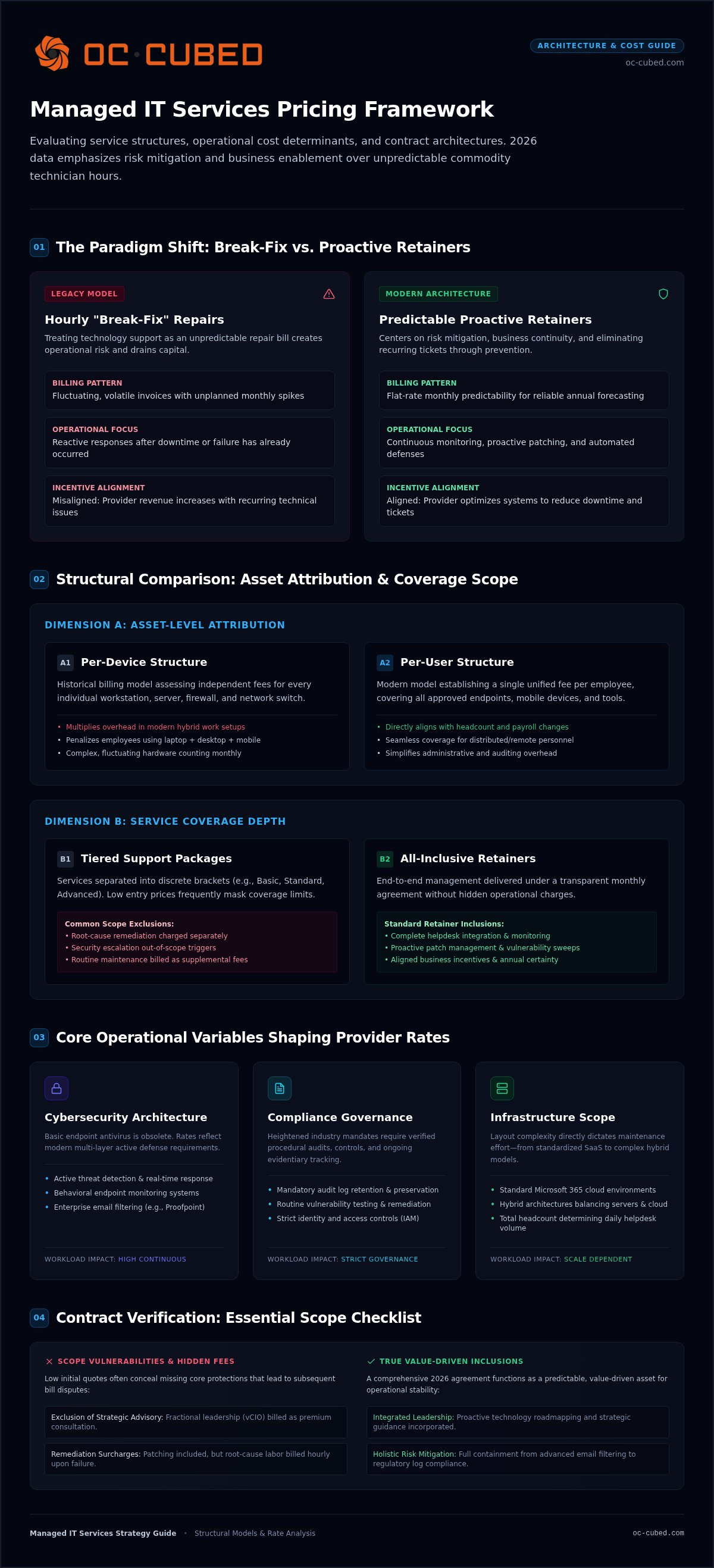
Service structures define how risk is managed across your organization. Rather than relying on rigid, one-size-fits-all contracts, modern providers align billing models with operational scale, workforce distribution, and technical architecture. Selecting the right framework prevents budget surprises and ensures critical infrastructure receives continuous oversight. When evaluating the average cost of managed IT services 2026 projections, business leaders generally encounter two major structural decisions: asset-level attribution and service coverage depth.
Per-User vs. Per-Device Pricing Structures
How your team works dictates how support should be invoiced. A traditional Managed Service Provider (MSP) historically billed per device. That approach charged an independent fee for every workstation, server, firewall, and switch on the corporate network.
Modern hybrid organizations often find per-device accounting cumbersome and unpredictable. When a single employee uses a desktop, laptop, and smartphone, device-based billing multiplies administrative overhead. A per-user structure establishes a single fee for each employee, covering all of that individual's approved endpoints and productivity tools. Reviewing what is a managed service provider covers can clarify baseline expectations, but per-user arrangements consistently simplify payroll-aligned budgeting.
Tiered Support Packages vs. All-Inclusive Retainers
Beyond endpoint counting, contract scopes determine whether your monthly bills stay predictable. Tiered packages separate services into discrete brackets, often labeled as basic, standard, or advanced. While introductory tiers appear cost-effective initially, they frequently exclude root-cause remediation, security escalations, or routine maintenance, triggering unexpected supplemental invoices when issues arise.
By contrast, an all-inclusive monthly retainer creates operational alignment between your business and your technical partner. These agreements deliver end-to-end management under a flat, predictable fee structure:
- Comprehensive prevention: Helpdesk integration, continuous monitoring, and proactive patching operate without surprise charges.
- Aligned business incentives: Providers actively engineer solutions that eliminate recurring tickets rather than billing for repeated repairs.
- Budget certainty: Leadership forecasts annual operating expenses without fearing unplanned technical invoices.
Ultimately, assessing the average cost of managed IT services 2026 models comes down to clarity. Choosing flat-rate, user-centered agreements establishes firm control over technology expenditures while keeping critical systems resilient.
Key Factors That Determine Managed IT Support Rates
Managed IT agreements do not rely on guesswork. Service rates reflect the tangible operational effort required to secure your data, maintain performance, and protect business continuity. While headcount influences daily helpdesk volume, broader architectural and governance demands determine provider workload. Gaining clarity on these operational variables helps organizations understand baseline commitments when evaluating the average cost of managed IT services 2026 industry benchmarks.
Cybersecurity Architecture and Compliance Requirements
Basic endpoint antivirus no longer shields modern organizations from sophisticated intrusion attempts. Modern defense requires active threat detection, behavioral monitoring, and email filtering through enterprise platforms like Proofpoint. Industry legal analysis from Morgan Lewis on Outsourcing Trends for 2026 demonstrates how risk management and technical integration increasingly drive outsourcing contracts. Heightened regulatory standards mandate rigorous log preservation, routine vulnerability remediation, and strict identity controls. For a deeper breakdown of essential defenses, explore our guide on managed cybersecurity services for small business protection.
Infrastructure Complexity and Cloud Management Scope
The layout of your technology environment heavily dictates ongoing management labor. A company running exclusively within a well-structured Microsoft 365 tenant requires fundamentally different oversight than a business balancing hybrid infrastructure. Key architectural variables include:
- Cloud administration: Continuous Microsoft 365 tenant maintenance, conditional access policies, and permission audits.
- Network perimeter controls: Centralized switch administration, active firewall governance, and 24/7 network monitoring.
- Vendor coordination: Managing software, internet service, and peripheral vendors to eliminate finger-pointing during unexpected interruptions.
Strategic Advisory and Virtual Executive Leadership
Technology tools fail to drive growth without cohesive strategic direction. Organizations that avoid surprise capital expenses rely on forward-looking technology roadmaps rather than reactive fixes. Integrating virtual CIO, CTO, or CISO guidance provides senior governance, regulatory oversight, and capital planning without the payroll overhead of dedicated executives. Review our framework detailing IT leadership without full-time hire requirements to see how fractional advisory accelerates long-term business performance.
Aligning strategic guidance with comprehensive remote infrastructure oversight stabilizes annual tech investments. If you want to streamline your operating stack with dependable, flat-rate nationwide support, explore how OC Cubed builds predictable managed partnerships.
Comparing the True Costs: Managed IT vs. In-House Teams vs. Break-Fix
Evaluating technology expenses requires looking beyond the face value of a single invoice. To make sound financial choices, leadership must analyze total cost of ownership, operational risk, and long-term business resilience. When organizations analyze the average cost of managed IT services 2026 metrics against alternative support models, the contrast between reactive firefighting and proactive stewardship becomes clear.
The Financial Risk of Break-Fix and Reactive Repairs
Hourly break-fix support creates an inherent conflict of interest. Reactive technicians bill exclusively when systems fail, meaning the vendor profits from technical disruptions. Because support only begins after an outage occurs, technicians focus on patching immediate symptoms rather than addressing architectural root causes.
This cycle generates substantial hidden liabilities:
- Compounding downtime costs: Disrupted workflows, missed client deadlines, and halted transactions quickly outpace routine maintenance budgets.
- Surge repair billing: Unanticipated emergency escalations and after-hours recovery rates trigger severe budget volatility.
- Unmonitored risk: Reactive models skip routine vulnerability scanning, leaving infrastructure exposed to silent security breaches.
The True Overhead of Full-Time In-House Personnel
Hiring internal technical staff seems like a direct way to regain control, but the fully loaded cost often strains growing companies. Salaried IT employees require payroll taxes, health benefits, paid leave, and continuous certification stipends. Recruiting and onboarding technical talent also consumes leadership bandwidth and capital.
Beyond payroll, internal teams create operational bottlenecks. A solo IT administrator cannot be available every hour of the year. Sickness, vacations, or sudden departures expose the business to severe vulnerabilities. Modern environments demand broad specialization across network engineering, cloud identity governance, and threat detection. Expecting a single in-house generalist to master every discipline introduces operational gaps.
Organizations balance these realities by moving to comprehensive remote support. Adopting structured remote IT management services delivers access to an entire team of certified specialists, network engineers, and executive advisors without full-time employee overhead. When benchmarking the average cost of managed IT services 2026 frameworks, proactive remote retainers deliver superior coverage depth, predictable cash flow, and measurable operational resilience.
How to Evaluate Provider Proposals and Uncover Hidden Fees
Low upfront quotes often mask substantial ongoing costs. A proposal might look attractive on paper, but vague boundaries create friction once everyday operational challenges arise. When assessing the average cost of managed IT services 2026 bids, leadership must inspect the underlying scope of work rather than accepting headline numbers at face value. A disciplined vetting process protects your bottom line and ensures your partner is truly accountable for system performance.
Scrutinizing Service Level Agreements and Support Scope
A dependable agreement defines exactly how and when support is delivered. Look closely at guaranteed response and resolution times for both urgent incidents and standard employee inquiries. Confirm whether support access aligns with your operating hours or if after-hours tickets trigger unexpected surcharges. Day-to-day administrative changes, such as user onboarding, credential updates, and offboarding workflows, should be bundled into baseline service without supplemental administrative billing.
Identifying Excluded Tooling and Out-of-Scope Projects
Hidden surcharges often hide behind vague definitions of maintenance. Clarify whether critical defense layers, including endpoint protection, Proofpoint email security, and routine patch validation, are fully covered under the retainer. Many providers charge separate project fees for tasks that should be standard:
- Identity administration: Ongoing Microsoft 365 maintenance and group permission audits should be standard inclusions, not billable projects.
- Network oversight: Regular firewall policy updates, switch configurations, and log reviews must occur proactively without manual change fees.
- Transparent documentation: Demand detailed monthly reporting that tracks resolved tickets, active security controls, and infrastructure health metrics.
Essential Questions to Ask Before Signing an Agreement
Before committing to a contract, clarify operational boundaries to prevent future billing disputes. Ask how the provider handles vendor management when your internet service provider drops or third-party cloud applications degrade. Confirm whether virtual CIO consultations are built directly into your recurring retainer to guide annual technology investments, or if strategic planning carries separate executive rates. Finally, verify renewal terms and transition protocols so you retain total control over your business assets.
Understanding these contract nuances prevents surprise fees and helps you accurately assess the average cost of managed IT services 2026 market offerings.
Maximizing Business Value Through Predictable Remote IT Management
Transitioning to an all-inclusive managed retainer transforms technology from a recurring vulnerability into a stable growth driver. When leadership looks past short-term break-fix billing, IT shifts from an administrative drain into an operational asset. Modern distributed teams require rapid, centralized oversight rather than slow on-site dispatches. In evaluating the average cost of managed IT services 2026 data emphasizes one constant: operational resilience stems from prevention, not emergency response.
Proactive Maintenance That Protects Bottom-Line Profitability
Stopping system interruptions before they reach end users protects workforce productivity and revenue. Proactive remote oversight achieves this through structured, continuous technical discipline:
- Continuous oversight: Proactive 24/7 network monitoring tracks firewalls, switches, and core infrastructure to catch performance anomalies before they trigger outages.
- Automated patching: Routine patch management shields Microsoft 365 tenants and user endpoints from actively exploited security vulnerabilities.
- Integrated support: Helpdesk and NOC integration eliminates daily friction so employees get immediate assistance without workflow delays.
- Standardized security: Regular infrastructure reviews verify systems consistently meet established operational and cybersecurity benchmarks.
Partnering for Long-Term Technology Strategy and Growth
Predictable monthly retainers turn erratic technology outlays into clean, forecastable operating expenses. You don't have to navigate sudden capital spikes caused by unexpected outages or out-of-scope vendor bills.
True value comes from consolidating your technical stack under a single accountable partner. Managing remote helpdesk support, email filtering, threat remediation, and vendor communication under one roof eliminates miscommunication. Virtual CIO, CTO, and CISO advisory ensures technical choices directly support corporate expansion goals. When weighing the average cost of managed IT services 2026 models against business outcomes, all-inclusive retainers deliver the highest return on investment.
Schedule a strategic consultation with OC Cubed to stabilize your infrastructure and build a secure foundation for growth.
Take Control of Your Technology Budget
Technology spending shouldn't be an unpredictable gamble. Analyzing the average cost of managed IT services 2026 landscape shows that true financial predictability comes down to contract structure. Moving away from reactive hourly repairs to an all-inclusive monthly retainer eliminates surprise invoices and secures continuous oversight. Bundling proactive 24/7 network monitoring, multi-layer endpoint defense, and Proofpoint email security keeps operations resilient against costly disruptions.
Integrating fractional executive leadership delivers virtual CIO and CISO guidance directly into your recurring plan, providing strategic clarity without full-time executive payroll. You gain total peace of mind knowing your digital assets are defended, properly maintained, and engineered for sustained performance.
With a dependable remote partner managing your infrastructure, you can stop stressing over unexpected tech emergencies and focus entirely on growing your business.
Frequently Asked Questions
How much do managed IT services typically cost each month?
Monthly costs depend directly on total user count, infrastructure complexity, and security requirements. When evaluating the average cost of managed IT services 2026 agreements typically package support into flat-rate retainers rather than hourly invoices. This model provides budget certainty by combining daily helpdesk assistance, proactive system monitoring, and strategic management into one consistent operational expense, preventing the unpredictable spikes common with reactive technical repairs.
What is usually included in an all-inclusive managed IT retainer?
A comprehensive agreement covers complete operational infrastructure oversight rather than just basic ticket resolution. Standard inclusions encompass proactive remote IT support, helpdesk and NOC integration, and continuous network monitoring. Essential cybersecurity measures, such as enterprise endpoint protection and Proofpoint email security, are bundled alongside regular Microsoft 365 tenant maintenance. Many contracts also integrate vendor management and virtual CIO advisory to guide strategic growth without separate consulting fees.
Can managed IT services completely replace the need for an in-house IT employee?
Yes, an outsourced managed service provider can fully replace internal technology staff for most growing businesses. A single internal employee presents scheduling bottlenecks during vacations or sick leave and rarely possesses deep expertise across every technical discipline. Partnering with a managed provider gives your business immediate access to network engineers, cybersecurity analysts, and strategic advisors at a fraction of the overhead tied to dedicated executive or technical payroll.
Is remote IT support as effective as having an on-site technician?
Remote support is often more efficient than maintaining physical technicians. Modern business infrastructure operates in cloud environments and secure networks where diagnostics, endpoint updates, and identity management happen digitally. Nationwide remote engineering eliminates travel delays, resolving technical tickets immediately from central network operations centers. Dedicated remote teams monitor systems continuously, isolating and resolving background glitches long before an on-site technician could ever arrive at an office.
How do cybersecurity requirements impact the overall cost of managed IT?
Stricter cybersecurity standards naturally expand the scope of required technical defenses. In assessing the average cost of managed IT services 2026 agreements reflect whether an environment demands standard endpoint defense or advanced multi-layer protections. Regulatory mandates in finance or healthcare require continuous vulnerability scanning, hardened identity access controls, and detailed audit logging. Investing in layered security upfront protects operating budgets against catastrophic regulatory fines and costly ransomware disruptions.
What happens if our company experiences an IT emergency outside standard business hours?
Continuous 24/7 network monitoring systems remain active around the clock, detecting performance anomalies and security threats before they impact operations. Established service level agreements clearly define response protocols and triage procedures for unexpected critical emergencies. Proactive infrastructure management ensures system backups, firewalls, and security policies are actively maintained, which dramatically minimizes the likelihood of catastrophic off-hours failures in the first place.
Why do managed IT providers favor per-user over per-device billing models?
Per-user billing reflects how modern distributed teams actually work. Today's employees routinely access corporate resources across multiple devices, including laptops, tablets, and smartphones. Invoicing per device creates unnecessary administrative overhead and unpredictable fluctuations whenever hardware is replaced. A per-user structure simplifies budgeting by linking technology expenses directly to organizational headcount, ensuring every approved endpoint used by that employee remains fully supported and secured.


