

A virtual CIO turns business priorities into a technology roadmap, guides IT budget decisions, and provides strategic oversight of cybersecurity. To understand what a virtual CIO does, distinguish strategic planning from hands-on support: the role focuses on direction, investment, risk, and key technology decisions, not routine troubleshooting.
That distinction matters when a business needs clearer priorities but also relies on IT staff or providers to keep systems running. A virtual CIO plans technology spending, oversees cybersecurity, and guides decisions about vendors and change. Understanding how the role differs from managed IT and support helps clarify where strategic guidance ends and day-to-day operations begin.
Key Takeaways
- Connect IT spending to business priorities with a roadmap that clarifies investments, timing, and risks.
- Look for recurring technology decisions, unclear priorities, or cybersecurity concerns as signs strategic guidance could help.
- Separate executive-level planning from the day-to-day troubleshooting and system upkeep handled by IT support teams.
- Use cybersecurity oversight to clarify risks, responsibilities, and how security priorities are reviewed.
- Match the support model to the need: strategic direction, operational IT management, or both.
IT budget planning
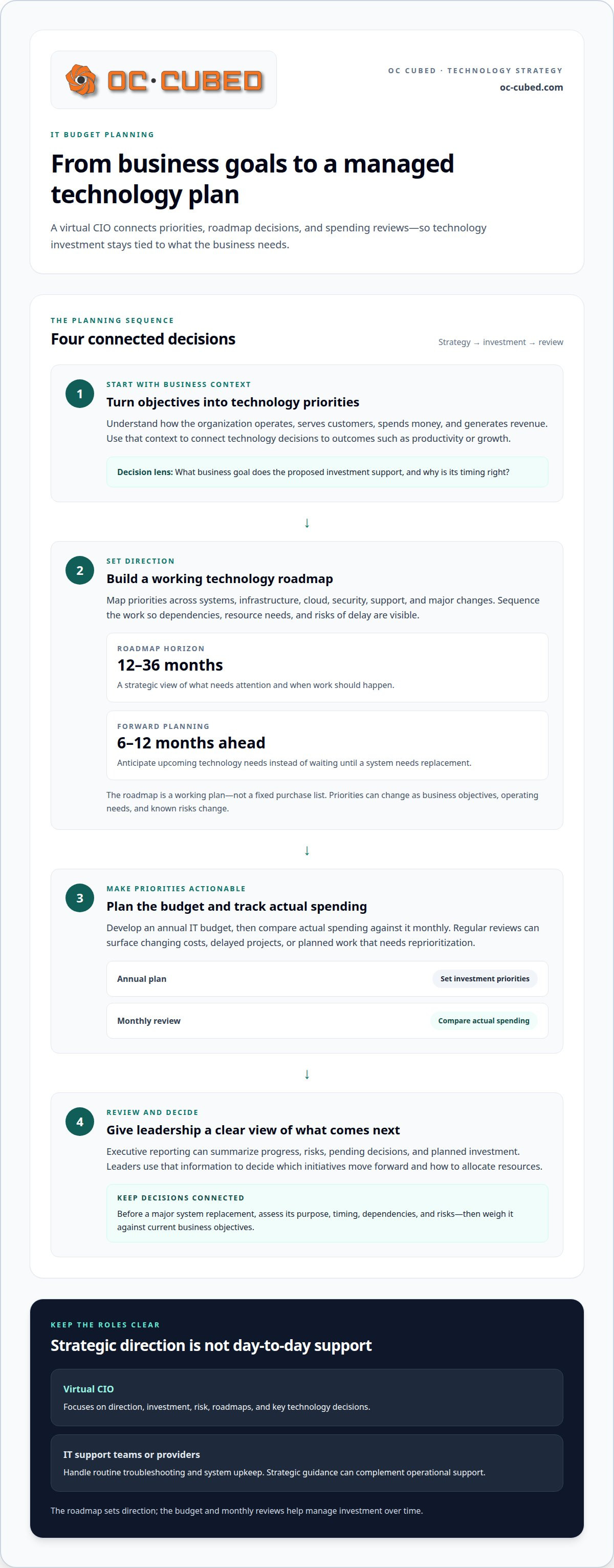
A virtual CIO develops and manages IT strategy by connecting business objectives to technology priorities, investments, and risks. The work can include building a technology roadmap, developing an annual IT budget, and tracking spending against it monthly.
Aligning IT Strategy with Business Goals
Strategic IT planning connects technology decisions to the business outcomes they should support. A virtual CIO learns how the organization operates, serves customers, spends money, and generates revenue. That context helps turn broad objectives, such as improving productivity or supporting growth, into practical technology priorities.
This alignment helps leaders weigh proposed spending against its purpose and timing. Replacing an outdated system, for example, may improve efficiency, while adding a tool may support a change in customer service. The virtual CIO considers operating needs, dependencies, and known risks before recommending investments. Leaders can then assess how each proposal supports business goals instead of treating technology purchases as isolated decisions.
Budget management makes priorities actionable. A virtual CIO develops an annual IT budget and tracks actual spending against it monthly. Regular reviews can reveal a delayed project, a changing cost, or planned work that needs reprioritization. This gives leadership a clearer view of spending and pending decisions, keeping technology investment tied to current objectives.
Building Technology Roadmaps
A technology roadmap sets out priorities for systems, infrastructure, cloud, security, support, and major technology changes over an agreed planning period. A typical roadmap covers 12-36 months. It gives leaders a strategic view of what needs attention, when work should happen, and how one project may depend on another.
Roadmap planning sequences priorities, decisions, and investments. Replacing an outdated system, for example, may need to come before a related workflow change. The roadmap can show that dependency, the resources involved, and the risks of delay. A virtual CIO also considers technology needs six to twelve months ahead, helping the business prepare for upcoming decisions rather than react only when a system needs replacement.
A roadmap is a working plan, not a fixed purchase list. Business objectives, operating needs, and known risks can change, so the virtual CIO reviews priorities with leadership and adjusts planned work. Executive reporting can summarize progress, risks, pending decisions, and planned investment. Leaders can use that information to decide which initiatives move forward and how to allocate resources.
The result is a connected strategy: the roadmap sets direction, while the annual budget and monthly spending reviews help manage investment over time. Before committing resources to a major system replacement, leaders can assess its purpose, timing, dependencies, and risks. This process aligns budget decisions with longer-term technology goals.
Signs a business may need a vCIO
A virtual CIO can help when technology decisions affect business growth, operations, or risk but lack clear strategic ownership. Common signals include recurring disagreements about priorities, uncertainty about technology investments, or major changes that require coordination across teams. The role provides advisory leadership, but executives retain business decision-making authority.
The main limits are scope and authority. A vCIO advises and plans, but executives remain responsible for business decisions, budgets, accepted risks, and organizational commitments. The role does not automatically include hands-on support or operational work. A clear agreement defines decision rights, deliverables, reporting relationships, and coordination with internal staff and technology providers.
Look for decisions that keep resurfacing without an owner. A company preparing for an acquisition, opening a new location, replacing a core system, or changing providers may need help aligning technology decisions with business goals. For example, leadership may need to identify which systems a transition affects, which decisions require approval, and who will communicate changes to employees.
Company size can offer context, but it doesn’t settle the question. Businesses with 20 to 500 employees are identified as a potential fit for virtual CIO guidance. A fractional model may make financial sense for organizations with 20 to 250 staff, while full-time CIO roles may suit organizations with 250 staff and above. Businesses below roughly 20 staff may be better served by managed IT support with strategic input.
Industry needs can also shape the work. A law firm with 8 attorneys may need to coordinate technology decisions with staff workflows and client service. A medical practice with 3 providers and 12 staff may need leadership for a system change. A construction firm with 22 employees may need to align technology planning with evolving operations. In each case, the vCIO’s scope should reflect the organization’s real decisions.
Risk and continuity are also important signals. A vCIO can assess infrastructure risks and develop disaster recovery plans intended to help maintain operations during disruptions. Leadership may need to decide which systems are essential and how internal teams coordinate with providers during a server failure. Executives still approve the plan and decide which risks the business accepts.
An IT assessment can identify gaps, priorities, and decisions that need leadership attention before an ongoing advisory relationship begins. Other organizations already know they need help with a transition or recurring technology decisions. In either case, establish priorities, meeting cadence, reporting, and decision rights at the outset. A defined scope separates advisory guidance from implementation and clarifies accountability across the business.
How do virtual CIO consulting services differ from managed IT services?
A virtual CIO provides strategic direction, while managed IT services operate and support technology. Some organizations use both: one role sets priorities, and another handles daily work.
Comparing vCIOs, Full-Time CIOs, and IT Support
A virtual CIO provides senior technology leadership part-time or for a defined project, unlike a full-time CIO embedded in the organization’s leadership team. This distinction helps businesses choose the level of strategic involvement that fits their needs and structure.
An IT support provider handles operational work such as troubleshooting, network administration, software installation, and system backups. Support staff might resolve an employee’s access issue, while a vCIO advises leadership on whether a broader system change supports business priorities.
Virtual CIO and Managed IT Service Roles
Managed IT services keep technology operating through ongoing technical work. vCIO services guide priorities, investment, vendors, and decisions. Understanding the difference clarifies who owns each next step.
A vCIO may evaluate vendors, negotiate contracts, and monitor whether service-level agreements are met. A managed IT provider may handle network administration or a software deployment. These responsibilities can complement each other, but a vCIO role does not automatically expand the scope of related managed IT, cybersecurity, or cloud services.
Proactive Cybersecurity and Risk Management
A vCIO can assess cybersecurity risks, develop security policies, and recommend protections for systems and data. This strategic view helps leadership connect security priorities to business operations and clarify who is responsible.
A vCIO might identify a risk that needs an executive decision, recommend a response, and define how internal staff and technology providers should coordinate. The operational provider may implement agreed measures within its service scope. Clear responsibilities prevent strategic advice from being mistaken for hands-on monitoring or incident remediation.
The roles differ in focus and authority. A virtual CIO advises on direction and helps leaders make informed choices. A full-time CIO works within the organization’s leadership structure, while managed IT teams perform operational tasks. An organization might ask a vCIO to assess a proposed software change, then assign implementation to its IT operations provider.
Scope matters. The vCIO engagement should define which decisions the advisor recommends, which require business approval, who receives reports, and how priorities are reviewed. This protects executive decision rights and clarifies each technology team’s remit. Leadership retains approval of budgets and accepted risks, even when a vCIO presents options and their implications.
A vCIO can support provider transitions and other defined technology changes. The advisor can help set objectives, coordinate milestones, and surface risks, while operational teams carry out assigned technical work. This gives employees clear responsibility for planning and execution without assuming strategic CIO services include every technical task.
Choose a model by identifying the work required. If the immediate need is troubleshooting or system backups, operational support is central. If leadership needs help evaluating vendors, setting technology priorities, or managing a change, strategic guidance may help. When both are needed, clearly defined roles keep decisions, cybersecurity recommendations, and implementation tasks moving without overlap.
Executive-level cybersecurity oversight
A virtual CIO gives executives strategic guidance on cybersecurity risks, technology decisions, and security priorities. The role connects infrastructure risks with business impact, helping leaders decide what needs attention and who owns each action. A review might identify a system supporting customer operations that needs a clear protection and recovery plan.
Risk oversight starts with understanding the organization’s systems, information, and responsibilities. A virtual CIO can assess potential vulnerabilities, recommend security measures, and help develop defense and disaster recovery strategies. Leadership can weigh the consequences of disruption, set priorities, and approve decisions about accepted risk. The advisor informs those choices, while executives retain responsibility for business decisions and commitments.
Governance makes cybersecurity work easier to coordinate. A vCIO can clarify decision rights, service ownership, review cadence, and escalation paths across internal and external teams. During a suspected security incident, for example, staff need to know who reports it, who assesses its business impact, and who authorizes major response decisions. Clear responsibilities reduce confusion and help teams act within their roles.
Security policies turn leadership priorities into practical expectations. A virtual CIO may help define who can approve access, how security concerns reach decision-makers, and how teams review risks. Policies should reflect the organization’s operations and technology environment. Executive reviews can track open risks, agreed actions, and decisions requiring leadership approval without making every technical task an executive responsibility.
Cybersecurity and compliance require careful coordination. A vCIO can support technology work related to regulatory, legal, accounting, contract, or insurance questions. The advisor may help identify relevant systems, document technical controls, or organize information for a qualified adviser. Interpretation of legal or regulatory obligations belongs with appropriately qualified advisers; the vCIO contributes technology context and helps coordinate next steps.
A virtual chief information security officer, or vCISO, provides outsourced cybersecurity leadership and guidance. The title differs, but the practical value is clear: leadership gets focused security direction, distinct from implementation. An executive may approve a policy while the assigned technology team carries out work within its scope. The engagement should define who recommends security priorities, who approves them, who receives reports, and how progress is reviewed.
Regular oversight connects cybersecurity with technology investment and business objectives. Leadership reports can summarize priority risks, progress, pending decisions, and planned work. If a security recommendation competes with a system replacement or another investment, executives can review the trade-offs together. This aligns protection with operational needs while keeping approval authority and accepted risk with the organization.
Virtual CIO versus IT support providers
A virtual CIO and an IT support provider serve different needs, though their work can intersect in an active technology relationship. A virtual CIO typically provides ongoing advice; an IT consultant is often engaged for a defined project and leaves when it ends. This distinction helps organizations decide whether they need continuing strategic input, operational support, or both.
To choose a virtual CIO provider, define the business priorities, decisions, and deliverables the role should address. Agree on reporting relationships, meeting cadence, decision rights, systems and providers in scope, and coordination with internal teams. These terms clarify who makes recommendations and who approves business decisions.
Internal IT leadership can work alongside a virtual CIO rather than be replaced. An internal technology lead might manage daily operations while the virtual CIO helps leadership assess a new location or system replacement. Define how the roles share information, assign next steps, and raise obstacles that affect the plan.
Match the engagement to the work. A defined migration or provider transition may call for project-based guidance, while recurring technology decisions may benefit from ongoing advice. For a migration, clarify who tracks milestones, reports risks, and handles implementation. This keeps strategic oversight distinct from hands-on technical execution.
Scope also matters when reviewing a provider’s deliverables. A virtual CIO can support vendor oversight and help monitor service-level agreements, but the advisory role does not automatically expand related managed IT or cybersecurity work. A recommendation to improve security, for example, should identify the responsible team and its assigned tasks.
During early discussions, ask what the engagement will accomplish during its first 90 days. A useful answer should connect initial priorities to concrete deliverables, such as an assessment, a decision schedule, or an agreed reporting process. Also establish who receives updates and how leadership reviews priorities. These details help organizations judge progress without confusing activity with outcomes.
Choose a provider relationship that fits the organization’s decision-making structure. If leaders need recurring guidance on technology priorities, vendors, and risks, an ongoing virtual CIO role may fit. If the need is a specific project, defined consulting may be more suitable. In either case, make responsibilities, approvals, and coordination with internal teams clear from the start.
OC Cubed - Your trusted MSP
OC Cubed helps businesses connect technology decisions with practical IT support and security services. Its Virtual CIO / CTO / CISO offering provides strategic technology guidance, while Remote IT Support addresses operational IT needs.
For businesses strengthening cybersecurity, Security Threat Detection and Remediation, Endpoint Protection / Antivirus, and Email Security with Proofpoint can support protection across key parts of the IT environment. Microsoft 365 Tenant Maintenance helps keep that business platform maintained. The right combination depends on whether your priority is strategic direction, ongoing support, security, or a mix of needs.
Contact OC Cubed - Your trusted MSP to discuss your IT priorities.
Turn technology priorities into a clear next step
Knowing what a virtual CIO does can help you decide what kind of guidance your business needs. Make your next planning conversation practical: choose an upcoming technology decision, identify who owns approval, and define the business outcome it should support. This gives leadership a useful starting point for aligning advice, operational work, and accountability.
OC Cubed - Your trusted MSP can connect strategic IT guidance with services such as Remote IT Support, Microsoft 365 Tenant Maintenance, and Security Threat Detection and Remediation. The right next step depends on whether your immediate need is clearer direction, dependable operational support, stronger security oversight, or coordinated help across those areas.
Clear priorities help move technology decisions forward. Take the next step with confidence.
Frequently Asked Questions
What Is a Virtual CIO?
A virtual CIO is an outsourced technology leader who advises a business without joining as a full-time executive. The role gives leadership access to strategic IT expertise while day-to-day system operation stays with internal staff or service providers. A company planning a major software change, for example, can use a virtual CIO to assess its business impact and organize decisions before work begins.
What Is a vCIO and What Do They Do?
A vCIO is another name for a virtual CIO. The role can include reviewing technology needs, advising on vendor choices, guiding projects, and helping executives weigh security and investment decisions. During a provider transition, for example, the vCIO can help define what the business needs from the new relationship and coordinate planning, while the organization retains approval authority.
What size company benefits most from a virtual CIO?
Company size is one factor, but strategic complexity and upcoming decisions matter too. Some guidance identifies organizations with 20 to 250 staff as potential fits for fractional leadership, while full-time CIO roles may suit organizations with 250 staff and above. A smaller company facing a system replacement or provider transition may still need strategic advice, while a larger company with established leadership may have different needs.
Does the virtual CIO replace my internal IT team?
No. A virtual CIO can provide senior planning and decision support without replacing an internal technology lead or operating provider. The internal team can maintain systems and respond to employee issues, while the vCIO helps leadership set priorities for a planned transition. Define responsibilities, approvals, and reporting so advice complements operational work instead of creating uncertainty about ownership.
How many hours a month does a vCIO work?
There is no standard monthly schedule for every vCIO engagement. The time required depends on the organization’s priorities, upcoming decisions, and whether defined projects need leadership support. A stable business seeking occasional strategic input may need a different cadence from one managing a provider transition. Set meeting frequency, expected deliverables, and how urgent decisions are handled in the scope.
How quickly do businesses see results from virtual CIO services?
Progress depends on the work involved and how quickly the organization makes decisions. Early value may come from clarifying priorities, assigning owners, or organizing an upcoming technology project. Operational outcomes, such as completing a transition or adopting a new system, take time. Agree on milestones and reporting at the outset so leadership can track progress and distinguish completed work from longer-term business results.
What does virtual CIO cost compared to hiring full-time CIO?
A virtual CIO provides fractional executive-level technology leadership without adding a full-time CIO role. The engagement structure and scope shape the arrangement, so businesses should compare the responsibilities and deliverables they need rather than assume every role is identical. A full-time CIO is embedded in the organization’s leadership team; a virtual CIO provides strategic support part-time or on a project basis.
What does a virtual CIO do for a business?
A virtual CIO helps a business make technology decisions with its objectives, operations, and risks in view. Before opening a new location, for example, the advisor can help leadership identify technology requirements, dependencies, and decisions that need approval. The business retains ownership of its commitments, while the vCIO organizes a practical path forward and coordinates the technology work involved.

Article by
Peter Irizarry
Peter Irizarry founded OC Cubed, LLC in 2023 to help small to mid-sized businesses stop worrying about downtime and cybersecurity threats. A frequent speaker on SMB digital transformation, Peter is passionate about translating complex IT roadmaps into plain-English business growth strategies. He resides in North Texas with his family.


