

Adding an in-house IT generalist to your payroll often seems like the natural next step for a growing business, but it's frequently the most expensive way to stay trapped in reactive firefighting. You already recognize the daily friction. Senior employees lose high-value hours troubleshooting software, unpredictable invoices arrive from ad-hoc break-fix technicians, and the quiet fear of an unmonitored security breach lingers in the background. Knowing when to outsource IT support isn't about giving up control; it's about building operational stability so your leadership team can focus entirely on strategic growth.
In this strategic guide, you'll discover the critical operational tipping points, organizational cost models, and security risks that indicate exactly when your company should transition to proactive remote management. We examine the financial comparison between internal tech salaries and predictable flat-rate retainers, unpack evolving compliance obligations, and deliver a practical roadmap to eliminate technical downtime across your entire organization.
Key Takeaways
- Identify the operational bottlenecks and employee productivity losses that signal exactly when to outsource IT support.
- Assess how modern cyber threats and regulatory compliance demands expose the vulnerabilities of relying on unmonitored systems.
- Compare the hidden organizational overhead of a solo internal hire against the comprehensive coverage of a predictable monthly remote retainer.
- Apply a structured readiness framework to audit technology risks, eliminate downtime, and prepare for a seamless onboarding transition.
Critical Tipping Points: When to Outsource IT Support for Your Business
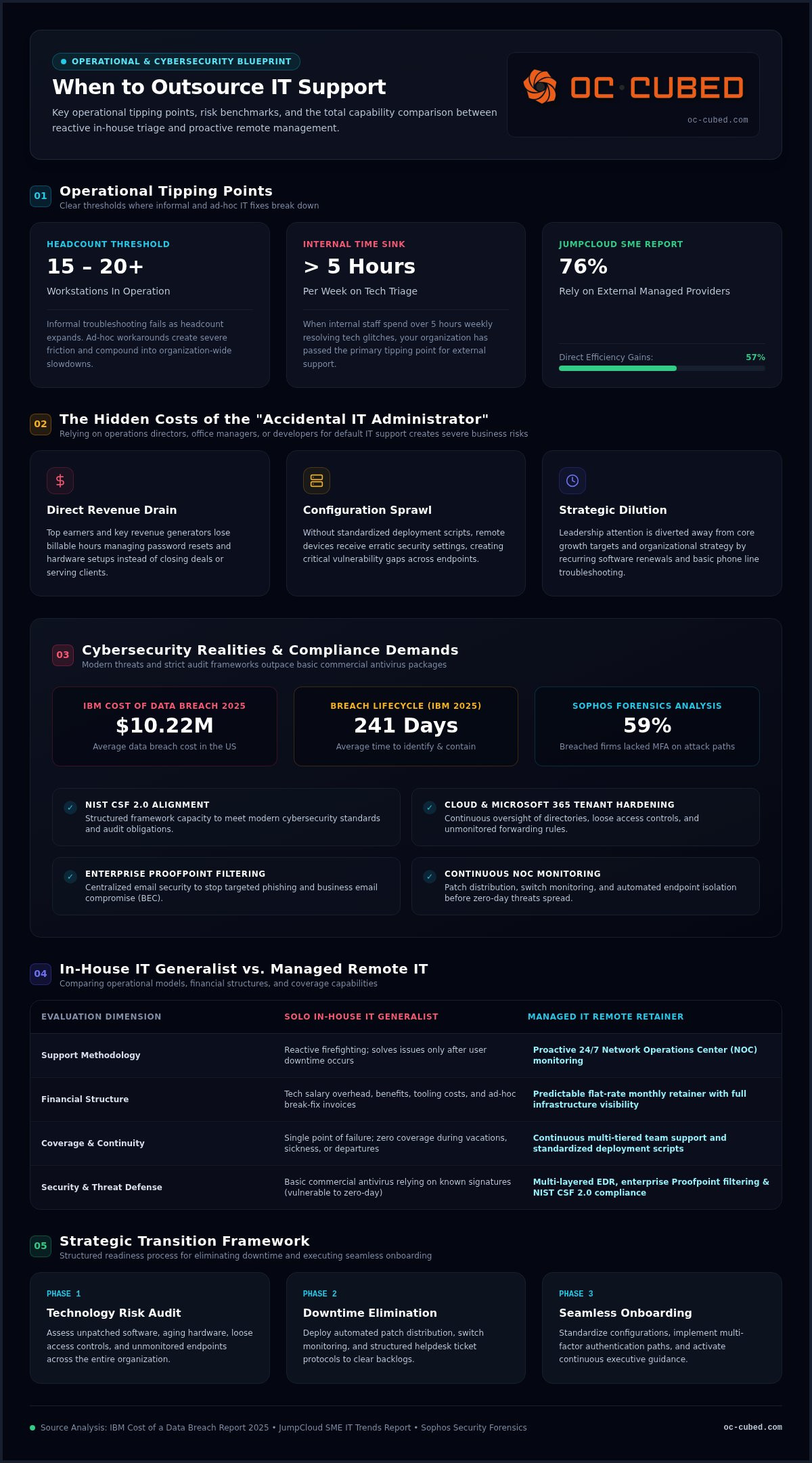
Every expanding company reaches an operational threshold where informal technology fixes fail. In the early stages, improvised troubleshooting feels harmless. As your headcount climbs past 15 or 20 workstations, ad-hoc workarounds create severe friction. Knowing when to outsource IT support comes down to recognizing specific operational tipping points before small glitches become full outages.
The clearest warning sign is the hidden cost of reactive firefighting. When internal staff drop revenue-generating projects to address email synchronization errors, network crashes, or software stalls, billable momentum vanishes. A JumpCloud SME IT Trends Report revealed that 76% of SMEs rely on external managed providers for IT and security functions, with 57% reporting direct operational efficiency gains. Proactive remote management continuously monitors systems to resolve issues before users notice them, replacing random technical fires with sustained stability.
Recurring Operational Downtime and Ticket Backlogs
Unresolved helpdesk tickets compound faster than internal teams can close them. A printer offline for an afternoon slows an entire billing department, while unpatched software introduces preventable vulnerabilities. Frequent application crashes signal aging hardware and unmanaged local environments. Deploying dedicated remote IT management services establishes structured Network Operations Center (NOC) oversight, handling patch distribution, switch monitoring, and routine desktop support before backlogs choke company productivity.
The Hidden Cost of the Accidental IT Administrator
Most growing firms develop an accidental IT administrator: an operations director, office manager, or tech-savvy developer who slowly becomes the default support person. This informal arrangement creates three distinct business risks:
- Direct revenue drain: Top earners spend billable hours managing password resets and hardware setups instead of closing deals or serving clients.
- Configuration sprawl: Lacking standardized deployment scripts, devices receive erratic security settings, creating major gaps across remote endpoints.
- Strategic dilution: Key leaders lose their focus on revenue targets, distracted by software renewals and troubleshooting phone lines.
If your internal staff spend more than five hours each week handling tech triage, you have passed the primary tipping point for external support. Deciding when to outsource IT support at this stage protects both your payroll investment and your bottom line.
Evaluating Cybersecurity Vulnerabilities and Compliance Pressures
Modern compliance demands and automated cyber threats have outpaced basic defense tools. According to the IBM Cost of a Data Breach Report 2025, the average cost of a data breach in the United States reached $10.22 million, with an average containment lifecycle of 241 days. For companies handling proprietary client records or financial data, unmonitored infrastructure isn't just an operational bottleneck. It is a critical exposure point. Recognizing when to outsource IT support often hinges on your internal capacity to maintain strict security frameworks like NIST CSF 2.0 and meet expanding audit obligations.
Advanced Threat Detection Beyond Basic Commercial Antivirus
Traditional antivirus waits for known signatures, leaving systems defenseless against modern zero-day exploits and credential stuffing. Forensics analysis from Sophos revealed that multi-factor authentication was absent from critical attack paths in 59% of breached organizations. Effective protection requires automated endpoint detection, firewall and switch management, and continuous network monitoring to isolate threats before they spread. Review our comprehensive breakdown of managed cybersecurity services for small business to evaluate where standard protection packages fall short.
Safeguarding Cloud Environments and Microsoft 365 Tenants
Cloud platforms make collaboration simple, yet default tenant configurations regularly leave corporate directories exposed. Without continuous oversight, loose access controls and unmonitored forwarding rules invite account takeovers. Protecting distributed work environments requires a multi-layered approach:
- Centralized email security: Stopping targeted phishing and business email compromise using enterprise Proofpoint filtering.
- Proactive cloud maintenance: Routine Microsoft 365 tenant auditing to enforce multi-factor authentication and purge dormant user permissions.
- Endpoint visibility: Continuous patching and real-time monitoring across all remote devices connecting to company resources.
When third-party vendor assessments or cyber insurance renewals demand enterprise-grade validation, relying on an informal internal setup quickly fails. Transitioning your technical oversight to an experienced provider like OC Cubed delivers the security governance, continuous monitoring, and data protection required to keep your business fully defended.
In-House IT vs. Outsourced Managed IT Support: Total Cost and Capability Analysis
Hiring an internal technician feels like a straightforward solution for growing operations. On paper, having a dedicated specialist down the hall seems convenient. In practice, the total cost of ownership extends far beyond a base salary. When evaluating when to outsource IT support, business leaders must measure the full financial burden of internal employment against the collective capabilities of an external technical partner.
A single employee simply cannot match the multi-layered expertise required to manage contemporary infrastructure. Network architecture, regulatory auditing, and endpoint defense require distinct skill sets rarely possessed by one generalist. When that individual takes vacation, calls in sick, or resigns unexpectedly, your company is left with an operational vacuum and zero technical documentation.
The Full Financial Burden of Internal IT Staffing
Building an internal tech department involves substantial hidden overhead. Beyond baseline compensation, employers must fund benefits packages, payroll taxes, recruiting placement fees, and ongoing technical certification courses. In addition, internal teams require enterprise-grade management tooling. Remote monitoring platforms, ticketing software, and threat-hunting licenses add significant overhead to your monthly balance sheet.
Relying on a solo administrator also creates single-person dependency. If they transition to another role, critical system credentials, network diagrams, and recovery procedures often walk out the door with them. Rebuilding that institutional knowledge takes months of billable disruption.
Predictable Budgeting with a Monthly Managed IT Services Retainer
Partnering with an external team changes technology from an unpredictable capital drain into a stable operational investment. Under a monthly retainer model, your business secures comprehensive network monitoring, endpoint defense, helpdesk access, and virtual CIO advisory for one consistent operational expense. Learning how a managed service provider structures proactive agreements highlights a fundamental alignment: the provider succeeds when your systems remain completely operational, eliminating surprise bills for reactive repairs.
- Breadth of skills: Immediate access to network engineers, cloud administrators, and cybersecurity analysts instead of a lone generalist.
- Continuous coverage: Team-based coverage models ensure helpdesk tickets and network anomalies get handled without vacation disruptions.
- Financial certainty: Fixed monthly retainers replace the volatile emergency invoices common to legacy break-fix arrangements.
Balancing these trade-offs makes the decision clear. When you calculate the fully loaded expense of internal hiring against the specialized capabilities of a full team, knowing when to outsource IT support shifts from an operational guess to a sound financial strategy.
Strategic Decision Framework: Assessing Your Readiness to Outsource Tech Operations
Making the leap to external management requires structured analysis rather than a gut reaction. Many leadership teams delay the decision until a catastrophic failure forces their hand. Determining precisely when to outsource IT support works best when you quantify your internal vulnerabilities, recurring operational friction, and required support tiers ahead of time.
Unplanned outages carry severe financial consequences. Industry research from Gartner estimates that unplanned IT downtime costs mid-sized businesses an average of $427 per minute. When you tally the accumulated hours your workforce spends troubleshooting broken connections, local software crashes, and slow logins, the business case for proactive management becomes undeniable.
Auditing Your Current IT Infrastructure and Bottlenecks
Before vetting external providers, conduct a thorough internal baseline audit. Documenting your current technical footprint highlights where your vulnerabilities lie and what level of support you truly need:
- Hardware and network inventory: Catalog every active workstation, laptop, firewall appliance, and network switch across your organization.
- Cloud tenant and software mapping: List all SaaS applications, shared document repositories, and administrative Microsoft 365 licensing assignments.
- Recurring trouble tickets: Review the past three to six months of employee support requests to identify chronic hardware failures or repeated application stalls.
- Regulatory standards: Identify the specific data privacy mandates governing your customer records, payment channels, and partner contracts.
Matching Needs to Support Tiers: Helpdesk, NOC, and Infrastructure
Effective IT management splits into distinct operational disciplines. Frontline helpdesk support resolves day-to-day user tickets, such as application errors, printer mapping, and account access. In contrast, a Network Operations Center (NOC) focuses entirely on backend infrastructure health. The NOC monitors server uptime, supervises switch performance, and deploys system patches remotely without interrupting daily operations.
Understanding these distinct tiers allows you to set precise Service Level Agreements (SLAs). You can establish defined response times for routine user tickets while ensuring backend security anomalies trigger immediate intervention. Pinpointing which tiers your business lacks clarifies exactly when to outsource IT support to preserve operational momentum.
Transitioning to a Managed Service Provider: Seamless Onboarding and Executive Guidance
Making the move to an outsourced provider shouldn't cause chaos or workflow interruption. A properly orchestrated transition follows a phased onboarding structure designed to secure assets, catalog infrastructure, and assume administrative control silently. Deciding when to outsource IT support becomes significantly easier when you realize the transition process protects ongoing operations rather than disrupting them.
What to Expect During the Initial System and Security Takeover
The onboarding process begins with silent network discovery. Remote agents deploy across endpoints and servers, conducting comprehensive baseline security audits without interrupting daily workflows. This discovery phase maps existing configurations, identifies unpatched vulnerabilities, and secures administrative credentials to eliminate unauthorized access.
Vendor management duties transfer immediately. Your internal staff stop acting as intermediaries between telecom providers, internet carriers, and software vendors. An external team takes over technical disputes directly, ensuring carrier outages and hardware warranties get addressed without pulling your team off task.
Executive Technology Strategy with Virtual CIO and CISO Leadership
Beyond frontline technical repairs, modern technology operations require high-level governance. Growing businesses rarely have the payroll capacity for a full-time Chief Information Officer or Chief Information Security Officer. Fractional executive guidance fills this void, aligning software investments, compliance roadmaps, and hardware lifecycle schedules with your broader corporate growth objectives.
Learn how forward-thinking organizations secure enterprise IT leadership without full-time hire expenses through dedicated vCIO and vCISO advisory. This strategic oversight pairs with structured monthly reporting, giving executive teams complete visibility into network uptime, threat remediation logs, and infrastructure health.
Recognizing when to outsource IT support gives your organization both day-to-day stability and executive-level clarity. Partner with OC Cubed for proactive managed IT support to protect your systems, eliminate recurring bottlenecks, and keep your company moving forward.
Take Control of Your Technology and Accelerate Growth
Deciding when to outsource IT support marks the moment your leadership stops reacting to tech friction and starts building long-term operational resilience. Trading the unpredictable expenses of legacy break-fix models for a predictable all-inclusive monthly retainer stabilizes your budget while protecting your bottom line. You gain comprehensive remote management, continuous 24/7 network monitoring, and responsive helpdesk integration without the payroll overhead of an internal department.
With fractional virtual CIO, CTO, and CISO advisory steering your technology roadmap, your systems actively support strategic expansion instead of holding it back. You don't have to navigate complex security demands or system upgrades alone.
Step into the clarity of proactive tech management and give your team the freedom to focus entirely on what they do best.
Frequently Asked Questions
When is the right time for a growing business to outsource IT support?
The right time to outsource IT support arrives when technical troubleshooting pulls key employees away from core revenue-generating work or creates recurring operational backlogs. Growing businesses usually hit this tipping point between 15 and 50 workstations, where informal peer troubleshooting collapses. If leadership spends hours managing software glitches, cloud tenant updates, or erratic workstation performance, transitioning to an external provider establishes operational stability without hiring a dedicated internal team.
Is outsourcing IT support cheaper than hiring a full-time internal technician?
Yes, outsourcing technology management is significantly more cost-effective than adding a salaried technician to your payroll. A full-time employee requires recruitment expenses, healthcare benefits, payroll taxes, and dedicated management software tooling. Outsourced support bundles an entire team of network engineers, cloud administrators, and cybersecurity specialists into a predictable monthly retainer. You gain broad enterprise-level technical expertise at a fraction of the fully loaded annual overhead of a single internal hire.
Can a managed IT service provider support remote and hybrid teams nationwide?
Modern managed service providers deliver comprehensive remote support for distributed workforces anywhere in the country. Cloud-based monitoring agents, secure endpoint protection, and centralized Microsoft 365 tenant maintenance allow technicians to configure devices, install patches, and remediate security issues remotely. Your remote staff receive responsive helpdesk access and identical security standards regardless of where they log in, eliminating the need for legacy on-site technical personnel.
How does an MSP handle our existing third-party technology vendors?
A managed provider assumes direct responsibility for managing your third-party technology vendors, acting as your technical liaison. When an internet service provider experiences an outage, a phone carrier fails, or a software platform encounters a billing issue, your MSP logs the tickets and speaks the vendor's technical language. This vendor management service shields your internal staff from frustrating support queues and speeds up incident resolution.
What happens if a critical system fails after standard business operating hours?
Automated 24/7 network monitoring tools detect anomalies, outages, and suspicious activity the moment they occur, even outside standard business hours. Network Operations Center (NOC) integration constantly tracks the health of switches, firewalls, and servers. When abnormal spikes or outages trigger alerts, automated remediation scripts and remote engineers work to isolate and resolve the issue before your staff opens their laptops the following morning.
Will our business lose control over sensitive data and proprietary systems?
No, your business retains full ownership and ultimate administrative authority over all systems, files, and tenant accounts. An outsourced provider acts as an authorized custodian and technical operator, not an owner. Through structured monthly reporting, credential governance, and defined access privileges, you gain greater visibility into who accesses your infrastructure than informal internal management typically allows. Knowing when to outsource IT support means gaining institutional control, not surrendering it.
How quickly can a managed service provider onboard our existing infrastructure?
A standard remote IT onboarding typically takes between two and four weeks, depending on total workstation volume and cloud architecture. The process begins with automated network discovery, inventory mapping, and security baseline audits that execute silently in the background. Technicians deploy endpoint agents, configure firewall policies, and secure tenant accounts without disrupting daily employee productivity. By the time the formal handoff finishes, your systems operate under complete proactive oversight.


