

If your technology feels more like a recurring expense than a strategic advantage, you're likely caught in the reactive trap. Most business owners expect their digital tools to accelerate growth, yet they often find themselves staring at surprise IT bills that don't correlate with their actual success. This disconnect between leadership vision and technical execution is common, but it's also avoidable. Achieving true technology alignment for business goals requires moving beyond the break-fix mindset. It's about building a bridge between where your company is today and where you want it to be by 2026.
You deserve a partner who views IT as a growth engine rather than a cost center. In this guide, you'll learn how to transform your infrastructure into a predictable, scalable asset that supports every new hire and office expansion. We'll cover the shift from reactive support to proactive management, the vital role of fractional leadership in strategic planning, and how to create a roadmap that connects every tech dollar spent directly to your ROI. By the end, you'll have the framework needed to ensure your technology finally works as hard as you do.
Key Takeaways
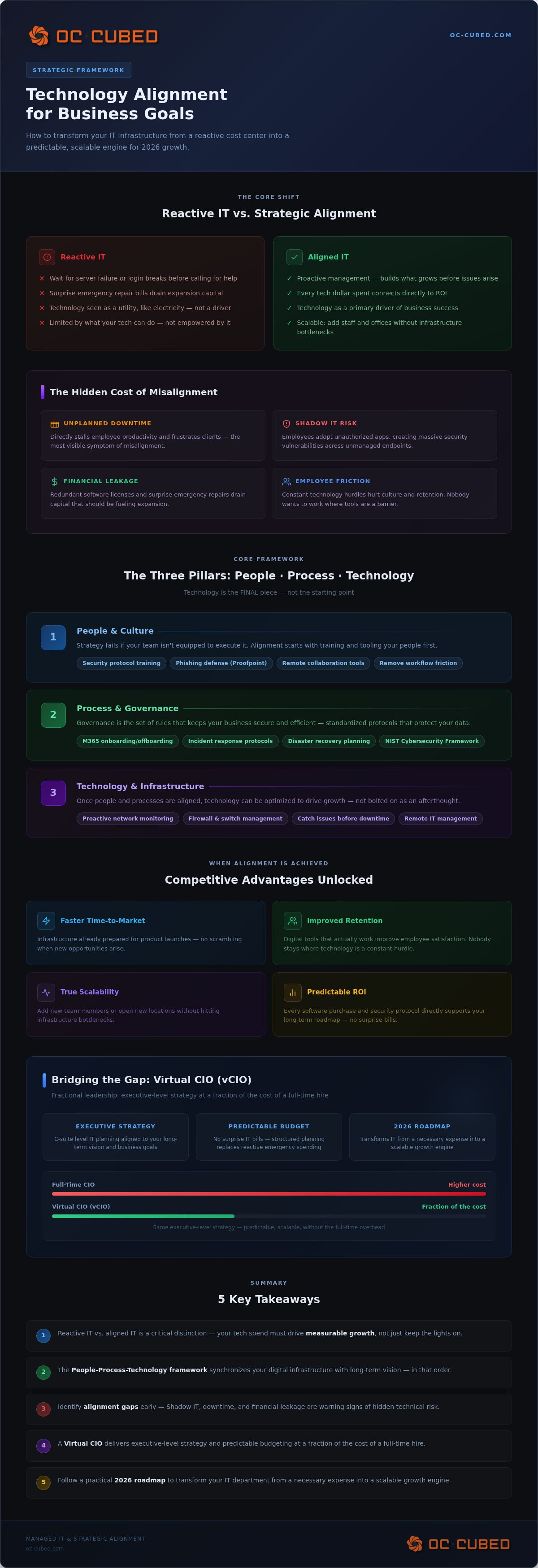
- Understand the critical difference between reactive IT and proactive technology alignment for business goals to ensure your tech spend drives measurable growth.
- Learn how to apply the People-Process-Technology framework to synchronize your digital infrastructure with your long-term vision.
- Identify the subtle signs of an alignment gap to prevent hidden technical risks from becoming expensive operational bottlenecks.
- Discover how a Virtual CIO provides executive-level strategy and predictable budgeting at a fraction of the cost of a full-time hire.
- Follow a practical roadmap to transform your IT department from a necessary expense into a scalable engine for 2026.
What is Technology Alignment and Why Does It Matter in 2026?
Technology alignment for business goals is the continuous synchronization of your IT resources with your company's core objectives. It's the difference between seeing technology as a utility, like electricity, and seeing it as a primary driver of your success. Most businesses operate in a state of reactive IT. They wait for a server to fail or a login to break before they call for help. Aligned IT, by contrast, focuses on building what grows. It ensures that every software purchase and security protocol directly supports your long-term roadmap.
As we look toward 2026, the urgency for this synchronization has never been higher. The rise of hybrid work and the rapid integration of AI tools mean that a disconnected tech stack isn't just an inconvenience; it's a liability. Technology alignment is a strategic bridge between executive vision and digital execution. Achieving strategic alignment ensures that your technical infrastructure can handle the weight of your ambitions without buckling under the pressure of new market demands.
The High Cost of Misalignment
When your tech and your goals aren't in sync, the friction shows up in your bank account and your culture. Unplanned downtime is the most obvious symptom, directly stalling employee productivity and frustrating clients. Beyond the visible outages, misalignment often leads to "Shadow IT." This happens when employees use unmanaged, unauthorized apps because your official tools don't meet their needs. This creates massive security vulnerabilities across unmanaged endpoints. You also face financial leakage. Redundant software licenses and surprise emergency repairs drain capital that should be fueling your expansion.
The Competitive Advantage of Strategic Sync
A business that masters technology alignment for business goals moves faster. You gain a quicker time-to-market for new products because your infrastructure is already prepared for the launch. Digital tools that actually work also improve employee retention; nobody wants to work for a company where the technology is a constant hurdle. Finally, alignment provides true scalability. You can add new team members or open new locations without hitting infrastructure bottlenecks. You're no longer limited by what your tech can do; you're empowered by it.
The Three Pillars of Technology Alignment for Business Goals
Successful technology alignment for business goals relies on a balanced framework: People, Process, and Technology (PPT). While many leaders rush to buy software first, the most effective strategies treat technology as the final piece of the puzzle. This structured approach ensures your digital investments aren't just gadgets; they're tools that solve specific operational challenges. Comprehensive remote IT management services provide the glue that holds these pillars together, ensuring your strategy remains consistent across every department and every remote office.
Pillar 1: People and Culture
Strategy fails if your team isn't equipped to execute it. Alignment starts by training staff on critical security protocols, such as using Proofpoint email security to defend against phishing. It also means providing the right tools for remote collaboration so that distance doesn't hinder productivity. When your IT support understands the actual workflow of your employees, they can remove friction instead of creating it. A culture that values security and efficiency is the strongest foundation for any technical change.
Pillar 2: Process and Governance
Governance is the set of rules that keeps your business secure and efficient. This includes standardized onboarding and offboarding for Microsoft 365 tenants to protect your data when staff changes occur. Establishing clear incident response and disaster recovery protocols is equally vital. We recommend following the NIST Cybersecurity Framework to ensure your governance meets recognized standards. Integrating cybersecurity risk management for small business as a core process protects your reputation and your bottom line.
Pillar 3: Technology and Infrastructure
Once people and processes are aligned, your technology can be optimized to drive growth. This involves proactive network monitoring and configuration to catch issues before they cause downtime. Effective firewall and switch management secures your perimeter, while endpoint protection shields every laptop and mobile device. Consolidating your vendors is another key step. It reduces complexity, lowers costs, and ensures your stack is manageable. If you're ready to stabilize your infrastructure, you can review our managed service models to see how we simplify complex tech environments through technology alignment for business goals.
Identifying the Alignment Gap: Signs Your Tech is Holding You Back
Many CEOs believe their technology is working simply because their email opens and the Wi-Fi stays on. This surface-level stability often masks deeper structural issues. True technology alignment for business goals isn't just about daily uptime; it's about whether your infrastructure can scale with your 2026 ambitions. If your IT team operates in a silo, fixing tickets without understanding your five-year plan, you have a significant alignment gap. Understanding what is a managed service provider helps you identify where your current support falls short of a true strategic partnership.
The most dangerous objection to strategic planning is the feeling that "everything seems fine." In reality, invisible risks often accumulate beneath the surface. Misalignment happens when technical decisions are made in a vacuum, separate from leadership's vision. This leads to a reactive environment where you're constantly paying to fix the past instead of investing in the future. It's time to look closer at the friction points in your organization.
Financial Red Flags
Your balance sheet often reveals misalignment before your hardware does. Frequent "emergency" IT invoices are a clear sign that your environment is reactive rather than managed. These surprise costs disrupt your cash flow and make budgeting impossible. You might also be leaking capital through your software stack. Many businesses pay for premium Microsoft 365 licenses or "seats" for former employees because their offboarding process is broken. Relying on heavy capital expenditure for hardware that becomes obsolete quickly is another sign of poor lifecycle planning.
Operational Red Flags
Operational friction is a quiet productivity killer. When employees complain about "slow systems" or outdated software, they're reporting lost billable hours. If your IT projects consistently run over budget or miss deadlines, there's a fundamental disconnect between your vision and the technical execution. This friction often prevents leadership from accessing critical data for timely decision-making. Following a structured approach like the NIST Cybersecurity Framework ensures your data remains accessible and secure, turning your operations into a competitive advantage rather than a bottleneck.
A Step-by-Step Roadmap to Aligning Technology with Your 2026 Goals
Technology alignment for business goals isn't a single event. It's a structured journey. Many organizations treat it as a "one-and-done" checkbox, but that approach leads to technical debt and stagnation. A true roadmap requires a continuous loop of assessment and optimization. This process starts long before you purchase a single piece of hardware or software. The "Discovery" phase is the most critical part of the entire cycle. Without a deep understanding of your current state, any new investment is just an expensive guess. Achieving consistent technology alignment for business goals requires a disciplined, five-step approach.
Step 1-3: Assessment, Strategy, and Security
First, you need a comprehensive audit of your current systems. You must identify what you have versus what you actually need to reach your 2026 targets. We look for redundant licenses, aging hardware, and security gaps. Once the audit is complete, we define your 12-month business goals and map them to specific technical requirements. This ensures every dollar spent serves a specific purpose. Security isn't an afterthought in this roadmap. We layer in security governance with CISO-level oversight from day one. This proactive stance protects your assets while you build for growth, ensuring that your foundation is as secure as it is functional.
Step 4-5: Implementation and Continuous Review
Execution must be precise to avoid operational disruption. We focus on project-based upgrades designed for minimal remote downtime. Once the new systems are in place, we transition to a phase of constant vigilance. This includes 24/7 network monitoring and seamless helpdesk integration to catch issues before they impact your staff. Alignment is maintained through a steady rhythm of communication. Monthly reporting provides data-driven insights into your progress. We also establish a cadence for quarterly strategic reviews with a vCIO to ensure your tech stack evolves alongside your business. This level of IT leadership without a full-time hire makes the roadmap accessible and effective for growing companies.
Fractional Leadership: Bridging the Alignment Gap with vCIO Services
Achieving technology alignment for business goals requires more than just technical skill; it requires executive-level vision. A Virtual CIO (vCIO) acts as the chief architect of this alignment. They don't just fix servers; they design the digital strategy that supports your revenue targets. For many growing companies, hiring a full-time C-suite executive is financially out of reach. A fractional advisor provides that same high-level expertise at a fraction of the cost. This model allows you to access enterprise-grade leadership without the overhead of a permanent executive salary.
At OC Cubed - Your trusted MSP, we believe leadership is the missing link in most IT relationships. Without a dedicated strategist, technical decisions are often made in a vacuum. This leads to a fragmented environment where tools don't talk to each other and security gaps go unnoticed. A vCIO ensures that every technical move is a calculated step toward your 2026 milestones. They bring a level of steady reliability that turns your digital infrastructure into a predictable asset rather than a source of constant anxiety.
The vCIO as a Strategic Partner
A vCIO acts as a vital translator for your organization. They take your high-level business objectives and turn them into technical requirements for vendors and internal teams. This bridge prevents "technology bloat," where companies pay for flashy tools they don't actually need or use. Budget planning becomes a collaborative effort based on data rather than guesswork. By acting as an objective third party, your vCIO evaluates technology investments based on ROI rather than technical novelty. This ensures every dollar you spend is a calculated move toward your long-term roadmap. They provide the quiet authority needed to say no to distractions and yes to scalable solutions.
Removing the Burden from the CEO
Your time is best spent on growth, not managing IT vendors or reviewing firewall logs. When a CEO tries to bridge the alignment gap alone, they often end up bogged down in technical minutiae that distracts from their primary mission. OC Cubed - Your trusted MSP's approach to fractional leadership includes rigorous vendor management and project oversight. We handle the negotiations and the timelines so you don't have to. A critical part of this leadership is our managed cybersecurity services for small business, which ensures your growth is protected from emerging threats. True technology alignment for business goals gives you the peace of mind that comes from knowing your digital foundation is solid. It's the key to predictable, scalable growth.
Building a Scalable Future Through Strategic IT
Scaling your business requires a technical foundation that keeps up with your ambition. Moving from a reactive mindset to a proactive strategy eliminates the friction that holds many organizations back. By focusing on the three pillars of people, process, and technology, you create a scalable engine ready for 2026. This ensures your digital tools serve your long-term roadmap rather than creating new obstacles.
True technology alignment for business goals isn't achieved through hardware alone; it requires fractional leadership that understands your bottom line. You can eliminate surprise IT bills with our flat-rate monthly retainer while benefiting from 24/7 proactive monitoring and threat remediation. This steady reliability allows you to focus on your growth while our team protects your infrastructure with fractional vCIO leadership and managed cybersecurity.
Enterprise-grade leadership is now accessible without the traditional C-suite price tag. It's time to stop managing vendors and start driving growth with a trusted advisor who understands your vision. Your path to a secure, predictable digital future starts here.
Frequently Asked Questions
What is the difference between IT support and technology alignment?
IT support is primarily reactive. It focuses on maintaining existing systems and resolving immediate technical issues like a broken login or a server error. Technology alignment for business goals is a proactive strategy. It ensures your digital infrastructure directly supports your long-term expansion plans. While support keeps the lights on, alignment ensures those lights are pointing in the right direction to fuel your growth. It transforms IT from a cost center into a strategic engine.
How often should a business review its technology alignment?
We recommend a layered review cadence to maintain peak efficiency. You should receive monthly reporting to track ongoing performance and security metrics. On a broader scale, businesses should conduct formal strategic reviews with a vCIO every quarter. These meetings allow you to adjust your roadmap based on market shifts or internal changes. Regular check-ins prevent technical debt from accumulating and ensure your investments remain synchronized with your 12-month objectives.
Can a small business achieve technology alignment without an internal IT department?
Yes, most small to mid-sized businesses achieve better alignment through a fractional model than with a small internal team. By partnering with a managed service provider, you access a full suite of experts including a vCIO and a dedicated NOC. This provides enterprise-grade leadership and 24/7 monitoring without the high overhead of full-time salaries. You get the strategic oversight needed to scale without the burden of managing internal staffing and training.
What are the first steps to take if our technology feels misaligned?
The first step is a comprehensive discovery phase to audit your current environment. You need to identify redundant software licenses, aging hardware, and security gaps that create friction. Once you have a clear picture of your current state, you must define your primary business goals for the next year. Mapping these goals to specific technical requirements allows you to create a prioritized roadmap that addresses immediate pains while building for the future.
How does technology alignment impact cybersecurity?
Alignment and security are inseparable. When your technology is aligned, security protocols like endpoint protection and Proofpoint email security are integrated into your daily workflows rather than bolted on as afterthoughts. This strategic approach follows frameworks like NIST to ensure your data remains protected as you scale. Proper technology alignment for business goals removes "Shadow IT" risks by ensuring employees have the authorized tools they need to work securely and efficiently.
What is the role of a vCIO in the technology alignment process?
A vCIO acts as the chief architect of your digital strategy. Their role is to translate your high-level executive vision into a concrete technical roadmap. They handle vendor management, budget planning, and project oversight so you don't have to. By providing fractional leadership, they ensure your technology investments are objective and results-driven. They bridge the gap between leadership and technical execution, ensuring every decision supports your company's bottom line and long-term stability.
Will technology alignment help reduce our monthly IT spending?
Alignment focuses on value and predictability rather than just cutting costs. While it often reduces waste by eliminating redundant licenses and "technology bloat," its primary benefit is the removal of surprise IT bills. By moving to a flat-rate monthly retainer, you stabilize your budget and prevent expensive emergency repairs. You stop paying for reactive fixes and start investing in scalable infrastructure that drives measurable business growth over the long term.
How do we measure the ROI of technology alignment?
Measuring ROI involves tracking both financial and operational metrics. Look for a reduction in unplanned downtime and an increase in employee productivity as systems become more reliable. You can also measure the speed of onboarding new hires or opening new offices without hitting technical bottlenecks. Finally, compare your annual IT spend against your growth targets. Aligned technology should result in a lower cost-per-user and a higher contribution to your overall company revenue.


