

What if your business could access a team of elite security experts and strategic advisors for less than the cost of a single junior IT hire? Most growing organizations find that technology management eventually becomes a full-time distraction. You likely spend too many hours fixing minor tech issues personally or worrying about a cyberattack that could halt your operations. It's frustrating to deal with unpredictable invoices from vendors who only show up when something breaks. Finding reliable IT services for companies without IT staff shouldn't feel like a gamble with your company's future.
This 2026 guide shows you how to secure professional, enterprise-grade technology management without the overhead of a full-time internal department. You'll learn how to transition from reactive chaos to a state of steady reliability. We'll explore how a remote-first managed model provides total peace of mind through 24/7 monitoring and strategic vCIO leadership. We outline exactly how to stabilize your IT budget and build a technology roadmap that supports your long-term growth.
Key Takeaways
- Identify the "hidden IT tax" that drains daily productivity when non-technical employees are forced to troubleshoot complex technology issues.
- Explore how professional IT services for companies without IT staff deliver enterprise-grade security and 24/7 monitoring through a remote-first model.
- Learn how virtual leadership roles like vCIOs and vCISOs provide high-level strategy and risk management without the cost of a full-time executive.
- Follow a structured roadmap for transitioning your business from reactive "break-fix" chaos to a proactive and secure technology foundation.
- Discover how a flat-rate monthly retainer replaces unpredictable bills with a stable, all-inclusive budget designed to support long-term growth.
The High Cost of Having No Dedicated IT Staff
Business owners often view technology as an expense to be deferred. This mindset creates a "hidden IT tax" where your highest-paid employees lose hours every week to software updates or connectivity lags. When you don't have a structured department, these small frictions accumulate into massive productivity losses. Finding reliable IT services for companies without IT staff is the first step toward reclaiming that lost time. Managed IT functions as a comprehensive department-replacement model for SMBs, providing the same level of oversight as an internal team without the executive-level salary requirements.
This shift follows the managed service provider model, which prioritizes proactive maintenance over reactive repairs. Without a professional roadmap, companies often suffer from strategic stagnation. You might find yourself relying on five-year-old hardware or legacy software simply because nobody has the bandwidth to plan for an upgrade. This lack of foresight limits your ability to scale and compete in a digital-first market. Technology should be a growth engine, not a bottleneck that holds your team back.
The 'Accidental IT Person' Trap
Delegating technology to your most tech-savvy employee is a productivity killer. While they might be able to reset a password, they aren't trained to manage complex firewall configurations or network security. This "accidental IT person" soon faces burnout as they juggle their actual job with constant interruptions. When IT is everyone's job, it becomes no one's job. Accountability vanishes. Professional IT services for companies without IT staff eliminate this burden by providing a clear point of contact for every technical hurdle.
Security Gaps in Unmanaged Environments
Basic antivirus software is no longer a sufficient defense. Cybercriminals specifically target companies without internal IT because they know these environments often have unpatched Microsoft 365 tenants and outdated firewall settings. Vulnerabilities grow over time. Ransomware attacks are now automated, scanning for easy targets with weak email security or exposed ports. For businesses in regulated industries, the absence of a dedicated security lead creates significant compliance risks. You need constant threat detection and remediation to protect your reputation and your data.
How Managed IT Services Function as Your Complete Remote Department
Many businesses assume that without a person in a physical office chair, IT doesn't exist. This is a common misconception. High-quality IT services for companies without IT staff provide a comprehensive remote department that operates 24/7. This model utilizes a Network Operations Center (NOC) to watch your infrastructure while you sleep. It moves beyond basic antivirus to advanced endpoint protection and remediation. Resources like the NIST Small Business Cybersecurity Corner emphasize that for small organizations, having a structured framework is vital for survival. You gain the power of an enterprise IT department without the physical footprint or the executive payroll.
The Helpdesk vs. The NOC: A Two-Layer Defense
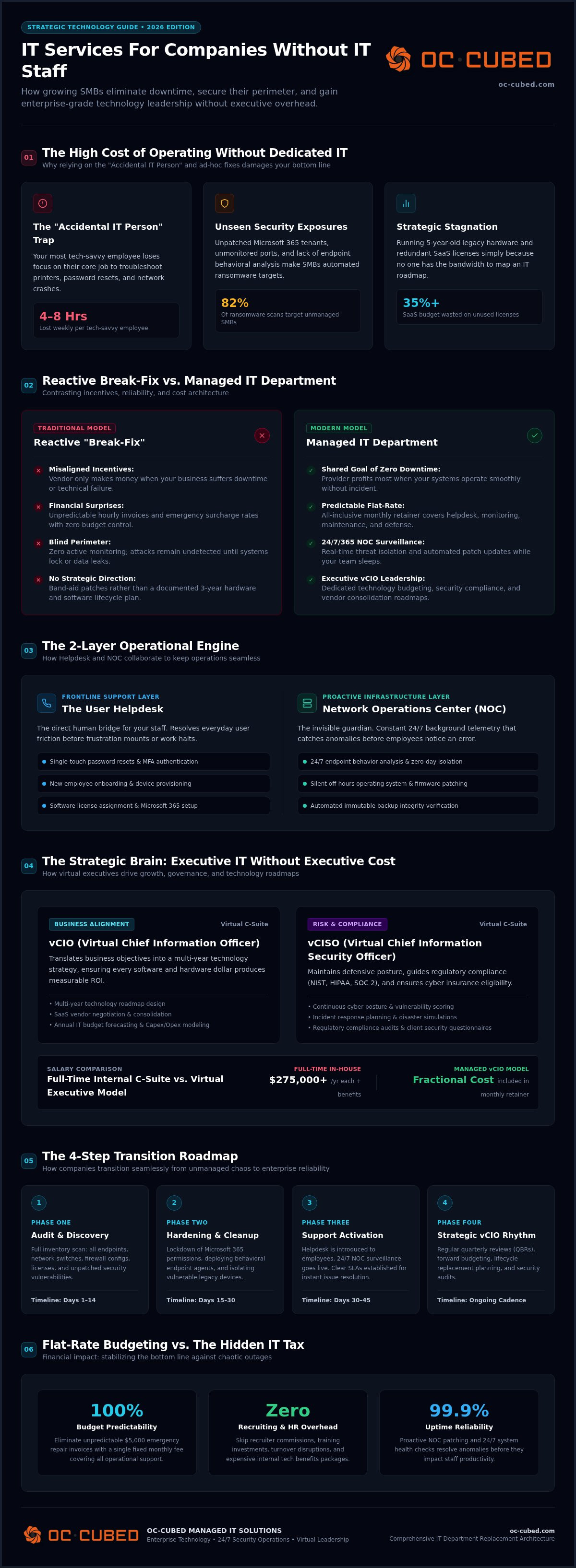
Effective IT management requires two distinct layers of protection. The helpdesk acts as the reactive support layer. It's the team your employees contact when a printer fails or a login won't work. In contrast, the NOC is the proactive layer. These technicians monitor your firewalls, switches, and servers behind the scenes. They detect anomalies before they cause downtime. These two layers work together to create a seamless experience. Most issues are resolved before an employee even notices a problem. This dual-layered approach is the gold standard for modern managed IT solutions.
Modern protection requires more than a software installation. Endpoint protection and remediation involve constant behavior analysis to stop zero-day threats before they spread. Similarly, Microsoft 365 tenant maintenance ensures your cloud environment is secure and efficient. This includes managing permissions, monitoring for suspicious logins, and optimizing licenses to prevent waste. By treating these as ongoing tasks rather than one-time setups, you maintain a hardened perimeter against external threats. This steady oversight is what allows your business to scale without technical debt.
Proactive Maintenance vs. Break-Fix
The "call-me-when-it-breaks" model is a financial trap. It creates unpredictable bills and rewards vendors for your downtime. Proactive maintenance flips this script. By investing in a monthly retainer, you ensure that someone is constantly optimizing your systems. This reduces total IT spend over time by preventing catastrophic failures and data loss. For a deeper look at how this works, read our Remote IT Management: Complete Guide for Modern Business. Transitioning to professional IT services for companies without IT staff allows your team to focus on growth while we handle the technical heavy lifting.
The Strategic Brain: Why You Need Virtual IT Leadership
Technology is more than just hardware and support tickets. For companies without an internal department, the biggest missing piece is often leadership. You need someone to bridge the gap between technical possibilities and business outcomes. This is where virtual IT leadership becomes essential. A vCIO acts as a fractional executive focused on ROI and business alignment, ensuring every dollar spent on tech serves a specific objective. High-quality IT services for companies without IT staff include this strategic layer to prevent wasteful spending and operational stagnation.
A Virtual CISO (vCISO) offers similar high-level value for your security posture. They manage cybersecurity governance and risk without requiring the six-figure salary of a full-time officer. Additionally, your provider should handle vendor management. This means letting your MSP manage the "finger-pointing" between internet providers and software vendors so you don't have to. You gain a single point of accountability for your entire technology stack.
IT Strategy and Budgeting
Effective technology management requires looking years ahead. A vCIO prevents "surprise" hardware costs by developing concrete 3-year and 5-year capital plans. This approach shifts your focus from buying the latest gadgets to aligning technology investments with your actual business goals. You gain a clear understanding of when to upgrade and how much it will cost. For more on this, explore our guide on Enterprise-Grade IT Leadership Without a Full-Time Hire. This level of planning creates the stability needed for long-term growth.
Compliance and Risk Governance
Security isn't just about software; it's about policy and oversight. A vCISO ensures your organization meets industry-standard security requirements like SOC2 or HIPAA. This is critical as the FTC small business cybersecurity guide highlights that organizations without dedicated IT staff are often the most vulnerable to data breaches. Protecting your perimeter requires sophisticated tools like Proofpoint email security and robust identity management.
Beyond technical tools, governance manages the "human factor." This involves security awareness training and strict policy enforcement to ensure your team doesn't accidentally open the door to threats. By integrating these leadership roles into your IT services for companies without IT staff, you build a resilient foundation that protects your reputation and your bottom line.
The Onboarding Roadmap: Transitioning from No IT to Managed IT
Transitioning from a "do-it-yourself" approach to a professional management model requires a structured sequence of events. Many businesses fear that onboarding will cause more disruption than the problems they are trying to solve. However, high-quality IT services for companies without IT staff use a phased roadmap to ensure a seamless shift. This process replaces technical debt with a reliable foundation. We focus on visibility first, followed by immediate stabilization and long-term strategy.
Everything begins with a comprehensive IT audit. This isn't just an inventory list; it's a deep dive into every device, software license, and hidden vulnerability on your network. Once we understand the landscape, we move to security baselining. This involves the immediate implementation of endpoint protection and enterprise-grade email security. We prioritize these steps to stop active threats before moving to long-term optimization. Establishing a "Single Source of Truth" through documentation ensures that every piece of your infrastructure is mapped and managed according to best practices. Finally, we focus on helpdesk integration. We train your staff on how to use support tools, ensuring they get technical assistance in seconds. This eliminates the frustration of waiting for a callback or trying to fix things themselves.
Phase 1: Stabilization and Security
The first 30 to 60 days focus on addressing "low-hanging fruit" risks. We implement robust multi-factor authentication (MFA) and secure any unmanaged firewalls that might be exposing your data. We also audit Microsoft 365 permissions to prevent accidental data leakage. By setting up 24/7 monitoring at this stage, we establish a performance baseline. This allows us to track improvements and identify recurring issues that need permanent resolution.
Phase 2: Operational Excellence
Once the environment is secure, we move from "emergency mode" to "maintenance mode." This phase introduces monthly reporting that shows uptime, ticket volume, and the specific security threats our systems blocked. You'll participate in regular vCIO meetings to review your technology roadmap. This ensures that your IT investments always support your scaling goals. Professional IT services for companies without IT staff provide the clarity you need to stop worrying about technology and start focusing on your business.
Flat-Rate IT: Predictable Budgeting for Growing Companies
The "break-fix" model is a relic of the past that punishes your cash flow. When you rely on hourly billing, your interests and your vendor's interests are misaligned. They profit when you have downtime. High-quality IT services for companies without IT staff flip this incentive. A monthly managed IT services retainer ensures your provider is motivated to keep your systems running perfectly. Predictability is the primary benefit. You get a single invoice every month, allowing you to forecast expenses with total confidence.
Scaling your business shouldn't lead to technical friction. As you add employees, your IT department grows with you. This elastic model is far more efficient than trying to hire, train, and manage internal staff. Consider the ROI of uptime. A four-hour outage for a mid-sized company can result in thousands of dollars in wasted salaries and lost opportunities. Proactive support prevents these disasters before they start. It's a strategic investment in business continuity rather than just a cost center.
What’s Included in an All-Inclusive Retainer?
A truly all-inclusive plan should remove all technical anxiety from your daily operations. You shouldn't have to worry about whether a support call will trigger a surprise bill. A comprehensive retainer covers several core layers of protection. Remote helpdesk provides instant support for your team's daily technical hurdles. NOC monitoring offers 24/7 oversight of your servers and network infrastructure. M365 maintenance ensures ongoing security for your cloud environment, while endpoint security provides advanced threat detection to stop malware and phishing.
Crucially, your base fee should include vCIO leadership. This provides the strategic roadmap discussed earlier without additional consulting costs. Project-based fees are reserved for major infrastructure migrations, ensuring routine maintenance remains predictable. This structure allows you to maintain enterprise-grade technology without the executive-level overhead.
Choosing the Right Managed Partner
The best partner for a growing company is one that understands the modern, remote-first landscape. Remote-first MSPs offer superior speed and scalability because they don't rely on physical travel time to solve problems. They prioritize cybersecurity risk management as a core component of every service. This steady reliability allows you to focus on your clients while we protect your data and optimize your systems. When looking for IT services for companies without IT staff, prioritize partners who offer transparency and a clear path for growth.
Secure Your Future with Professional IT Leadership
The transition from managing tech yourself to a professional department-replacement model is a vital step for any growing company. By eliminating the "hidden IT tax" of lost productivity and replacing it with steady reliability, you free your team to focus on their core roles. Professional IT services for companies without IT staff provide the enterprise-grade protection you need without the high cost of internal hiring.
You gain immediate access to 24/7 proactive network monitoring and enterprise-grade Proofpoint email security. This infrastructure is backed by virtual CIO and CISO leadership, ensuring your technology roadmap always aligns with your business goals. These elements combine to provide total peace of mind and a predictable, flat-rate budget that supports your long-term success.
Your business deserves a technology foundation that drives growth rather than creating obstacles. Take control of your infrastructure today and build a more resilient organization for tomorrow.
Frequently Asked Questions
Is managed IT support cheaper than hiring a full-time IT person?
Yes, it's significantly more cost-effective. Hiring a full-time IT manager in 2026 involves a high salary, benefits, and payroll taxes. A managed IT services retainer provides a whole team of experts, including NOC technicians and vCIOs, for a fraction of that cost. You avoid the overhead of a dedicated employee while gaining broader expertise across cybersecurity, cloud maintenance, and proactive network monitoring.
What happens if we need someone to physically touch a computer?
We operate on a remote-first model, resolving the vast majority of technical issues through our helpdesk and NOC integration. If a hardware failure requires physical intervention, we guide your local staff through the process or coordinate with hardware vendors under our vendor management service. Modern IT services for companies without IT staff are designed to be managed remotely to ensure national scalability and faster response times.
Can a managed service provider handle our Microsoft 365 security?
Absolutely. We provide comprehensive Microsoft 365 tenant maintenance to ensure your cloud environment is hardened against threats. This includes managing user permissions, monitoring for suspicious login activity, and implementing advanced email security with Proofpoint. Our team ensures that your configuration stays updated with the latest security protocols, protecting your data from phishing and unauthorized access without requiring any internal oversight from your team.
How fast can we expect a response when an employee has a technical issue?
Our remote helpdesk is built for speed, often providing support in seconds or minutes rather than hours. Because we don't use on-site technicians, our team is immediately available to remote into a workstation and resolve issues. This efficiency is a core benefit of professional IT management, as it minimizes employee downtime and keeps your operations running smoothly throughout the workday without technical interruptions.
Does managed IT include the cost of hardware and software licenses?
No, the monthly retainer covers the management and support of your technology, not the cost of the hardware or licenses themselves. However, our vCIO leadership helps you plan for these expenses with 3-year and 5-year capital plans. We also handle vendor management to ensure you're getting the right licenses at the best value, preventing you from overpaying for tools your team doesn't actually use.
What is the difference between a helpdesk and a virtual CIO?
A helpdesk is a reactive support layer that assists employees with daily technical problems like password resets or software glitches. A virtual CIO (vCIO) provides high-level strategic leadership. They focus on your technology roadmap, ROI, and business alignment. While the helpdesk keeps your current tools working, the vCIO ensures those tools support your long-term growth and prevent future technical debt or security gaps.
How do we know our data is secure with an outside IT company?
We use industry-standard security frameworks and enterprise-grade tools to protect your environment. Our services include 24/7 network monitoring, endpoint protection, and proactive threat detection. By utilizing a virtual CISO for security governance, we ensure your business meets strict compliance requirements. We prioritize transparency through monthly reporting, giving you full visibility into the threats we've blocked and the current status of your network's overall health.
What industries benefit most from outsourcing their IT department?
Any industry that relies on data security and uptime benefits from outsourcing, particularly professional services, healthcare, and finance. These sectors often face strict regulatory compliance needs that require expert oversight. By choosing IT services for companies without IT staff, businesses in any sector can access the same level of security and strategic planning as a large corporation without the burden of managing a physical IT department.


