

Imagine opening your monthly ledger only to find an IT invoice that has tripled because of a single "emergency" support call or an afternoon of unplanned downtime. For many owners, technology feels like a black hole for capital where bills are as volatile as the systems they support. You've likely accepted these fluctuations as the cost of doing business, but inconsistent invoices shouldn't be your standard. It's frustrating to manage growth when you're constantly bracing for the next technical "surprise" that disrupts your cash flow.
Achieving predictable IT costs for small business is not about finding the cheapest hourly rate. It's about moving toward a flat-rate managed model that prioritizes prevention over panic. In this 2026 financial strategy guide, you'll learn how to stabilize your budget and eliminate hidden fees for good. We'll examine the shift from reactive repairs to proactive maintenance and show you how fractional leadership can guide your technology investments without the overhead of a full-time executive. By the end, you'll have a clear roadmap to turn your IT department into a fixed, reliable line item that supports your goals instead of draining your reserves.
Key Takeaways
- Understand why reactive models drive up expenses and how a proactive subscription provides predictable IT costs small business owners can rely on.
- Identify the essential services that should be included in an all-inclusive retainer to prevent hidden fees and surprise invoices.
- Learn how Virtual CIO leadership helps you plan hardware refreshes years in advance to eliminate the shock of sudden replacement bills.
- Compare the financial impact of guaranteed response times against the hidden costs of extended downtime and emergency labor rates.
- Discover a practical process for auditing your current technology spend to uncover shadow IT costs and identify critical assets.
The Hidden Cost of Unpredictable IT: Why the Break-Fix Model Fails
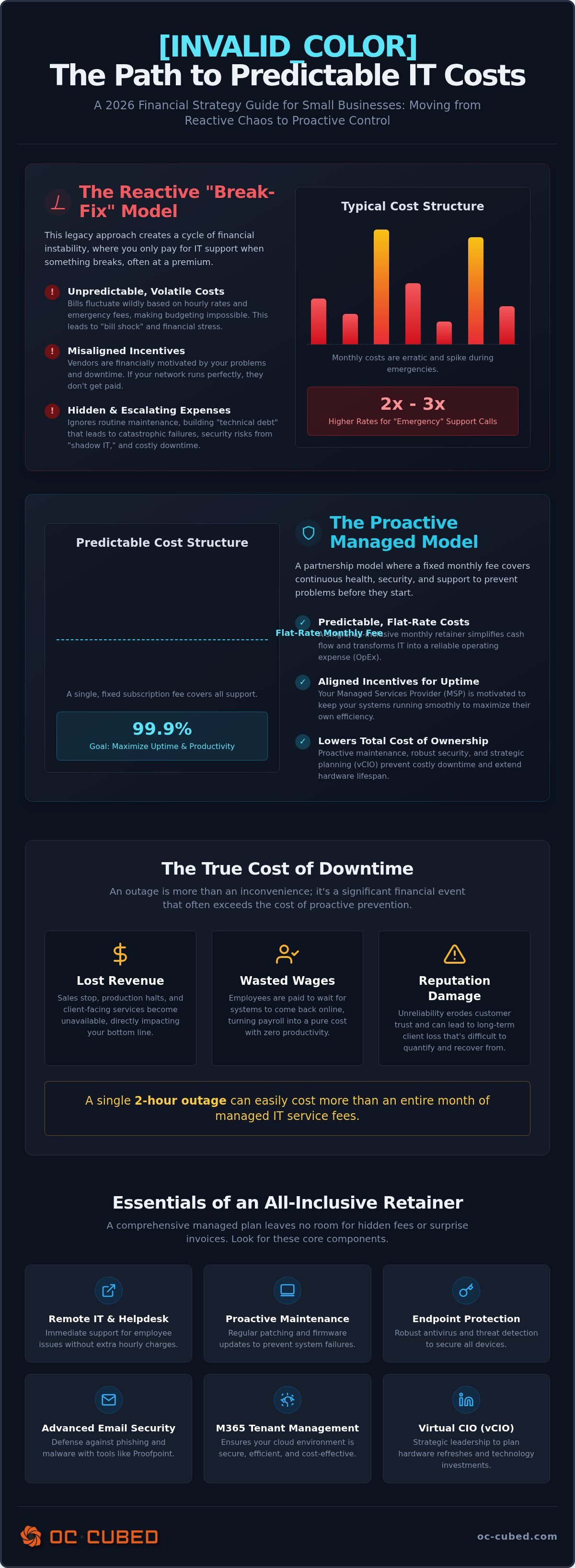
The "break-fix" model is a legacy approach to technology. It operates on a simple, flawed premise: you only pay for IT support when something stops working. While this might look like a way to save money on your monthly ledger, it actually creates a cycle of financial instability. Instead of achieving predictable IT costs small business owners need for growth, you end up at the mercy of the "Emergency Premium." When a critical system fails, reactive support providers often charge two to three times their standard hourly rate for an immediate response. This isn't just a service fee; it's a penalty for not having a proactive plan.
This model also builds "technical debt." By ignoring routine maintenance and security patches to save a few dollars today, you invite a catastrophic failure tomorrow. These unbudgeted replacement costs often arrive at the worst possible time, forcing business owners into "bill shock." This psychological toll is significant. It makes leaders hesitant to invest in new tools because they're constantly waiting for the next expensive emergency to hit their bank account.
The Reactive Support Trap
In a break-fix arrangement, your IT vendor is financially incentivized by your problems, not your uptime. If your network is running perfectly, they don't make money. This creates a fundamental conflict of interest. Additionally, the lack of professional oversight often leads to "shadow IT." This happens when frustrated employees attempt to fix technical issues themselves or sign up for unauthorized software to bypass broken systems. These "quick fixes" often introduce security vulnerabilities that lead to even larger invoices down the road.
Calculating the Real Cost of Downtime
Downtime cost is the sum of lost revenue, employee wages paid during the outage, and long-term reputation damage. In 2026, the stakes are higher than ever. With a hyper-connected, remote workforce, a network failure doesn't just slow things down; it stops production entirely. A single two-hour outage can easily exceed the cost of an entire month of managed service fees. Businesses looking for stability often move toward a Managed Services Model to align their technology costs with their revenue goals. This shift ensures that your IT partner is motivated to keep you online, providing the foundation for predictable IT costs small business leaders can actually budget for.
What Are Predictable IT Costs? The Managed Services Model Explained
Predictable IT costs for small business are built on a partnership, not a transaction. A Managed IT Services Provider (MSP) acts as your external technology department. Instead of paying for repairs after things break, you pay a fixed monthly subscription for continuous health and security. This model shifts your technology spend from unpredictable Capital Expenditure (CapEx) to steady Operating Expenditure (OpEx). It simplifies your cash flow. You no longer have to worry about a sudden five-figure bill for a server failure or a security breach.
To truly stabilize your budget, you must look at the Total Cost of Ownership (TCO) of your infrastructure. This includes not just the hardware, but the labor, security, and downtime risks associated with it. A flat-rate retainer covers these variables, providing a single, reliable line item for your ledger. If you are tired of fluctuating invoices, exploring an all-inclusive monthly retainer from OC Cubed - Your trusted MSP can provide the financial clarity you need.
The Components of a Flat-Rate IT Plan
A comprehensive managed plan leaves no room for hidden fees. It should include remote IT support and helpdesk integration to resolve employee issues immediately without extra hourly charges. Security is a non-negotiable part of this bundle. Your retainer should cover endpoint protection and robust email security with Proofpoint to defend against phishing. Additionally, Microsoft 365 tenant maintenance is essential. Active management prevents licensing waste and ensures your cloud environment remains secure and efficient.
Why Proactive Maintenance Saves Money
Proactive maintenance is the foundation of cost control. Think of it like a vehicle. You don't wait for the engine to seize before checking the oil. Regular patching and firmware updates prevent the engine failure of a major server crash or network outage. Remote management tools allow these fixes to happen in the background. They never interrupt your workday. Monthly reporting then closes the loop. These reports identify aging hardware or licensing gaps before they become expensive emergencies. This level of visibility allows you to make informed decisions rather than reactive purchases.
Managed IT vs. Hourly Support: A Financial Comparison
Hourly support providers sell hours. Managed partners sell results. This distinction is the core of predictable IT costs small business owners must master to protect their margins. Achieving predictable IT costs small business leaders can rely on requires moving away from the "pay-as-you-break" mentality. In an hourly model, you typically receive "Best Effort" response times. This means you wait at the back of the line while the technician works on whoever is currently paying the highest emergency rate. A managed model uses a Service Level Agreement (SLA). This guarantees a response within a specific window. It turns a variable risk into a controlled, manageable expense.
Budgeting for hourly support is a guessing game. You might pay very little in February and then face a massive invoice in March. This volatility makes it impossible to forecast cash flow with any accuracy. A flat-rate model replaces these spikes with a single, predictable line item. This stability allows you to allocate capital toward revenue-generating projects rather than hoarding cash for the next technical crash. It's about moving from a state of constant financial defense to a position of strategic growth.
Direct vs. Indirect Costs
Direct costs are easy to track. They appear on your invoices as labor, hardware, and software licenses. Indirect costs are harder to see but often more expensive. When your team can't work because of a network issue, you're still paying wages for zero output. You're also missing deadlines and potentially losing client trust. Remote IT management services mitigate these indirect costs by resolving issues in the background. This eliminates the need for expensive on-site visits and keeps your staff focused on their actual jobs.
The ROI of Preventative Security
Security expenses are frequently the biggest source of "bill shock" in the break-fix model. Reactive patching usually happens only after a breach has occurred. By then, the damage is already done. Predictable security costs are significantly lower than the price of a single ransomware remediation or a data leak fine. Implementing a robust cybersecurity risk management plan ensures you are spending a fixed amount on defense rather than an unknown fortune on recovery. In 2026, the expanding patchwork of state-level data privacy laws makes this proactive approach a financial necessity. It's much cheaper to maintain compliance than to pay for a legal defense after a failure.
Virtual CIO Leadership: The Secret to Long-Term Budget Stability
While the helpdesk handles the day-to-day, a Virtual CIO focuses on your long-term roadmap. This fractional executive role provides the high-level strategy required for predictable IT costs small business owners need to scale. Instead of reacting to tech failures, you gain a partner who aligns every technology investment with your revenue targets. This ensures that IT is a driver of growth rather than a recurring drain on your capital.
Strategic roadmapping is the most effective way to prevent budget shocks. A vCIO audits your current vendor contracts for VOIP and connectivity to ensure you are receiving modern market rates. By planning hardware refreshes three years in advance, you can move away from emergency purchasing. This foresight allows you to allocate funds gradually, ensuring you never face a surprise five-figure bill for a critical system replacement. This leadership is the foundation of predictable IT costs small business leaders need for long-term growth.
Eliminating Technical Debt
Accessing IT leadership without a full-time hire allows you to identify aging hardware before it becomes a liability. Business owners often try to save money by keeping equipment past its prime. However, this technical debt actually increases your total spend through higher maintenance labor and increased risk of failure. A vCIO manages the lifecycle of your equipment so replacements are scheduled and budgeted. This proactive approach ensures your team always has the tools they need to stay productive.
Security Governance and Compliance
Compliance is a financial risk management exercise. A Virtual CISO ensures your business meets national data protection standards and avoids the heavy fines associated with regulatory failures. They provide oversight for your third-party vendors, ensuring their security protocols don't introduce hidden financial risks to your organization. In 2026, staying ahead of the shifting legal landscape is a financial necessity. Budgeting for compliance is always cheaper than paying for a recovery after a failure.
How to Transition to a Predictable IT Budget in 2026
Moving your organization toward predictable IT costs small business owners can depend on requires a tactical shift in how you view your ledger. It's not enough to simply swap vendors. You must fundamentally change the way technology is procured and managed. By following a structured transition, you can move from a state of constant financial defense to a proactive model where every dollar is accounted for in advance. This transition ensures that your growth is never hindered by technical "surprises" that drain your capital reserves.
Audit Your Current IT Spend
The first step is a comprehensive audit of your last 12 months of spending. This goes beyond looking at standard support invoices. You must calculate the hidden costs of shadow IT, which includes unauthorized software subscriptions your team purchased to solve immediate problems. Include Microsoft 365 license management in this process to identify seats that are active but unused. You should also quantify the lost revenue from minor outages that didn't necessarily require an emergency call but still slowed production. These silent leaks often represent a significant portion of your annual technology spend.
Identify Critical Assets and Compliance
Once you understand your spending, map out your "must-protect" assets. These include your proprietary data, client records, and the core systems required for daily operations. In 2026, national data privacy standards have become more rigorous. Your budget must reflect the cost of maintaining these compliance requirements to avoid the catastrophic fines associated with a breach. By identifying these priorities, you ensure your monthly retainer is focused on the most critical parts of your infrastructure, providing the stability you need to operate without fear of regulatory penalties.
Choosing the Right Partner
The final step is selecting a partner that aligns with your financial goals. Evaluate Managed Service Providers based on their definition of "all-inclusive." A reliable contract should clearly include 24/7 monitoring, NOC integration, and executive-level advisory as standard features. Watch for exclusions that might lead to additional hourly billing for security remediation or strategy meetings. Shifting to a fixed-fee model that incorporates both daily support and long-term leadership is the only way to secure a truly stable budget.
Secure Your Financial Future with Strategic IT
Moving away from the chaos of reactive technology isn't just an IT decision; it's a financial imperative for 2026. By choosing an all-inclusive managed model, you replace volatile emergency labor rates with a single, reliable line item. This shift provides the predictable IT costs small business leaders need to fund strategic growth and navigate complex new data privacy regulations with confidence. You no longer have to wait for a system to fail before you can justify the cost of its maintenance.
Stable budgets are built on the foundation of 24/7 proactive network monitoring and fractional executive leadership. When you integrate Virtual CIO and CISO advisory into your monthly retainer, you eliminate technical debt and plan for the future without budget shocks. Technology should empower your business, not hold it hostage with surprise invoices. You deserve the peace of mind that comes from knowing your infrastructure is protected by experts who are incentivized by your uptime, not your problems.
Your business is ready for its next chapter. Take the first step toward a more stable and profitable tomorrow by aligning your technology with your financial goals today.
Frequently Asked Questions
What is usually included in a flat-rate IT service agreement?
A standard agreement covers the proactive management and support of your entire technology environment. This includes remote IT support, Microsoft 365 tenant maintenance, and 24/7 network monitoring. Security essentials like endpoint protection and email security with Proofpoint are also bundled in. By including helpdesk and NOC integration along with monthly reporting, the model ensures all operational needs are met without the need for per-incident billing or surprise invoices.
How do predictable IT costs improve a small business’s cash flow?
Fixed monthly fees replace the volatile spikes associated with the traditional break-fix model. This stability allows business owners to forecast their capital requirements with total accuracy. Instead of hoarding cash to cover a potential server crash or a security emergency, you can invest those funds back into revenue-generating activities. Achieving predictable IT costs small business leaders can trust means your technology spend stays consistent regardless of support ticket volume.
Does "all-inclusive" IT support really mean no extra bills?
Yes, for the standard scope of maintenance and support defined in your retainer. It covers the ongoing health, security, and remote management of your existing infrastructure. While major new initiatives like full cloud migrations might fall under separate project-based fees, your daily support and proactive monitoring are fully covered. This approach eliminates the emergency labor premiums that typically inflate hourly invoices when a technical crisis occurs.
Can managed IT services help reduce my Microsoft 365 costs?
Managed partners optimize your cloud spend through active tenant maintenance. This involves auditing your license usage to identify and remove unused subscriptions for former employees or redundant services. Many businesses overpay for seats they don't actually need. Proactive oversight ensures you only pay for necessary licenses while closing security gaps. This continuous management prevents licensing waste and ensures your cloud environment remains both secure and cost-effective.
Why is a Virtual CIO better for budgeting than a standard IT technician?
A technician focuses on fixing current problems, but a Virtual CIO focuses on preventing future financial shocks. vCIOs provide strategic roadmapping to plan hardware refreshes years in advance. They also handle vendor management to negotiate better rates for your internet and VOIP services. This executive-level oversight ensures your technology investments align with your business goals, preventing the bill shock of sudden, unplanned equipment failures or infrastructure gaps.
How much can a small business save by switching from break-fix to managed IT?
Savings are primarily realized through the elimination of downtime and emergency labor premiums. While the monthly fee is recurring, it is often significantly lower than the total cost of lost productivity and reputation damage from an outage. Reactive support often costs two to three times more per hour than proactive maintenance. By preventing issues before they occur, you avoid the massive, unbudgeted expenses associated with ransomware remediation.
What happens if we have a major IT project that isn’t in the monthly retainer?
Major initiatives such as infrastructure upgrades or security implementations are handled through project-based management fees. These are scoped and quoted upfront with clear timelines and deliverables through virtual project management. This maintains the predictable IT costs small business owners need by keeping daily support separate from strategic investments. You will always know the cost of a project before it begins, ensuring there are no surprises on your ledger.
Is remote IT support as effective as having someone on-site for cost control?
Remote support is often more effective for cost control because it provides immediate response times without travel expenses. Most technical issues, security threats, and configuration changes are resolved faster through helpdesk and NOC integration. This model maintains high national-level standards while eliminating the overhead costs of on-site staffing. It keeps your monthly retainer lower and more predictable while ensuring that your systems are monitored by experts 24/7.


