

What if your helpdesk team knew about a critical server failure before the first frustrated employee even reached for their phone? For many businesses, the reality is the exact opposite. You're likely tired of hearing about system outages from your users while your technicians scramble to figure out what went wrong on the backend. Realizing the benefits of integrated NOC and helpdesk services is the first step to breaking this reactive cycle that drains productivity and erodes trust in your systems.
This integration turns your IT department into a single, proactive unit. When network monitoring and user support share the same eyes, communication gaps disappear. This article shows you how unifying these functions slashes downtime and provides a seamless experience for your entire team. We'll examine how a unified approach leads to faster incident resolution and predictable IT costs through a monthly managed IT services retainer. You'll also see how current advancements in automation make this alignment a requirement for business stability and growth in 2026.
Key Takeaways
- Stop the reactive cycle where employees identify system outages before your technical team has a chance to respond.
- Discover the primary benefits of integrated NOC and helpdesk services, specifically how shared data creates a proactive early warning system.
- Learn why unifying network monitoring and user support leads to faster incident resolution and higher internal satisfaction scores.
- Understand the financial stability gained by moving to a Monthly Managed IT Services Retainer that covers both backend and frontend support.
- See how integrated operations provide better protection for your Microsoft 365 tenant and critical business infrastructure.
The High Cost of Siloed IT: Why Separate NOC and Helpdesk Fail
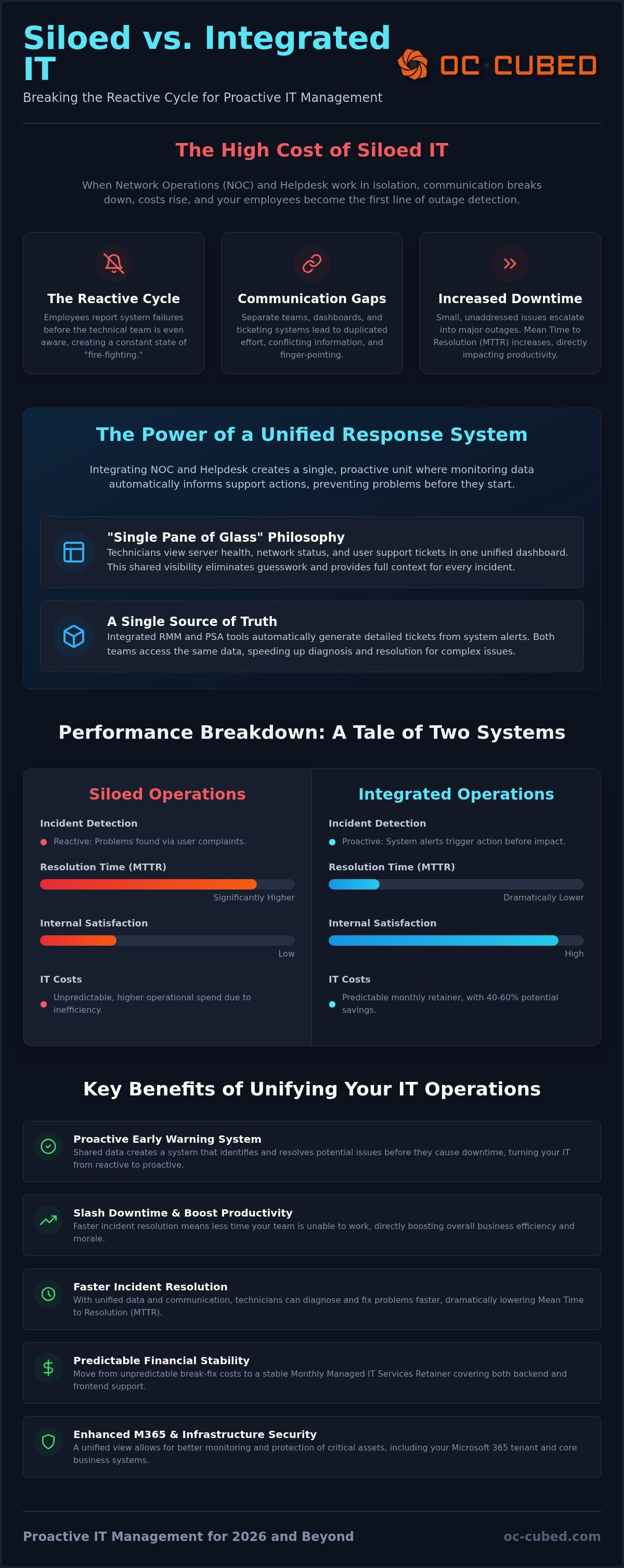
Siloed IT departments create a structural blind spot that directly impacts your bottom line. When your Network Operations Center (NOC) and Helpdesk operate as separate islands, they solve problems in isolation. Your helpdesk technicians might spend hours troubleshooting a single user's connectivity issue, unaware that the NOC is already investigating a failing switch. This lack of visibility is more than just a nuisance; it's a drain on your technical resources. One of the primary benefits of integrated NOC and helpdesk services is the immediate elimination of this duplicated effort.
Communication lag often results in your employees becoming your primary monitoring system. It's a frustrating scenario: a user calls the helpdesk to report an outage, but the technician has no visibility into the backend server status. They offer generic troubleshooting steps while the NOC works on a fix in a different dashboard. This creates a perception of disorganization. When IT feels reactive, employee morale suffers. Your team loses confidence in the tools they need to perform their jobs, leading to a culture of workarounds rather than solutions.
The Communication Gap Between Monitoring and Support
Siloed data leads to a finger-pointing trap. When an incident occurs, the NOC might blame the infrastructure while the helpdesk insists on user error. Without a unified view, stakeholders receive conflicting information about when systems will be back online. Separate ticketing systems further complicate the issue. They create a fragmented history of your network health. This makes it nearly impossible to track recurring problems across the entire environment, leaving your business vulnerable to the same issues week after week.
Downtime Cascades: When Small Issues Become Major Outages
Small glitches often serve as early warning signs for catastrophic failures. In siloed environments, these signals never reach the people supporting your end-users. Teams miss the pattern recognition required for proactive maintenance because they only see half the picture. The financial reality is clear. Extended Mean Time to Resolution (MTTR) is a hallmark of separate teams. Research shows that outsourced NOC operations can deliver 40 to 60 percent cost savings compared to fragmented in-house setups. Without integration, your business pays for every minute of redundant investigation and mismanaged communication. This is why the benefits of integrated NOC and helpdesk systems are essential for any organization prioritizing uptime and efficiency in 2026.
How Integrated NOC and Helpdesk Create a Unified Response System
A unified IT response system isn't just about sharing an office space. It's a sophisticated operational model where monitoring data automatically informs support actions. Integrated NOC and helpdesk functions serve as the nervous system of modern business IT, sending signals between infrastructure and users in real time. When these two units operate in tandem, the "Early Warning and Response System" becomes your business's strongest defense against disruption. One of the primary benefits of integrated NOC and helpdesk services is the shift from reacting to fires to preventing them entirely.
This model relies on a "Single Pane of Glass" philosophy. Instead of technicians toggling between network maps and support queues, they view everything in one dashboard. They see the health of your switches and servers alongside the tickets submitted by your team. This removes the guesswork and ensures that every technician has the full context of an incident before they even pick up the phone. When you invest in a comprehensive remote IT management strategy, this level of synchronization becomes the standard for your operations.
Shared Information Systems: The Single Source of Truth
Integrating Remote Monitoring and Management (RMM) with Professional Services Automation (PSA) tools creates a single source of truth for your network. When a firewall triggers an alert, the system automatically generates a ticket containing the exact configuration details and history of that device. This shared documentation speeds up the resolution of complex tier-2 issues because the helpdesk doesn't have to wait for a NOC specialist to provide technical specs. Automated asset management keeps both teams informed, ensuring that no piece of hardware or software update falls through the cracks.
The Proactive Notification Loop
The real value of integration shows up in the user experience. Imagine the NOC detects a server slowdown that hasn't caused a crash yet. In a siloed environment, the helpdesk wouldn't know until users started complaining. In a unified system, the detection triggers an immediate proactive notification loop. The helpdesk can message affected users with a clear status update: "We've detected a lag on the application server and are already applying a fix. Estimated resolution is 15 minutes." This "Head-Off" strategy slashes ticket volume and eliminates the frustration of being left in the dark. It transforms IT from a mysterious backend function into a visible, reliable partner for your entire workforce.
Integrated vs. Siloed Operations: A Performance Breakdown
Measuring the performance difference between siloed and integrated IT reveals a stark contrast in operational maturity. In a siloed model, Mean Time to Detection (MTTD) is often delayed because the monitoring team is disconnected from the frontline support desk. Mean Time to Resolution (MTTR) suffers as a result, with technicians losing valuable minutes simply trying to verify the scope of an outage. One of the clearest benefits of integrated NOC and helpdesk services is the compression of these metrics. When detection and support exist in the same ecosystem, the "find-to-fix" cycle is nearly instantaneous.
User satisfaction (CSAT) scores also tell a compelling story. During major network events, integrated teams maintain higher trust because they provide accurate, real-time updates. Leadership gains peace of mind knowing that IT functions as a single unit rather than a collection of competing vendors. This integration also optimizes resource allocation. It eliminates the "double-billing" trap where both teams investigate the same incident independently, wasting hours that your business shouldn't have to pay for.
Efficiency Gains and Cost Reduction
Integrated teams excel at reducing the "noise" of false alerts. Coordinated filtering ensures that only actionable items reach your technicians, preventing alert fatigue and wasted labor. Industry data shows that AI-powered tools in integrated environments can reduce ticket resolution times by 40 to 70 percent. This efficiency is a core component of a Monthly Managed IT Services Retainer. It provides your business with predictable costs while preventing the "surprise" downtime bills that often plague less organized IT environments.
Cybersecurity Synergy: Detection Meets Remediation
Integration is a requirement for modern security. Your NOC monitoring feeds directly into security threat detection and remediation, allowing for immediate action when an anomaly appears. Robust endpoint protection works best when it's part of this integrated environment. It allows for a coordinated response between firewall and switch management and user access requests. When a threat is detected on a single device, the integrated team can isolate that endpoint and update network configurations simultaneously, stopping a breach before it spreads. This level of synergy is one of the most critical benefits of integrated NOC and helpdesk operations in 2026.
Key Benefits of Unifying Your Network Operations and User Support
Unifying your network operations and user support eliminates the "IT Chaos" that typically accompanies infrastructure upgrades or cloud migrations. When these teams are siloed, a migration often leads to a surge in helpdesk tickets that the support staff isn't prepared to handle. Integration ensures that the technicians answering user calls are the same ones monitoring the migration progress. This alignment is one of the most practical benefits of integrated NOC and helpdesk services. It keeps your business moving forward without the traditional "dip" in productivity during transitions.
This combined approach also enhances your Microsoft 365 tenant maintenance. Instead of just resetting passwords, your IT partner monitors the health of your tenant and identifies security gaps or underutilized licenses in real time. Integration supports business growth by removing technology friction and letting your staff focus on their actual work. You also gain better vendor management. Your IT team holds third-party providers accountable because they have the network data to prove exactly where a service failure occurred.
Strategic IT Leadership and Vendor Oversight
Reliable data is the foundation of smart decision-making. You can achieve enterprise-grade IT leadership without a full-time hire by leveraging the data generated from an integrated environment. When your NOC and helpdesk share a dashboard, your virtual CIO can identify long-term trends rather than just reacting to individual tickets. This informs a more accurate technology roadmap. It also simplifies your life by providing a single point of accountability for your entire technology stack.
Predictable IT Costs with a Monthly Retainer
Integration is the financial engine behind a stable IT budget. It allows your provider to offer a flat-rate Monthly Managed IT Services Retainer. This model aligns your interests with those of your IT partner. In a traditional "break-fix" scenario, your provider only makes money when your systems fail. A retainer model incentivizes the provider to keep your network healthy and your users productive. You can budget for growth instead of setting aside "emergency funds" for the next major outage. Proactive monitoring identifies hardware failures before they crash, turning a potential disaster into a scheduled, budget-friendly replacement.
OC Cubed: Proactive IT Management for Growing Businesses
OC Cubed provides a steady foundation for your company's growth. Our approach to remote IT management services is built on the philosophy that monitoring and support are two sides of the same coin. We deliver 24/7 network monitoring combined with responsive user support to ensure your infrastructure remains resilient. This alignment ensures that the benefits of integrated NOC and helpdesk services are felt across every level of your organization, from the server room to the front desk.
Our Monthly Managed IT Services Retainer provides the steady reliability business owners crave. This all-inclusive model covers your entire technology stack without the unpredictable costs of hourly billing. We prioritize comprehensive protection, including email security with Proofpoint and advanced endpoint defense. By unifying these security measures with our monitoring and support teams, we create a defensive perimeter that adapts to threats in real time. We remove the burden of IT management so you can focus on your core business objectives.
Enterprise-Grade Support for the Modern Team
We take the complexity out of cloud environments. Our team maintains your Microsoft 365 tenant to prevent security incidents and optimize performance. We also handle proactive firewall and switch management to ensure 100 percent connectivity for your remote and office-based staff. You won't have to wade through technical jargon to understand your network's health. We provide monthly reporting that actually makes sense to business owners, highlighting trends and identifying opportunities for improvement before they become problems.
Your Partner in Technology Strategy
Technology should enable your growth, not hinder it. As your partner, we provide access to fractional CIO, CTO, and CISO leadership for high-level governance and strategy. This strategic oversight ensures that your IT investments align with your long-term business goals. We also provide virtual project management to keep your infrastructure upgrades on track and within budget. We handle the technical details so you can focus on leading your company. Ready to stop reacting to IT fires? Schedule an IT strategy call with OC Cubed to see how an integrated approach can transform your business.
Securing Your Operational Future with Integrated IT
Technology should be a quiet engine for your growth, not a constant source of anxiety. By unifying your network monitoring and user support, you replace the friction of siloed IT with a proactive response system. You gain the ability to resolve infrastructure threats before they impact your staff. This ensures your team stays focused on high-value work. Realizing the full benefits of integrated NOC and helpdesk services allows your business to operate with a level of stability that separate teams simply cannot match.
Our approach focuses on steady reliability. We combine 24/7 proactive network monitoring with expert Microsoft 365 and Proofpoint management. This all-inclusive Monthly Managed IT Services Retainer provides you with predictable costs. It gives you a partner who is genuinely invested in your uptime. You deserve an IT environment that protects your progress and removes obstacles to your success.
We're ready to help you build a more resilient future. Your business is too important to be held back by disconnected support systems.
Frequently Asked Questions
What is the main difference between NOC and Helpdesk?
The NOC focuses on the health and stability of your backend infrastructure, such as servers, firewalls, and switches. The helpdesk provides direct support to your employees for software issues and hardware malfunctions. While they serve different functions, integration ensures the helpdesk knows about a network outage before a user calls. This coordination is one of the primary benefits of integrated NOC and helpdesk services, as it creates a unified front for your technology management.
How does integrating NOC and Helpdesk reduce my IT costs?
Integration reduces costs by eliminating redundant labor and preventing expensive, unplanned downtime. When your monitoring data flows directly into your support system, technicians don't waste time investigating issues that are already being fixed. This efficiency is the foundation of our Monthly Managed IT Services Retainer. You pay a predictable flat fee for bundled management, which removes the financial incentive for an IT provider to profit from your technical failures or emergency repairs.
Can integrated IT services help prevent cyberattacks?
Yes, a unified IT response system is a powerful defense against modern security threats. Your NOC monitoring identifies unusual network traffic or unauthorized access attempts in real time. This data allows the helpdesk to immediately isolate affected endpoints and initiate remediation protocols. By combining email security with Proofpoint and advanced threat detection, an integrated team stops a breach from spreading across your entire network, protecting your sensitive business data from catastrophic loss.
Do I need integrated NOC and Helpdesk if I have a small team?
Small teams often have the most to gain from this model because they lack the redundant staff to handle major outages. A single day of downtime can be devastating for a growing business. Proactive monitoring identifies failing hardware or security gaps before they disrupt your workflow. You gain access to enterprise-grade tools and virtual CIO strategy without the cost of a full-time hire, ensuring your small team remains as productive and secure as a much larger corporation.
What should I look for in a provider that offers integrated services?
Look for a provider that uses a single dashboard to manage both network health and user tickets. This "single pane of glass" approach ensures that data isn't lost between separate teams. You should also verify that they provide 24/7 proactive monitoring and clear monthly reporting. A partner like OC Cubed offers strategic leadership through virtual CIO services, ensuring your technology roadmap aligns with your business goals while providing a transparent, all-inclusive retainer model for your support needs.
How does integration improve the employee experience?
Integration ensures that your employees are never the "early warning system" for technical failures. When your helpdesk knows about a server slowdown before the first user notices, they can send proactive notifications with estimated resolution times. This transparency reduces frustration and keeps your staff focused on their work. One of the benefits of integrated NOC and helpdesk operations is the creation of a seamless IT experience where technical issues are resolved quietly in the background.
Is integrated NOC and Helpdesk included in a standard MSP retainer?
Many providers still treat these as separate, billable functions, which can lead to surprise costs. At OC Cubed, helpdesk and NOC integration is a core component of our Monthly Managed IT Services Retainer. We believe that proactive monitoring and responsive support are inseparable for modern business stability. Our all-inclusive model bundles remote IT support, Microsoft 365 maintenance, and 24/7 network configuration into one predictable monthly fee, ensuring you never face unexpected charges for basic operational alignment.
What happens if my NOC and Helpdesk are not integrated?
Non-integrated teams often operate with significant blind spots that lead to extended downtime. You'll likely experience a communication lag where users report outages while the NOC is still trying to identify the root cause. This leads to a reactive "firefighting" culture where technicians spend more time fixing symptoms than preventing problems. The lack of shared documentation between teams creates a fragmented history of your network health, making it difficult to identify and fix recurring technical issues permanently.


