
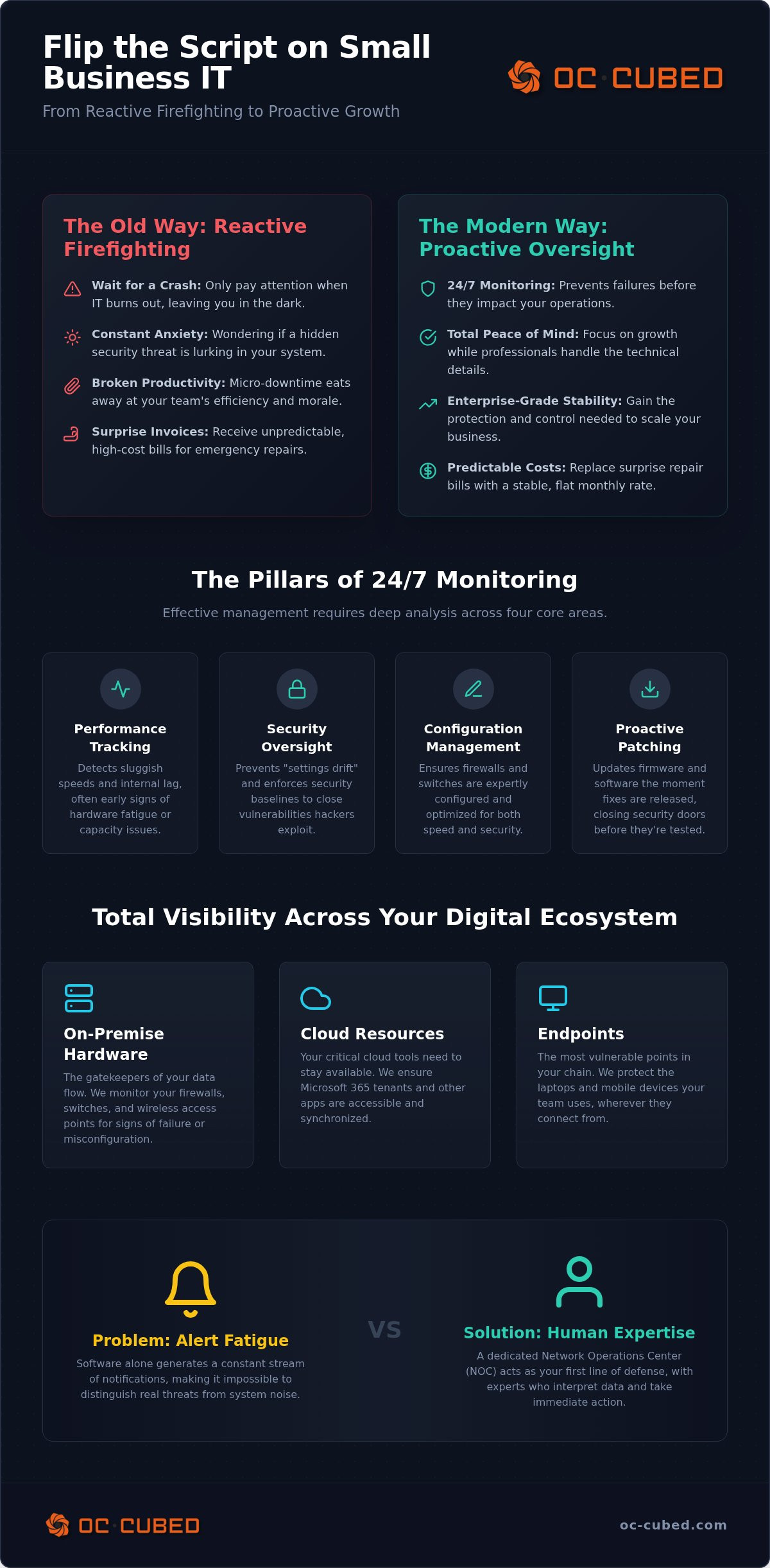
Most small businesses treat their IT network like a lightbulb; they only pay attention when it burns out and leaves them in the dark. You likely understand the frustration of micro-downtime that eats away at your team's productivity or the constant anxiety of wondering if a hidden security threat is lurking in your system. It's exhausting to wait for a crash just to receive a surprise invoice from a technician who only fixes what's already broken.
This guide shows you how to flip the script. You'll discover how proactive IT monitoring for small business prevents downtime before it starts, secures your sensitive data, and replaces reactive headaches with enterprise-grade stability. We'll explore the shift from traditional support models to 24/7 network oversight and explain how this transition delivers predictable monthly costs and total peace of mind for your organization. By moving toward a managed model, you gain the protection and control necessary to focus on growth rather than technical obstacles.
Key Takeaways
- Learn how to move from a reactive model to an always-on infrastructure that prevents failures before they impact your operations.
- Understand why proactive IT monitoring for small business must include both performance tracking and real-time security oversight at the firewall level.
- Discover why software alone is insufficient and how human expertise solves the problem of alert fatigue.
- See how switching to a managed IT retainer stabilizes your budget by replacing unpredictable repair bills with a flat monthly rate.
- Find out what to expect during a professional network audit and how it sets the foundation for long-term growth.
What is Proactive Remote Network Monitoring for Small Business?
Proactive remote network monitoring is the 24/7 oversight of your digital infrastructure by remote experts. Its goal is simple: prevent failures before they disrupt your operations. In the past, many companies relied on a reactive model where you only called for help when something stopped working. Today, that approach is a liability. Modern Network monitoring shifts the focus to an always-on management style. This ensures your systems are healthy, updated, and secure without you ever having to pick up the phone. It's about staying ahead of the curve.
By 2026, the business environment has become too complex for a basic router and off-the-shelf antivirus. You likely manage a mix of office-based hardware and distributed remote connections. This hybrid reality creates more noise and more opportunities for things to go wrong. A dedicated Network Operations Center (NOC) acts as your first line of defense. It provides the steady reliability needed to catch anomalies in real time. This integration gives you the quiet authority to focus on growth while professionals handle the technical background. You don't have to worry about whether a server is up or a firewall is patched; the NOC is already on it.
Key Components of a Modern Network
Your network is more than just wires in a wall. It is a multi-layered ecosystem that requires constant attention. Proactive IT monitoring for small business covers three primary areas to ensure total visibility:
- On-premise hardware: This includes your firewalls, switches, and wireless access points. These are the gatekeepers of your data flow and require precise configuration.
- Cloud resources: Your Microsoft 365 tenants and cloud-hosted applications must stay accessible and synchronized. Monitoring ensures these tools remain available for your team.
- Endpoints: The laptops and mobile devices your team uses every day are often the most vulnerable points in your chain. Endpoint protection keeps these devices safe regardless of where they connect.
Why "Good Enough" IT is a Business Risk
Relying on "good enough" technology creates hidden costs that drain your bottom line. Micro-downtime, those five-minute outages that happen once a week, kills employee productivity and frustrates your team. These small gaps in service add up to hours of lost revenue and damaged morale. Network monitoring is the foundation of business continuity. Without it, you are flying blind. Modern proactive IT monitoring for small business acts as an early warning system. It detects signs of imminent hardware failure, such as an overheating switch or a struggling server drive, allowing for a planned replacement rather than an emergency crash. This level of control replaces technical anxiety with predictable stability and ensures your budget isn't blown by a sudden, avoidable catastrophe.
The Core Elements of 24/7 Network Monitoring
Effective network management requires more than a simple dashboard of green lights. It demands a constant, deep-dive analysis of four core areas to maintain stability. True visibility starts with performance tracking. Sluggish internet speeds or internal lag aren't just minor nuisances. They're often early indicators of capacity issues or hardware fatigue. This Network Monitoring Explained resource highlights how tracking these metrics in real time allows for adjustments before your team's workflow stops entirely. We ensure your speeds always meet your operational demand.
Security oversight and configuration management are equally vital. Settings drift occurs when small, unauthorized changes to your network configuration accumulate over time. These minor shifts create accidental vulnerabilities that hackers love to exploit. Proactive IT monitoring for small business prevents this by enforcing strict security baselines across all hardware. We also handle proactive patching. This means updating your firmware and software the moment a fix is released. We don't wait for a breach to happen. We close the door before an exploit can be used against you.
Firewall and Switch Management
Your firewall is your first line of defense against external cyber threats. It requires expert management to stay hardened against evolving attack methods. We don't just set it and forget it. We monitor firewall logs to detect and block unauthorized access attempts instantly. Similarly, we watch your switches to identify internal bottlenecks. If data isn't moving efficiently between departments, your productivity suffers. Managed configuration ensures your hardware is optimized for both speed and security, providing a foundation you can trust.
Endpoint Protection and Threat Detection
Modern teams connect from various locations, making individual user devices a primary target. We monitor the health and security of every laptop and mobile device remotely to ensure they remain compliant with your safety standards. This includes a tight integration with email security for small business using industry-leading tools like Proofpoint. Early threat detection is your best defense against catastrophe. A single malicious click shouldn't lead to a company-wide ransom event. By isolating threats at the endpoint, we neutralize risks before they can move laterally through your network. Managing these complex layers is a full-time commitment. An all-inclusive managed IT retainer provides the expert oversight needed to keep your infrastructure silent, secure, and stable.
Software vs. Managed Monitoring: The Human Element
Many small businesses fall into the DIY trap. They purchase expensive monitoring software but quickly realize nobody has the time or expertise to watch the dashboard. It's a common mistake. A software license is just a tool, not a solution. Effective proactive IT monitoring for small business requires human intervention to interpret data and act on it. Without a dedicated team, that expensive software often becomes shelfware, providing a false sense of security while alerts go unread in an overflowing inbox.
Then there's the reality of alert fatigue. If your system sends fifty notifications a day, you'll eventually start ignoring them. You might miss a critical system failure because it looked like a minor glitch at first glance. Managed monitoring removes this burden from your shoulders. It also solves the 2 AM factor. Critical networks don't wait for business hours to fail. When a server goes down on a holiday weekend, a remote expert is already working on the fix while you sleep. You shouldn't have to be the one responding to a technical crisis in the middle of the night.
Consider the Total Cost of Ownership (TCO). Buying individual software licenses might seem cheaper upfront, but you're still paying for the human labor required to manage them. If your internal staff spends hours troubleshooting network lag, they aren't focusing on the projects that grow your company. A managed service retainer provides a predictable monthly cost. It covers both the advanced technology and the seasoned experts who run it, ensuring your budget remains stable and your infrastructure remains silent.
The Role of NOC Integration
A Network Operations Center (NOC) is the engine behind your stability. It's a centralized team that provides continuous oversight of your digital environment. There's a massive difference between receiving an automated alert and receiving a remediation report. An alert tells you something is wrong; remediation means the problem was identified and solved before you even knew it existed. For a deeper look at how these systems integrate with your operations, see our Remote IT Management: Complete Guide for Modern Business.
Expertise on Demand
Managed services give you access to high-level specialists without the overhead of a full-time in-house IT hire. You get the benefit of enterprise-grade security standards applied to a small business budget. This helps you meet the rigorous standards outlined in federal Cybersecurity for Small Business guidelines without hiring a six-figure security officer. While a software dashboard only shows you the problem, a managed NOC service provides the hands-on expertise to solve it. This transition from "watching" to "managing" is what creates true peace of mind for business owners.
Strategic Benefits: Using Data to Drive Growth
Proactive IT monitoring for small business isn't just a safety net. It's a financial strategy. By shifting to a managed model, you trade unpredictable emergency repair bills for a flat monthly rate. This stability allows you to plan your budget with total confidence. We also take over the heavy lifting of vendor management. You don't need to spend your afternoon on the phone with an ISP or hardware provider when something goes wrong. We handle those technical conversations for you, ensuring your service providers deliver exactly what they promised in their contracts.
Data-driven decisions rely on clear visibility. Our monthly reports provide a transparent look at your network's health and performance metrics. You'll see which systems are nearing the end of their lifecycle and where your bandwidth is being used most heavily. This information allows you to plan infrastructure upgrades based on facts rather than guesswork. It transforms IT from a mysterious expense into a measurable asset that supports your company's long-term growth.
Compliance and insurance are major hurdles in 2026. Modern cyber insurance providers now require proof of active monitoring and consistent patching before they'll issue or renew a policy. Proactive IT monitoring for small business ensures you meet these strict standards without the stress of a last-minute audit. It provides the concrete documentation needed to prove your digital environment is hardened against threats. This level of transparency can help lower your premiums and significantly reduce your organization's overall liability.
Virtual CIO and CISO Leadership
Fractional leadership is about alignment. We use the data gathered from your network monitoring to build a long-term technology roadmap. This ensures every dollar you spend on IT directly supports your specific business goals. For a deeper look at this approach, read our guide on Enterprise-Grade IT Leadership Without a Full-Time Hire. This high-level guidance helps you scale your operations without the burden of a full-time executive salary.
Business Continuity and Risk Management
Monitoring is the first step in effective disaster recovery. By detecting anomalies early, we significantly reduce the "blast radius" of potential security incidents. If a threat is identified on a single user device, we isolate it before it has the chance to spread across your entire network. This proactive stance is essential for maintaining business continuity and protecting your reputation. Learn more about protecting your assets in our Managed Cybersecurity for Small Business: 2026 Guide.
Implementing Proactive Monitoring with OC Cubed
OC Cubed - Your trusted MSP provides an all-inclusive approach to proactive IT monitoring for small business. We don't just watch your network; we manage it 24/7 with the quiet authority of a seasoned team. This oversight includes full configuration and management of your firewalls and switches to ensure maximum uptime. Our process begins with a comprehensive onboarding phase where we audit your current network and security posture. We look for hidden vulnerabilities that others might miss, creating a solid foundation for your future growth. This audit isn't just a checklist; it's the baseline for your custom technology roadmap.
Seamless integration is where our service delivers the most value. We blend our helpdesk and Network Operations Center (NOC) into a single experience for your entire team. When a staff member needs assistance, they reach a professional who understands your specific environment. In the background, our NOC handles the heavy lifting of Microsoft 365 tenant maintenance and endpoint protection. We also integrate email security with Proofpoint to stop threats before they hit an inbox. This multi-layered defense ensures your team stays productive while your data remains secure. You get a partner who shows up, solves problems, and protects your assets without constant supervision.
The Monthly Managed IT Services Retainer
Surprise invoices from technicians can disrupt your financial planning and create unnecessary friction. Our managed IT services retainer eliminates these costs with a bundled, predictable model. This all-inclusive service covers monitoring, helpdesk support, security remediation, and strategic advisory. By choosing a retainer, you ensure our goals are perfectly aligned with your business uptime. We are incentivized to keep your systems running smoothly. If your network is silent and stable, we've done our job correctly. This model replaces technical anxiety with the steady reliability of a trusted advisor who knows exactly how to fix what goes wrong.
Ready for Proactive Protection?
Taking the first step toward a more stable network is simple. We start with a professional network assessment to evaluate your current infrastructure. This assessment isn't just a technical scan; it's the beginning of a long-term IT partnership designed to scale with your business. You gain access to enterprise-grade security and leadership without the overhead of a full-time in-house department. We focus on removing technical obstacles so you can focus on your company's mission. Our team provides the protection and forward momentum your organization deserves.
Secure Your Infrastructure for Long-Term Growth
Transitioning from a reactive "break-fix" mindset to a proactive one is the most significant step you can take for your company's digital stability. You've seen how human-led oversight prevents micro-downtime and how data-driven insights from a Virtual CIO can align your technology with your business goals. Implementing proactive IT monitoring for small business isn't just about catching errors. It's about building a resilient foundation that supports your team's best work every day.
Choosing a managed approach provides the steady reliability you need to scale without technical anxiety. You gain the benefit of 24/7 NOC integration and a predictable monthly retainer model that eliminates surprise invoices. This level of protection ensures your data stays secure and your infrastructure remains optimized for performance. With a trusted advisor handling the technical background, your path forward is clear and unobstructed.
With a steady hand on your network and a predictable budget in place, you can stop reacting to technical crises and start focusing on what you do best. We're here to ensure your technology remains a silent, powerful enabler of your success.
Frequently Asked Questions
What is the difference between network monitoring and managed IT services?
Network monitoring is a specific technical function that tracks the health and performance of your digital infrastructure. Managed IT services is a comprehensive service model that includes monitoring alongside helpdesk support, security remediation, and strategic leadership. While monitoring identifies a problem, managed IT provides the experts to solve it. OC Cubed bundles these into a monthly retainer to ensure your business remains stable without requiring you to manage individual tools.
Will remote network monitoring slow down my internet speed?
No, remote monitoring will not noticeably impact your internet speed. The software agents used for proactive IT monitoring for small business are designed to be extremely lightweight, sending tiny packets of telemetry data to our Network Operations Center. This process uses a negligible amount of bandwidth, often less than a single web page load. Instead of slowing you down, monitoring actually improves speed by identifying bottlenecks and hardware issues that cause lag before they disrupt your work.
Does remote monitoring mean someone is looking at my private data?
No, our monitoring focuses on the health and performance of your hardware and software, not the content of your private files. We track metadata such as processor usage, disk space, and security logs to ensure system stability. Our team sees that a server is running hot or a firewall blocked an intrusion, but we don't access your sensitive business documents or private communications. This oversight is strictly about protecting your infrastructure and maintaining operational uptime.
How much does remote network monitoring cost for a small business?
Small businesses typically find that proactive IT monitoring for small business is most cost-effective when bundled into a managed services retainer. While industry rates for basic support often vary based on the number of users and devices, OC Cubed uses an all-inclusive monthly model. This approach replaces unpredictable hourly "break-fix" bills with a predictable fee. By consolidating monitoring, security, and support into one package, you eliminate surprise costs and stabilize your annual IT budget.
What happens if the monitoring system detects a threat at 3 AM?
If a threat is detected at 3 AM, our integrated Network Operations Center (NOC) responds immediately to neutralize the risk. You don't have to wait until business hours for a technician to see the alert. Our proactive system triggers a remediation process that can isolate an infected device or block a malicious IP address automatically. This 24/7 oversight ensures that technical crises are resolved while you sleep, preventing a minor overnight glitch from becoming a morning catastrophe.
Can remote monitoring help with my cyber insurance requirements?
Yes, remote monitoring is often a core requirement for obtaining or renewing modern cyber insurance policies. Insurers now demand proof that your business maintains active threat detection and consistent software patching. Our system provides the detailed reporting and documentation needed to demonstrate your compliance with these security standards. By maintaining a hardened network environment, you reduce your overall risk profile, which can help you qualify for better coverage and potentially lower your annual premiums.
Is network monitoring necessary if we only use cloud apps like Microsoft 365?
Yes, monitoring remains essential even for businesses that rely heavily on cloud applications. While Microsoft manages the data center, you are still responsible for the security of your local network, the health of your team's laptops, and the configuration of your Microsoft 365 tenant. We monitor these "last mile" connections to ensure your staff can always reach their tools. Without it, a local firewall failure or a compromised user account could still bring your operations to a standstill.
How long does it take to set up remote monitoring for my business?
The initial setup and onboarding process typically takes between one and two weeks, depending on the complexity of your current infrastructure. This period includes a thorough audit of your firewalls, switches, and endpoints to establish a secure baseline. We work in the background to install monitoring agents and configure security protocols, ensuring there is no disruption to your daily operations. Once the audit is complete, your network is fully integrated into our 24/7 oversight system for immediate protection.


