

A single hour of IT downtime costs 91% of small and mid-sized enterprises an average of $300,000 in 2026. For most business owners, that isn't just a statistic; it's a looming threat to their annual budget and operational stability. You've likely felt the sting of an unpredictable invoice after a week of system failures, wondering why you're paying more for technology that seems to work less. It's exhausting to manage a budget when your IT costs fluctuate based on how many things broke this month.
We understand that you want your technology to be a silent engine for growth, not a source of constant anxiety. This guide will help you settle the managed services vs break fix debate for your organization. We'll compare the hidden risks of reactive support against the predictable stability of a proactive partner. By the end of this article, you'll know how to secure zero unplanned downtime and access high-level security strategy without the six-figure cost of an executive hire. We'll break down the financial reality of both models so you can choose a path that protects your bottom line while fueling your expansion through 2026.
Key Takeaways
- Identify why reactive IT models create a conflict of interest that makes your provider profit from your downtime.
- Explore how proactive monitoring stops technical failures before they impact your productivity or budget.
- Compare the financial logic of managed services vs break fix to find the most stable model for your 2026 growth.
- Learn how co-managed IT empowers your internal team by offloading routine maintenance and 24/7 oversight.
- Discover the value of fractional C-suite leadership in aligning your technology with long-term business goals.
The Fundamental Conflict: Why the Break-Fix Model is Failing in 2026
The traditional break-fix model relies on a fundamental misalignment of incentives. In this setup, your IT provider only generates revenue when your technology fails. If your network is running smoothly, they aren't getting paid. This creates a "Conflict of Interest" where the vendor has no financial motivation to prevent the very problems that halt your productivity. When you analyze managed services vs break fix, this is the most critical distinction to understand. One model rewards stability, while the other thrives on chaos.
The Reality of Reactive IT Support
Break-fix is a reactive cycle of crisis management where technical support only begins after a system failure occurs. This approach forces your team to sit idle while you wait for a technician to respond to an urgent ticket. Because these providers often lack deep institutional knowledge of your specific environment, every ticket becomes a "first-time" investigation. They spend billable hours learning your setup instead of fixing the problem. It's an inefficient use of your time and your capital.
The stakes for this reactive approach have never been higher. According to research, a single hour of IT downtime now costs an average of $300,000 for 91% of small and mid-sized enterprises. You can compare this reactive approach to Wikipedia's definition of managed services, which emphasizes the shift toward ongoing, proactive responsibility. Relying on a technician who only shows up after the damage is done is a high-stakes gamble. Modern businesses simply can't afford to wait for a crisis to secure their operations.
Unpredictable Budgeting and Surprise Invoices
Budgeting for IT under a break-fix model is nearly impossible. You might have three months of low costs followed by a single ransomware attack or server failure that wipes out your entire quarterly budget. Hourly rates of $150 to $225 might seem manageable in isolation, but they are a poor metric for IT value. These numbers don't account for the "downtime tax" or the lost revenue that occurs while your systems are dark. A cheap hourly rate becomes incredibly expensive when the repair takes six hours and your team is paralyzed.
Technology should be a predictable utility, not a series of financial landmines. When you pay for repairs by the hour, you're essentially penalizing your business for its own growth. As your infrastructure expands, your risk and your repair bills grow in tandem. Choosing a model that prioritizes prevention over repair allows you to forecast spending with confidence. It ensures that your technology remains an asset for growth rather than a recurring budget crisis.
Managed IT Services: A Proactive Approach to Business Stability
Managed services isn't just a different way to pay for repairs. It's a different way to run a business. The core philosophy centers on preventing issues before they impact your operations. This shifts the dynamic from a vendor relationship to a true partnership. In this model, your provider's success is tied directly to your uptime. When your systems are healthy, everyone wins. This alignment is the primary advantage when comparing managed services vs break fix.
By utilizing remote IT management services, providers maintain 24/7/365 oversight without the overhead of on-site staffing. You gain enterprise-grade tools that consolidate security, helpdesk, and cloud management into one predictable cost. It's about taking control of your infrastructure instead of letting it control your schedule. You no longer have to worry about whether a technician is available or if they understand your specific network configuration. The systems are already being watched.
Proactive Maintenance and Monitoring
Continuous oversight is powered by NOC integration. This team catches hardware failures like failing hard drives or overheating processors before the "blue screen" ever appears. Automated patch management ensures your software stays current without manual intervention. We also focus on Microsoft 365 license management for small business to optimize your spend and ensure every user has exactly what they need. Endpoint protection remains active and updated across all remote devices, creating a consistent shield for your data regardless of where your team works.
Advanced Security as a Standard
Security isn't an add-on; it's a foundational element of the managed model. We integrate cybersecurity risk management for small business into your daily workflow to stop threats before they escalate. This includes using enterprise tools like Proofpoint email security to block phishing attempts at the inbox. Continuous firewall and switch management prevents unauthorized network access while ensuring your remote devices remain protected. By treating security as a standard requirement rather than an emergency fix, you build a resilient environment. If you're ready to move beyond the uncertainty of hourly repairs, a proactive IT partnership offers the peace of mind you deserve.
The Co-Managed IT Services Model: The Best of Both Worlds?
Many organizations reach a stage where they outgrow the reactive chaos of a break-fix vendor but aren't ready to replace their internal IT staff. This is where the co-managed model provides a strategic middle ground. It isn't an all-or-nothing decision between managed services vs break fix. Instead, co-management is a collaborative partnership where an external provider supplements your existing team with enterprise-grade tools and specialized expertise. You keep your internal institutional knowledge while gaining the stability of a national infrastructure provider.
Solving the 'Drowning IT Manager' Syndrome
Internal IT managers often spend the majority of their time on routine maintenance like resetting passwords, managing updates, and troubleshooting hardware connections. This leaves them no time for the strategic projects that actually drive your business forward. By offloading infrastructure maintenance to a managed partner, your internal team can focus on proprietary software and user experience. We provide the 24/7 NOC integration and network monitoring tools that internal departments often lack the budget to acquire independently.
Co-managed IT acts as a force multiplier for internal teams by providing the sophisticated oversight and automated patching required to maintain 100% uptime. This arrangement removes the burden of after-hours emergency calls from your staff. Your internal manager stays in control of the high-level vision, while the MSP ensures the digital foundation remains rock-solid. It is an efficient way to scale your technical capabilities without doubling your internal headcount.
Filling the Security and Compliance Gap
The complexity of cybersecurity and state-level privacy laws has made it difficult for a generalist IT person to stay current. Hiring a full-time security specialist can cost upwards of $150,000 per year, a figure that is out of reach for many small businesses. Co-management allows you to augment your staff with a fractional CISO or security expert. You gain access to high-level governance and advanced threat remediation that requires constant, 24/7 eyes-on-glass monitoring.
This model ensures that your compliance standards are met consistently without burdening your daily helpdesk staff. We implement enterprise tools like Proofpoint email security and managed firewalls to create a defensive perimeter that your generalist staff can then manage on a day-to-day basis. It provides the high-level strategy needed to navigate modern AI governance and incident reporting requirements. You get the protection of a full security team while maintaining the personal touch of your in-house staff.
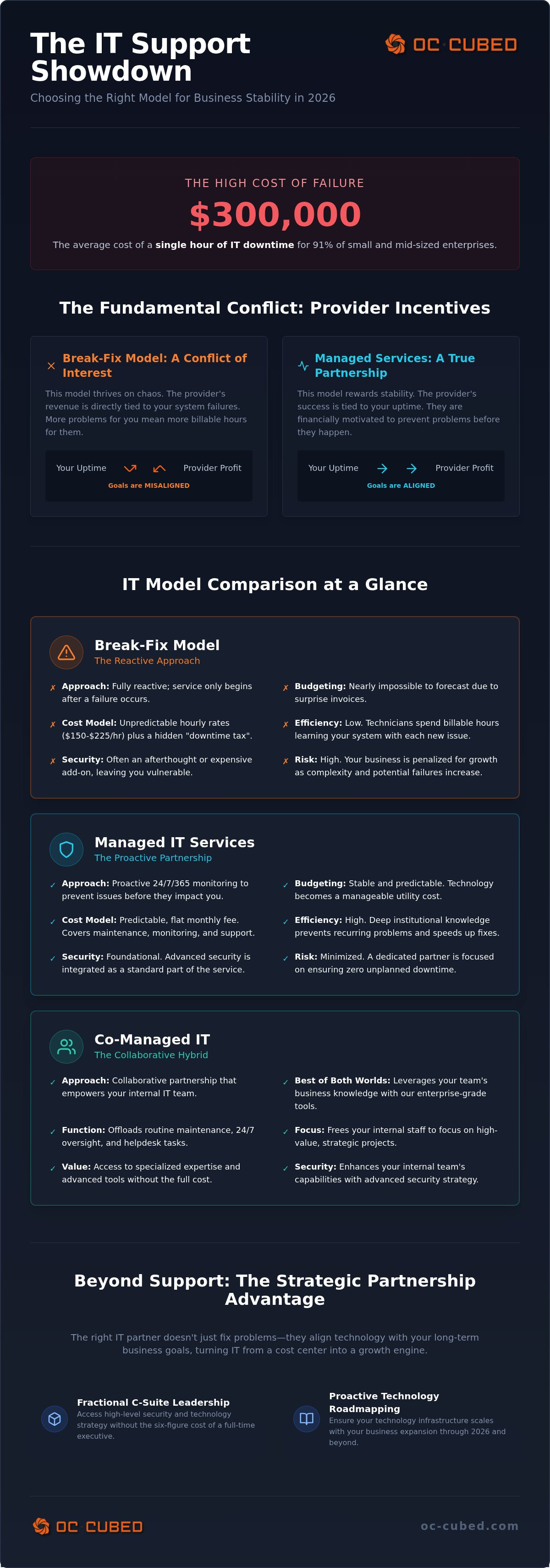
Break-Fix vs. Managed Services vs. Co-Managed: A 2026 Comparison
Choosing the right IT model requires a clear look at your financial logic and risk tolerance. In the managed services vs break fix debate, the primary difference is how you value uptime. Break-fix uses a "best effort" response model. This means you wait at the back of the line during regional outages or high-demand periods. Managed services provide Service Level Agreements (SLAs) that guarantee specific response times. You aren't just paying for a repair; you're paying for a contractual commitment to your business continuity.
The strategic depth of these models also varies significantly. Break-fix focuses exclusively on repairing what is already broken. It offers no forward-looking guidance or architectural planning. Managed services provide IT leadership without full-time hire costs, giving you access to vCIO advisory services. This ensures your technology roadmap aligns with your 2026 growth targets instead of just reacting to mounting technical debt. You gain a partner who carries the burden of prevention, sharing the risk of a cyberattack rather than just billing you to clean up the aftermath.
Choosing Based on Business Growth Stage
Break-fix might still work for micro-businesses with fewer than five employees and zero regulatory compliance needs. If your operations can handle a full day of downtime without losing significant revenue, the hourly model is a low-risk option. However, scaling past 20 employees or handling sensitive client data acts as a trigger for moving to fully managed IT. At this stage, the complexity of Microsoft 365 maintenance and security remediation requires constant oversight. If you already have a trusted IT person on staff, the "institutional knowledge" test suggests a co-managed approach. This allows you to supplement their internal expertise with our enterprise-grade tools and 24/7 monitoring.
Total Cost of Ownership (TCO) Analysis
A true TCO analysis looks beyond the hourly invoice. You must calculate the cost of four hours of downtime, including lost wages and missed sales opportunities, against a fixed monthly fee. Many businesses find that preventing a single major outage pays for an entire year of managed support. License optimization and the prevention of "Shadow IT" also contribute to the bottom line. The cheapest hourly rate often leads to the most expensive annual spend because it lacks the preventive maintenance that keeps systems running at peak efficiency. Predictability is the ultimate hedge against the rising costs of technical failure.
Strategic IT Leadership: The OC Cubed Hybrid Advantage
Understanding what is a managed service provider is only the baseline in 2026. Most organizations need more than just a helpdesk. They need a strategic partner who understands their business goals. When evaluating managed services vs break fix, the deciding factor is often the level of leadership provided. The OC Cubed - Your trusted MSP Hybrid Advantage centers on this transition from technical support to business enablement. We provide 100% remote efficiency backed by national-scale security expertise. It's a model designed for leaders who want to eliminate the friction of technical debt.
The Virtual CIO (vCIO) role is critical for long-term stability. Instead of reacting to failures, we focus on proactive roadmapping and budget forecasting. This approach eliminates the surprise costs that often complicate the managed services vs break fix decision. We align your technology with your specific objectives for 2026 and beyond. You get a clear path forward without the $200,000 salary of a full-time executive hire. It's about building a foundation that supports expansion rather than just patching holes.
Fractional Executive Leadership Included
We provide high-level leadership that scales with your needs. This includes a Virtual CISO to manage your security governance so you don't have to worry about compliance. We also handle your vendor management. Our team deals with the ISPs and software companies so your staff can stay focused on productive work. We ensure your Microsoft 365 tenant is fully optimized. We balance security requirements with cost efficiency to protect your bottom line. You gain the benefit of an entire IT department for a fraction of the cost of a single hire.
Next Steps: Auditing Your Current IT Model
Moving away from a reactive model starts with a simple gap analysis. You should evaluate your current support structure against your 2026 growth targets. If you're experiencing repeated downtime or unpredictable invoices, it's time to audit your risk. The first 30 days of transitioning from break-fix to managed services involves a deep dive into your infrastructure. We document your systems, secure your endpoints, and establish a baseline for performance. This creates the stability you need to stop worrying about IT and start focusing on your core mission.
Securing Your Business Foundation for 2026
Relying on a reactive IT model is no longer just a technical risk; it's a financial one. The hidden costs of downtime and the conflict of interest inherent in hourly billing can stall your progress. When you evaluate managed services vs break fix for your 2026 strategy, the most important factor is alignment. You need a partner whose goals match yours. A proactive approach ensures your budget is predictable and your systems are resilient.
OC Cubed provides that alignment through 24/7 NOC monitoring and expert management of your Microsoft 365 and Proofpoint environments. We remove the burden of routine maintenance while providing the fractional C-suite leadership your business needs to stay competitive. You gain enterprise-grade protection and a clear technical roadmap without the overhead of a full-time executive hire. It's time to stop managing crises and start managing growth.
Your technology should be the silent engine driving your expansion. By choosing a model built on stability and foresight, you're giving your team the tools they need to succeed. We're here to help you make that transition seamless and secure.
Frequently Asked Questions
Is managed IT services more expensive than break-fix in the long run?
Managed IT is generally more cost-effective because it eliminates the "downtime tax" associated with reactive repairs. While break-fix invoices appear lower during months with no issues, a single hour of downtime costs an average of $300,000 for most small and mid-sized enterprises in 2026. By choosing managed services vs break fix, you replace these catastrophic surprise bills with a predictable monthly retainer. This stability allows you to invest in growth rather than emergency recovery.
Can a co-managed IT services model work if I already have an IT manager?
A co-managed model is specifically designed to empower your existing IT manager by offloading routine infrastructure tasks. We handle the 24/7 network monitoring and automated patching that often consumes an internal manager's entire day. This partnership provides your team with enterprise-grade tools and NOC integration without increasing your headcount. Your internal staff stays focused on proprietary software and high-level business goals while we ensure the digital foundation remains secure and stable.
What is the biggest risk of staying with a break-fix IT provider?
The biggest risk is the fundamental conflict of interest where your provider only generates revenue when your systems fail. In a reactive setup, there is no financial incentive for the vendor to perform the proactive maintenance required to prevent outages. This leaves your business vulnerable to hidden security gaps and repeated downtime. In the 2026 threat landscape, waiting for a failure to occur before seeking support is a high-stakes gamble that often leads to data loss.
Does OC Cubed offer 24/7 support as part of the managed services retainer?
OC Cubed includes 24/7 network monitoring and NOC integration as a core component of our managed services retainer. This continuous oversight allows us to identify and remediate hardware failures or security threats before they impact your operations. While we are a 100% remote provider, our automated systems and threat detection tools work around the clock to maintain your uptime. You gain peace of mind knowing that your infrastructure is being watched even when your team is offline.
How long does it take to transition from break-fix to a managed model?
Most businesses complete the transition from a reactive model to a managed retainer within 30 days. This initial period focuses on a comprehensive audit of your current infrastructure and the implementation of essential security tools. We document your network configuration, secure your endpoints, and optimize your Microsoft 365 tenant during this phase. This structured onboarding process ensures a seamless shift that establishes a baseline for long-term stability and proactive growth through technology.
Will I lose control over my company data if I use a managed service provider?
You maintain full ownership and control over your company data at all times. Our role as a managed service provider is to act as a protector and enabler of your digital assets, not an owner. We implement robust security governance and access controls to ensure your data remains protected from unauthorized access. Our management of your environment is transparent, providing you with monthly reporting and fractional C-suite leadership to keep you informed and in command.
What specific security tools are included in OC Cubed's managed services?
Our managed services include a comprehensive suite of enterprise-grade security tools. We provide Proofpoint email security to stop phishing at the inbox and active endpoint protection for all user devices. Our team also handles firewall and switch management, along with continuous security threat detection and remediation. These tools are integrated into your daily workflow to provide a resilient defense against modern cyberattacks without requiring your team to manage the technical complexity themselves.
Does managed IT include support for remote employees and home offices?
Yes, our model is built specifically for the modern distributed workforce. As a 100% remote provider, we specialize in delivering remote IT support and endpoint protection for employees regardless of their physical location. We manage your Microsoft 365 tenant and secure home office connections to ensure your data remains protected across the entire national landscape. This approach allows your business to scale and hire talent anywhere in the United States while maintaining enterprise-grade security standards.


