
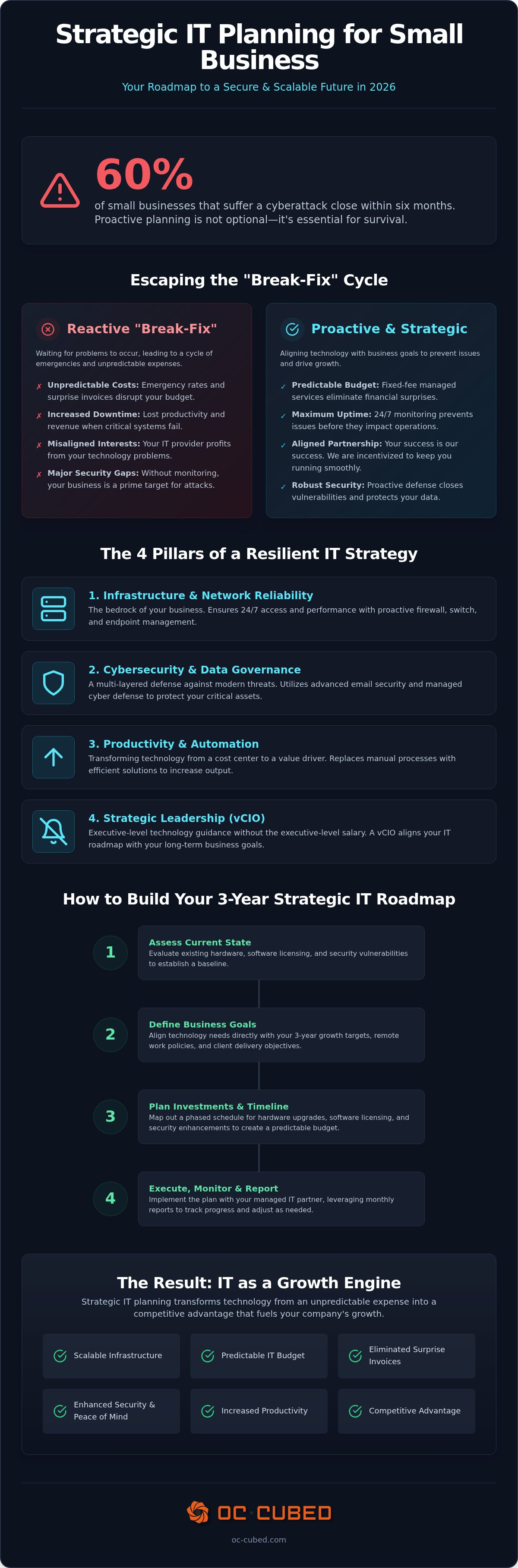
Did you know that 60% of small businesses that suffer a cyberattack close their doors within just six months? It is a sobering reality in 2026. Technology is no longer just a support tool; it is the foundation of your entire operation. You have likely felt the frustration of a surprise repair invoice or the sting of a system crash during a peak sales period. It often feels like you are playing catch-up with your own tools instead of leading your team.
Strategic IT planning for small business changes that dynamic. It turns your technology into a predictable growth engine rather than a source of anxiety. You deserve a clear path forward where every dollar spent on tech actually moves the needle for your company. This roadmap explains how to align your digital infrastructure with your 2026 business goals. We will explore how to eliminate emergency repair costs, secure your remote workforce, and leverage fractional leadership to build a scalable, secure future.
Key Takeaways
- Discover why moving from a reactive "break-fix" mindset to proactive management is the first step toward long-term operational stability.
- Learn the four essential pillars of a resilient infrastructure, including how to integrate managed security to protect your assets in a 2026 threat landscape.
- Understand how strategic IT planning for small business leverages vCIO advisory services to provide executive-level technology leadership at a fraction of the cost of a full-time hire.
- Follow a step-by-step guide to building a three-year IT roadmap that aligns your hardware, licensing, and security with your specific growth targets.
- See how monthly reporting and fixed-fee managed services eliminate surprise invoices and turn your IT department into a scalable growth engine.
Beyond the Break-Fix Cycle: Why Small Businesses Need Strategic IT Planning
Strategic IT planning for small business is the process of aligning your technology investments with your long-term commercial goals. It moves you away from a "break-fix" model where you only pay for IT when something stops working. In a break-fix environment, your interests and your IT provider's interests are fundamentally misaligned. They make money when you have problems. A strategic approach ensures your technology works for you, not against you, by preventing issues before they disrupt your workflow.
Transitioning to a managed, proactive model provides a predictable IT budget for 2026. Instead of waiting for a server to fail or a workstation to lag, you follow a roadmap that anticipates needs. This shift replaces anxiety with steady reliability. You stop viewing technology as an unpredictable expense and start seeing it as a controlled asset that supports your operations.
The High Cost of Reactive Technology
Unplanned downtime is a silent revenue killer. Research indicates that 43% of all cyberattacks target small businesses, yet many companies still operate without a proactive defense. When a system fails, the costs go far beyond the technician's hourly invoice. You lose employee productivity, customer trust, and potentially your entire operation. Data shows that 60% of small businesses that suffer a major cyberattack close within six months.
Reactive IT forces you into a cycle of emergency labor rates and surprise invoices. By utilizing remote IT management services, you close the "Security Gap" that reactive models leave wide open. This proactive stance ensures your systems are monitored 24/7. You stop wondering when the next disaster will strike. You gain peace of mind knowing your infrastructure is protected by a seasoned team.
Shifting from Cost Center to Value Driver
Technology shouldn't just be a line item on your balance sheet. It's a tool for automation and scale. A well-designed roadmap identifies where manual processes can be replaced by efficient software or hardware solutions. This increases your employee output without necessarily increasing your headcount. It's about working smarter, not harder.
When you understand the Components of a strategic technology plan, you can allocate resources with a higher ROI. You aren't just buying laptops; you're building a platform that supports remote work and faster client delivery. This shift turns your IT from a necessary evil into a genuine competitive advantage. You gain the clarity needed to make tech investments that actually matter for your bottom line.
The 4 Core Pillars of a Resilient IT Strategy in 2026
Building a resilient company requires more than just buying the latest gadgets. It demands a structured approach that covers every angle of your digital operations. Effective strategic IT planning for small business rests on four critical pillars: infrastructure, security, productivity, and leadership. These elements work together to ensure your systems are fast, safe, and ready to scale as your revenue grows. When these pillars are stable, technology becomes an invisible enabler rather than a constant hurdle.
Infrastructure and Network Reliability
Infrastructure is the bedrock of your business. Without 24/7 network monitoring and proper configuration, a single failed switch can halt your entire production. We focus on proactive firewall and switch management to prevent these bottlenecks before they impact your bottom line. For a distributed, remote-first workforce, endpoint protection is no longer optional. It is the frontline defense that keeps company data secure on every laptop, regardless of where your employees log in. Reliability starts with hardware that is built to handle your growth targets.
Cybersecurity and Data Governance
Standard antivirus software is insufficient for the sophisticated threats of 2026. Modern attacks often bypass basic filters, making a comprehensive managed cybersecurity for small business strategy essential for survival. Phishing remains a primary threat to your data integrity. This is why we utilize Proofpoint for advanced email security to stop attacks before they reach an inbox. Following Cybersecurity best practices for small businesses helps you maintain client trust and meet evolving regulatory requirements. Implementing a robust cybersecurity risk management small business plan ensures your expansion isn't derailed by a preventable breach.
Cloud Ecosystem and Productivity
Microsoft 365 is the engine of modern collaboration, but it requires active tenant maintenance to stay efficient and secure. Proper cloud management allows for seamless remote IT support, ensuring your team stays productive from any location. When managed correctly, Microsoft 365 acts as a unified platform that prevents fragmented data silos from slowing down your decision-making. Optimizing these tools ensures your staff spends less time fighting with software and more time serving your customers.
The final pillar is leadership. Most small businesses don't need a full-time, six-figure executive to manage their tech. Instead, they need fractional guidance to oversee these pillars and ensure the technology roadmap stays aligned with commercial objectives. You get the expertise of a seasoned professional without the overhead of an additional executive salary.
Strategic IT Planning Models: In-House vs. vCIO Advisory
Small businesses often reach a crossroads where their technical needs outpace their internal expertise. Hiring a full-time Chief Information Officer (CIO) can cost over $200,000 annually. This is a steep price for a growing company to pay for leadership alone. Conversely, relying on an internal technician often leads to a strategy vacuum. These staff members are typically overwhelmed by day-to-day tickets. They lack the bandwidth to develop a comprehensive investment strategy that looks three years into the future.
What is a Virtual CIO (vCIO)?
A vCIO is a fractional executive who provides high-level guidance without the burden of a full-time salary. They focus on the big picture rather than just fixing PCs. This model delivers IT leadership without a full-time hire. You get the benefit of a seasoned professional who has seen dozens of different environments and knows what works.
The specific deliverables of a vCIO include:
- Multi-year IT roadmaps aligned with business growth.
- Predictable budget planning to eliminate surprise costs.
- Security governance and compliance audits.
- Professional vendor management to streamline third-party software and hardware relationships.
They also navigate the complex regulatory environment of 2026. Whether you need to comply with the transparency requirements of the EU AI Act or the resilience mandates of DORA, you need an expert who understands how these rules impact your technology stack. They ensure your data governance policies aren't just a document on a shelf; they become a functional part of your infrastructure.
Why Managed IT Outperforms Break-Fix
The traditional break-fix model creates a fundamental conflict of interest. Your provider only makes money when your systems fail. This reactive approach is the enemy of strategic IT planning for small business. Managed services operate on a flat-rate monthly model. This aligns our goals with yours. We are incentivized to keep your systems running perfectly because downtime costs us money, too.
Enterprise-grade support is achieved through helpdesk and NOC integration. This ensures that while the vCIO handles the strategy, a dedicated team monitors your network 24/7. You gain the stability of a large IT department with the agility of a specialized partner. This combination of strategic foresight and technical execution is what drives sustainable growth for your company.
How to Build Your 3-Year Strategic IT Roadmap
A plan is only as good as the data behind it. Successful strategic IT planning for small business requires a documented sequence of improvements that mirror your commercial goals. You shouldn't be guessing which server to replace or which software to license next month. Instead, you follow a roadmap that anticipates these needs years in advance. This approach ensures your technology evolves alongside your revenue targets without causing financial friction.
The IT Audit: Knowing Where You Stand
You can't plan for the future without a clear view of the present. The first step is a comprehensive audit of your current environment. We evaluate your Microsoft 365 tenant health to ensure security configurations meet 2026 standards. We also assess hardware lifecycles. If your workstations are nearing the end of their reliable life, they become a productivity liability. Finally, we identify vulnerabilities in your remote support setup to ensure your distributed team stays secure. This audit provides the baseline for every decision that follows.
Goal Alignment and Budgeting
Effective technology initiatives must support your business objectives. If your goal is to reduce operational overhead, your roadmap might prioritize a full cloud migration to eliminate physical server costs. If you plan on doubling your headcount by 2027, we plan for scalable licensing and proactive network configuration today. This transition allows you to move from unpredictable capital expenditure (CapEx) to a steady, predictable operating expenditure (OpEx) model. A comprehensive 3-year budget is the only way to avoid surprise IT bills that disrupt your financial planning.
Once the foundation is set, you must maintain the momentum through a structured execution plan. We recommend a five-step process to keep your roadmap on track:
- Conduct a comprehensive IT audit: Review security, hardware, and licensing.
- Align IT goals with growth targets: Match tech spend to revenue and headcount projections.
- Create a prioritized project list: Rank migrations, upgrades, and security enhancements by urgency.
- Establish a 3-year budget: Map out every expected expense to eliminate "surprise" invoices.
- Schedule quarterly strategic reviews: Adjust the plan based on new market trends or business shifts.
Quarterly reviews are essential. They ensure your roadmap isn't a static document. As your business grows or new regulations emerge, your vCIO helps you pivot without losing progress. This constant refinement keeps your technology aligned with your mission.
Executing the Plan: Managed IT as a Growth Engine
Execution is where your vision meets reality. OC Cubed - Your trusted MSP acts as the strategic engine for your company, ensuring that the roadmap we built together actually reaches its destination. While our helpdesk and NOC teams handle daily support tickets, our virtual project management keeps your long-term initiatives moving forward. This separation of duties is vital. It means your security migrations and infrastructure upgrades don't stall just because a staff member has a login issue. This approach is the cornerstone of effective strategic IT planning for small business. You receive the executive-level leadership necessary for growth without the distraction of managing technical minutiae yourself.
A plan is only as strong as its implementation. Without dedicated project management, strategic goals often get buried under the weight of immediate technical issues. We prevent this by separating strategy from support. Your vCIO focuses on the milestones in your roadmap, ensuring that hardware refreshes and security enhancements happen on schedule. This proactive rhythm keeps your business agile and ready to capitalize on new opportunities without being held back by aging infrastructure. You gain the steady reliability of a team that monitors your network 24/7 while looking ahead to your next expansion.
The Role of Monthly Reporting
Clear data is the enemy of uncertainty. Monthly reporting is a core component of our service that keeps you informed and in control. These reports provide a transparent view of your security threat detection, network uptime, and the progress of ongoing roadmap projects. You stop making technology decisions based on "gut feelings" or recent frustrations. Instead, you use hard data to validate your investments and track your ROI. Regular touchpoints with your vCIO ensure that the plan remains relevant as your business evolves. It's a collaborative process that replaces technical jargon with commercial clarity.
Getting Started with OC Cubed - Your trusted MSP
Getting started is a structured process designed to build immediate stability. We begin with a comprehensive audit of your environment, identifying risks and performance bottlenecks. From there, we develop your custom 3-year roadmap. Our fixed-fee monthly retainer model supports this long-term approach. It eliminates the financial friction of traditional IT consulting. You get a partner invested in your success, not a vendor waiting for your systems to break. We take the burden of technology off your shoulders so you can focus on leading your team toward its 2026 goals.
Building Your Future on a Stable Foundation
Transitioning from reactive repairs to a proactive model is the most effective way to protect your revenue in 2026. By integrating 24/7 proactive monitoring and enterprise-grade security, you remove the technical obstacles that often stall growth. Fractional vCIO leadership ensures your technology roadmap stays aligned with your commercial objectives without the overhead of a full-time executive salary. This structured approach gives you the control and protection needed to scale with confidence.
Strategic IT planning for small business turns your technology from a constant source of stress into a predictable growth engine. It replaces surprise invoices with a clear, documented path forward. You deserve the peace of mind that comes from knowing your systems are monitored, secured, and optimized for your specific goals. This shift allows you to stop worrying about what might break and start focusing on where your business is going.
You don't have to navigate the complexities of the modern tech landscape alone. With a seasoned partner like OC Cubed - Your trusted MSP and a resilient strategy in place, you can focus on leading your team and serving your customers. Your growth is the priority, and the right roadmap will help you reach it.
Frequently Asked Questions
What is strategic IT planning for small business?
Strategic IT planning for small business is the process of aligning your technology infrastructure with your long-term commercial objectives. It involves mapping out hardware, software, and security needs years in advance. This approach ensures your digital tools support your growth rather than causing bottlenecks. Instead of reacting to failures, you proactively invest in systems that increase efficiency and protect your revenue. It turns technology from an unpredictable expense into a controlled asset.
How much should a small business spend on IT strategy?
Most small businesses should focus on a predictable monthly retainer model rather than one-off emergency repairs. While specific costs vary based on headcount and infrastructure complexity, the goal is to shift from capital expenditure to operating expenditure. This allows for better cash flow management and eliminates surprise invoices. Investing in fractional executive leadership ensures you spend your budget on tech that actually drives ROI. It's about value, not just the lowest price tag.
What is the difference between a CIO and a vCIO?
A Chief Information Officer (CIO) is a full-time executive responsible for a company's technology strategy and implementation. A Virtual CIO (vCIO) provides the same high-level leadership on a fractional basis. This model gives small businesses access to seasoned expertise without the six-figure salary of a dedicated hire. Your vCIO handles vendor management, security governance, and roadmap planning. They act as a trusted advisor who understands your business goals and ensures your technology supports them.
How often should we update our IT roadmap?
You should conduct a formal review of your IT roadmap every quarter. Technology changes rapidly, and your business goals might shift as you scale. Quarterly touchpoints with your vCIO allow you to adjust priorities and budgets based on real-world performance data. An annual deep dive is also necessary to assess hardware lifecycles and major software transitions. Constant refinement ensures your plan remains a functional tool rather than a static document gathering dust.
Can strategic IT planning help with cybersecurity?
Security is a foundational pillar of any modern technology strategy. Strategic IT planning for small business identifies vulnerabilities before they are exploited by attackers. We implement layers of protection, such as endpoint security and Proofpoint email filtering, as part of a long-term defense plan. This proactive stance is essential because 60% of small businesses close within six months of a major breach. A well-designed roadmap ensures your security posture evolves to meet new threats.
What are the first steps in creating an IT budget?
The first step is conducting a comprehensive audit of your current hardware, software, and security configurations. You need a clear inventory of your assets and their remaining lifecycles. Next, align your spending with your growth targets, such as planned headcount increases or new service offerings. This data allows you to move toward a fixed-fee monthly managed services model. It replaces the "gut feeling" approach with a documented, data-driven financial plan for your technology.
Does my small business really need a 3-year IT plan?
A 3-year plan is essential for avoiding emergency replacements and surprise invoices. Most hardware has a predictable lifecycle, and software needs change as your team grows. Mapping these transitions over several years allows you to distribute costs evenly and avoid massive capital outlays. It also ensures your infrastructure is ready for future scaling. Without a long-term plan, you are constantly playing catch-up with your own technology, which distracts you from leading your company.
How does Microsoft 365 fit into a strategic IT plan?
Microsoft 365 serves as the core productivity engine for most modern organizations. It's not a set-and-forget tool. Strategic planning includes ongoing tenant maintenance to ensure security settings and collaboration features are optimized. Proper cloud management prevents data silos and supports a seamless remote workforce. Integrating Microsoft 365 into your roadmap ensures your team has the right tools for maximum output while keeping your company data protected within a secure, managed environment.


