

What if your biggest technology headache wasn't a broken server, but the unpredictable invoice that followed it? For many executives, the real cost of IT isn't just the hardware; it's the constant anxiety over potential breaches and the lack of a clear strategy for growth. You've likely felt the frustration of paying for solutions that only seem to fix problems after they've already disrupted your workday. Finding reliable managed IT services should mean more than just having someone to call when a laptop fails.
You deserve a partner that acts as both a protector and an enabler. We agree that technology should be a silent engine for your success, not a source of surprise expenses. This guide explains how modern managed IT provides the proactive security, remote support, and executive leadership your organization needs to eliminate downtime. You'll discover how a flat-rate retainer creates predictable monthly spending. We also examine how enterprise-grade tools and fractional vCIO advisory services ensure your business remains secure and compliant as data privacy regulations continue to evolve.
Key Takeaways
- Learn why shifting from a reactive "break-fix" mindset to a proactive partnership is essential for eliminating unplanned downtime.
- Understand the speed and security advantages of remote-first managed it services in washington dc, which provide faster remediation than traditional on-site models.
- Discover how flat-rate monthly retainers replace unpredictable hourly invoices with steady, predictable technology spending.
- Identify why modern security requires more than basic antivirus, including the integration of enterprise-grade tools like Proofpoint for email protection.
- Explore how fractional vCIO and CISO advisory services provide high-level strategy and vendor management for growing organizations.
Understanding Managed IT Services in Washington DC: A Proactive Shift
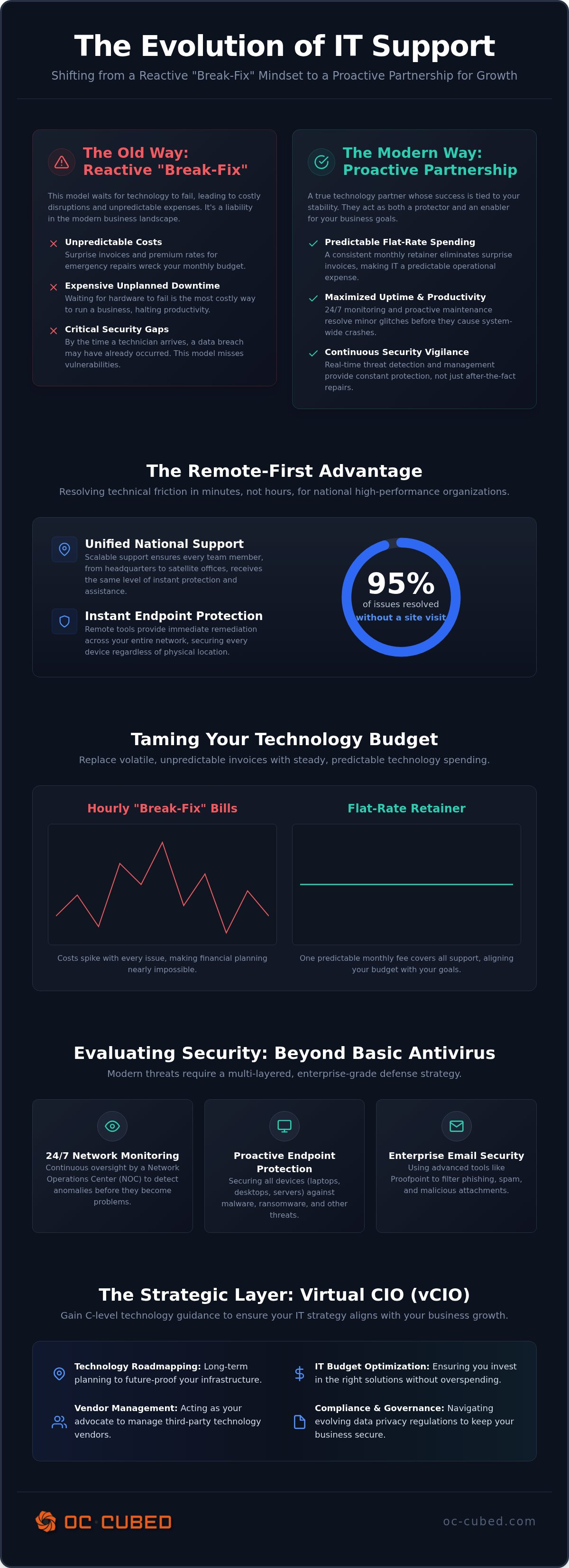
Business leaders often view technology as a utility. It's something you pay for only when it fails. This "break-fix" approach is a liability in 2026. Managed services represent a fundamental shift in this logic. Instead of a vendor who profits from your failures, you gain a partner whose success is tied to your stability. High-performing organizations rely on managed it services in washington dc to maintain a competitive edge. This isn't just about outsourcing helpdesk calls. It's about a comprehensive partnership where the provider manages your entire technology stack.
A true technology partner doesn't just respond to tickets. They take ownership of your network monitoring, configuration, and long-term roadmap. They act as a protector and an enabler. This relationship removes the friction between your business goals and your digital tools. When your IT partner manages everything from firewall settings to Microsoft 365 maintenance, you can stop worrying about the "how" and focus on the "what" of your business growth.
The Problem with Reactive IT Support
Waiting for hardware to fail leads to expensive unplanned downtime. It's the most costly way to run a business. You face "surprise" IT invoices that wreck your monthly budget. Emergency repairs usually come with premium rates. More importantly, reactive support often misses critical security vulnerabilities. By the time a reactive technician arrives, the data breach has already happened. Security requires constant vigilance, not a repairman who only shows up when the alarm is already ringing.
The 2026 Managed Services Advantage
Modern managed services provide continuous threat detection. This is a massive leap over old-fashioned annual security audits. Your business needs real-time eyes on the network. Helpdesk and NOC integration ensures 24/7 uptime by resolving minor glitches before they trigger a system crash. We monitor your firewalls, switches, and cloud environments around the clock. This proactive stance means we find and fix issues while your team is sleeping. Managed it services in washington dc provide the steady reliability you need to scale without technical roadblocks.
Managed IT is a growth-enabling strategy for 2026 that turns technology from a cost center into a competitive advantage.
The Remote-First Advantage for National Managed IT
Many traditional providers still rely on a legacy model that requires dispatching technicians to a physical office. This approach is inherently slow. In a high-speed environment, waiting for a car to arrive in traffic is a strategic failure. Remote-first support is the standard for high-performance national organizations. It's faster, more efficient, and often more secure than manual intervention. When you utilize managed it services in washington dc, you gain the ability to resolve technical friction in minutes rather than hours. This model allows for instant endpoint protection and remediation across your entire network, regardless of where your team is located.
Scalability is the primary benefit of this approach. Businesses with distributed teams can't wait for local technicians in every city. Remote tools provide a unified view of your technology stack. This ensures that a staff member in a satellite office receives the same level of protection as someone in the headquarters. For a deeper look at these technical workflows, you can explore our Remote IT Management Guide. Transitioning to a remote-first model ensures that your growth isn't limited by physical proximity to an IT shop.
Instant Response via Helpdesk Integration
Helpdesk and NOC integration is the engine of modern uptime. A sophisticated remote helpdesk can resolve over 95% of common technical issues without a site visit. This speed is critical for maintaining productivity. While the helpdesk supports your people, the Network Operations Center (NOC) monitors your infrastructure. This continuous oversight detects anomalies in server health or connectivity before they cause a crash. Beyond speed, this model significantly reduces a company’s overhead and carbon footprint. You aren't paying for a technician's travel time or fuel; you're paying for their expertise and results.
Security at the Edge: Endpoint Protection
Security no longer stops at the office door. We manage firewalls and switches remotely to ensure consistent security policies across all locations. This centralized control is vital for preventing ransomware. Proactive endpoint threat detection monitors individual devices for suspicious behavior in real time. If a laptop is targeted, we can isolate it from the network instantly. This level of control aligns with current FTC cybersecurity guidance regarding the protection of sensitive data. OC Cubed manages these complex firewall and switch configurations across national locations to keep your data locked down. If you want to see how this level of protection fits your organization, you can view our service options to learn more.
Comparing Managed IT Models: Flat-Rate Retainers vs. Hourly Bills
Choosing how to pay for technology support is as important as the support itself. For many firms, the traditional hourly billing model creates a fundamental conflict of interest. A break-fix technician only makes money when your systems fail. This means they have little incentive to invest in the long-term health of your infrastructure. In contrast, managed it services in washington dc typically operate on a flat-rate monthly retainer. This model flips the script. When your systems are stable, your provider is successful. This alignment of goals ensures that your IT partner is constantly looking for ways to prevent problems rather than just reacting to them.
A monthly retainer acts as a powerful budgeting tool. It replaces the "peaks and valleys" of IT spending with a predictable, fixed cost. You won't face a massive, unbudgeted invoice because a server crashed or a workstation needed an emergency patch. Modern retainers are designed to be all-inclusive. They bundle essential services like Microsoft 365 maintenance, security threat detection, and remote support into a single fee. This bundling often saves money compared to purchasing individual licenses and security tools separately. It provides a level of financial control that hourly billing simply cannot match.
Why Flat-Rate Support Aligns Business Goals
The psychological benefit of a flat-rate model is the "steady reliability" it provides. You gain peace of mind knowing that your technology is being watched 24/7 without a ticking clock on every phone call. Hourly billing often encourages "band-aid" fixes. If a technician is worried about your bill, they might choose the fastest fix rather than the most thorough one. Flat-rate support encourages root-cause solutions. We want to fix the problem once and fix it right, because recurring issues cost us time and cost you productivity. This approach allows for better long-term financial planning because your IT costs remain static while your business scales.
What Should Be Included in Your Monthly Fee?
A comprehensive retainer should cover the entire lifecycle of your technology. At a minimum, your monthly fee should include remote IT support, proactive Microsoft 365 tenant maintenance, and continuous network monitoring. It should also provide executive-level transparency through monthly reporting. These reports help you see exactly what's happening in your environment and where your technology stands. For a detailed look at what you should expect from a partner, read our MSP Guide for Leaders. This transparency ensures that you aren't just paying for "support," but for a managed strategy that protects your organization's future.
Evaluating Managed IT Security: Beyond Basic Antivirus
Antivirus is a baseline, not a strategy. In 2026, threats move too fast for reactive software to keep pace. Relying solely on a scanning tool is like locking your front door while leaving the windows wide open. Effective managed it services in washington dc must provide a more robust defense through continuous Threat Detection and Remediation. This isn't a one-time setup. It's an active, ongoing process where engineers monitor network behavior in real time. We look for anomalies that signal a breach before your data is encrypted or exfiltrated. This proactive stance turns security from a hope into a measurable result.
Traditional security often fails because it waits for a known virus signature to appear. Modern attackers use polymorphic code and "living off the land" techniques that bypass these old filters. Threat remediation involves isolating infected endpoints the moment suspicious activity is detected. This speed prevents lateral movement within your network. By combining automated tools with human oversight, we ensure that your protection scales with the complexity of modern cybercrime.
Securing the Inbox with Proofpoint
Email remains the primary entry point for cyberattacks targeting small and mid-sized businesses. It's the weakest link in most security chains. Sophisticated phishing attempts now use social engineering to trick even the most cautious employees. We integrate Proofpoint to identify and block these threats before they ever reach a user's inbox. This enterprise-grade tool analyzes attachments and URLs for malicious intent with a level of scrutiny that standard filters can't match. Security is a layered strategy that requires multiple points of defense rather than a single product.
Microsoft 365 Security Management
Microsoft 365 is the backbone of the modern office, yet many organizations treat its configuration as a "set it and forget it" task. This is a critical mistake. The default settings are often too permissive for high-security environments. Regular tenant maintenance is essential for preventing unauthorized access and accidental data leaks. We audit your environment to ensure that multi-factor authentication is strictly enforced and that global admin privileges are limited. Proper M365 license management ensures your security features are correctly aligned with your organization's needs. Consistent hygiene in your cloud environment is your best defense against credential harvesting.
The Strategic Layer: Virtual CIO and IT Leadership
Many organizations view IT as a cost center. They see it as a necessary expense to keep the lights on. This mindset limits your potential for growth. True enterprise-grade success requires a strategic layer that goes beyond fixing computers. Fractional executive roles, such as a Virtual CIO (vCIO), CTO, or CISO, provide the high-level leadership your firm needs to scale without the six-figure salary of a full-time hire. These advisors don't just manage your hardware; they manage your future. When you partner with managed it services in washington dc, you shouldn't just get a helpdesk. You should get a seat at the leadership table for your technology decisions.
This leadership layer ensures that every technology investment aligns with your specific business goals. It's about more than just buying the latest software. It's about ensuring those tools actually drive efficiency and protect your bottom line. A vCISO, for example, focuses specifically on your risk profile. They ensure that your security posture meets the evolving compliance standards of 2026. This proactive oversight turns your technology stack into a silent engine for success rather than a source of constant friction.
Vendor and Project Management
Business owners often waste dozens of hours every month chasing software and hardware vendors. This isn't a productive use of executive time. A vCIO takes over these relationships entirely. They act as your single point of contact for all technology providers. They evaluate contracts, manage renewals, and ensure that your tools are actually working together. Additionally, virtual project management is essential for complex infrastructure migrations. Whether you're moving to a cloud-first architecture or upgrading your national network, a dedicated project manager ensures the initiative stays on time and on budget. This level of technology governance removes the burden from your internal team and eliminates the risk of costly project overruns.
Fractional Executive Leadership Benefits
The biggest advantage of fractional leadership is strategic roadmapping. Most small businesses only think about technology when something breaks or needs an immediate upgrade. A vCIO helps you plan for the next three to five years of growth. They look at where your business is going and ensure your technology stack can handle the load before you hit a bottleneck. This prevents "technical debt" where you're forced to pay for expensive emergency upgrades because of poor planning. You can explore more about these high-level advisory roles in our guide to Enterprise-Grade IT Leadership.
Establishing this strategic layer ensures that your security, remote support, and budgeting all work in harmony. It's the final piece of the puzzle for any business leader who wants peace of mind and a competitive advantage in a digital-first market.
Future-Proofing Your Organization for 2026 and Beyond
Technology should be the silent engine of your business growth. By moving away from the unpredictability of hourly billing and embracing a proactive partnership, you eliminate the friction of downtime. High-performance organizations now rely on managed it services in washington dc to provide more than just technical support. They look for a strategic layer that includes fractional CIO expertise and enterprise-grade security tools like Proofpoint to secure their data. This shift ensures your Microsoft 365 environment is maintained and your endpoints are guarded against evolving threats.
The transition to a remote-first, flat-rate model ensures your costs stay predictable while your security remains absolute. With proactive 24/7 network monitoring and dedicated executive leadership, you can stop managing vendors and start focusing on your long-term vision. Your business deserves a partner that acts as both a protector and an enabler. You have the tools to turn your technology from a burden into a competitive advantage. It's time to reclaim your peace of mind and lead your organization with confidence.
Frequently Asked Questions
What is the difference between managed IT services and traditional IT support?
Managed IT is a proactive, partnership-based model focused on preventing technology failures before they happen. Traditional support is reactive, meaning you only call a technician when something breaks. Our model uses a flat-rate monthly retainer to align our success with your stability. We monitor your network 24/7 to catch anomalies, which moves technology from a recurring headache to a reliable asset that supports your operations without surprise invoices.
Can a managed service provider support my remote or hybrid team?
Yes, a modern provider uses remote-first tools to support teams regardless of their physical location. We manage endpoint protection and provide helpdesk integration that resolves the vast majority of issues without needing an on-site visit. This approach is ideal for businesses with distributed staff across the country. Our team handles firewall and switch management remotely to ensure every employee has the same level of security and connectivity as they would in a central office.
How does a Virtual CIO help a small business grow?
A Virtual CIO provides fractional executive leadership to align your technology roadmap with your long-term business goals. Instead of just fixing computers, they manage vendor relationships and oversee technology governance. This strategic layer helps you plan for growth over the next three to five years. By acting as a trusted advisor, a vCIO ensures you avoid technical debt and invest in tools that actually drive efficiency and protect your bottom line.
Why is Microsoft 365 tenant maintenance included in managed services?
Microsoft 365 tenant maintenance is essential because default configurations are often too permissive for secure business operations. We proactively manage your tenant to enforce multi-factor authentication and limit global admin privileges. This continuous hygiene prevents unauthorized access and accidental data leaks. Regular audits ensure your licenses are optimized and your security settings evolve alongside new threats. It's a critical component of managed it services in washington dc that keeps your primary cloud environment healthy.
How much do managed IT services typically cost for a small business?
The cost of managed IT services varies based on the size of your organization and the complexity of your technology stack. Most providers use a per-user or per-device monthly fee to provide predictable spending. This flat-rate model replaces the unpredictable expenses of emergency repairs and hourly billing. Factors like security requirements and the level of executive advisory services included will influence the final retainer. You should look for a transparent agreement that covers remote support and proactive monitoring.
What is the response time for remote IT helpdesk support?
Remote IT helpdesk support typically offers faster remediation than traditional on-site models. Because our team uses secure remote-access tools, we can begin troubleshooting the moment a ticket is submitted. This eliminates travel time and allows us to resolve technical friction within minutes. Our helpdesk and NOC integration ensures that while technicians assist your people, automated systems are monitoring your infrastructure to prevent issues from escalating into significant downtime.
Does managed IT include cybersecurity protection like Proofpoint?
Comprehensive managed IT includes advanced security layers like Proofpoint to protect your primary attack vectors. Email remains the most common entry point for cyberattacks, so we integrate enterprise-grade filtering to block phishing and social engineering attempts. This is part of a broader security threat detection and remediation strategy. We combine endpoint protection with continuous network monitoring to ensure your data stays locked down against both known and emerging threats.
What happens if we have an IT emergency after business hours?
Our 24/7 network monitoring and configuration services ensure that your infrastructure is watched even when your office is closed. If an anomaly is detected, our NOC systems can often remediate the threat or alert an engineer before your team starts work the next day. This continuous oversight is designed to eliminate unplanned downtime. While we focus on proactive prevention, our systems provide the steady reliability you need to feel confident that your systems are always protected.


