

In 2026, the average cyber breach stays hidden for 247 days before it's even detected. For many enterprise leaders, the fear isn't just the attack itself. It's the quiet breach that siphons data while your team is buried under a mountain of false alarms. Managing a sprawl of remote employees and complex cloud tenants makes effective IT security threat detection feel like chasing a ghost. You want to grow your business. It's hard to move fast when you're constantly looking over your shoulder.
At OC Cubed - Your trusted MSP, we understand that alert fatigue is real. The complexity of modern defense can be paralyzing. This guide provides a clear framework to help you master the modern threat landscape. You'll learn how to navigate the detection lifecycle and gain total confidence that your Microsoft 365 and endpoint environments are being watched. We'll show you how to neutralize sophisticated threats before they disrupt your operations. You deserve the peace of mind that comes from knowing experts have remediation under control. It's time to stop reacting to the noise and start leading with a proactive strategy.
Key Takeaways
- Identify the hidden "Quiet Breaches" that dwell in networks for weeks and learn the proactive steps to stop them.
- Master a robust framework for IT security threat detection that integrates 24/7 monitoring with advanced endpoint protection.
- Bridge the remediation gap by moving beyond simple alerts to a strategy that neutralizes threats before they disrupt operations.
- Secure your most vulnerable entry points with a clear audit of your cloud tenants and the deployment of advanced email security.
- Gain enterprise-level defense through a managed service model that handles everything from Microsoft 365 maintenance to active remediation.
Understanding the 2026 IT Security Threat Landscape
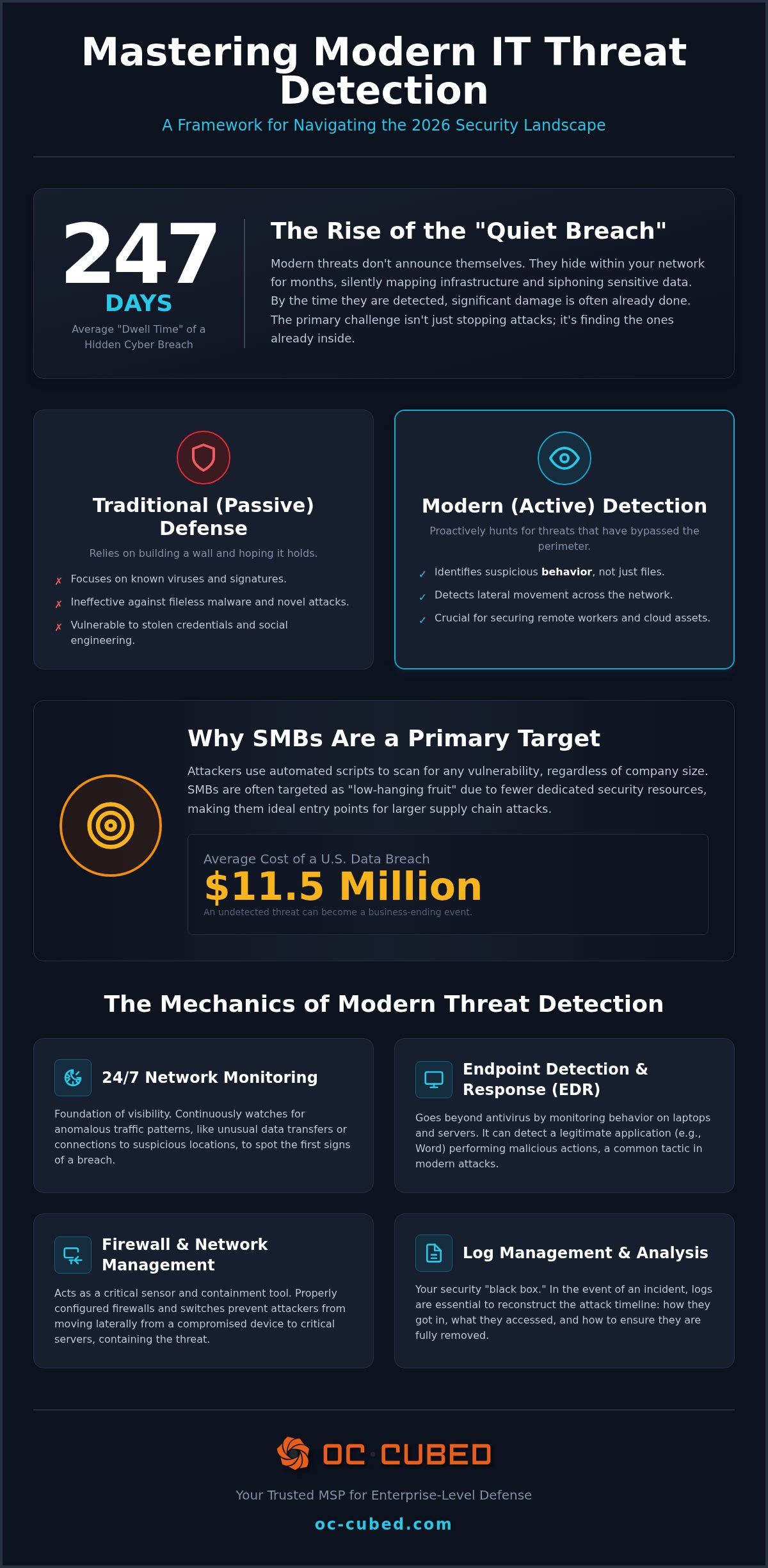
The security landscape in 2026 has shifted away from simple prevention. It's no longer enough to build a wall and assume it holds. Modern IT security threat detection is the proactive identification of malicious activity before it results in data loss. It's the process of seeing what others miss. Today's threats aren't always loud. They don't always lock your screen with a ransom note immediately. Instead, we see the rise of "Quiet Breaches." These attacks dwell in networks for an average of 247 days. During this time, attackers move silently, mapping your infrastructure and stealing sensitive information bit by bit.
Traditional antivirus is often insufficient in this environment. It relies on recognizing known "bad" files. Modern attackers use fileless malware that lives only in memory, leaving no footprint on your hard drive for a scanner to find. They use lateral movement to hop from a single compromised laptop to your most sensitive servers. For hybrid and remote-first businesses, the "Attack Surface" is now massive. Every home router, unsecured mobile device, and cloud tenant represents a potential doorway for an intruder.
The Shift from Passive Protection to Active Detection
Think of a firewall as a locked gate. It's a necessary first step, but it's passive. If an attacker uses social engineering to trick an employee or buys stolen credentials on the dark web, they can walk right through that gate without triggering an alarm. Active detection is like having a trained guard inside the building. This involves proactively searching for threats that have already bypassed your perimeter. Relying on a gate alone leaves you vulnerable to identity-based attacks that happen every day. You can find more context on building a resilient defense in our guide on the 2026 Cybersecurity Risk Strategy for Small Business.
Why SMBs Are the Primary Target in 2026
Many business owners believe they are too small to be a target. This is a dangerous misconception. Attackers in 2026 use automated "spray and pray" scripts that scan the entire internet for vulnerabilities. They don't care about your company's name, its industry, or its revenue. They only care if your Microsoft 365 tenant is misconfigured or if a remote employee is using an outdated VPN. Small and medium businesses often have fewer defenses, making them "low-hanging fruit" for automated attacks. With the average cost of a US data breach hitting $11.5 million, the stakes have never been higher. Unplanned downtime from an undetected threat can be a business-ending event. Professional IT security threat detection provides the steady reliability you need to focus on growth instead of recovery.
The Mechanics of Modern Threat Detection and Monitoring
Visibility is the foundation of effective IT security threat detection. You can't stop what you can't see. 24/7 network monitoring identifies anomalous traffic patterns, such as a sudden data burst at odd hours. This goes beyond finding a virus; it's about identifying the "context problem." Is that activity a routine update or a breach attempt? Real-time response requires NOC (Network Operations Center) integration. Automated tools find the problem, but experts provide the judgment necessary for Cyber Threat Hunting services. This ensures every alert is handled with the appropriate level of urgency.
Endpoint Protection: Beyond Basic Antivirus
Endpoint Detection and Response (EDR) is a core component of IT security threat detection. It catches behavior-based threats that traditional antivirus misses. Instead of just searching for known files, it monitors laptops and servers for suspicious activity, like a document executing code. This is vital for remote workers who operate outside the office firewall. Endpoint Protection is a continuous monitoring service for every device on your network.
Network and Firewall Management as Detection Points
Firewalls act as critical sensors for inbound and outbound threat data. When combined with switch management, they prevent attackers from moving laterally through your network. Proactive IT solutions focus on these configurations to contain threats at the point of entry. Our team provides comprehensive network monitoring and configuration to keep your infrastructure resilient. Steady oversight removes the obstacles that slow your business down.
Log management is your black box recorder. If a detection occurs, logs allow you to reconstruct the attack timeline. You can see how they entered, what they touched, and if they're still present. Without these records, remediation is just guesswork. By centralizing these logs, you gain the clarity needed to satisfy compliance requirements and protect your operations from future disruptions. This data-driven approach turns a confusing security event into a manageable process.
Why Detection Without Remediation Is a Liability
A common objection we hear is simple: "We get alerts, but we don't know what to do with them." This is a dangerous position. Software tools are excellent at sounding the alarm, but they don't fix the underlying problem. If your IT security threat detection system identifies a breach and no one acts, you haven't improved your security. You've simply gained a front-row seat to your own data loss. This creates the "Remediation Gap," which is the critical time between finding a threat and stopping it. In 2026, minutes matter. A delay of just one hour can be the difference between a minor incident and a total operational shutdown.
Alert fatigue is another silent killer. When your team is bombarded with hundreds of notifications every day, they naturally start to tune them out. Critical warnings get buried under routine pings. At OC Cubed, our philosophy is that detection is only half the battle. Real security happens during remediation. We don't just tell you there's a problem. We fix it. This approach removes the anxiety of "what now?" and replaces it with the steady reliability of a professional response plan.
The Role of Helpdesk and NOC Integration
A managed Network Operations Center (NOC) acts as a filter. It separates the background noise of the internet from real security incidents. This integration allows for immediate action. If a threat is detected on a workstation, our team can remotely isolate that infected device instantly. This prevents the attacker from moving laterally to your servers. Having this level of Remote IT Management is the backbone of fast remediation. It ensures that the expert who sees the alert is the same one who neutralizes the threat.
Managed Remediation vs. Automated Deletion
Simply deleting a malicious file isn't enough. If an attacker entered through an unpatched vulnerability or a misconfigured cloud tenant, they'll just come back with a different file. Automated tools often stop at deletion. Professional IT security threat detection requires root cause analysis. We look at how the threat arrived and close that entry point for good. Our team ensures your entire environment is truly clean before resuming normal operations. This thoroughness provides the peace of mind that a simple "delete" button never could. It's about solving the problem, not just hiding the symptoms.
How to Implement a Proactive Threat Detection Framework
Building a resilient defense isn't a one-time project. It's a continuous cycle of improvement. A proactive framework for IT security threat detection ensures you aren't just waiting for an alarm to go off. You're actively hardening your environment to prevent the alarm from ever needing to sound. This starts with a clear, five-step implementation plan that addresses both your tools and your team. We focus on removing the obstacles that prevent you from scaling with confidence.
- Audit your cloud tenants. We identify misconfigurations in Microsoft 365 that leave your data exposed. Many competitors focus only on external vendor risk, but internal settings are often where the most dangerous vulnerabilities hide.
- Deploy advanced email security. Stop malicious links and attachments at the gateway before they reach a user's inbox.
- Monitor every endpoint. 24/7 oversight of laptops, servers, and network hardware is mandatory for a modern workforce.
- Centralize your data. Monthly reporting provides a clear view of your security posture and helps you make informed decisions.
- Secure expert leadership. Use a vCISO to oversee governance and ensure your strategy evolves alongside emerging threats.
Securing the Inbox: Proofpoint and Email Defense
Email remains the primary entry point for cyberattacks in 2026. Standard filters are no longer enough to stop sophisticated phishing campaigns. Attackers use these methods for credential harvesting to gain access to your entire Microsoft 365 environment. We use Proofpoint to provide a layer of security that standard filters miss. It analyzes every link and attachment to ensure your inbox stays a safe place to do business. This level of protection is essential for maintaining the integrity of your tenant and protecting sensitive client communications.
Leadership and Strategy: The Virtual CISO
Governance is the missing piece for many growing firms. You need a fractional CISO to manage vendor risk and ensure compliance without the enterprise price tag. This role turns technical data into business intelligence through monthly reporting. It allows you to see exactly where your budget is protecting you and where you need to adjust. Explore our guide on IT Leadership Without a Full-Time Hire to understand how fractional experts protect your growth and provide long-term stability.
A structured approach to IT security threat detection gives you the peace of mind that your operations are being handled by professionals. It moves your business from a state of constant anxiety to one of steady reliability. When the framework is in place, you can focus on what you do best while we handle the complexities of your cyber defense.
Managed Security: Scaling Your Defense with OC Cubed
OC Cubed provides a Monthly Managed IT Services Retainer designed to act as your complete security department. We move beyond selling software licenses to deliver actual results. Effective IT security threat detection requires more than just a subscription; it requires active management. Our retainer integrates Proofpoint for email defense, constant NOC monitoring for network health, and diligent Microsoft 365 maintenance. Our NOC integration provides continuous oversight, ensuring that anomalous traffic is identified and neutralized in real time. This layered approach creates a steady protector for your business. For companies without in-house IT, this provides enterprise-grade protection that was once reserved for the largest corporations.
Our approach is reassuring and results-driven. We've seen what goes wrong when businesses lack proper support, and we know exactly how to fix it. By managing your firewall, switch configurations, and endpoint protection, we remove the technical obstacles that lead to quiet breaches. You get the benefit of a seasoned IT professional who oversees every detail of your infrastructure. This steady reliability ensures that your remote employees and cloud tenants stay secure while you scale your operations. We focus on eliminating unplanned downtime so you can focus on your next quarterly goal.
Predictable Security Costs, Professional Results
Many businesses struggle with the financial uncertainty of reactive IT. When security is treated as an emergency, the bills are unpredictable and often arrive too late to prevent damage. Our recurring monthly model provides professional results with no surprise IT bills. By bundling IT security threat detection with comprehensive remote support, we create a resilient environment that scales with you. This predictable cost structure allows you to budget with confidence while maintaining a high level of defense. OC Cubed replaces the outdated "Break-Fix" mentality with a proactive, service-first approach to security.
Your Partner in Growth and Protection
Technology should be an enabler, not an obstacle. Our vCIO and vCISO advisory services ensure your security strategy aligns with your long-term business goals. We help you move from a state of constant anxiety about the next breach to a position of total control. You gain the quiet authority of a seasoned IT team without the overhead of a full-time executive hire. We show up, solve problems, and keep your operations moving forward. Our team handles the vendor management and monthly reporting so you always have a clear view of your security posture. It's time to stop worrying about your tools and start trusting your partner.
Securing Your Business Growth in 2026
Effective IT security threat detection is the difference between a minor blip and a business-ending breach. You've seen how modern threats dwell silently in networks and why simply getting an alert isn't enough to stay safe. Real protection requires closing the remediation gap with a team that acts instantly. By integrating 24/7 NOC monitoring with enterprise-grade Proofpoint email security, you build a defense that removes obstacles rather than creating them.
Scaling a business is challenging enough without the constant fear of a quiet breach. Managed security provides the steady reliability you need to focus on your operations. With fractional CISO leadership included in our managed retainers, you gain high-level governance and a clear view of your security posture. It's about moving from a state of alert fatigue to one of total control. You deserve the peace of mind that comes from knowing your environment is being watched by experts who understand the stakes.
Your growth is our priority. Let's build a secure future together.
Frequently Asked Questions
What is the difference between threat detection and traditional antivirus?
Traditional antivirus relies on recognizing known bad files through signatures. In contrast, IT security threat detection monitors for suspicious behavior and anomalies like unauthorized lateral movement. While antivirus is a reactive tool, detection is a proactive service that identifies intruders who have already bypassed your perimeter. It's the difference between a lock on a door and a security guard watching for suspicious activity inside the building.
Can IT security threat detection prevent ransomware before it encrypts my files?
Yes, proactive detection identifies the early stages of a ransomware attack before the encryption phase begins. Attackers often spend weeks mapping your network and stealing data before deploying the final payload. By monitoring for unusual outbound traffic and suspicious admin activity, we can isolate infected devices and stop the attack in its tracks. This proactive approach prevents the massive costs and downtime associated with full-scale ransomware encryption.
How does 24/7 network monitoring work for remote employees?
We use endpoint protection and cloud-based monitoring to secure remote workers regardless of their physical location. Every laptop or mobile device becomes a monitored endpoint that sends real-time data to our NOC. This ensures your team stays protected while working from home or traveling. We monitor individual device behavior and Microsoft 365 tenant activity to ensure that remote access doesn't become a gateway for malicious actors to enter your network.
What happens immediately after a security threat is detected by OC Cubed?
Our team immediately investigates the alert to verify its severity and then begins remediation. We can remotely isolate a compromised device from the network to prevent the threat from spreading to other systems. Once isolated, we perform a root cause analysis to understand how the attacker gained entry. This process ensures the threat is neutralized and the vulnerability is closed before we return the device to normal operation.
Why is Microsoft 365 tenant maintenance considered a security service?
Microsoft 365 tenants are a primary target for credential harvesting and data theft. Maintenance involves auditing configurations, managing user permissions, and ensuring that security features like multi-factor authentication are correctly applied. Without regular maintenance, a single misconfigured setting can leave your entire cloud environment exposed. We treat tenant management as a core security layer to protect your sensitive business communications and documents from unauthorized access.
Is Proofpoint email security necessary if we already have Microsoft 365?
Proofpoint provides advanced protection against sophisticated phishing and link-based attacks that standard Microsoft 365 filters often miss. It adds an enterprise-grade layer of security that analyzes attachments and URLs in a safe environment before they reach your user's inbox. Since email is the primary entry point for most breaches, this extra layer is essential. It significantly reduces the risk of human error leading to a major security incident.
How much does managed IT security threat detection cost for a small business?
We provide managed security through a recurring monthly retainer that bundles various protections into a predictable fee. This model eliminates surprise IT bills and the high costs of emergency repairs. Every business has different needs based on their number of users and complexity. We focus on delivering IT security threat detection that fits your specific operational requirements. This allows you to invest in growth with the confidence that your security costs are stable.
What is the role of a virtual CISO in threat detection strategy?
A virtual CISO (vCISO) provides high-level security governance and strategic planning for your business. They oversee your entire threat detection framework and ensure your technology aligns with your long-term goals. This includes managing vendor risk, satisfying compliance requirements, and reviewing monthly security reports with you. Having a fractional expert gives you the leadership of a full-time executive without the associated overhead, ensuring your defense strategy remains effective as threats evolve.


