

A high volume of resolved tickets isn't a sign of a healthy IT environment. It's often a warning sign that your systems are failing to meet your needs. Many business owners feel the frustration of paying a monthly retainer while still facing unexpected downtime or security concerns. It's difficult to have meaningful conversations about business goals when your technical team only talks about hardware and software. You shouldn't have to wonder if your IT investment is actually working.
We believe your technology should be a quiet engine for growth, not a source of constant noise. This guide will show you how to measure MSP performance using outcome-based metrics that prioritize security and stability over simple activity logs. We'll provide a clear framework to evaluate your current provider and ensure they're acting as a true strategic partner. You'll learn how to demand accountability through proactive reporting and virtual leadership, giving you the peace of mind to focus on your business. By the end of this article, you'll have the tools to turn IT from a cost center into a strategic asset.
Key Takeaways
- Stop relying on ticket counts as a primary measure of success and learn how to measure MSP performance through business alignment and risk reduction.
- Identify the core KPIs that actually impact your bottom line, including system uptime and the measurable strength of your security posture.
- Discover how to use monthly reports as a transparency tool to verify that your IT environment is being actively managed and protected.
- Master the Strategic Quarterly Business Review process to ensure your IT roadmap remains aligned with your long-term growth and compliance goals.
- Shift from reactive support to a proactive model that eliminates surprise costs and leverages virtual leadership for better investment returns.
Beyond the Ticket Count: Reframing Managed IT Performance
Performance in managed IT is often misunderstood by leadership. Many executives look at helpdesk logs and assume a busy provider is a hard-working one. This is a mistake. True MSP performance is the alignment of your IT infrastructure with your specific business goals and risk tolerance. If your provider is constantly fixing the same printer or server, they aren't managing your environment. They're just reacting to it. Real success is found in the silence of a stable network where technology facilitates growth rather than creating obstacles.
A high number of closed tickets is a classic vanity metric. It creates an illusion of value while hiding poor root-cause analysis. When you evaluate how to measure MSP performance, you must look for the absence of noise. Relying on ticket volume as a success metric rewards inefficiency and encourages a reactive mindset within a managed service contract. High-performing providers focus on permanent fixes that reduce ticket volume over time. This shift signals higher operational maturity, where your IT investment is protected by strategy rather than just labor.
The Difference Between Activity and Outcomes
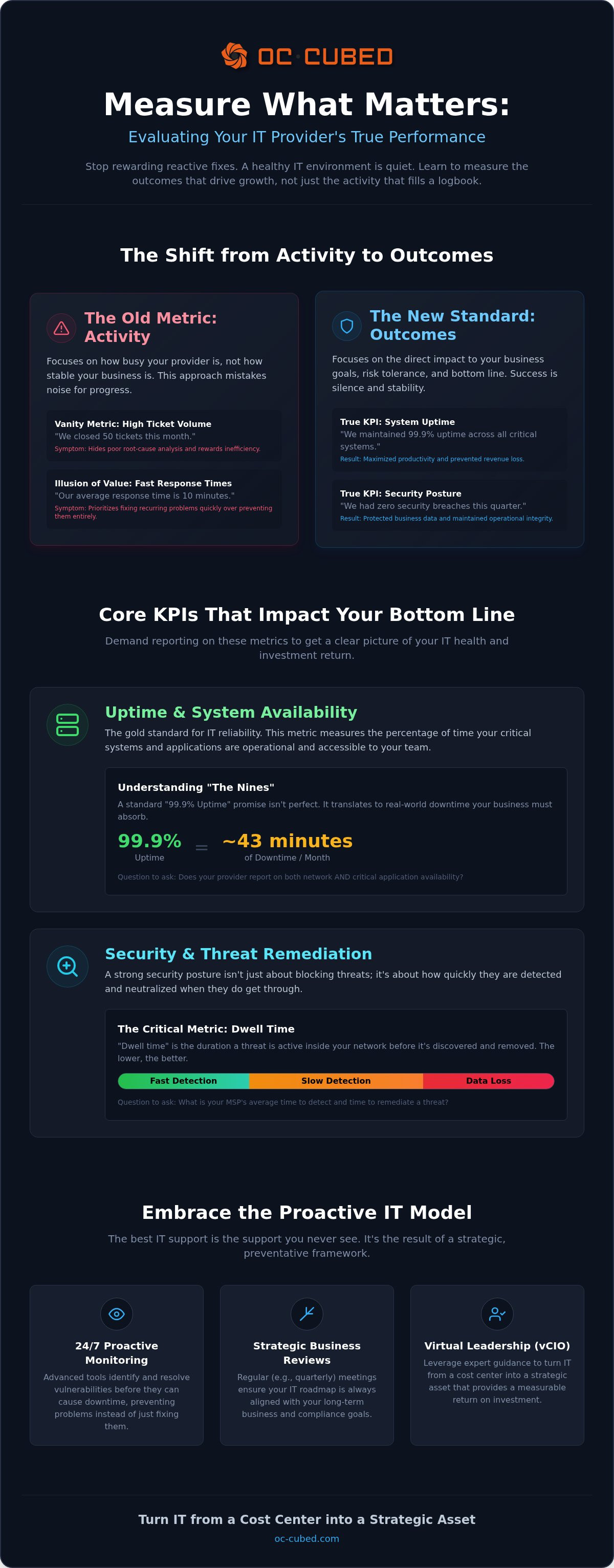
Understanding how to measure MSP performance requires a shift in focus from what technicians do to what your business experiences. Activity metrics, like response time or tickets closed, tell you what the provider did. Outcome metrics, such as the percentage of system uptime, tell you what your business gained. Leaders should prioritize system stability over response speed. It's better to have a system that never breaks than one that is fixed quickly every week. To understand these fundamentals, it's helpful to first clarify what is a managed service provider and how they should integrate with your leadership team. Every Key Performance Indicator (KPI) you track should focus on the health of your business.
- Activity focus: "We closed 50 tickets this month with a 10-minute response time."
- Outcome focus: "We maintained 99.9% uptime and zero security breaches this month."
The Role of Proactive Monitoring
The best IT support is often the support you never see. This is the result of 24/7 network monitoring and configuration. When your provider uses advanced threat detection and remote maintenance, they identify and resolve vulnerabilities before they cause downtime. This "invisible" support keeps your systems running without user intervention, allowing your staff to remain productive. Instead of measuring how many fires were put out, measure how many were never allowed to start. Proactive IT is the prevention of business-impacting events through continuous monitoring.
The Core KPIs That Impact Your Bottom Line
Business leaders need clarity, not spreadsheets full of technical jargon. When determining how to measure MSP performance, focus on metrics that directly correlate with your revenue and operational risk. These data points provide a window into the health of your partnership and the stability of your infrastructure. High-quality reporting should move past simple activity logs and instead focus on the stability of your business operations.
Uptime and System Availability
Uptime is the gold standard for IT reliability. While many providers promise 99.9% uptime, it's vital to understand what that looks like for your operations. In a standard month, 99.9% uptime allows for about 43 minutes of total downtime. If your systems are down for two hours, your provider has failed to meet that standard. You can calculate the true cost of downtime by multiplying the number of affected employees by their average hourly wage and adding lost revenue opportunities. High-performing MSPs report on availability at both the network and application levels. This ensures that even if the internet is up, your critical business software is also functioning properly. Tracking these Key Business Metrics helps bridge the gap between technical status and financial impact.
Security and Threat Remediation
Security metrics must go beyond checking a box. You need to know how effectively your provider handles threat detection and remediation. Effective endpoint protection and email security should stop the majority of attacks before they reach a user's inbox. However, no system is perfect. The real measure of performance is detection speed. If a threat enters your network, how long does it take for your MSP to identify and neutralize it? Slow detection leads to data loss and costly recovery efforts. For a deeper look at risk strategy, see our Managed Cybersecurity Guide. Proactive teams like OC Cubed use continuous monitoring to stay ahead of these risks.
Finally, hold your provider accountable through SLA adherence and Mean Time to Resolve (MTTR). A Service Level Agreement (SLA) is a contractual promise. If your provider consistently misses their windows for critical issues, the partnership is failing. Pay close attention to MTTR. MTTR is a critical component of how to measure MSP performance because it reflects the actual impact on your productivity. Some providers boast about fast response times, but a response is just a polite email acknowledging the problem. Resolution is what matters. MTTR tracks how long it actually takes to fix the issue and get your team back to work. If MTTR is high, it usually indicates a lack of technical expertise or poor internal processes.
Analyzing Monthly Reports: What to Look For
Monthly reporting isn't an optional add-on. It's the primary way to verify your provider is actually doing the work you pay for. Transparency is a major performance indicator. If you aren't receiving a report, you aren't being managed. A professional report provides the visibility you need to hold your technical team accountable and ensures your environment remains stable. A quality report should include these four elements:
- Executive Summary: A high-level view of system health, identified risks, and completed improvements.
- Trend Analysis: Data showing whether ticket volume is decreasing as the environment stabilizes.
- Infrastructure Health: Current status of critical hardware like firewalls and switches.
- Cloud Governance: Oversight of Microsoft 365 tenants and user access logs.
When you evaluate how to measure MSP performance, the direction of the data matters more than a single snapshot. As your provider stabilizes your network, the number of recurring tickets should go down. If ticket volume remains high month after month, your MSP is likely treating symptoms rather than solving root causes. This lack of progress indicates a reactive mindset that will eventually lead to unexpected downtime.
The Response Time vs. Resolution Time Trap
Don't be fooled by "instant" response times. An automated email saying "we received your ticket" isn't a response. It's a notification. Resolution time is the only metric that directly impacts your team's productivity. It measures the actual time a user is unable to work. Some providers use "ticket padding" in their reports to appear busier than they are. They might open dozens of internal tickets for minor automated tasks to inflate their activity logs. Focus on the time it takes to get your employees back to work, as this is the true measure of service quality.
Strategic Progress and Project Management
A good report tracks the future, not just the past. It should clearly outline the status of infrastructure upgrades and migrations. Virtual project management ensures these initiatives don't stall due to a lack of oversight. Use a structured framework for Remote IT Management to ensure your reporting is consistent and actionable. This level of transparency is essential for understanding how to measure MSP performance effectively. It turns your IT provider into a transparent partner rather than a black box of technical activity. You deserve to see exactly how your investment is protecting your business and enabling growth.
How to Conduct a Strategic Quarterly Business Review (QBR)
A Quarterly Business Review (QBR) is not a sales meeting. While some providers use this time to push new hardware, a high-performing partner uses it to demonstrate value and align with your future. This is the ultimate forum for leadership to evaluate how to measure MSP performance over a long-term horizon. It moves the conversation from daily tickets to annual growth. A structured QBR ensures your IT investment remains a strategic asset rather than a recurring expense.
The process follows four critical steps:
- Step 1: Review the data from the previous three monthly reports. Look for patterns in uptime and resolution times to ensure the environment is stabilizing.
- Step 2: Assess security governance and compliance status. Review threat detection logs to verify that your protection layers are holding firm.
- Step 3: Align IT spending with upcoming business goals. Discuss hiring plans, new locations, or department expansions that require technical support.
- Step 4: Update the technology roadmap and budget for the next 12 months. This eliminates surprise costs and provides financial predictability.
Holding Your MSP Accountable
Accountability requires the right questions. Ask your provider, "What is our biggest recurring risk?" and "How are we improving efficiency through automation?" These inquiries shift the focus toward continuous improvement. If you find service gaps, use the data to request a specific remediation plan. This isn't about confrontation; it's about professional alignment. A Virtual CIO (vCIO) facilitates these high-level strategic discussions, ensuring technical details never overshadow your business objectives. Their role is to translate complex data into actionable leadership decisions.
Future-Proofing Your Strategy
A strategic review must look forward. Evaluate your Microsoft 365 license management and cloud utilization to eliminate wasted spend on unused accounts. This is also the time to plan for security threat remediation before incidents occur. You should leave the meeting with a clear understanding of your risk profile and the steps being taken to lower it. A successful QBR results in a documented 12-month technology roadmap that provides total visibility into your IT investment. This roadmap acts as a contract of intent, ensuring both parties are working toward the same definition of success.
OC Cubed defines accountability through action. We don't hide behind jargon or wait for you to call us with a problem. Our service model eliminates surprise IT costs by using a flat-rate retainer. This structure creates a partnership where our interests are perfectly aligned with yours. When your systems are stable, your business grows and our team can focus on optimization rather than fire-fighting. This is the most effective way to ensure your IT investment is working for you. Our integration of Helpdesk and NOC services provides a unified view of your entire infrastructure. This seamless tracking means every alert is captured and every resolution is recorded. We provide this data to you through monthly reporting as a standard service. This level of transparency is essential when you consider how to measure MSP performance. It gives you the evidence you need to verify that your environment is being actively managed and protected. Total transparency. No excuses.Proactive Support That Prevents Downtime
Prevention is the core of our proactive model. We use 24/7 network monitoring and configuration to spot issues before they impact your staff. Our endpoint protection and antivirus solutions act as a constant shield for your devices. We catch threats early to minimize business impact. Email security is equally critical. We integrate Proofpoint to provide superior protection against phishing and malware. This ensures your primary communication channel remains a safe tool for your team. You gain peace of mind knowing your data is guarded by industry-leading tools. It's about stability, prevention, and forward momentum.
Strategic Leadership Without the Executive Salary
Enterprise-grade direction shouldn't be out of reach for growing businesses. Our fractional C-suite services provide the leadership you need without the executive salary. A virtual CIO or CISO works with you to ensure your IT strategy supports your long-term growth objectives. We help you navigate complex decisions like cloud utilization and security threat remediation. This leadership turns IT from a cost center into a strategic asset. Learning how to measure MSP performance is simpler when you have a dedicated advisor translating technical data into business results. To explore how this leadership model works, see our guide on IT Leadership Strategy. We are your dependable, no-nonsense partners in growth.
Securing Your Path to Strategic Growth
Reframing your IT relationship starts with a shift in perspective. You've learned that true value isn't found in a long list of closed tickets, but in the sustained uptime and security of your business operations. By focusing on outcome-based metrics and holding your provider accountable through monthly reports and quarterly reviews, you turn technology into a quiet engine for growth. This approach removes the anxiety of unexpected downtime and replaces it with steady reliability.
Understanding how to measure MSP performance gives you the control needed to protect your investment. You deserve a partner who provides proactive 24/7 network monitoring and comprehensive monthly performance reporting as a standard service. With virtual CIO strategic leadership, your IT roadmap will finally align with your actual business objectives. It's time to move past the vanity metrics and demand transparency that reflects the real health of your environment.
Take charge of your technology strategy today. A dependable partnership is built on clear outcomes and professional accountability, ensuring you can focus on what matters most: growing your business.
Frequently Asked Questions
What is the most important KPI for measuring MSP performance?
Uptime and system availability are the most critical KPIs for any business. If your team can't work, nothing else matters. This metric tracks the percentage of time your critical systems are operational. High-performing providers aim for 99.9% uptime. This gives you a clear, non-technical way to understand how to measure MSP performance based on business impact. It shifts the focus from technician activity to actual business outcomes and productivity.
How often should I receive performance reports from my IT provider?
You should receive comprehensive performance reports at least once per month. Regular reporting is a standard service that ensures transparency and accountability. These documents provide a clear view of system health, security threats identified, and ticket resolution trends. Without monthly reporting, it's impossible to verify if your environment is being managed or if you're just paying for reactive support. Consistency builds the trust needed for a long-term partnership.
What should I do if my MSP is not meeting their SLA?
Start by reviewing the specific performance data in your monthly reports during a meeting with your account lead. Address the service gaps professionally by asking for a documented remediation plan. If the provider consistently fails to meet their contractual promises, it's time to evaluate if they have the technical maturity to support your growth. Professional providers like OC Cubed use SLAs as a baseline for accountability, ensuring you always know where you stand.
Is a high number of support tickets a bad sign for my MSP?
Yes, a consistently high volume of tickets often indicates poor root-cause analysis. While some tickets are expected during an initial onboarding, the number should decrease over time as the environment stabilizes. If your ticket count remains high, your provider is likely treating symptoms rather than solving the underlying technical issues. True performance is measured by the absence of recurring problems, not by how many times the same issue is "fixed."
How does a Quarterly Business Review (QBR) improve IT performance?
A QBR improves performance by aligning your technology roadmap with your long-term business goals. It moves the conversation away from daily technical hurdles and toward strategic growth and risk management. During these reviews, you'll assess security governance, update budgets, and plan for future initiatives like infrastructure upgrades. This process ensures your IT investment is always working to remove obstacles rather than creating new ones as your company expands.
What is the difference between response time and resolution time?
Response time is how quickly a provider acknowledges your request, while resolution time is how long it takes to actually fix the problem. Many providers use automated notifications to inflate their response metrics. However, resolution time is the only figure that directly impacts your team's productivity. When learning how to measure MSP performance, prioritize the time it takes to get your employees back to work over how quickly an email was sent.
Can I measure MSP performance without being a technical expert?
You don't need to be an engineer to evaluate your provider effectively. Focus on business outcomes like system uptime, the frequency of security incidents, and the clarity of their reporting. A good provider will translate technical data into executive-level summaries that highlight risks and improvements. If you can't understand your IT report, the provider is failing to communicate. Leadership is about managing results, not understanding every line of code.
How do proactive monitoring services impact my IT metrics?
Proactive monitoring identifies and resolves vulnerabilities before they cause downtime, which significantly improves your uptime metrics. By using 24/7 network monitoring, a provider can catch threats like failing hardware or security breaches early. This reduces the overall number of support tickets and prevents business-impacting events. The goal is "invisible" IT support where your systems stay operational without constant manual intervention from your staff or the helpdesk team.


