

If your IT budget feels like a series of emergency repairs rather than a strategic investment, you're losing more than just money. Most business owners view technology as a necessary but unpredictable cost center. It's frustrating to open a monthly invoice only to find surprise fees that weren't in the plan. You want control, protection, and a clear path forward. With global IT spending projected to reach $6.37 trillion in 2026, the stakes for your vCIO IT budget planning have never been higher.
Strategic leadership changes this dynamic by shifting technology from a liability to a predictable asset. We believe that your technology should serve your business goals, not the other way around. This guide explores how fractional leadership eliminates surprise costs and builds security directly into your financial strategy. We will examine the shift toward rolling forecasts for 2026 and show you how to develop a clear three year roadmap that stabilizes your IT spend. You'll discover how to align every dollar with measurable growth and long term stability.
Key Takeaways
- Escape the volatile "break-fix" cycle that causes unpredictable monthly IT invoices and hidden downtime costs.
- Leverage vCIO IT budget planning to transform your technology from a burdening cost center into a strategic growth asset.
- Evaluate the financial advantages of fractional C-suite leadership over the high overhead of a full-time executive salary.
- Ensure your 2026 financial plan includes proactive monitoring and Proofpoint security to prevent expensive remediation efforts.
- Establish a clear three-year roadmap that provides predictable flat-rate costs and long-term technology stability.
The High Cost of Reactive IT Budgeting
Reactive IT management is a financial gamble. When you rely on a break-fix model, your technology budget is determined by the next crisis rather than your business goals. This approach creates extreme volatility. One month your costs are manageable; the next, a server failure or a security incident triggers a massive, unbudgeted expense. This unpredictability prevents you from reinvesting capital where it matters most. It keeps your business in a defensive crouch, reacting to problems instead of pursuing opportunities.
Without professional vCIO IT budget planning, companies often accumulate technical debt. This happens when you patch old problems instead of investing in modern infrastructure. Eventually, the interest on that debt comes due in the form of system wide failures. For many business owners, the psychological toll is just as heavy as the financial one. The constant dread of surprise IT invoices creates a culture of hesitation. It's difficult to focus on growth when you're constantly waiting for the next emergency. Even a seasoned Chief Information Officer (CIO) would struggle to manage a department that only reacts to fires.
The Downtime Tax: Why Guessing Costs More
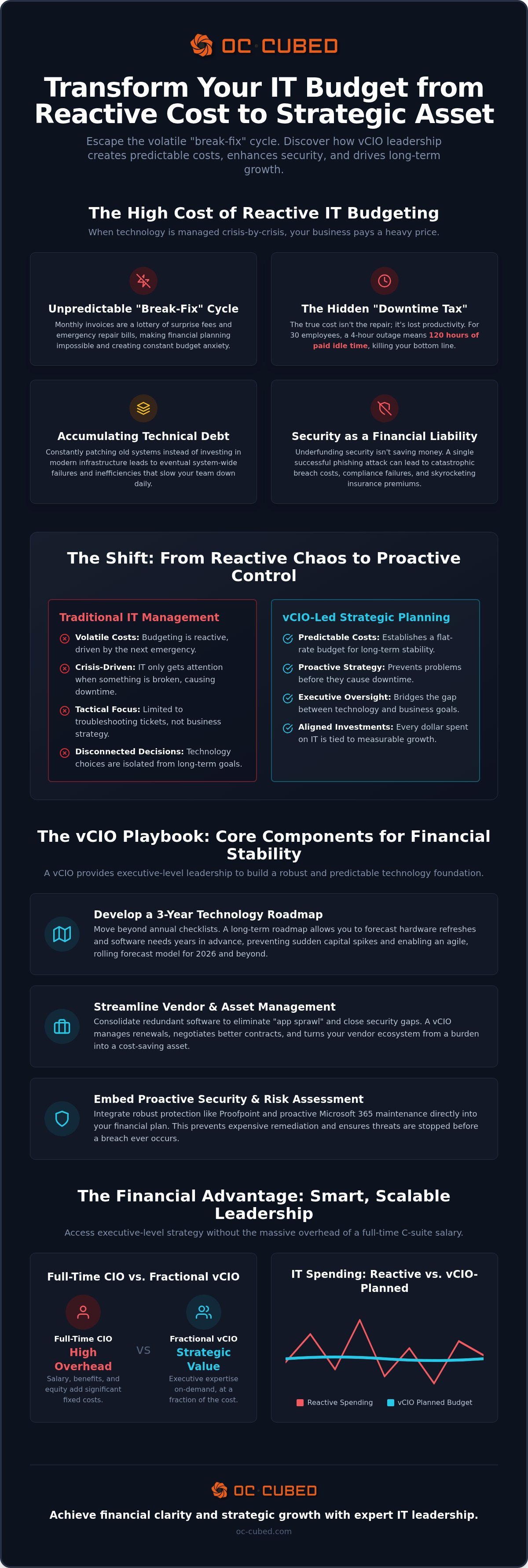
The true cost of an outage isn't just the repair bill. It's the downtime tax paid through employee idle time. If thirty employees can't access their files for four hours, you've lost 120 hours of productivity while still paying their full wages. Emergency vendor fees add another layer of pain. Most providers charge a premium for urgent support, which can double or triple your expected labor costs. Additionally, running outdated hardware forces your team to work slower every day. These micro losses in efficiency are invisible on a balance sheet but devastating to your bottom line over a fiscal year.
Security Gaps as Financial Liabilities
Underfunding security is a liability, not a savings strategy. Email remains the primary vector for cyberattacks. A single successful phishing attempt can lead to catastrophic breach costs that far exceed the price of robust protection. Proactive vCIO IT budget planning prioritizes tools like Proofpoint and Microsoft 365 tenant maintenance to stop threats before they reach the inbox. This isn't just about safety; it's about financial preservation. Compliance failures can also lead to skyrocketing insurance premiums or outright denial of coverage. By building threat detection into your financial plan, you move from a defensive posture to one of controlled, predictable growth.
What Are vCIO IT Budgeting and Forecasting Services?
A vCIO provides executive-level technology leadership on a fractional basis. This model allows mid-sized companies to access high-level strategy without the massive overhead of a full-time executive salary. Unlike a standard IT manager who handles tactical tickets and daily troubleshooting, a vCIO bridges the gap between technical operations and business strategy. This executive oversight is the foundation of effective vCIO IT budget planning. They turn technology from a necessary evil into a predictable asset that drives efficiency and growth.
The core components of these services include comprehensive roadmap development, vendor oversight, and rigorous risk assessment. The goal is to move from reactive spending to proactive investment. For example, integrating high-level security tools like Proofpoint into your vCIO IT budget planning ensures that protection is funded before a breach occurs. This proactive stance helps business leaders gain control over their financial future by translating technical needs into clear business outcomes. If you're ready to stabilize your technology costs, fractional C-suite services can provide the steady reliability your organization requires.
The 3-Year Technology Roadmap
Annual checklists often fail to account for long-term growth and scaling needs. A 3-year technology roadmap allows you to forecast hardware refresh cycles years in advance. This prevents the sudden capital expenditure spikes that often derail quarterly budgets. By aligning Microsoft 365 license management with your projected headcount growth, a vCIO ensures you only pay for the seats you actually need. They help you transition to an agile rolling forecast model that adapts to market changes without compromising your long-term vision.
Vendor and Asset Management
Businesses often suffer from app sprawl, where disconnected software tools create redundant costs and security gaps. A vCIO consolidates these systems into a unified, manageable framework. They manage software renewals with precision to prevent service interruptions and use their industry expertise to negotiate better contracts during procurement. This oversight turns vendor management from an administrative burden into a strategic cost-saving opportunity. They see the gaps internal teams miss, ensuring your vendor ecosystem remains lean, secure, and efficient.
Internal Management vs. vCIO-Led IT Planning
Hiring a full-time executive is a massive commitment. For many organizations, the salary and benefits burden of a dedicated leader is simply out of reach. This is where vCIO IT budget planning offers a distinct advantage. You gain the same level of strategic foresight without the six-figure overhead. Internal teams often become too close to the daily operations. They might miss systemic gaps because they're focused on keeping the lights on. An external advisor brings an objective perspective that internal staff cannot replicate. They see the forest when your team is busy looking at the trees.
The Cost of a Full-Time Executive Hire
As of August 2026, the average salary for a full-time CIO in the United States is approximately $341,665. When you add payroll taxes, health benefits, and performance bonuses, the total cost of employment often exceeds $400,000. For most mid-market companies, this is an inefficient use of capital. A fractional model provides scalability. Your leadership grows with your organization. You don't have to worry about the single point of failure risk that comes with a small internal department. If your only IT leader leaves, your strategy often leaves with them. Training and retaining top-tier executive talent is also a constant challenge in a competitive labor market. Fractional leadership removes this burden from your HR department.
Strategic Breadth and Specialized Expertise
Internal teams naturally focus on the how of technology. They excel at maintaining the status quo and responding to immediate needs. In contrast, vCIOs focus on the why. They look at how technology investments align with your long-term business outcomes. This executive-level strategic foresight is essential for effective vCIO IT budget planning. You also gain access to a wider pool of specialists. Instead of relying on one generalist, you benefit from experts in cloud migration and advanced security protocols like Proofpoint. These advisors leverage cross-industry data to improve your tech stack. They know what works for companies in your sector and beyond. This allows you to avoid expensive trial-and-error mistakes while ensuring your infrastructure remains enterprise-grade. It's about moving from simple maintenance to a growth-oriented mindset.
Choosing the Right vCIO Budgeting Partner for 2026
Selecting the right partner is about more than just finding a technical vendor. It's about finding an advisor who understands that technology must support your financial health. In 2026, a local presence is less important than a robust national remote support infrastructure. You need a team that can manage your environment with precision, regardless of where your employees are located. Effective vCIO IT budget planning relies on a partner who possesses deep technical proficiency in platforms like Microsoft 365 and Proofpoint. These aren't just tools; they are the frontline of your business defense and productivity.
The ideal partner carries a protection and growth mindset. They don't just fix what's broken. They look for ways to stabilize your costs while enabling your team to work faster and more securely. This requires a shift from the traditional billable hour model to a results driven relationship. When your IT partner is incentivized to prevent problems rather than bill for repairs, your interests finally align. This alignment is the only way to achieve true budget predictability in an increasingly complex digital environment.
Evaluation Checklist for vCIO Providers
When vetting potential partners, ask if they offer a bundled retainer model. This is the only way to truly eliminate surprise costs and ensure your monthly IT spend remains flat and predictable. You should also evaluate their process for security threat detection and remediation. A reactive partner will wait for you to call with a problem; a proactive partner will stop the threat before it impacts your operations. Finally, ensure they can demonstrate a track record of enterprise-grade IT leadership. This experience is what separates a basic support desk from a true strategic advisor.
The Role of Reporting in Transparency
Monthly reports should be more than just a list of closed tickets. They are essential for board-level decision making. Your vCIO should provide deep insights into network uptime, security incidents, and total technology spend. This transparency allows you to see exactly where your money is going and how it's protecting your assets. It also ensures your partner is adhering to a strict remote IT management framework. When you have clear data, you can make informed choices about your technology roadmap instead of guessing about your needs.
Strategic IT Leadership with OC Cubed
OC Cubed provides the executive-level oversight needed to stabilize your financial future. We deliver fractional C-suite services that include CISO, CTO, and CIO expertise. This gives you access to enterprise-grade leadership without the burden of a full-time executive hire. Our approach is built for national reach. We act as a dependable, no-nonsense expert for your team. This moves your organization away from the "break-fix" trap and toward a growth-oriented identity. We focus on results, not billable hours. Our team speaks with the quiet authority of professionals who have seen what goes wrong when businesses lack proper support.
The foundation of our service is the bundled retainer. It's designed specifically to provide predictable costs for growing companies. By integrating vCIO IT budget planning into this model, we ensure that your technology investments are always aligned with your long-term business goals. You won't face surprise invoices. You get steady reliability instead. We position ourselves as both a protector and an enabler for your organization. We remove obstacles so you can focus on scaling your business. This model ensures that security and compliance are built into your financial plan from day one.
The OC Cubed Advantage
We focus on the intersection of protection and growth. This includes total inbox protection through the strategic integration of Proofpoint and Microsoft 365. We provide 24/7 network monitoring to identify and resolve issues before they cause downtime. Our proactive endpoint protection ensures your devices remain secure regardless of where your team is working. We remove technical obstacles so you can focus on your core operations. Our service descriptions are simple and benefit-first. We provide network monitoring to prevent downtime. We offer email security to stop breaches. We deliver monthly reporting to ensure transparency and control.
Next Steps for Your 2026 Tech Strategy
Transitioning from reactive support to a managed partnership starts with a clear understanding of your current state. Our initial discovery process involves a thorough audit of your current infrastructure and spending. We identify gaps in security and compliance that could lead to future financial liabilities. This audit forms the basis of your vCIO IT budget planning for the coming years. It's a structured, progressive sequence that builds confidence in your technology roadmap. We respect your time and provide the substance needed to move forward with certainty. Our goal is to move you from a reactive posture to a proactive, strategic partnership.
Secure Your Financial Future with Strategic IT Leadership
Effective technology management isn't about fixing problems as they arise. It's about building a stable foundation for growth. You've seen how reactive models lead to financial volatility and hidden downtime costs. By contrast, vCIO IT budget planning transforms your technology into a predictable asset. You gain the steady reliability of fractional executive leadership without the burden of a full-time salary. This ensures your infrastructure is protected while your monthly costs remain flat and manageable.
Our approach combines proactive security monitoring through Proofpoint and Microsoft 365 with a national remote support infrastructure designed for growing businesses. We remove the technical obstacles that slow you down. This allows you to focus on your core mission while we handle your technology roadmap. You deserve peace of mind and total control over your spend. We provide the quiet authority needed to manage the digital landscape with confidence.
Take the first step toward a more secure and predictable 2026. Your business is ready for the next level of strategic leadership. We're here to ensure your technology serves as a catalyst for your success.
Frequently Asked Questions
What is the difference between a vCIO and an IT consultant?
A vCIO provides ongoing, fractional leadership that focuses on your long-term business strategy. While an IT consultant typically solves a specific problem or manages a one-time project, a vCIO acts as a permanent part of your executive team. They bridge the gap between technical operations and business outcomes. This ensures your technology roadmap supports your growth goals for years to come. It's a continuous partnership rather than a temporary fix.
How much do vCIO IT budget planning services typically cost?
Costs for these services depend on your specific organizational needs and the complexity of your technology stack. A fractional model is typically a fraction of the cost of a full-time executive hire. We utilize a bundled retainer model to ensure your monthly IT expenses remain flat and predictable. This approach helps you avoid the volatility of hourly billing and eliminates surprise invoices. It's a strategic way to manage your technology budget with total transparency.
Does my business need a vCIO if we already have an IT person?
Yes, because a vCIO and a dedicated IT person serve different functions. Your internal staff likely focuses on daily tasks like troubleshooting and hardware maintenance. A vCIO provides the high-level strategic oversight that internal teams often lack. They handle vCIO IT budget planning, vendor negotiations, and long-term roadmaps. This partnership allows your technical staff to focus on execution while the vCIO ensures every project aligns with your broader business objectives.
Can a vCIO help with cybersecurity risk management and compliance?
Cybersecurity is a core component of fractional leadership. A vCIO or vCISO builds security and compliance directly into your financial and operational plans. They manage threat detection and remediation to prevent expensive data breaches. By implementing frameworks like Microsoft 365 tenant maintenance and Proofpoint email security, they reduce your overall risk profile. This proactive approach helps you meet industry regulations and can even lower your cyber insurance premiums by demonstrating a robust security posture.
How often should a vCIO review our IT budget and roadmap?
We recommend a comprehensive review of your IT budget and roadmap at least once per quarter. This frequency allows you to adapt to market changes and emerging technologies like AI. Monthly reporting also provides a continuous feedback loop on your current spend and system performance. These regular check-ins ensure your vCIO IT budget planning remains agile. It prevents technical debt from accumulating and keeps your technology investments perfectly synced with your evolving business needs.
Will a vCIO handle vendor management and software renewals?
A vCIO takes full responsibility for managing your technology vendors and software renewals. They consolidate disconnected applications to reduce sprawl and eliminate redundant costs. By overseeing contracts and renewal dates, they prevent service interruptions and ensure you aren't paying for unused licenses. They use their industry expertise to negotiate better terms during procurement. This oversight turns vendor management into a strategic advantage that protects your bottom line and improves operational efficiency.
What industries benefit most from fractional IT leadership?
Any organization that relies on secure, high-uptime technology will benefit from fractional leadership. This includes industries with strict compliance requirements like finance, healthcare, and legal services. Growing companies that lack the budget for a full-time C-suite hire also find immense value in this model. Because we provide national remote support, businesses with distributed teams or multiple locations gain a consistent, enterprise-grade management framework. It provides the stability and protection needed to scale without technical friction.
How does a vCIO improve our Microsoft 365 security posture?
A vCIO improves your posture through proactive Microsoft 365 tenant maintenance and configuration. They ensure that security features like multi-factor authentication are correctly implemented across your entire organization. By integrating advanced tools like Proofpoint, they add a critical layer of protection against phishing and malware. They also monitor for unauthorized access and suspicious activity 24/7. This comprehensive oversight closes the gaps that often lead to breaches, keeping your data secure and your team productive.


