

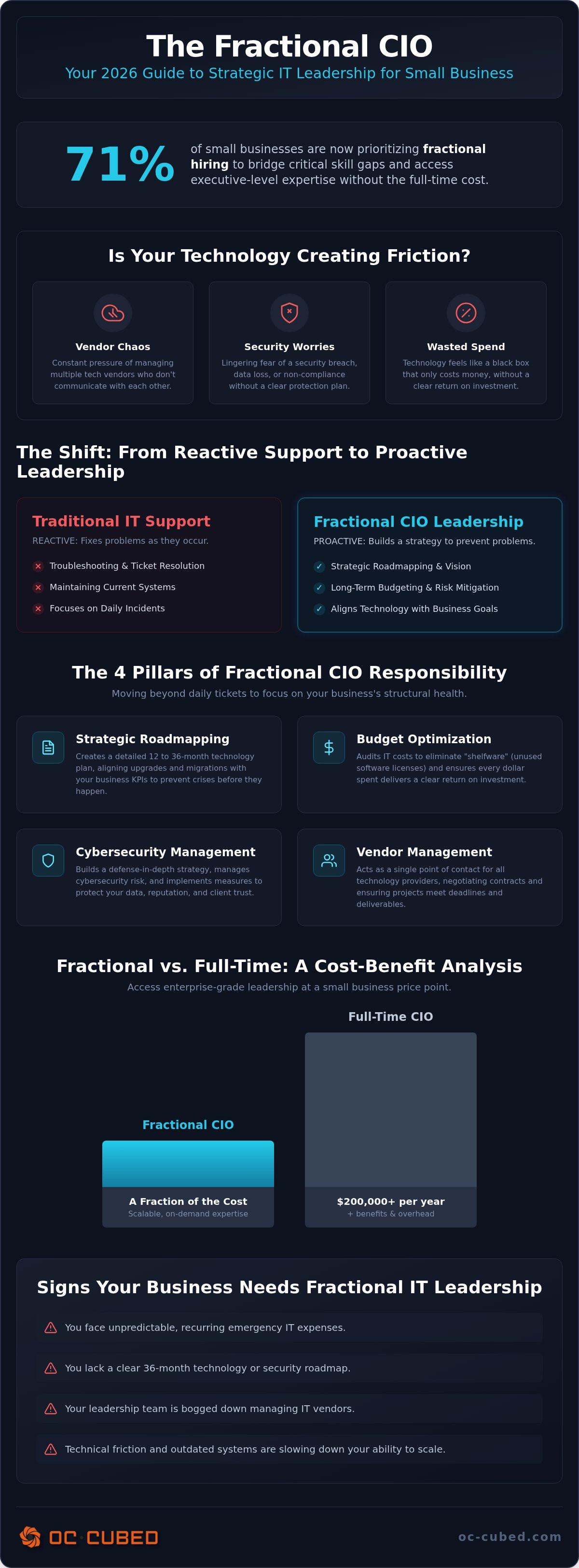
Recent data shows that 71% of small businesses are now prioritizing fractional hiring to bridge critical skill gaps. For many leaders, technology still feels like a black box that only seems to cost money. You might feel the constant pressure of managing vendors who don't talk to each other or the lingering worry of a security breach. It's a common struggle. A fractional CIO small business approach changes that dynamic by putting a seasoned expert in your corner.
You deserve a technology strategy that actually drives growth. This 2026 guide helps you discover how a fractional CIO provides executive-level technology strategy to drive growth and security without the expense of a full-time hire. You'll learn how to transform your IT from a source of frustration into a predictable, well-oiled machine. We will cover the specific ways fractional leadership builds a strategic roadmap, manages your vendors, and provides the steady reliability you need to scale with confidence.
Key Takeaways
- Learn how high-level strategy and technical roadmapping provide executive leadership without the burden of a six-figure salary.
- Identify how a fractional CIO small business model aligns your technology spending with long-term growth goals to eliminate waste.
- Understand the cost-benefit of flexible IT leadership that scales with your projects, providing expert oversight only when you need it.
- Recognize the warning signs of reactive IT, such as unpredictable emergency expenses and the lack of a clear 36-month security roadmap.
- Discover how integrating virtual CIO leadership with managed support streamlines vendor management and removes the technical friction slowing your scale.
What is a Fractional CIO for a Small Business?
A fractional CIO is an outsourced executive who provides high-level technology strategy on a part-time or contract basis. This model allows you to access 100% of the expertise found in a Chief Information Officer (CIO) for a fraction of the cost. It's a strategic solution for companies that need executive guidance but don't require a full-time C-suite hire. This partnership provides the leadership necessary to turn technology into an asset rather than a liability.
The primary goal of a fractional CIO small business partnership is alignment. They ensure your technology investments directly support your specific growth goals for 2026 and beyond. This is fundamentally different from traditional technical support. While a technician fixes a broken computer, a CIO determines if that computer should even be in your environment. It's about leadership and long-term vision rather than just resetting passwords or troubleshooting software.
The Difference Between IT Support and IT Leadership
Many small businesses eventually outgrow their IT support. A helpdesk is reactive; it focuses on troubleshooting problems and maintaining current systems. IT leadership is proactive. It involves strategic roadmapping, long-term budgeting, and risk mitigation. Most organizations reach a point where their technical needs exceed their technician's capacity, yet they aren't ready for a $200,000 executive hire.
- IT Support: Reactive maintenance and ticket resolution.
- IT Leadership: Proactive planning and business alignment.
The Evolution of the Virtual CIO (vCIO) in 2026
In 2026, the shift toward hybrid work and decentralized security has changed the vCIO role. Modern leaders manage complex cloud architectures and prioritize data protection across multiple locations. They use data-driven monthly reporting to drive every decision. This is a core part of our Enterprise-Grade IT Leadership Guide. It moves your business away from reactive fixes toward a steady, reliable rhythm of growth and protection. By focusing on the big picture, a fractional CIO small business engagement ensures your infrastructure scales as fast as your ambitions.
Key Responsibilities: What a Fractional CIO Actually Does
A fractional CIO moves beyond the daily tickets to focus on the structural health of your organization. Their work centers on four key pillars: strategy, budget, security, and vendor relations. By taking these burdens off your plate, they allow you to lead your company without the weight of technical debt holding you back.
Strategic roadmapping is the first priority. This involves creating a detailed 12 to 36 month plan for technology upgrades and migrations. It ensures you aren't surprised by equipment failure or outdated software. Budget optimization follows closely. Many businesses unknowingly pay for "shelfware," which are software licenses that sit unused. A CIO audits these costs to ensure every dollar spent on IT delivers a clear return on investment.
Security is no longer a luxury for small firms. A fractional leader takes charge of cybersecurity risk management, building a defense-in-depth strategy that protects your reputation. They also serve as the single point of contact for all technology vendors. This eliminates the frustration of managing multiple providers who don't communicate with each other. Choosing a fractional CIO small business solution means you finally have one person responsible for the big picture.
Executive-Level Technology Strategy and Planning
Strategic planning starts with a deep assessment of your current infrastructure. The goal is to identify scalability hurdles and security gaps before they become crises. A fractional leader aligns your tech stack with your business KPIs to ensure your tools help you reach your numbers. A technology roadmap serves as the essential blueprint for business continuity; it is the difference between surviving a disruption and thriving through one.
Vendor Management and Project Accountability
Managing tech vendors is often a full-time job. A fractional CIO negotiates contracts and manages relationships with software and hardware providers to get you the best value. They oversee complex initiatives like cloud migrations or firewall implementations, providing virtual project management that keeps teams accountable. This level of oversight ensures your projects meet their deadlines and deliverables. If you are ready to stop managing IT vendors yourself, consider how Virtual CIO services can streamline your operations and restore your peace of mind.
Fractional CIO vs. Full-Time CIO: A Comparison
The choice between a full-time executive and a fractional partner usually comes down to the scale of your current needs. A full-time Chief Information Officer carries a national average salary exceeding $200,000. For many growing organizations, this expense is simply too high to justify. Adopting a fractional CIO small business model allows you to redirect those significant funds into your actual infrastructure and growth initiatives. You receive the same level of strategic oversight without the heavy burden of a permanent C-suite payroll.
Flexibility remains one of the strongest arguments for the fractional approach. You can scale executive hours up during a major project, such as a firewall overhaul, and scale them back once the environment stabilizes. This level of agility is impossible with a salaried employee. Fractional leaders also deliver value with remarkable speed. Because they specialize in high-impact strategy, they often onboard and start making meaningful improvements within weeks. They don't require months of "settling in" before they begin protecting your data and optimizing your spend.
When the Full-Time Hire Doesn’t Make Financial Sense
For organizations with 10 to 100 employees, a full-time CIO is rarely the right financial move. Beyond the base salary, you have to account for the hidden costs of benefits, performance bonuses, and equity packages. These expenses accumulate quickly. A fractional leader focuses on results-driven outcomes rather than simple desk time. You pay for their deep expertise and the execution of your technology roadmap. This "sweet spot" of company size is where the fractional model offers the most significant return on investment. It provides the steady reliability you need without the overhead you don't.
The Benefit of Unbiased, Third-Party Perspective
Internal hires can occasionally develop a degree of technical stagnation. They might stick to familiar legacy systems even when more secure or efficient solutions exist. A fractional leader brings a fresh, unbiased perspective to your business. Because they manage multiple environments, they bring cross-industry best practices that an internal hire might miss. This ensures your technology choices are based on merit and security rather than personal preference. Partnering with a fractional CIO small business specialist gives you a partner who is strictly committed to the best possible outcome for your specific growth goals.
Signs Your Business Needs Fractional IT Leadership
Many business owners find themselves in a constant loop of reactive fixes. If you don't have a clear technology plan for the next 12 months, you're likely overspending on short-term solutions. It's a clear sign that your organization has outgrown basic support. Another major red flag is unpredictable spending. If IT expenses always arrive as "emergency" surprises, you lack the executive oversight a fractional CIO small business engagement provides. Stable businesses don't guess their IT costs; they plan them.
The "CEO bottleneck" is another critical indicator. If the chief executive is still the person making final decisions on software licenses or security protocols, the business is at risk. Executives should focus on market growth, not technical specifications. You need a trusted advisor who looks at the big picture while you focus on the bottom line. This transition allows the leadership team to regain their time and confidence. Expert leadership ensures that every technical decision supports a specific business outcome.
The Tipping Point: From Support to Strategy
Recognizing the difference between maintenance and leadership is essential for scaling. Your current managed service provider might be excellent at maintaining systems, but they might not be leading your strategy. This often creates a dangerous security gap. Basic antivirus is no longer sufficient for a modern risk profile. High-level leadership uses remote IT management as the stable foundation for all strategic decisions. This proactive layer ensures your systems are always ready for the next phase of growth.
Compliance and Security Governance Requirements
Regulatory landscapes like HIPAA, SOC2, or CMMC require more than technical patches. They demand documented governance and executive accountability. A fractional CISO manages security threat detection and establishes a formal culture of protection within your staff. This involves creating executive-level policies that satisfy both auditors and cyber-insurance providers. Documented IT governance is now a standard requirement for insurance renewals. Without it, your premiums will rise or your coverage could be denied entirely. A fractional CIO small business partnership ensures you stay ahead of these requirements before they become roadblocks.
The OC Cubed Approach to Fractional IT Leadership
OC Cubed provides a unique blend of high-level guidance and ground-level execution. Unlike consultants who deliver a thick report and then disappear, our virtual executive leadership is natively integrated into our Managed Service Provider model. This ensures that the strategy we build for your fractional CIO small business engagement is actually implemented by the same team that understands your daily operations. We focus on removing the technical friction that slows down your ability to scale. Our goal is to make technology invisible so you can focus entirely on your mission.
Transparency is at the heart of our steady reliability. You'll receive monthly reporting that shows exactly how your technology is performing and where your specific risks lie. We take a security-first approach, leveraging enterprise-grade tools like Proofpoint and advanced endpoint protection. These aren't just standalone products; they're part of a cohesive strategy designed to protect your reputation and your bottom line. We provide the quiet authority of an IT partner who knows exactly how to prevent downtime before it starts. This integrated approach means your technology roadmap isn't just a document on a shelf. It's a living plan that we execute every day.
Leadership That Executes: The Integrated Model
Strategy and execution belong together. Having both under one roof prevents the common problem of "finger-pointing" between outside consultants and technical staff. When we manage your Microsoft 365 tenant, we ensure every setting aligns with your long-term security goals. We treat 24/7 network monitoring as a strategic asset. It provides the data we need to make informed leadership decisions rather than just acting as a simple alert system. It's the foundation of your business continuity. Our monthly reporting translates technical metrics into business outcomes you actually care about, such as risk reduction and cost savings.
Getting Started with a Strategic IT Assessment
Our virtual executive onboarding process begins with a comprehensive strategic IT assessment. We look at your current infrastructure to set immediate priorities that reduce risk and unplanned downtime. This process is direct and efficient. We respect your time and focus on results that move the needle for your organization. We show up, solve problems, and help you grow with professionalism and care. Ready to lead with technology? Contact OC Cubed for a fractional leadership consultation.
Securing Your Competitive Edge with Strategic IT
Technology doesn't have to be a source of constant frustration or unpredictable expense. By adopting a fractional CIO small business strategy, you gain access to the high-level vision required to scale safely and efficiently. You move from reactive troubleshooting to a proactive roadmap that aligns every technical choice with your specific growth targets. This transition removes the technical friction that often holds ambitious organizations back from reaching their full potential. It's about moving from a state of worry to a state of control.
OC Cubed acts as your dependable expert, providing the steady reliability of a seasoned executive without the C-suite price tag. Our team serves as Microsoft 365 security experts who handle everything from proactive 24/7 network monitoring to comprehensive monthly IT reporting. We believe that your technology should be an enabler, not an obstacle. It's time to stop worrying about the "black box" of IT and start leading with confidence. We are ready to help you transform your infrastructure into a predictable growth engine that protects your data and your bottom line. Your journey toward enterprise-grade leadership begins today.
Frequently Asked Questions
What is the difference between a Fractional CIO and a Virtual CIO?
The terms are often used interchangeably, but they have slight differences in focus. A fractional CIO typically refers to a part-time executive who dedicates a specific number of hours to your leadership team. A virtual CIO focuses on delivering that same high-level strategy through a remote, service-based model. At OC Cubed, we provide virtual leadership that integrates directly with your technical execution. Both roles prioritize alignment between your technology and your long-term business objectives.
How much does a fractional CIO cost for a small business?
Costs for a fractional CIO small business engagement vary based on your technical complexity and the level of oversight required. Most small businesses pay a monthly retainer that is a fraction of the $200,000 national average salary for a full-time executive. This investment covers strategic roadmapping, budget optimization, and security governance. It allows you to access enterprise-grade expertise without the added costs of executive benefits, bonuses, or equity packages.
Will a fractional CIO replace my current IT support team or MSP?
A fractional CIO usually works alongside your existing helpdesk or MSP rather than replacing them. While your support team handles reactive maintenance and daily tickets, the CIO provides the proactive strategy and leadership. Our model at OC Cubed is unique because our virtual leadership is natively integrated with our remote IT support. This prevents communication gaps and ensures that your daily technical execution always supports your high-level growth goals.
How many hours a month does a fractional CIO typically work?
Most small businesses require between 8 and 20 hours of strategic leadership per month. The exact time depends on your current projects, such as a firewall migration or a major infrastructure upgrade. During steady-state operations, the commitment might be lower, focusing on monthly reporting and vendor management. The fractional model is designed for flexibility; you can scale these hours up or down based on the needs of your 2026 strategic plan.
What industries benefit most from fractional IT leadership?
Industries with strict regulatory requirements or high data-security needs benefit the most from this model. This includes healthcare, finance, manufacturing, and professional services. These sectors often face complex compliance audits like HIPAA or SOC2 that require executive-level documentation. A fractional leader ensures your technology meets these standards while removing the friction that slows down scaling. It provides the steady reliability needed to manage growth in high-stakes environments.
Can a fractional CIO help with cybersecurity and compliance audits?
Yes, managing security threat detection and compliance is a core responsibility. A fractional leader establishes formal security policies and ensures your infrastructure meets the standards required for insurance renewals and audits. They provide the documented governance that basic IT support often lacks. This proactive approach protects your reputation and ensures you are always prepared for external reviews. You avoid the last-minute scramble of an "emergency" audit by maintaining a culture of security.
How do I measure the ROI of a fractional CIO?
You measure ROI through reduced downtime, predictable spending, and the elimination of "shelfware" or unused software licenses. A successful fractional CIO small business partnership leads to a clear technology roadmap that accelerates your specific business goals. You should also see lower cyber-insurance premiums due to improved risk management. Ultimately, the value is found in the peace of mind that an expert is looking at the big picture while you focus on scaling.
Does a fractional CIO manage my IT vendors and software contracts?
Yes, vendor management is a major relief point for many business owners. Your fractional leader acts as the single point of contact for all software providers and hardware vendors. They negotiate contracts, manage renewals, and ensure that different systems communicate with each other properly. This removes the burden of technical coordination from your plate. It ensures your tech stack remains cohesive and that you only pay for the tools your team actually uses.


