

What if your biggest business risk in 2026 isn't a sophisticated hacker, but a denied insurance renewal or a failed compliance audit? You've likely noticed that the bar for basic protection has moved. Cybersecurity insurance providers now demand rigorous controls, and enterprise clients won't sign contracts without proof of SOC 2 or HIPAA compliance. Finding a fractional CISO small business owners can trust is the modern solution to this pressure. You know that reactive IT support isn't enough anymore, but a full-time security executive simply isn't in the budget.
The good news is that you don't need a massive payroll to get enterprise-grade protection. Integrating fractional leadership provides the high-level strategy and technical governance required to stay ahead of threats. This article shows you how to secure executive cybersecurity guidance at a fraction of the cost of a traditional hire. We'll look at how a fractional leader builds a clear security roadmap, simplifies complex audits, and provides the steady reliability you need to focus on your business goals. You'll discover how to turn disconnected security tools into a unified defense that protects your reputation and your bottom line.
Key Takeaways
- Learn the critical difference between basic technical support and the strategic leadership provided by a virtual security executive.
- Discover how a fractional CISO small business partnership simplifies complex compliance audits like SOC 2 and HIPAA.
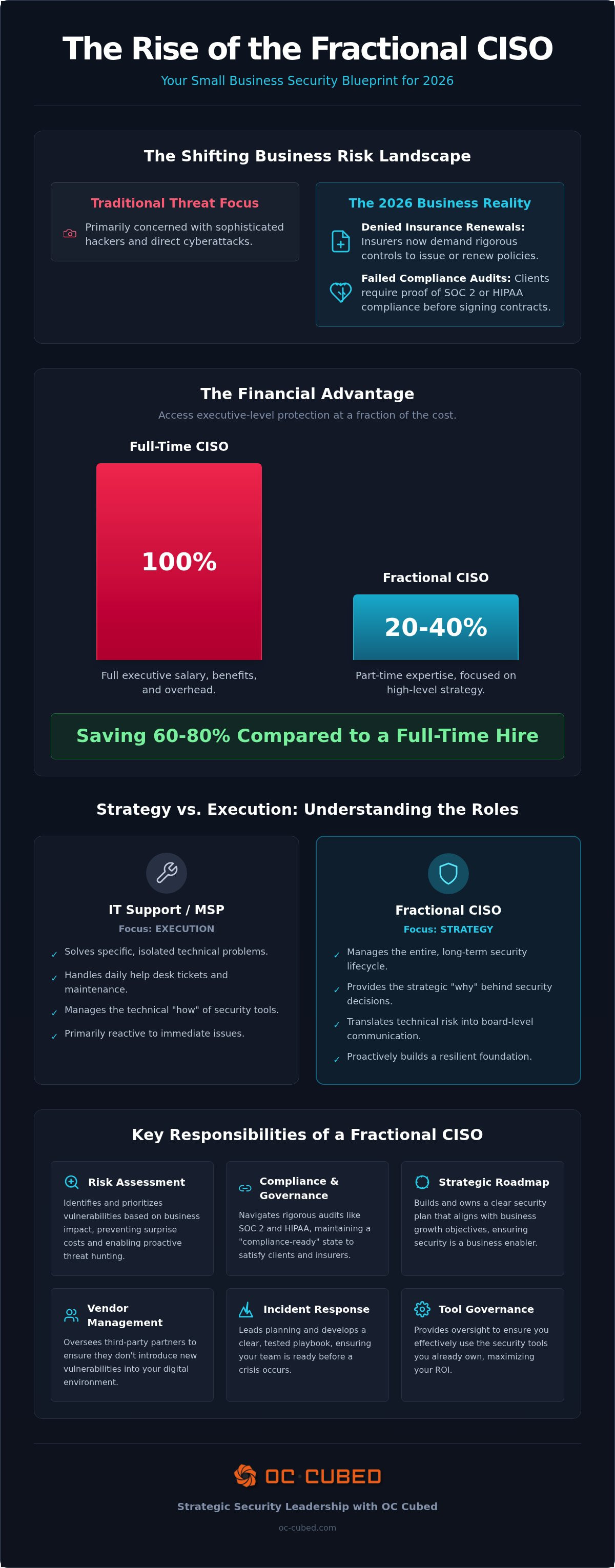
- Understand the financial benefits of the fractional model, which provides executive-level protection while saving 60-80% compared to a full-time hire.
- Get a clear roadmap for aligning your security posture with your specific business growth objectives.
- See how integrating strategic oversight with proactive monitoring eliminates surprise IT costs and protects your brand reputation.
What is a Fractional CISO for Small Business?
A fractional CISO is an executive-level leader who provides part-time security guidance and long-term strategy. They aren't just technical staff; they're business advisors who bring the same authority as a full-time Chief Information Security Officer. For a growing company, this means accessing high-level expertise without the burden of a permanent executive salary. This role is frequently referred to as a Virtual CISO; the focus remains on long-term governance rather than simple technical fixes. Integrating a fractional CISO small business partnership allows you to stop reacting to threats and start building a resilient foundation.
This model has become the standard for businesses in 2026 because it bridges the gap between basic IT and executive risk management. A fractional leader doesn't replace your existing IT team or Managed Service Provider (MSP). Instead, they complement those teams by providing the strategic "why" behind the technical "how." They manage vendors, oversee project timelines, and ensure that every technology investment actually reduces your business risk.
The Core Difference: Strategy vs. Execution
Security consultants usually solve specific, isolated problems. They might come in to help you pass a single audit or configure a new firewall. A fractional CISO manages the entire security lifecycle. Most small businesses already own the necessary tools, such as Microsoft 365 security features or endpoint protection, but they lack the governance to use them effectively. The CISO provides this missing layer of oversight. They translate technical vulnerabilities into clear, board-level risk communication so you can make informed decisions about where to invest your resources.
Why 2026 Demands Specialized Leadership
The digital environment has shifted. AI-driven phishing attacks and complex supply chain vulnerabilities are now everyday realities for companies of all sizes. The old "set it and forget it" approach to security is no longer viable. You need a leader who stays ahead of shifting national regulations and evolving threat patterns. Fractional leaders bring a broad perspective gained from working across multiple industries. This experience allows them to spot emerging risks before they impact your operations, ensuring your business remains compliant and protected as the regulatory environment grows more demanding.
Key Responsibilities of a Fractional Security Leader
A fractional security leader doesn't just check boxes. They own the strategic security roadmap. While your IT team handles daily tickets, the CISO focuses on the long-term health of your organization. This includes overseeing vendor management to ensure your third-party partners don't introduce new vulnerabilities into your environment. They also lead incident response planning, so you have a clear, tested playbook ready before a crisis occurs. Choosing a fractional CISO small business owners can rely on means finding a partner who handles the heavy lifting of governance while you focus on growth.
When researching How to Find a CISO, it's clear that cloud expertise and business alignment are the two most critical factors for modern leadership. If you're ready to move beyond basic IT, OC Cubed provides Virtual CISO leadership that turns security into a competitive advantage.
Risk Assessment and Vulnerability Management
Risk management isn't a one-time project. It's a continuous cycle of identification and mitigation. A fractional CISO starts by identifying where your business is most exposed today. They don't just hand you a list of problems; they prioritize security spend based on actual business risk. This prevents the "surprise IT bills" that often plague growing companies. Instead of reactive patching, they implement proactive threat hunting and endpoint protection. This shift in strategy ensures that your most critical assets are shielded by a defense-in-depth approach.
Compliance and Governance Leadership
Compliance often feels like an uphill battle for small teams. Whether you're facing SOC 2, HIPAA, or industry-specific standards, a fractional CISO provides the leadership needed to navigate these rigorous audits. They help you maintain a "compliance-ready" state throughout the year rather than scrambling at the last minute. This ongoing governance is also vital for your bottom line. Most cybersecurity insurance providers now require proof of specific controls before they'll issue or renew a policy. Your CISO links these security policies directly to insurance requirements, ensuring you remain covered and your premiums stay manageable.
Finally, a security leader builds a culture of awareness. They oversee employee training programs that teach your staff how to recognize AI-driven phishing and other social engineering tactics. By turning your employees into a human firewall, the CISO adds a critical layer of protection that technology alone can't provide. This comprehensive approach covers everything from technical disaster recovery to the human element of security.
The Financial Case: Fractional vs. Full-Time CISO Costs
Hiring a full-time security executive is a significant financial commitment. A traditional CISO requires a high six-figure salary, comprehensive benefit packages, and often a piece of company equity. For an enterprise with thousands of employees, this investment makes sense. For most growing companies, it's often an inefficient use of capital. A fractional CISO small business model changes the math. You get the same executive-level expertise while only paying for the hours or outcomes you actually need. This approach typically saves businesses between 60% and 80% compared to a full-time hire.
There's also the "Hidden Cost" of having no security leadership. Without a professional at the helm, security spending is often fragmented and reactive. You might buy tools that don't talk to each other or miss critical vulnerabilities that lead to a breach. The expense of a single data breach, including remediation, legal fees, and lost reputation, far outweighs the cost of proactive leadership. Strategic oversight ensures that every dollar you spend on security actually reduces your risk profile.
Comparing Executive Leadership Models
Different business stages require different levels of support. Understanding where you fit helps you avoid overspending or under-protecting your assets.
- Full-time CISO: Best for enterprise-level complexity and massive internal security teams.
- Fractional CISO: Ideal for businesses with 20 to 250 employees that need strategy, compliance, and vendor management without the full-time overhead.
- Ad-hoc Consulting: Best for one-time projects or single audits, but it lacks the ongoing governance and accountability required for long-term protection.
ROI of Fractional Leadership
The return on investment for fractional leadership is felt across the entire business. First, documented security controls and executive oversight often lead to lower cybersecurity insurance premiums. Carriers want to see that a professional is managing your risk. Second, you'll pass client security reviews much faster. Instead of stumbling through complex questionnaires, your CISO provides the authoritative answers that close deals. This leadership turns security from a cost center into a growth enabler. For a broader look at how executive strategy impacts your operations, read our guide on fractional CIO for small business. This scalable model ensures you have the right leadership at the right time as your company grows.
How to Implement a Fractional CISO Roadmap
Implementing a fractional CISO small business strategy requires a structured approach that moves beyond temporary fixes. The process begins with a baseline security and risk assessment. You can't protect what you haven't measured; this initial audit identifies where your data is most vulnerable and where your current controls fall short. Once the gaps are identified, the next step involves aligning security goals with your specific business growth objectives. If your company plans to scale into regulated industries like healthcare or finance, your roadmap must prioritize those compliance requirements immediately to prevent future bottlenecks.
Success depends on consistency. Establishing a regular cadence for reporting and review ensures that security remains a board-level priority rather than a secondary concern. Monthly reports provide the visibility needed to track progress and adjust to new threats. Finally, you must integrate CISO strategy with your daily managed IT operations. When your executive leadership and your Network Operations Center (NOC) work in sync, you eliminate the friction that often exists between high-level policy and technical execution. This alignment turns security into a proactive shield for your operations.
Setting Realistic Security Milestones
What should you expect in the first 90 days of fractional leadership? The initial phase focuses on immediate risk reduction and establishing governance. Your leader will identify "low-hanging fruit" such as unmanaged devices or missing multi-factor authentication. By the end of the first quarter, you should have clearly defined Key Performance Indicators (KPIs) for security. These might include the average time to remediate vulnerabilities or employee phishing simulation results. Achieving these milestones requires executive buy-in across all departments. Security is not just an IT task; it is a fundamental business function that protects your reputation and your revenue.
Managing the Technology Stack
A fractional CISO provides the oversight needed to optimize your existing technology. They ensure that Microsoft 365 tenant maintenance is handled correctly, preventing data leaks through misconfigured permissions or stale user accounts. They also focus on hardening your perimeter by optimizing endpoint protection and email security tools. Proofpoint integration stops threats at the inbox by using advanced threat intelligence to identify and quarantine malicious attachments before they ever reach your users. This level of technical governance ensures that your security stack works as a unified defense rather than a collection of disconnected software.
Strategic Security Leadership with OC Cubed
OC Cubed provides a unique advantage by combining executive leadership with proactive technical management. Most providers offer either high-level consulting or low-level helpdesk support. We bridge that gap. By integrating our fractional CISO small business services directly with our Network Operations Center (NOC), we ensure that your security strategy isn't just a document on a shelf. It's a living part of your daily operations. This synchronization means that when your CISO identifies a new threat, your technical team is already implementing the remediation. You don't have to worry about a strategy that your IT staff can't actually execute.
This unified model eliminates the "surprise IT bills" that small business owners often fear. We provide strategic support on a flat-rate basis, allowing you to budget with confidence. Our approach turns your IT from a source of anxiety into a predictable engine for growth. We act as your protector and enabler simultaneously. For a deeper look at how this fits into your long-term planning, check out our enterprise-grade IT leadership guide. Integrating a fractional CISO small business partnership with OC Cubed means you aren't just getting advice; you're getting execution.
A Unified Approach to Protection
We move your business beyond the "break-fix" cycle. Instead of waiting for something to fail, we maintain a proactive security posture through 24/7 monitoring and threat detection. Our fractional CISO services also take the burden of vendor and project management off your plate. We handle the technical conversations and ensure your third-party partners meet your security standards. This means you don't have to spend your time vetting software or managing IT projects. Every month, you receive clear reporting that provides executive-level accountability. You'll know exactly what was protected and how your risk profile has improved. It's about providing the quiet authority you need to stay focused on your core business goals.
- Threat Detection: Proactive 24/7 monitoring that stops breaches before they start.
- Vendor Management: Expert oversight that ensures your partners aren't your weakest link.
- Compliance Readiness: Strategic leadership that simplifies complex audits and insurance renewals.
Ready to Secure Your Growth?
Every industry has unique security requirements. Whether you're managing sensitive patient data or securing proprietary engineering files, we customize the fractional model to fit your specific needs. We've seen what happens when businesses lack proper support, and we know exactly how to fix it. Starting the conversation is simple. We'll look at your current environment and identify the most efficient way to implement enterprise-grade leadership. Our goal is to provide the steady reliability and peace of mind you deserve.
Building a Resilient Foundation for Growth
The shift toward enterprise-grade security isn't just about avoiding breaches; it's about enabling your business to compete at a higher level. By 2026, the gap between companies with strategic leadership and those without will only widen. Implementing a fractional CISO small business model gives you the executive oversight needed to manage complex compliance audits and rising insurance requirements. You gain access to 24/7 proactive network monitoring and expert Proofpoint email security integration at a fraction of the cost of a full-time hire.
It's time to move beyond reactive IT support that only fixes problems after they occur. A fractional leader ensures your Microsoft 365 tenant maintenance is flawless and your security roadmap aligns with your long-term growth goals. You deserve the peace of mind that comes from knowing a seasoned professional is watching the gate. This strategic approach removes the technical obstacles that hinder your expansion, allowing you to focus on your core mission with complete confidence. Your business is ready for the next level of protection and performance.
Let's build a secure future together. We're here to provide the steady reliability your organization needs to thrive in an evolving digital landscape.
Frequently Asked Questions
What is the average cost of a fractional CISO for a small business?
Costs are structured as a monthly advisory fee based on your specific risk profile and organizational complexity. While a full-time executive requires a massive salary and equity, a fractional CISO small business model allows you to pay only for the leadership you need. This typically results in a significant reduction in total cost of ownership. You get the same level of strategic oversight without the permanent executive payroll burden or benefit costs.
How many hours a month does a fractional CISO typically work?
Most fractional leaders work between 5 and 20 hours per month depending on your business size and security maturity. During the initial 90 day roadmap phase, the time commitment is usually higher as they conduct assessments and build your strategy. Once your governance is established, the cadence shifts to regular reporting and oversight. This flexible model ensures you aren't paying for idle time while still maintaining a professional security posture.
Does my business really need a CISO if we already have an IT company?
Yes, because IT management and security governance are two distinct functions. Your IT company focuses on technical execution and keeping systems running. A CISO focuses on risk management, compliance, and strategic alignment. A fractional leader provides the oversight to ensure your IT tools are configured correctly and that your business meets the standards required by insurance carriers. It's about having a strategist who guides the technical team.
Can a fractional CISO help us pass a SOC 2 or HIPAA audit?
A fractional CISO is specifically designed to lead your organization through complex compliance audits. They don't just help you prepare; they manage the entire governance lifecycle. This includes writing policies, implementing controls, and acting as the primary point of contact for auditors. Their presence gives auditors confidence that your security is managed by a professional. This leadership often shortens the audit timeline and reduces the stress on your internal staff.
What is the difference between a vCISO and a fractional CISO?
These terms are often used interchangeably, though vCISO refers to the virtual delivery method while fractional refers to the part-time nature of the role. Both models provide executive-level security leadership on a non-permanent basis. The core value remains the same: you receive strategic guidance and risk management without the cost of a full-time hire. At OC Cubed, we treat these as a unified service that integrates with your existing operations.
What qualifications should I look for in a fractional CISO?
Look for a leader who possesses both technical depth and business acumen. They should have experience managing security for companies in your specific industry and hold recognized certifications like CISSP or CISM. Beyond technical skills, your fractional CISO small business partner must be able to communicate risk to non-technical stakeholders. They should have a track record of leading successful compliance audits and managing technical teams to achieve strategic security objectives.
How does a fractional CISO handle an active security breach?
A fractional CISO acts as the incident commander during a security breach. They lead the execution of your incident response playbook and coordinate between technical teams, legal counsel, and insurance carriers. Their role is to manage the crisis, limit the damage, and ensure clear communication with stakeholders. Having a professional at the helm during a breach prevents panic and ensures that remediation steps are handled according to industry best practices and regulatory requirements.
Will a fractional CISO manage our existing IT vendors?
Yes, vendor risk management is a core responsibility of a fractional security leader. They vet your third-party partners to ensure they meet your security standards and don't introduce vulnerabilities into your environment. Your CISO also manages technical projects and holds vendors accountable for their deliverables. This removes the burden of managing complex IT relationships from the business owner, ensuring that every partner in your supply chain is contributing to your overall security.


