

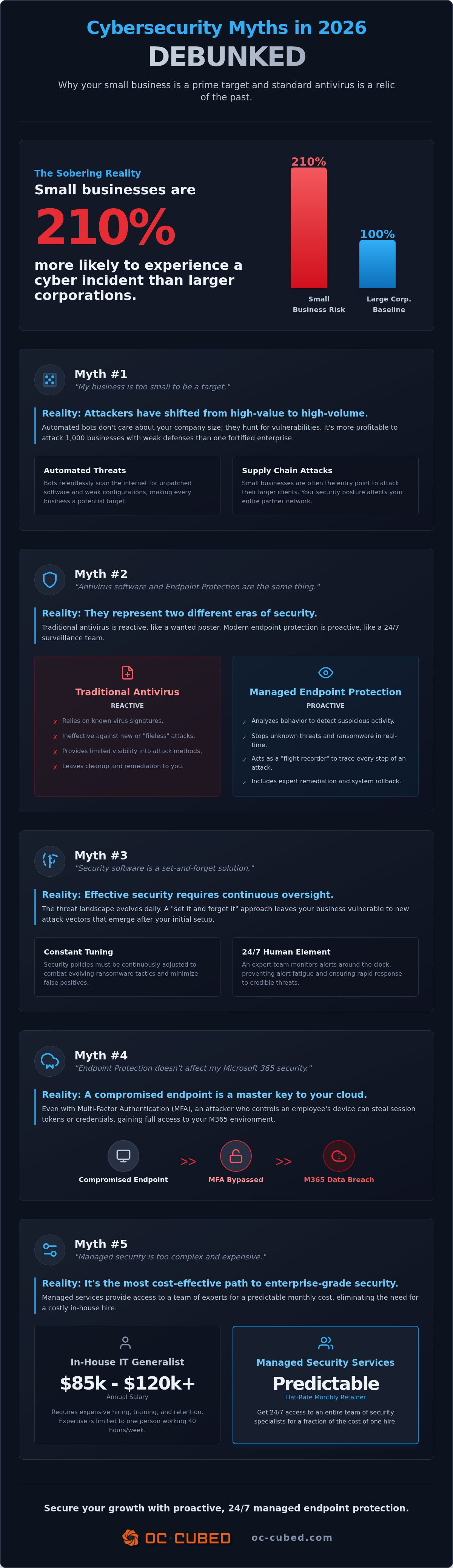
Small businesses are 210% more likely to experience cyber incidents than larger corporations, yet many still rely on basic software to guard their front lines. You might feel that your current antivirus is a solid shield, but in 2026, a "set it and forget it" approach is an invitation for disaster. Investing in endpoint protection managed services is no longer a luxury for the few. It's the essential baseline for any company that needs to stay operational and secure.
We understand the stress of managing remote employee devices while the threat of ransomware looms. It's overwhelming to parse technical jargon when all you really want is a stable environment and predictable monthly IT costs. This guide will clarify why standard antivirus is no longer enough to protect your growth. You'll discover how 24/7 oversight provides the total visibility required to prevent unplanned downtime. We're debunking five dangerous security myths that could be putting your business at risk today.
Key Takeaways
- Learn why reactive antivirus is insufficient against 2026 threats and how behavior-based detection closes the remediation gap.
- Understand how 24/7 oversight prevents alert fatigue and keeps your security settings tuned against evolving ransomware tactics.
- Discover the direct link between device security and your Microsoft 365 environment to prevent compromised endpoints from bypassing MFA.
- Explore how endpoint protection managed services provide total device visibility and predictable IT costs through a simple monthly retainer.
- Recognize why attackers in 2026 target small businesses as high-volume opportunities and how to secure your remote workforce effectively.
Myth #1: 'My Business Is Too Small to Need Managed Endpoint Protection'
Many business owners assume they fly under the radar because their headcount is low or their revenue isn't in the billions. In 2026, that's a dangerous gamble. Endpoint security is the defense of every laptop, desktop, and mobile device your team uses. These devices are the primary targets for modern threats. Attackers have shifted their strategy. They now prefer high-volume targets over high-value ones. It's much easier to automate attacks against a thousand small businesses with weak defenses than it is to breach one heavily fortified enterprise.
Small businesses are often the entry point for supply chain attacks. Hackers target a small vendor to gain access to the larger corporations they serve. If your device is compromised, you aren't just losing your data; you're potentially risking the security of every partner you work with. A single breach can cost hundreds of thousands of dollars, often forcing smaller firms out of business entirely. When you look at the average cost of a breach, the investment in endpoint protection managed services becomes a logical business decision rather than an added expense.
The Reality of Modern Cyber Targeting
Automated bots don't check your tax returns before they launch an exploit. They look for vulnerabilities, not company size. In our remote-first world, your office walls no longer define your security. Your employees' devices are the new perimeter. Effective cybersecurity risk management small business strategies must start at the device level. If a remote worker's laptop is hit by ransomware, your entire network is at risk. Managed services ensure that every device is monitored, no matter where it's located. This visibility is the foundation of a proactive defense.
Why Managed Services are the Great Equalizer
In the past, enterprise-level security tools were only available to companies with massive budgets. The managed service provider model has changed that. Now, small businesses can access the same advanced threat detection technology used by Fortune 500 companies. OC Cubed provides this level of steady reliability through our flat-rate monthly retainer.
By using endpoint protection managed services, you benefit from fractional costs. You get a 24/7 security posture without the $85,000 to $120,000 annual salary of an in-house IT generalist. It's a predictable way to secure your growth. You don't need to build an expensive internal team. You just need the right partner to provide steady, reliable oversight and immediate remediation when threats appear.
Myth #2: 'Antivirus Software and Endpoint Protection are the Same Thing'
Traditional antivirus is like a security guard holding a book of "most wanted" posters. If a criminal isn't in that book, they walk right in. This is signature-based detection. It's reactive. In 2026, attackers don't use the same "file" twice. They use fileless malware and credential theft to bypass these old defenses entirely. This is where endpoint protection managed services differ. Instead of looking for a specific file, modern protection monitors behavior. It asks why a calculator app is suddenly trying to encrypt your hard drive.
The gap between detection and remediation is where most damage happens. Standard software might flag a threat, but it often leaves the cleanup to you. Endpoint Detection and Response (EDR) acts as a flight recorder for your devices. It captures every move an attacker makes. This allows for a proactive stance. If you want to see how this fits into a broader strategy, check out the Cyber Guidance for Small Businesses provided by CISA. It highlights why basic tools aren't enough for the modern threat landscape.
Beyond Signatures: How Behavioral Analysis Works
Behavioral analysis identifies "weird" actions instead of "known bad" files. It stops an attack in progress by recognizing patterns associated with ransomware or data exfiltration. Next-Gen Antivirus (NGAV) is a component of this, but it isn't the whole solution. Managed EDR provides the context needed to understand how a threat entered your system. It allows us to kill the process and roll back changes before the damage spreads. This level of proactive threat remediation is what keeps your business running without interruption.
The 24/7 Human Element: NOC and Helpdesk Integration
Software is only as good as the person monitoring it. Automated "quarantine" often fails because attackers move laterally across your network once they're inside. They don't stay on one device. This is why our Network Operations Center (NOC) is vital. When the software sends an alert, our team investigates it immediately. We don't just wait for a ticket to be filed. We hunt for the root cause.
Integrating your device security with remote IT management services creates a unified defense. It ensures that your helpdesk, NOC, and security tools are all speaking the same language. This coordination prevents alert fatigue. It ensures that when a real threat emerges, the response is instant and effective. You gain peace of mind knowing that a human expert is always watching the digital perimeter.
Myth #3: 'Security Software is a Set-and-Forget Solution'
Cybersecurity isn't a destination; it's a constant process of refinement. Many businesses assume that once they pay for a license and install the agent, the job is done. This "set-and-forget" mentality is a gift to modern hackers. Your security configuration must evolve alongside the threats it faces. Without regular tuning, software often falls into the trap of alert fatigue. This happens when a system generates so many low-level warnings that a team begins to ignore them. A real threat could easily hide in that digital noise.
Effective endpoint protection managed services solve this by providing continuous oversight. We don't just install a tool; we manage the outcome. This includes keeping patch management and endpoint protection in sync. If your software is active but your operating system has unpatched vulnerabilities, you're still at risk. We provide monthly reporting to show exactly what's happening on your network. This documentation proves your defenses are working and helps us identify areas for improvement before a crisis occurs.
Continuous Configuration and Policy Management
Default settings are a goldmine for sophisticated hackers. They know the standard configurations for most popular security tools and have built exploits specifically to bypass them. We move beyond defaults by customizing security profiles for different roles within your company. An accountant doesn't need the same access or permissions as a remote sales representative. By narrowing the attack surface for each user, we reduce the overall risk to the organization. This protection extends to your infrastructure through proactive firewall and switch management. Your hardware and software must work together to create a multi-layered defense.
Threat Detection and Remediation in Real Time
What happens in the first 60 seconds of a detected threat determines the survival of your data. If a laptop is compromised, the goal is to prevent lateral movement. Proactive remediation stops the infection from jumping to your servers or other employee devices. IBM's 2025 Cost of a Data Breach Report found that only 30% of companies regularly test their incident response plans. We bridge that gap by acting as your dedicated response team. This rapid response is a core part of a cybersecurity incident response plan small business owners can rely on. It ensures that a single mistake by one employee doesn't lead to total network downtime.
Myth #4: 'Endpoint Protection Doesn't Affect My Microsoft 365 Security'
Your cloud environment doesn't exist in a vacuum. It relies entirely on the devices your team uses every day to access data. If an employee's laptop is compromised, your Microsoft 365 data is immediately exposed. Many business owners believe that cloud security begins and ends with a strong password and Multi-Factor Authentication (MFA). In 2026, this is no longer true. Attackers now use sophisticated session token theft to bypass MFA. They don't need your password if they can take over an already authenticated session on a compromised local device. Managing these connections is a core part of effective endpoint protection managed services.
Compromised devices are the primary gateway to your cloud files. When an endpoint is unmanaged, you lose control over who is accessing your sensitive information. We bridge this gap by ensuring your device security and cloud security work as a single unit. This integrated approach is the only way to maintain total visibility in a remote-first work environment. It's about protecting the data, regardless of where it's being viewed or edited.
Securing the Cloud-to-Device Pipeline
Modern security relies on conditional access policies. These policies act as a digital bouncer, checking the health of a device before granting access to Microsoft 365. If a device is unmanaged or shows signs of infection, the connection is blocked automatically. Proper Microsoft 365 tenant maintenance now requires monitoring the health of every connected device. We ensure that when a sensitive file leaves the cloud and hits a laptop, it stays protected. This prevents data leaks and ensures that your compliance standards are met across the entire organization.
Total Inbox Protection
Most cyberattacks begin in the inbox. We use Proofpoint to kill threats before they ever reach the user's screen. This creates a powerful synergy with our endpoint protection managed services. Email security and endpoint protection share threat intelligence in real time. If a malicious link is blocked at the email gateway, the endpoint agents are immediately updated to watch for similar patterns. This layered defense stops attacks at the perimeter and significantly reduces the burden on your helpdesk. It's a proactive way to keep your team productive and your network clean.
Myth #5: 'Managed Security Services are Too Complex to Implement'
Many leaders hesitate to upgrade their security because they fear a long, disruptive implementation process. They imagine weeks of downtime and complex software that confuses their employees. This is a common misconception. Modern endpoint protection managed services use low-friction remote agents that deploy in minutes. There is no need for on-site technician visits or manual installs on every machine. We handle the technical heavy lifting behind the scenes. This allows your team to stay focused on their work while we secure the perimeter.
Some competitors promise "one-click" marketplaces, but implementation is rarely that simple for businesses with established systems. We move beyond marketing slogans to provide actual expert configuration. Transitioning from "break-fix" chaos to a managed model provides immediate stability. Instead of waiting for a disaster to happen and then scrambling for a solution, you move to a proactive stance. We take over the vendor management, coordinating between different software providers to ensure everything works together seamlessly. You get the benefits of enterprise-grade security without the implementation headaches.
Predictable Costs, Unlimited Protection
Budgeting for IT shouldn't feel like a guessing game. A flat-rate monthly retainer is almost always more cost-effective than a single emergency repair. When you rely on reactive support, a single ransomware incident can result in catastrophic, unbudgeted expenses. Bundled security services eliminate these surprises. You gain a clear understanding of your monthly IT spend while receiving 24/7 protection. Understanding what is a managed service provider helps you see the value of this partnership. It's about moving from a vendor relationship to a trusted advisor who cares about your long-term growth. We prioritize your peace of mind by removing the financial volatility of IT management.
Next Steps: Achieving Cybersecurity Peace of Mind
Securing your business starts with a clear picture of your current risks. We recommend conducting an initial security audit of your existing endpoints. This identifies vulnerabilities before attackers can find them. From there, our fractional leadership through a vCISO (Virtual CISO) guides your security roadmap. We don't just fix today's problems; we plan for tomorrow's threats. A single in-house IT generalist can cost a company $85,000 to $120,000 per year in fully loaded costs, but our managed model provides broader expertise for a predictable monthly fee. This steady, reliable approach ensures your business remains resilient as you scale. Contact OC Cubed today for a proactive IT assessment to see how we can protect your future.
Secure Your Digital Perimeter for 2026
The threat landscape has moved past simple viruses. Today, your business needs a defense that's as dynamic as the attackers themselves. Relying on outdated myths only leaves your data and your Microsoft 365 environment vulnerable. By investing in endpoint protection managed services, you gain the visibility needed to stop ransomware before it takes root. You've seen how behavior-based detection and constant policy tuning provide the steady reliability your growth requires.
We deliver enterprise-grade security for growing businesses through our flat-rate monthly retainer. This model eliminates surprise costs while providing 24/7 monitoring and NOC integration. You don't have to handle the technical burden alone. We take over the heavy lifting so you can focus on leading your team with confidence. Our team ensures your remote devices and cloud pipelines stay resilient against evolving extortion tactics.
Take the first step toward total peace of mind and zero unplanned downtime. Your business deserves a protector that never sleeps. We're here to ensure your technology remains an asset rather than a liability.
Frequently Asked Questions
What is the difference between antivirus and managed endpoint protection?
Antivirus relies on a static list of known threats, while managed endpoint protection monitors behavior to catch unknown attacks. It's the difference between a "most wanted" poster and a live security guard. Our service goes beyond software by adding human remediation through our NOC. If a threat is detected, our team acts immediately to isolate the device. This ensures even "zero-day" exploits are stopped before they spread.
Does endpoint protection work for remote employees using their own devices?
Yes, our remote agents are designed for the modern mobile workforce. We secure laptops and mobile devices regardless of ownership or location. By establishing a secure perimeter on the device itself, we protect your company data without interfering with personal files. This ensures every entry point to your network meets your strict security standards before any access to your cloud data is granted.
How much does managed endpoint protection cost for a small business?
We provide our services within a flat-rate monthly retainer to ensure your IT costs remain predictable. This approach is more cost-effective than the "break-fix" model, where a single ransomware incident leads to massive, unbudgeted expenses. You gain enterprise-grade security and 24/7 oversight without the overhead of an in-house team. This stability allows you to focus your budget on growth rather than emergency repairs.
Can endpoint protection prevent ransomware from encrypting my files?
Modern endpoint protection managed services are specifically built to stop ransomware in its tracks. Instead of just flagging a file, our system identifies the behavior of unauthorized encryption. Once detected, we automatically isolate the infected device from the rest of the network. This prevents lateral movement and allows our NOC team to roll back unauthorized changes, keeping your business operational and your data safe from extortion.
Do I still need a firewall if I have endpoint protection managed services?
Yes, a firewall remains a critical part of a multi-layered defense strategy. While endpoint protection secures the individual device, a firewall monitors and controls the traffic entering your network. Think of the firewall as your perimeter fence and endpoint protection as the lock on each individual door. We provide firewall and switch management as part of our comprehensive support to ensure your entire infrastructure stays resilient.
What happens if a threat is detected on a weekend or after hours?
Our 24/7 network monitoring and NOC integration mean that threats are addressed the moment they appear. Cybercriminals don't stick to business hours, and neither do we. If an alert triggers at 2:00 AM on a Sunday, our team is already working on the remediation. You don't have to wait until Monday morning to find out your network was compromised. We provide steady reliability every hour of the year.
How does managed endpoint protection integrate with Microsoft 365?
We integrate device security directly with your Microsoft 365 tenant maintenance. This creates a "conditional access" environment where only healthy, managed devices can access your cloud data. If a device is compromised or lacks latest security patches, it's blocked from your inbox and files. This synergy prevents attackers from using stolen session tokens to bypass MFA, ensuring your cloud-to-device pipeline remains completely secure.
Is managed endpoint protection compliant with industry regulations?
Choosing endpoint protection managed services is a major step toward meeting industry regulations like NIST CSF 2.0 or DORA. We provide the continuous monitoring and incident reporting required by most modern compliance frameworks. Our team maintains the audit trails and documentation you need to prove your security posture to auditors or insurance providers. It's a reliable way to ensure your business stays on the right side of evolving legal requirements.


