

What if your business's survival during a cyberattack didn't depend on your IT budget, but on a single sheet of paper? Most small business owners feel that high-end protection is out of reach. This leads to paralysis. Fear of downtime or data loss shouldn't stop your progress. It's true that threats are becoming more sophisticated, but you don't need a massive corporate budget to defend your livelihood. You simply need a lean, effective cybersecurity incident response plan small business teams can actually execute when the pressure is on.
Security is an enabler of growth, not a source of anxiety. This guide shows you how to build a response strategy that prioritizes uptime without unnecessary complexity. You'll learn how to navigate the critical first 24 hours of an attack and define clear roles for your staff. We'll also explain how a virtual CISO architects your defense. This roadmap provides the peace of mind your stakeholders require to keep your business resilient through 2026.
Key Takeaways
- Understand how a structured emergency playbook shifts your posture from reactive panic to a controlled, professional response.
- Build a lean cybersecurity incident response plan small business teams can execute by focusing on the six essential phases of incident management.
- Leverage a hybrid response model that integrates your internal staff with the strategic leadership of a virtual CISO.
- Identify the critical documentation, including communication trees and asset inventories, required to protect your business during the first 24 hours of an attack.
- Learn how to validate your strategy through tabletop exercises that prepare your leadership for the evolving threat landscape.
What Is a Cybersecurity Incident Response Plan for Small Business?
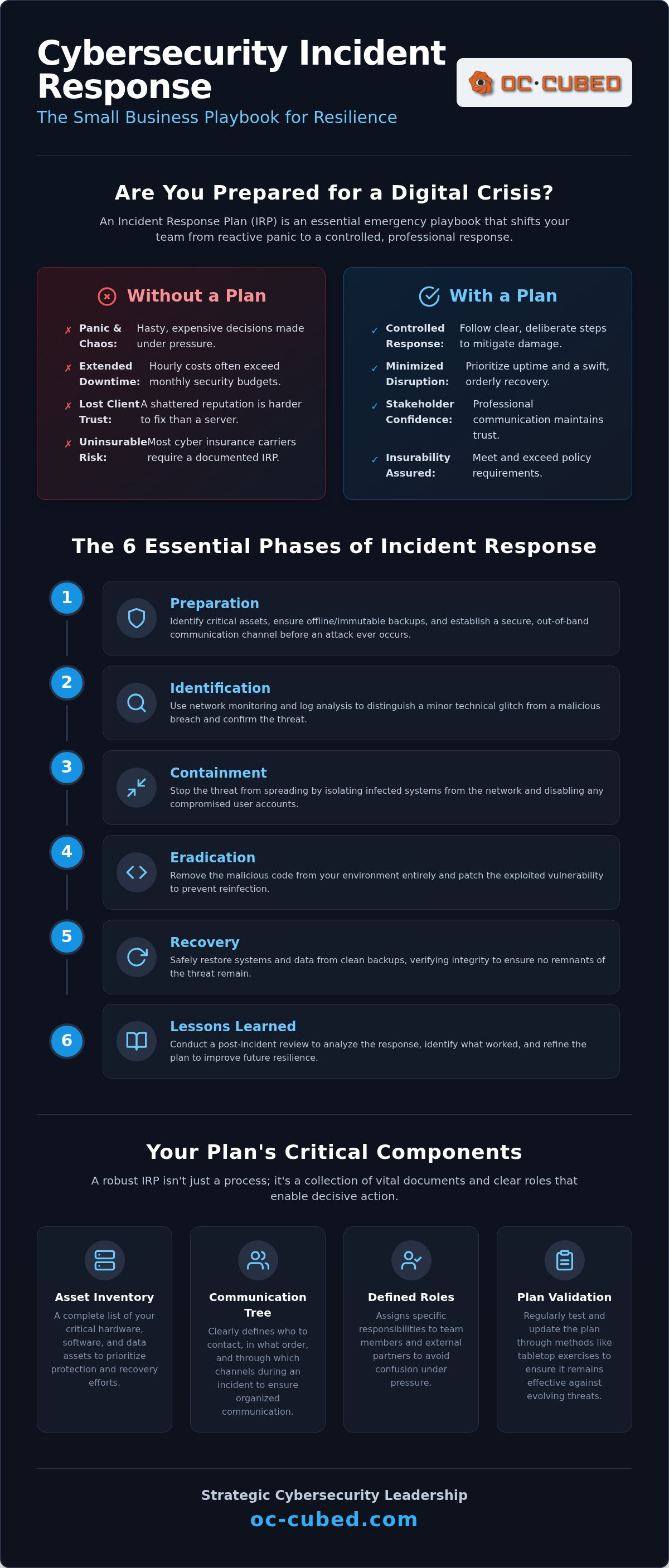
Think of a cybersecurity incident response plan small business teams can actually use as an emergency playbook. It provides the exact steps your organization must take when a digital crisis occurs. While your antivirus and firewalls act as your front line, the IRP is your contingency plan for when those lines are breached. As part of Computer security incident management, the plan ensures that every action taken during a breach is deliberate and effective.
Small businesses in 2026 often find themselves "target rich but resource poor." Hackers know you have valuable data but realize you may lack the enterprise-grade security teams of larger corporations. This makes a lean response plan even more vital. You don't need a hundred-page manual. You need a concise set of instructions that your team can follow under pressure. Additionally, most modern cyber insurance carriers now require a documented cybersecurity incident response plan small business leaders have signed off on before they'll issue a policy. Without one, you aren't just vulnerable to hackers; you're uninsurable.
The Consequences of Operating Without a Plan
Operating without a plan forces you into "panic-mode." When an attack happens, decisions made in haste are almost always expensive. While specific figures vary, the hourly cost of downtime for a small company often exceeds the monthly cost of managed security services. Beyond the immediate financial hit, a slow or disorganized response shatters client trust. It's much harder to rebuild a reputation than it is to restore a server. A clear plan keeps costs predictable and communication professional.
Proactive vs. Reactive: Where the IRP Fits
Proactive security includes tools like multi-factor authentication (MFA) and endpoint protection management. These are essential barriers. However, even the best defenses can be bypassed by sophisticated 2026-era threats. This is where the reactive side of your 2026 Cybersecurity Risk Strategy for Small Business comes into play. Proactive measures try to stop the fire; the IRP is your sprinkler system and evacuation route. It bridges the gap between a security event and a full business recovery.
The 6 Essential Phases of an Effective Response
A successful cybersecurity incident response plan small business leaders implement follows a structured lifecycle. This ensures no critical steps are missed when stress levels are high. By breaking the response into six distinct phases, your team can move from initial detection to full recovery with precision. This methodology transforms a chaotic situation into a manageable process.
Phase 1: Preparation is 90% of the Battle
Preparation occurs long before a threat appears. It involves identifying your most critical business assets, such as financial records, client databases, and proprietary software. You must ensure your backups are either offline or immutable. This prevents ransomware from encrypting your last line of defense. Part of this phase includes following the Cyber Guidance for Small Businesses provided by CISA to establish baseline security standards. You should also set up a "break glass" communication channel, like a secure messaging app, that operates entirely outside your company email system. If your primary email is compromised, you need a reliable way to coordinate your team.
Phases 2-4: Speed and Accuracy in Remediation
Identification is the moment your team distinguishes a minor technical glitch from a malicious security breach. We use continuous network monitoring and log analysis to spot anomalies before they escalate. Once a threat is confirmed, the focus shifts to Security Threat Detection and Remediation. This is the technical process of hunting for the root cause and neutralizing the attacker's presence within your environment.
Containment focuses on stopping the spread. An effective isolation strategy might involve disconnecting infected devices from the network or disabling compromised user accounts. Eradication follows, where we remove the threat entirely and patch the entry point to prevent a repeat performance. If you aren't sure where your current defenses stand, consider a professional review of your Network Monitoring and Configuration to identify potential gaps before they are exploited.
Phases 5-6: Recovery and Lessons Learned
Recovery is the stage where systems are safely brought back online. It's not enough to just flip a switch; you must verify the integrity of the data and ensure no remnants of the malware remain. The final phase, Lessons Learned, is often the most neglected but most valuable. It involves a post-incident analysis to determine what worked and what didn't. This feedback loop strengthens your cybersecurity incident response plan small business strategy, making your organization more resilient against future attacks.
Defining Roles: Who Leads Your Response Team?
Most cybersecurity guides assume your company has a dedicated Security Operations Center (SOC) on standby. For the average entrepreneur, this isn't the reality. You likely don't have a room full of monitors and analysts waiting for a breach. A successful cybersecurity incident response plan small business teams rely on uses a hybrid model. This approach combines your internal leadership with specialized external partners. It provides enterprise-level protection without the enterprise-level payroll.
One critical rule for any business owner is to avoid acting as the technical lead during a crisis. When an attack occurs, your focus must remain on high-level decision-making and stakeholder communication. Attempting to manage the technical recovery yourself leads to mistakes and slower remediation. Instead, your role is to empower your experts to execute the playbook. Citing a recent discussion on How Can Small Businesses Alleviate Cyber Risks?, experts emphasize that clear role definition is the primary factor in reducing recovery time.
The Role of the Virtual CISO (vCISO)
The vCISO is the architect of your response strategy. This is a fractional executive who provides high-level security leadership without the cost of a full-time hire. They bridge the gap between your business goals and the technical reality of your IT environment. During an incident, the vCISO coordinates with your legal team, insurance providers, and regulatory bodies to ensure you remain compliant. They take the guesswork out of the response by providing a steady, professional hand at the top of the chain of command.
The MSP as Your Tactical Engine
If the vCISO is the architect, the Managed Service Provider (MSP) is the tactical engine. An MSP acts as the "First Responder" in your incident response plan. Because they provide 24/7 network monitoring, they are often the first to detect an anomaly. They handle the technical execution of the plan, including remote containment and threat eradication. They use tools like endpoint protection management to isolate infected devices before the damage spreads. For a deeper look at how these partnerships function, read our guide on What Is a Managed Service Provider?. By outsourcing the technical labor, you ensure that your recovery is handled by specialists who see these threats every day. This structure provides the steady reliability you need to protect your growth.
Critical Documentation: What Your Plan Must Include
A cybersecurity incident response plan small business owners can rely on is built on documented facts, not guesses. When a breach occurs, information is your most valuable currency. You shouldn't spend the first hour of an attack looking for account numbers or trying to remember who manages your firewall. Your documentation acts as a single source of truth that keeps the response moving forward. It ensures that even if your primary systems are down, your team knows exactly how to proceed.
Your plan needs to include four core pillars of information to be effective:
- The Communication Tree: A clear hierarchy of who to call first, second, and third. This prevents overlapping efforts and ensures the right people are notified in the correct order.
- The Asset Inventory: A comprehensive list of every server, cloud tenant, and endpoint. If you don't know an asset exists, you can't secure it or verify its integrity during recovery.
- Vendor Contact List: Direct lines for Microsoft 365 support, your ISP, cyber insurance, and legal counsel. Many businesses forget that their vendors are critical partners in the containment process.
- Compliance Checklists: Specific steps required to maintain HIPAA, PCI DSS, or SOC 2 standards. These checklists ensure you don't accidentally violate regulatory requirements while trying to restore service.
External Communication: Beyond the IT Desk
Communication isn't just about technical fixes. You must notify your cyber insurance provider immediately. Most policies require notification before you incur significant recovery costs; waiting can jeopardize your coverage. You also need a pre-written holding statement. This allows you to communicate with clients and the public without revealing sensitive details prematurely. In the US, legal obligations for data breach notification vary by state and industry. Your documentation should list these specific requirements so you don't miss a mandatory reporting deadline during the chaos.
Managing Your Cloud Ecosystem
Your cloud environment requires its own set of response steps. For instance, Microsoft 365 tenant protection often involves resetting global admin passwords and auditing sign-in logs across the entire organization. You must also coordinate with third-party SaaS vendors to ensure their connections to your network haven't been compromised. Managing these moving parts is complex. It's helpful to follow a broader Managed Cybersecurity for Small Business strategy to ensure your cloud and on-premise documentation stay synchronized. This unified approach prevents gaps in your defense.
Testing and Evolving Your IRP with OC Cubed
A plan that only exists on paper is effectively useless. During a real-world breach, your team won't have time to read a manual for the first time. Muscle memory is what saves businesses from catastrophic downtime and data loss. This is why testing your cybersecurity incident response plan small business strategy is just as important as writing it. OC Cubed acts as your partner in this evolution; we don't just hand you a document and walk away. We help you build, test, and refine your strategy so it remains effective as your business grows.
Tabletop exercises are the gold standard for testing readiness. These are low-stress, verbal simulations where your leadership team walks through a hypothetical breach scenario. We ask the hard questions: Who is authorized to take the servers offline? How do we notify clients if our primary email is down? These sessions reveal gaps in your communication tree and decision-making process before a real attacker finds them. By practicing in a safe environment, your team gains the confidence to act decisively when a real crisis occurs. This proactive approach ensures your cybersecurity incident response plan small business teams execute is always ready for action.
Monthly reporting is the final piece of the puzzle. It provides a data-driven look at your network's health and any attempted threats we've remediated. These reports aren't just for show; they're an audit trail that helps us evolve your response plan. If we notice a spike in specific types of phishing attempts, we update your preparation phase accordingly. This continuous improvement cycle ensures your defenses are never static. We provide the quiet authority and steady reliability needed to keep your business moving forward.
The Value of Continuous Monitoring
24/7 monitoring is the most effective way to reduce your Mean Time to Detect (MTTD). Proactive maintenance stops minor vulnerabilities from becoming full-scale crises. When we manage your network, we handle the routine updates and patches that hackers often exploit. This steady protection allows you to focus on growth while we secure the infrastructure. If you haven't evaluated your current IT posture lately, now is the time to identify where your vulnerabilities lie.
Getting Started: Your First Steps Toward Resilience
Resilience doesn't happen overnight, but you can start today. Your first step should be a professional security audit to identify your current vulnerabilities. From there, draft a basic version of your communication tree. Knowing exactly who to call in the first ten minutes of an incident is a massive advantage. You don't have to navigate this alone. We provide the leadership and technical expertise required to keep your organization secure through 2026 and beyond.
Building a Resilient Future for Your Business
A digital crisis doesn't have to signal the end of your company. By establishing clear roles and maintaining rigorous documentation, you move from a state of constant anxiety to one of steady control. Implementing a robust cybersecurity incident response plan small business teams can trust is the difference between a minor technical setback and a total operation shutdown. You've learned that preparation is the foundation of recovery. Now, it's time to put those defensive layers in place.
Our team provides the steady reliability you need to grow without fear. We offer 24/7 proactive network monitoring and comprehensive Microsoft 365 management to keep your environment secure. With fractional CISO leadership, you gain the strategic guidance usually reserved for enterprise corporations. We handle the technical complexities so you can focus on your vision. You deserve the peace of mind that comes from knowing your livelihood is protected by seasoned experts.
Take the first step toward a more secure tomorrow. Your business is worth the investment in professional protection.
Frequently Asked Questions
Is an incident response plan required for cyber insurance?
Most modern cyber insurance carriers require a documented plan before they'll issue or renew a policy. Without one, your business is often considered uninsurable by major providers. Insurers want to see that you have a structured method for containing threats and minimizing financial loss. Having this documentation ready can also help lower your premiums by demonstrating a proactive security posture. It's a standard requirement for 2026 compliance that every owner should prioritize.
How often should a small business review its cybersecurity plan?
You should review your plan at least once a year or whenever your technology stack undergoes a significant change. If you add new cloud services or transition to a remote workforce, your documentation must reflect those shifts. Regular reviews ensure your communication tree and asset inventory remain accurate. We also recommend a brief update after any security event to incorporate lessons learned into your future response strategy and keep your resilience high.
What is the most common cybersecurity incident for small businesses?
Phishing remains the most frequent entry point for attackers targeting small organizations. These deceptive emails often lead to credential theft or ransomware deployment. Once an attacker gains access to a single employee's account, they can move laterally through your network to encrypt sensitive data. This is why email security with Proofpoint and endpoint protection management are critical components of a modern cybersecurity incident response plan small business teams use to stay resilient.
Can a small business handle incident response without an MSP?
Technically, a business can handle response internally, but it often leads to higher recovery costs and longer downtime. Small teams rarely have the 24/7 monitoring or specialized forensic tools needed to catch sophisticated threats early. An MSP acts as a first responder, providing the technical labor and executive leadership required to neutralize an attack. This allows your staff to focus on business operations while experts manage the complex remediation and recovery process.
What is the difference between a disaster recovery plan and an IRP?
A disaster recovery plan focuses on restoring your IT infrastructure after a total failure, such as a fire or server crash. In contrast, an IRP is specifically designed to manage a live security breach. While the two plans overlap during the recovery phase, the IRP includes unique steps for threat identification, containment, and evidence preservation. You need both to ensure your business can survive a digital emergency and maintain long-term stakeholder trust.
How much does it cost to create a cybersecurity incident response plan?
The cost varies based on the complexity of your network and the level of professional guidance you seek. While drafting a basic plan internally costs only staff time, partnering with a virtual CISO ensures your strategy meets insurance and compliance standards. It's helpful to view this as a preventative investment. The one-time cost of building a plan is significantly lower than the average financial impact of an unmanaged data breach or extended downtime.
What should I do in the first hour after discovering a data breach?
Your first priority is to isolate infected systems by disconnecting them from the network to stop the spread. Next, follow your cybersecurity incident response plan small business guide to notify your lead technical responder and insurance provider. Avoid deleting files or rebooting systems unless instructed; this can destroy critical forensic evidence. Clear, calm communication with your internal stakeholders is essential during these first sixty minutes to prevent panic-driven mistakes and ensure a professional recovery.


