

What if the biggest threat to your company growth isn't a sophisticated cyberattack, but the three different technology partners who all claim the other guy is responsible for your current network outage? Most owners find themselves drowning in a sea of subscriptions while trying to navigate IT vendor management for small business without a dedicated technical lead. It is exhausting to feel like you're paying for solutions that only create more work for your executive team.
You deserve a technology stack that works as hard as you do, backed by a single point of accountability. This 2026 guide provides a clear roadmap to help you eliminate surprise costs, reduce security risks, and reclaim your focus. We will show you how fractional leadership can transform your vendor relationships into a predictable, secure engine for growth. By the end of this article, you will have the framework to demand evidence-based security and financial transparency from every partner you trust with your data.
Key Takeaways
- Stop the "finger-pointing trap" by centralizing technical accountability and ensuring your different technology providers actually communicate with each other.
- Implement a mature strategy for IT vendor management for small business that prioritizes security vetting and supply chain risk over simple price comparisons.
- Leverage fractional leadership to manage vendor negotiations and performance, allowing you to reclaim executive focus for core business growth.
- Transition to an all-inclusive managed model to eliminate surprise invoices and ensure every technology partner consistently meets their Service Level Agreements.
The Hidden Cost of Vendor Sprawl: Why Management Matters in 2026
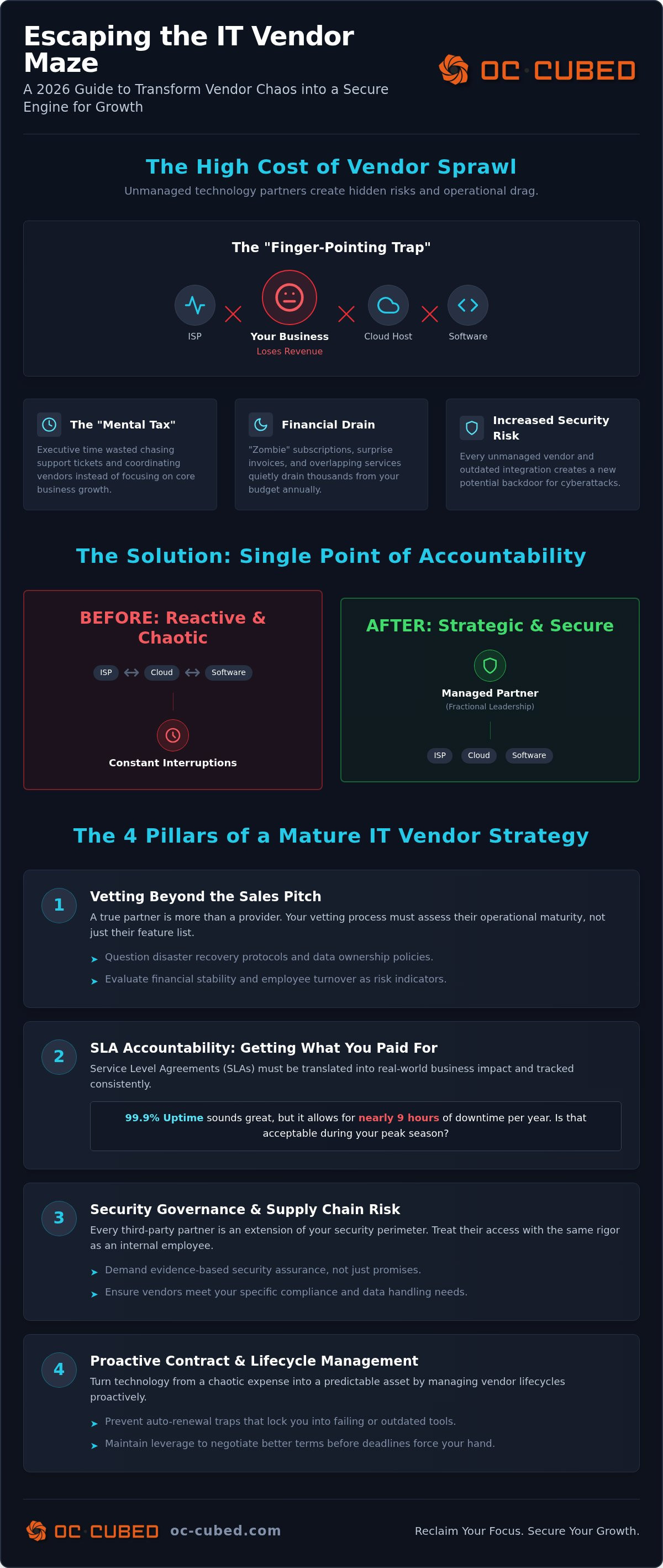
IT vendor management for small business is the strategic oversight of every third-party technology partner you rely on. It is more than just paying invoices on time. It is about ensuring those partners actually deliver the value and security they promised. In 2026, the complexity of the average tech stack has created what we call the "Finger-Pointing Trap." When your internet goes down or a critical cloud application fails, your ISP blames the cloud host. The cloud host blames the software provider. You sit in the middle, losing revenue while they argue over who owns the ticket. Effective management stops this cycle by establishing a single point of accountability for every technical issue.
The current environment means more vendors, which unfortunately creates more "attack surfaces." Every unmanaged login, outdated API, or poorly configured integration serves as a potential backdoor for hackers. You have to distinguish between supplier management and operational IT vendor management. Supplier management is procurement; it is simply about the transaction. Operational management is about success. It ensures the tools work together securely and efficiently every day.
The 'Mental Tax' on Small Business Leaders
Every hour you spend chasing a support ticket is an hour stolen from your business growth. Small business leaders often pay a "mental tax" when they act as their own IT coordinators. This constant vendor chaos prevents high-level decision-making because your focus is stuck on technical minutiae. Consolidating these communications through remote IT management services removes this friction. It allows you to step back from the troubleshooting desk and return to your role as a strategist.
Financial Impact: From Surprise Bills to Overlapping Subscriptions
Unmanaged tech stacks are notorious for "zombie" subscriptions. These are recurring charges for platforms you no longer use or licenses for employees who left months ago. Auto-renewals on outdated contracts can quietly drain thousands from your budget without a single alert. Professional oversight identifies these overlaps and eliminates waste. We ensure you only pay for what you actually use. This turns a chaotic, variable expense into a predictable monthly investment that supports your bottom line.
The 4 Pillars of a Mature IT Vendor Management Strategy
A mature IT vendor management for small business strategy rests on four distinct pillars. These are not just administrative tasks. They are active safeguards for your operations. By focusing on selection, performance, risk, and contract lifecycles, you turn technology from a variable expense into a stable asset. This structured approach ensures that every dollar spent on a third-party partner contributes directly to your company's growth and security.
Vetting Beyond the Sales Pitch
Sales teams are trained to say yes. Your job is to find where they might say no. Before signing a contract, ask about their specific disaster recovery protocols and data ownership policies. High employee turnover in an IT firm often leads to inconsistent service for your team. This is why understanding what is a managed service provider is vital when selecting a lead partner. You need a provider that acts as an extension of your company, not just another ticket system. Look for financial stability and a transparent support model. A vendor that lacks a clear roadmap for their own growth is a risk to yours.
SLA Accountability: Getting What You Paid For
Service Level Agreements (SLAs) often look like technical noise. You must translate them into business-impact metrics. For example, 99.9% uptime sounds excellent until you realize it allows for nearly nine hours of downtime every year. If those hours happen during your peak season, the cost is significant. Use monthly reporting to track responsiveness and resolution times. If a partner consistently fails to meet these targets, you have the data needed to demand credits or initiate a move to a better provider. Holding vendors to their promises is the only way to maintain a high-performing environment.
Security governance ensures every vendor meets your specific compliance needs. Whether you handle medical data or simple customer emails, your partners must provide evidence-based security assurance. This is a core component of effective IT vendor management for small business. Finally, lifecycle management prevents the auto-renewal traps that keep you tethered to failing tools. It gives you the leverage to negotiate better terms before a deadline forces your hand. If managing these moving parts feels like a full-time job, professional vendor oversight can provide the layer of protection you need to stay focused on your business.
Managed Services vs. Software Tools: Choosing Your Approach
Choosing how to execute IT vendor management for small business usually comes down to a choice: do you buy a tool or do you hire a team? Many software platforms promise to automate your vendor oversight. These tools are excellent at tracking data, but they cannot execute a strategy. A dashboard can show you that an ISP is failing its uptime requirements, but it will not pick up the phone to hold that ISP accountable. For most small businesses, adding another software subscription just creates more administrative work for an already busy executive. You end up managing the tool instead of the vendors.
The managed model provides a single point of accountability. This means you have one partner who owns the outcome of every technical interaction. If your cloud host and your firewall provider have a conflict, you don't spend your afternoon as a middleman. Your managed partner resolves the technical friction while you focus on your business operations. This approach moves technology from a source of stress to a reliable foundation for growth.
The Cost of Implementation vs. The Value of Expertise
Vendor management software often carries hidden costs that go far beyond the monthly license fee. You must account for the time spent on initial configuration, employee training, and the ongoing data entry required to keep the system accurate. Without a dedicated professional to interpret the data, these tools often become "shelfware" that provides zero ROI. A fractional leadership model offers a more efficient path forward. You gain access to enterprise-grade oversight without the overhead of a full-time executive salary. Fractional Leadership is the use of part-time executive expertise to guide technical strategy.
Eliminating Surprise IT Bills
Surprise bills are the enemy of a predictable budget. Traditional "Break-Fix" models create a conflict of interest because your IT provider only makes money when your systems fail. A flat-rate retainer model changes this dynamic entirely. It aligns your goals with your partner's goals. When your technology works perfectly, everyone wins. This shift creates a level of managed predictability that allows for better long-term planning.
- Retainer Efficiency: Fixed monthly costs cover ongoing vendor oversight and support.
- Predictable Migrations: Use project-based fees for major transitions instead of open-ended hourly billing.
- Waste Elimination: Regular audits identify and cancel overlapping subscriptions before they renew.
By choosing a managed approach, you replace technical uncertainty with financial clarity. You stop paying for "effort" and start paying for "results." This is the most effective way to ensure your technology stack remains an asset rather than a liability.
Security Governance: Managing Supply Chain Risk
Hackers have shifted their focus. They don't always attack your network directly anymore. Instead, they look for the weakest link in your supply chain. Small vendors often provide the easiest "backdoor" into your environment because they lack enterprise-grade security. Effective IT vendor management for small business must prioritize security governance to close these entry points. You have to treat every third-party connection as a potential risk that requires active monitoring.
A Virtual CISO doesn't just check boxes. They evaluate how a vendor's security posture impacts your specific risk profile. This involves ensuring every partner aligns perfectly with your cybersecurity incident response plan small business. If a vendor is breached, you need to know exactly how they will notify you and what steps they will take to contain the threat. Without this alignment, a vendor's crisis quickly becomes your disaster.
Your security is only as strong as the access you grant to outsiders. This is why endpoint protection managed services are critical. These services must extend to any device or connection that touches your data. If a vendor's technician logs into your system from an infected laptop, your internal firewalls may not be enough. You need a strategy that protects the point of entry, regardless of who owns the hardware.
The Virtual CISO's Security Checklist
Reading a SOC 2 report is a specialized skill. These documents are long, technical, and often hide critical weaknesses in the "exceptions" section. A Virtual CISO identifies these red flags before they become liabilities. We help you set minimum security requirements for any vendor with access to your data, such as mandatory multi-factor authentication and encrypted storage. Conducting a Gap Analysis on your current vendor roster allows you to see exactly where your partners fall short of 2026 standards. This data gives you the leverage to demand better protections or find a more secure partner.
Compliance and Regulatory Oversight
Regulated industries like healthcare or defense require more than just a handshake. You need documented evidence. Managing vendors under HIPAA or CMMC requires strict Data Processing Agreements (DPAs). These contracts legally bind your partners to your security standards. During an external audit, you will need to produce vendor logs to prove compliance. Having a partner who manages these logs centrally saves your team weeks of preparation time. It turns a stressful audit into a routine verification of your established controls.
Fractional Leadership: The OC Cubed Approach to Vendor Oversight
OC Cubed approaches IT vendor management for small business as a leadership challenge, not just an administrative task. We act as your internal IT department. This means we take full ownership of every vendor interaction from the moment a contract is signed. You stop being the middleman between competing technical interests. Our Virtual CIOs handle the negotiations and high-level strategy that most small businesses lack. We use real-time data from our Helpdesk and NOC integration to verify that vendors are meeting their performance targets. If a service level drops, we are the ones who catch it and demand a resolution. This proactive stance ensures your environment remains stable and secure without requiring your constant intervention. We provide the evidence-based security assurance you need to trust your partners.
Your Single Point of Contact
You only need one number to call. It does not matter if your email is down, your firewall is acting up, or a specific cloud application is failing. We manage the technical translation between your business goals and the vendor's specifications. This shift empowers you to lead your company instead of troubleshooting it. You no longer have to learn the dialect of every different provider. We speak their language so you don't have to. Our team provides a composed, professional layer of protection between your operations and technical friction. We remove the stress of finger-pointing so you can focus on high-level decision-making. This is about reclaiming your executive focus and building a culture of technical reliability.
Strategic Growth Through Better Partnerships
Effective IT vendor management for small business turns raw data into a strategic advantage. We analyze performance trends across all your partners to help you build a realistic 3-year technology roadmap. This foresight prevents the expensive "emergency buys" that often happen when a system suddenly fails or reaches its limit. You gain the ability to plan your budget with precision. Predictable monthly costs allow for better capital allocation across your entire organization. You can invest in growth initiatives because your technology overhead is finally under control. We take quiet pride in removing the obstacles that hold our clients back. Ready to stop chasing vendors? Schedule a consultation with OC Cubed.
Secure Your Growth Through Strategic Oversight
Small business owners have more important things to do than manage technical finger-pointing. By implementing a mature strategy for IT vendor management for small business, you replace technical friction with operational stability. You've learned that true oversight requires more than just software. It needs the fractional leadership of a Virtual CIO or CISO to hold partners accountable to their promises.
OC Cubed provides this level of protection through an all-inclusive monthly retainer. This model ensures your technology budget remains predictable while our team handles 24/7 proactive monitoring and vendor negotiations. You gain a partner who takes quiet pride in your success and removes the obstacles that stall growth. It's time to stop being the middleman for your technology providers.
Let us handle the technical details so you can focus on leading your company into a secure and profitable 2026. Your business deserves a foundation built on reliability and expert guidance.
Frequently Asked Questions
What is the difference between an IT vendor and a supplier?
An IT supplier typically provides a one-time product or hardware purchase while an IT vendor provides ongoing services and support. Effective IT vendor management for small business focuses on these long-term service relationships where performance impacts daily operations. Suppliers are managed through procurement; vendors require active operational oversight. You need both, but vendors carry higher risks and require more strategic leadership to ensure they deliver on their promises consistently.
How much does IT vendor management typically cost for a small business?
The cost of vendor management is usually included as part of an all-inclusive monthly retainer for managed IT services. This model eliminates surprise invoices by covering all technical oversight under one predictable fee. Factors like the number of third-party contracts and the complexity of your security requirements will influence the final agreement. It's more cost-effective than hiring a full-time CIO to coordinate your technology stack and manage provider relationships.
Can a managed service provider handle my existing software contracts?
Yes, a managed service provider can take over the day-to-day management of your current software licenses and service contracts. We act as your authorized representative to handle renewals, negotiations, and technical support tickets. This consolidation ensures that all your tools work together without you having to coordinate between different helpdesks. It transforms your role from a technical middleman into an empowered leader who focuses on business strategy instead of subscription management.
What are the biggest risks of not having a vendor management strategy?
The primary risks include unpatched security vulnerabilities in vendor software and the "finger-pointing trap" where providers blame each other for system failures. Without a strategy, you also face financial waste from overlapping subscriptions and "zombie" accounts that are no longer in use. These gaps create significant operational friction and can lead to extended downtime. A proactive management approach closes these backdoors and ensures every partner remains accountable for their specific portion of your network.
How often should I audit my IT vendors for security compliance?
You should audit your IT vendors for security compliance at least once a year or whenever there's a significant change in their service. For critical partners who handle sensitive customer data, more frequent reviews are necessary to ensure they meet 2026 security standards. These audits should include a review of their SOC 2 reports and incident response plans. Regular vetting prevents your supply chain from becoming a backdoor for cyberattacks against your business.
Does vendor management help with remote employee support?
Vendor management directly improves remote employee support by ensuring all cloud-based tools and security protocols are optimized for off-site access. We manage the relationships with your ISP, VPN provider, and SaaS vendors to minimize connectivity issues. When a remote worker has a technical problem, we coordinate the fix across all relevant platforms. This creates a seamless experience for your team regardless of their physical location, which is vital for modern growth.
What happens if an IT vendor goes out of business or fails to deliver?
If a vendor fails to deliver or goes out of business, a mature management strategy ensures you have a documented exit plan and data backups. We maintain a clear inventory of where your data lives and how to migrate it to a new provider quickly. This proactive planning prevents a single vendor's failure from causing a catastrophic loss for your company. It provides the steady reliability you need to keep your operations running during technical transitions.
Can I outsource vendor management without giving up control of my data?
You can outsource management without losing control by establishing strict Data Processing Agreements and maintaining ownership of all primary accounts. We act as the stewards of your technology stack, not the owners. You retain high-level administrative access while we handle the operational heavy lifting. This setup provides professional oversight and security assurance while keeping you in the driver's seat. It's the most secure way to scale your technical capabilities safely.


