

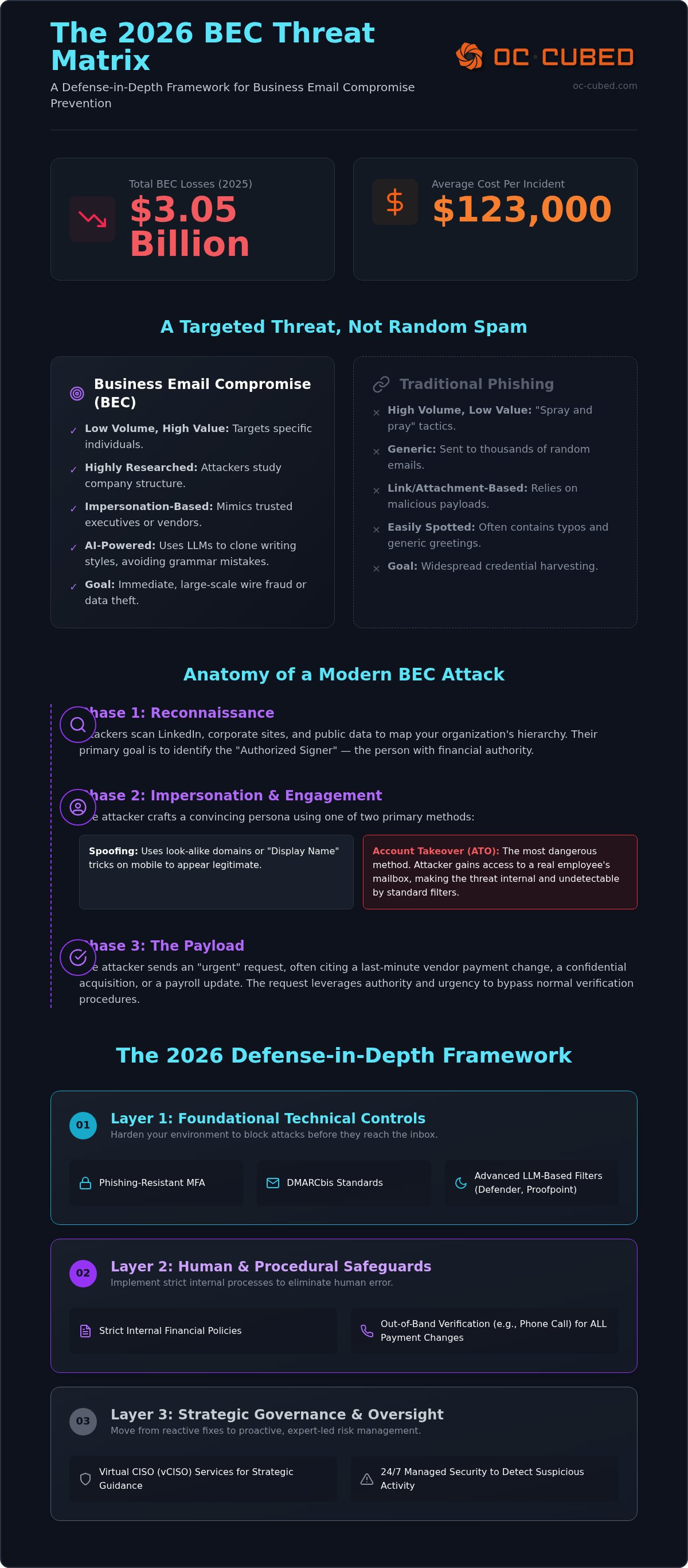
In 2025, Business Email Compromise (BEC) losses surged to $3.05 billion, with the average incident costing organizations $123,000. These aren't just numbers on a report; they represent real companies facing sudden financial crises because of a single sophisticated email. Effective business email compromise prevention has become a top priority for leaders who feel the pressure of protecting their assets while feeling overwhelmed by complex Microsoft 365 configurations. It's exhausting to wonder if your current tools are actually working or if you're just one "urgent" wire transfer away from a disaster.
This guide offers a clear strategy to shield your organization by blending executive leadership with advanced technical layers. You'll learn how to implement the 2026 "Defense in Depth" framework. We will cover everything from the latest DMARCbis standards and LLM-based filters in Microsoft Defender to the proactive protection provided by Proofpoint and virtual CISO oversight. By the end, you'll have a roadmap to lower your risk, eliminate human error in financial transactions, and finally gain the peace of mind that comes from expert-led security governance.
Key Takeaways
- Understand why BEC is a targeted, high-value threat that differs from generic phishing and why it often bypasses standard filters.
- Learn the reconnaissance tactics attackers use to identify your financial signers and how to disrupt their impersonation attempts.
- Implement a multi-layered approach to business email compromise prevention by combining enterprise-grade tools like Proofpoint with strict internal policies.
- Discover the essential technical controls, including phishing-resistant MFA and updated DMARC standards, to harden your Microsoft 365 environment.
- See how virtual CISO services provide the strategic oversight needed to move from reactive IT fixes to proactive, enterprise-level risk management.
What is Business Email Compromise and Why is it the #1 Threat in 2026?
Business Email Compromise (BEC) isn't just another form of spam. It's a highly targeted exploit where attackers impersonate trusted sources, such as executives or vendors, to steal funds or sensitive data. Unlike standard phishing, which relies on high-volume "spray and pray" tactics, BEC is low-volume and high-value. Attackers spend weeks or months researching their targets before sending a single message. Effective Business Email Compromise prevention is now a primary focus for leadership because these attacks bypass many traditional security filters that look for malicious links or attachments.
In 2026, the threat has evolved through the use of generative AI. Hackers now use LLMs to clone the specific writing styles, vocabulary, and even the "voice" of company leaders. This removes the traditional red flags of poor grammar or awkward phrasing. BEC remains more profitable for hackers than ransomware because it's quiet. While ransomware locks a system and demands attention, a BEC attacker can sit silently in a mailbox, learn payment schedules, and strike only when the timing is perfect.
The Shift from Bulk Phishing to Targeted Impersonation
Attackers have moved away from generic lures to a strategy of "hunting" specific financial roles. They use LinkedIn and other public data to map out your company's reporting structure. By identifying the "Authorized Signer" in your organization, they can craft an impersonation that feels entirely legitimate. Because AI now handles the drafting, the emails look identical to a standard internal request. This sophistication makes business email compromise prevention a human challenge as much as a technical one.
The Real-World Cost of a Single Compromised Account
The financial stakes of a successful attack are massive. You aren't just losing the money sent via wire fraud; you're also facing the indirect costs of forensic investigations, legal fees, and a damaged reputation. If an attacker takes over an internal account, they may use it to target your own vendors or clients. This turns your business into the "attacker" in the eyes of your partners, which can destroy years of built-up trust. Based on the latest FBI IC3 data analyzed in September 2026, the average cost of a reported BEC incident has reached approximately $123,000 per complaint.
The Anatomy of a Modern BEC Attack: How Hackers Get In
Modern BEC attacks are calculated campaigns. They begin with a reconnaissance phase where attackers scan LinkedIn, corporate websites, and news releases to map out your hierarchy. They aren't looking for just anyone; they're hunting for the "Authorized Signer," the person with the power to move money. Once identified, the attacker selects their hook. This is usually a choice between spoofing an external domain or committing a full account takeover (ATO). Effective business email compromise prevention starts with understanding that these criminals know your organizational chart as well as you do.
Impersonation Tactics: Spoofing and Look-Alike Domains
Attackers often use look-alike domains to trick the eye. Homograph attacks are a common choice, where characters from different alphabets that look identical to Latin letters are used to register fake domains. On mobile devices, "Display Name Spoofing" is even more effective because many email clients hide the actual sender address, showing only the name of the impersonated executive. Utilizing remote IT management services helps organizations catch these subtle anomalies before they reach an inbox.
Account Takeover (ATO): When the Threat is Internal
An account takeover is significantly more dangerous than spoofing. In this scenario, the attacker gains actual credentials for a legitimate user. This makes it the hardest threat to detect because the email is truly coming from your domain. Once inside, hackers often set up "silent" inbox rules that forward incoming mail to an external address or move replies to the trash. This allows them to conduct a conversation with a vendor or employee without the account owner ever seeing it. Proactive 24/7 network monitoring is essential here to identify suspicious login locations or unusual mailbox activity. As noted in CISA's BEC advisory, technical controls must be paired with rigorous verification processes to stop these internal threats.
The payload is almost always an "urgent" request. It might be a change in banking details for a long-standing vendor or a last-minute payroll update for a high-level employee. The urgency is designed to bypass your critical thinking. Once the victim authorizes the transfer, the exit happens instantly. Funds move through a series of "money mule" accounts, often across international borders, making recovery nearly impossible. If you're concerned about your current visibility into these threats, consider a security threat assessment to identify gaps in your defense. Comprehensive business email compromise prevention requires more than just a firewall; it requires a watchful eye on every digital interaction.
Technical Controls vs. Human Training: Why You Need Both
Effective business email compromise prevention requires a "Swiss Cheese" model of cybersecurity. In this framework, every security layer has inherent weaknesses, much like the holes in a slice of cheese. When you stack multiple layers of defense, the holes don't align. This prevents a threat from passing through the entire stack. Relying on a single solution like a standard firewall is a mistake. Technical filters are excellent at blocking known threats, but they often miss about 10% of attacks that rely purely on text and psychological manipulation.
Why Traditional Spam Filters Fail Against BEC
Legacy gateways were built to find malicious code. They scan for infected links or attachments. BEC attackers have pivoted to "payload-less" emails that contain only plain text. Because there is no malicious software to detect, these messages often bypass traditional filters. Catching these requires advanced behavioral analysis that monitors for anomalies in communication. For example, if a CEO suddenly asks for a wire transfer in a tone that doesn't match their history, the system flags it. This focus on intent rather than code is the future of email defense.
Technology has its limits, but so does human training. Even your most diligent employee can have a bad day. They might be rushed, tired, or distracted by a high-pressure deadline. Attackers exploit these moments of vulnerability with manufactured urgency. A single lapse in judgment can lead to a massive financial loss. A secondary technical check could have prevented this. This is why cybersecurity risk management for small business must be a balanced effort. You need technical guardrails to catch what the human eye misses and human protocols to catch what the software ignores.
Building a Culture of 'Healthy Skepticism'
Leadership must foster a culture where questioning an "urgent" request is rewarded, not punished. Implement strict internal verification protocols for all financial changes. A core rule is out-of-band verification. If an email requests a wire transfer or banking change, never verify it through that same email thread. Use a known phone number or a separate messaging platform. We provide monthly reporting to track how employees perform in phishing simulations. This data allows us to identify specific departments or individuals who need more support before a real attack occurs. Steady reliability in these processes builds long-term protection.
Building a Prevention Framework: MFA, DMARC, and Proofpoint
A resilient framework isn't built on a single tool. It's a combination of protocols that close the gaps attackers exploit. Effective business email compromise prevention requires a structured approach to identity and domain authentication. You can't just set it and forget it. You need layers that work together to identify, block, and remediate threats before they cause financial damage.
- Enforce Phishing-Resistant MFA: Move past SMS codes. Use hardware keys or biometrics to stop modern "adversary-in-the-middle" attacks.
- Implement DMARC, SPF, and DKIM: These protocols prevent hackers from sending mail that looks like it's from your domain.
- Deploy Proofpoint: This enterprise-grade layer catches what native filters miss.
- Proactive Microsoft 365 tenant maintenance: Regular updates and audits close security gaps caused by new feature rollouts.
- Least Privilege Audits: Review administrative accounts monthly to ensure no one has more access than they strictly need.
Domain authentication is a critical pillar of this framework. By May 2026, the DMARC standard was updated to DMARCbis. Organizations should align their records with these new RFC standards to ensure maximum deliverability and protection. This prevents your brand from being used in spoofing attacks that target your own clients and partners. It's about taking control of your digital identity.
The Proofpoint Advantage for Small Business
We choose Proofpoint because it offers superior threat intelligence. It identifies "Very Attacked People" (VAPs) in your organization. These are often the executives or financial officers hackers target most. Proofpoint applies extra scrutiny to mail sent to these individuals. If a malicious email reaches an inbox, the system uses automatic remediation to pull it out. This happens in seconds, often before the user even sees the message. It's the gold standard for stopping BEC before it hits the inbox.
Hardening your Microsoft 365 Environment
Microsoft 365 is a powerful tool, but it requires professional oversight. Disabling legacy protocols is the first step. These old connection methods often bypass MFA entirely, leaving a back door open for attackers. We also configure "Impossible Travel" alerts. These flag logins that occur from two distant locations in a timeframe that would be physically impossible to travel. Professional tenant management prevents "Configuration Drift," ensuring your security settings don't weaken as your business grows.
The Strategic Layer: Virtual CISO and Managed Security
Technical controls provide the armor, but strategy provides the direction. Technology alone cannot stop a criminal who exploits a flawed business process or a moment of executive distraction. True business email compromise prevention requires a strategic layer where executive leadership meets security governance. This is where many organizations struggle. They often lack the budget for a full-time security officer, leaving a gap in their high-level risk management. A Virtual CISO bridges this gap by providing enterprise-grade IT leadership without the cost of a full-time executive hire.
Shifting your mindset from "fixing IT" to "managing risk" is essential for long-term stability. A reactive approach only addresses problems after they occur, which is far too late in a BEC scenario. A managed security model ensures that your defenses evolve as fast as the threats do. A monthly managed IT retainer eliminates the dangerous security gaps that appear between one-off projects. It provides the steady reliability of constant oversight. This includes rigorous vendor management. You must ensure that your partners follow the same high standards you do, as a compromise in their environment can quickly become a threat to yours.
What a Fractional CISO Does for BEC Prevention
A fractional CISO focuses on the policies that technical tools can't enforce. They create formal Incident Response Plans. If a breach occurs, you won't be scrambling for answers; you'll have a proven script to follow. They also review your financial workflows. Implementing "Dual Control" on all wire transfers ensures that no single mistake can result in a massive loss. Finally, they provide risk-based reporting. This gives your board the clarity needed to justify security spending based on actual business outcomes rather than technical jargon.
Managed IT: Your 24/7 Defensive Line
Managed IT provides the tactical execution for your strategy. Our NOC integration ensures that network anomalies are caught at 3 AM, not at 9 AM when the damage is done. Consolidating your security under one expert team provides "one throat to choke." You don't have to manage multiple vendors or wonder who is responsible for a specific tenant setting. We handle the complexity so you can focus on growth. Our team acts as a trusted advisor, solving problems with quiet authority and professional care.
Securing Your Organization's Future Against Email Fraud
The landscape of email security is constantly shifting, but your defense shouldn't be a moving target. We've explored how attackers use AI and social engineering to bypass traditional filters, and why a multi-layered approach is the only way forward. Effective business email compromise prevention requires a shift from reactive fixes to proactive governance. By combining enterprise-grade tools like Proofpoint with the strategic oversight of a Virtual CISO, you close the gaps that lead to costly financial mistakes.
Steady reliability comes from knowing your environment is monitored 24/7 and your policies are managed by experts. You don't have to navigate these complexities alone. Implementing out-of-band verification and phishing-resistant MFA are critical steps, but having a partner to manage the configuration drift in your Microsoft 365 tenant provides the ultimate peace of mind. Protect your assets. Enable your growth.
Take control of your digital identity and protect your team. With the right strategy in place, you can focus on your business while we handle the defense.
Frequently Asked Questions
What is the difference between phishing and business email compromise?
Phishing is a broad net cast to capture any victim, while business email compromise is a spear-focused attack. Phishing usually contains malicious links or attachments sent to thousands of recipients. BEC involves deep research into your specific company hierarchy. The attacker impersonates a trusted colleague or vendor to authorize a fraudulent payment. Because BEC relies on psychological manipulation rather than malicious software, it often slips past standard security measures.
Does multi-factor authentication (MFA) stop all BEC attacks?
MFA is a foundational security layer, but it doesn't stop every attack. Sophisticated hackers use session hijacking or "MFA fatigue" to bypass these checks. In 2026, adversary-in-the-middle attacks can intercept your login token in real time. This is why business email compromise prevention requires more than just a password. You need phishing-resistant hardware keys and behavioral monitoring to catch suspicious activity that occurs after a user has already logged in.
Why did my spam filter miss a fake invoice email from my CEO?
Legacy spam filters were designed to catch "payloads" like infected files or suspicious URLs. Many BEC emails are "payload-less," containing only plain text that mimics a standard business request. Since there's no virus to detect, the filter sees the email as safe. Advanced tools use Large Language Models to analyze the intent and tone of the message. If the CEO's request for an "urgent" invoice payment seems out of character, the system flags it.
How can a Virtual CISO help a small business prevent wire fraud?
A Virtual CISO provides the executive oversight needed to govern your security policies. They don't just fix technical issues; they implement "Dual Control" protocols for all financial transactions. This ensures that no single person can authorize a wire transfer without a second set of eyes. By managing risk at the policy level, a vCISO creates a culture of verification that stops fraud before a single dollar leaves your bank account.
What is Proofpoint and how does it protect my Microsoft 365 inbox?
Proofpoint is an enterprise-grade security layer that sits in front of your Microsoft 365 environment. It uses global threat intelligence to identify "Very Attacked People" and applies stricter filtering to their mailboxes. Unlike native M365 security, Proofpoint can automatically pull malicious messages out of an inbox even after delivery. It's a critical component for filtering out the sophisticated impersonation attempts that define modern business email compromise prevention.
What should I do if I suspect a wire transfer was fraudulent?
Act immediately by contacting your financial institution to request a reversal of the transaction. Time is your biggest enemy. Once the bank is notified, you should file a report with the FBI's Internet Crime Complaint Center. After the external reports are filed, contact your IT team to perform a full audit of your email environment. This ensures the attacker hasn't left behind hidden inbox rules or persistent backdoors.
Can AI-generated deepfakes be used in BEC attacks?
AI deepfakes are a growing reality in 2026 BEC scams. Attackers now use generative AI to clone an executive's voice for fraudulent phone calls that "confirm" an email request. Some even use deepfake video in brief virtual meetings to establish trust. This makes out-of-band verification even more critical. Always use a known, trusted phone number to verify any unusual financial request, regardless of how convincing the voice or video might seem to be.
How often should we perform security awareness training for employees?
Security awareness training should be a continuous process rather than an annual event. We recommend monthly phishing simulations to keep security at the front of your employees' minds. These simulations provide real-time data on which departments are most vulnerable to social engineering. Regular, bite-sized training sessions are much more effective at building a culture of healthy skepticism than a single, long presentation that is quickly forgotten by the staff.


