

In 2026, most IT projects don't fail because the technology is broken; they fail because the leadership behind the implementation is missing. You've likely dealt with the fallout of a simple upgrade that spiraled into three days of downtime and a bill twice the original estimate. It's frustrating to watch a vendor avoid accountability when things get complicated or to realize your internal team is stretched too thin to handle a complex migration. This is where managed IT project management changes the equation by replacing chaos with a structured, results-driven framework.
You deserve an IT environment that supports your growth rather than hindering it with unplanned interruptions. This guide explains how to secure predictable project timelines and ensure your technology upgrades actually deliver business value. We will show you how to achieve zero-disruption infrastructure upgrades while keeping costs strictly under control. We'll also explore how to gain enterprise-grade leadership without the overhead of a full-time hire, moving your business forward with confidence and clarity.
Key Takeaways
- Understand why strategic oversight is essential to move beyond basic maintenance and actually transform your business infrastructure.
- Discover how managed IT project management provides long-term stability and prevents technical debt by prioritizing post-launch reliability.
- Learn to choose between Waterfall and Agile methodologies to ensure your hardware rollouts and cloud migrations remain on track.
- Master the five phases of the project lifecycle to eliminate surprise IT bills through rigorous planning and strategic alignment.
- Gain enterprise-grade technical leadership and virtual project oversight without the cost or commitment of a full-time executive hire.
What is Managed IT Project Management?
Managed IT project management is the strategic oversight of technology initiatives directed by a managed service provider (MSP). While standard IT support focuses on keeping the lights on, project management focuses on evolution. Support handles your daily help desk tickets and proactive network monitoring. Projects change the very fabric of your infrastructure. In 2026, businesses are moving away from traditional break-fix contractors because these one-off vendors often lack the context of your long-term goals. An MSP provides a broader perspective, ensuring that a single upgrade doesn't compromise other integrated systems. This discipline falls under the wider umbrella of Information technology management, where the goal is to align tech resources with business requirements.
One-off contractors often prioritize the go-live date above all else. Once they receive payment, they disappear. This leaves your leadership team holding the bag when technical debt surfaces six months later. Managed providers don't have that luxury. Since they usually manage the environment long-term, they have a vested interest in doing the job right the first time. They focus on accountability, business continuity, and the elimination of surprise costs that typically plague unmanaged initiatives.
The Role of the Virtual Project Manager
A Virtual Project Manager acts as the essential bridge between technical engineers and your business stakeholders. They translate complex technical requirements into business outcomes you can actually measure. You gain enterprise-grade oversight without the burden of an in-house, full-time salary. They own the timeline. They manage the deliverables. Most importantly, they ensure every technician stays on task and every milestone is met. A Virtual Project Manager serves as a fractional executive asset that removes operational friction to accelerate business growth.
Common IT Projects Handled by Managed Providers
Managed providers handle high-stakes initiatives that require specialized expertise. These projects aren't just about installing hardware; they're about building a resilient foundation for your company. Standard initiatives include:
- Infrastructure upgrades: This involves the configuration of servers, firewalls, and switch management to ensure peak network performance.
- Cybersecurity implementations: Providers roll out Zero Trust architecture and advanced endpoint protection to harden your perimeter against modern threats.
- SaaS transitions: Moving from fragmented legacy systems to a unified, managed Microsoft 365 environment simplifies collaboration and maintenance.
These examples represent more than just technical tasks. They are strategic investments. Whether it is a cloud migration or a security overhaul, managed IT project management ensures these transitions happen with zero disruption to your daily operations.
Managed IT vs. Independent Contractors: Which Model Wins?
Choosing between an independent contractor and a managed provider isn't just about the initial quote. It's about who owns the outcome. Contractors focus almost exclusively on the go-live date. They want the project closed so they can move to the next client. Managed providers focus on long-term stability because they're the ones who will support the environment once the project ends. This distinction is critical in 2026, as infrastructure becomes increasingly interconnected and complex.
One-off vendors often leave behind technical debt. This happens when shortcuts are taken to meet a tight deadline, leaving your leadership team with a system that's difficult to maintain or secure. Effective managed IT project management eliminates this risk. Since the provider is responsible for your ongoing uptime, they won't build a solution that creates more work for themselves later. They prioritize documentation and standardized configurations that ensure the system remains healthy for years, not just weeks.
The Advantage of Institutional Knowledge
Your remote IT management services partner already understands the nuances of your network. They monitor your firewalls, switches, and endpoints 24/7. This eliminates the lengthy discovery phase that contractors typically bill for. They already know which configurations will cause compatibility issues. By leveraging this existing data, they can bypass the trial and error phase that often stalls external contractors and leads to unexpected delays.
Vendor Management: One Point of Contact
Chasing multiple hardware and software vendors is a massive drain on your executive team's time. When things go wrong, vendors often point fingers at each other to avoid responsibility. A managed project leader takes over this burden. They ensure every third-party integration meets your security standards and stays on schedule. Balancing these technical and leadership demands requires specific IT project manager skills to keep the initiative aligned with business goals. They act as your single point of accountability, resolving disputes before they impact your timeline.
Contractors often use low initial bids but rely on scope creep and change orders to increase the final bill. Managed providers typically offer structured project fees based on a deep understanding of your current environment. This transparency provides the peace of mind business leaders need to stay on budget. If you want to see how this model works in practice, you can explore the project leadership options available through OC Cubed.
Essential Methodologies for Modern IT Initiatives
The success of managed IT project management depends on selecting the right engine for the job. In 2026, technology projects are too complex for a single, rigid approach. Methodologies provide the structure needed to control costs and hit deadlines. Without a clear framework, projects often descend into "scope creep," where small additions eventually derail the entire budget. We use specific methodologies to ensure every technical change aligns with your business objectives.
Waterfall remains the standard for physical infrastructure rollouts. When you are installing new firewalls, switches, or physical servers, you must follow a linear path. You cannot configure the network until the hardware is physically racked and cabled. Waterfall provides the predictability needed for these hardware dependencies. Conversely, Agile is the preferred choice for cloud migrations and iterative security improvements. It allows for constant testing and adjustments, ensuring that your Microsoft 365 environment or cloud database is hardened against threats at every stage of the rollout.
Visualizing progress is equally important for business leaders. We often use Scrum or Kanban boards to provide a real-time view of project status. These tools move tasks from "To-Do" to "Done," giving you a clear window into the technical work without needing to attend daily engineering meetings. Most modern initiatives actually use a hybrid approach. We plan the major milestones with Waterfall precision but execute the technical details with Agile flexibility.
Selecting the Right Framework for Your Business
A one-size-fits-all methodology is a primary cause of project failure. The framework must match your specific goal. If your priority is compliance, such as meeting new 2026 AI governance rules, you need the rigid documentation found in Waterfall. If your goal is rapid deployment of a new remote work tool, Agile provides the necessary speed. The best methodology is the one that minimizes user downtime. We choose the framework that protects your productivity while delivering the upgrade.
Risk Mitigation and Proactive Planning
Proactive planning identifies technical bottlenecks before they become expensive problems. Understanding what is a managed service provider helps explain why this is different from a contractor model. Managed providers build risk management directly into their project fees. We look for potential conflicts with existing endpoint protection or firewall configurations before the first line of code is moved. After the project goes live, proactive 24/7 network monitoring validates the success of the initiative. This continuous oversight ensures the new system performs as expected under real-world conditions.
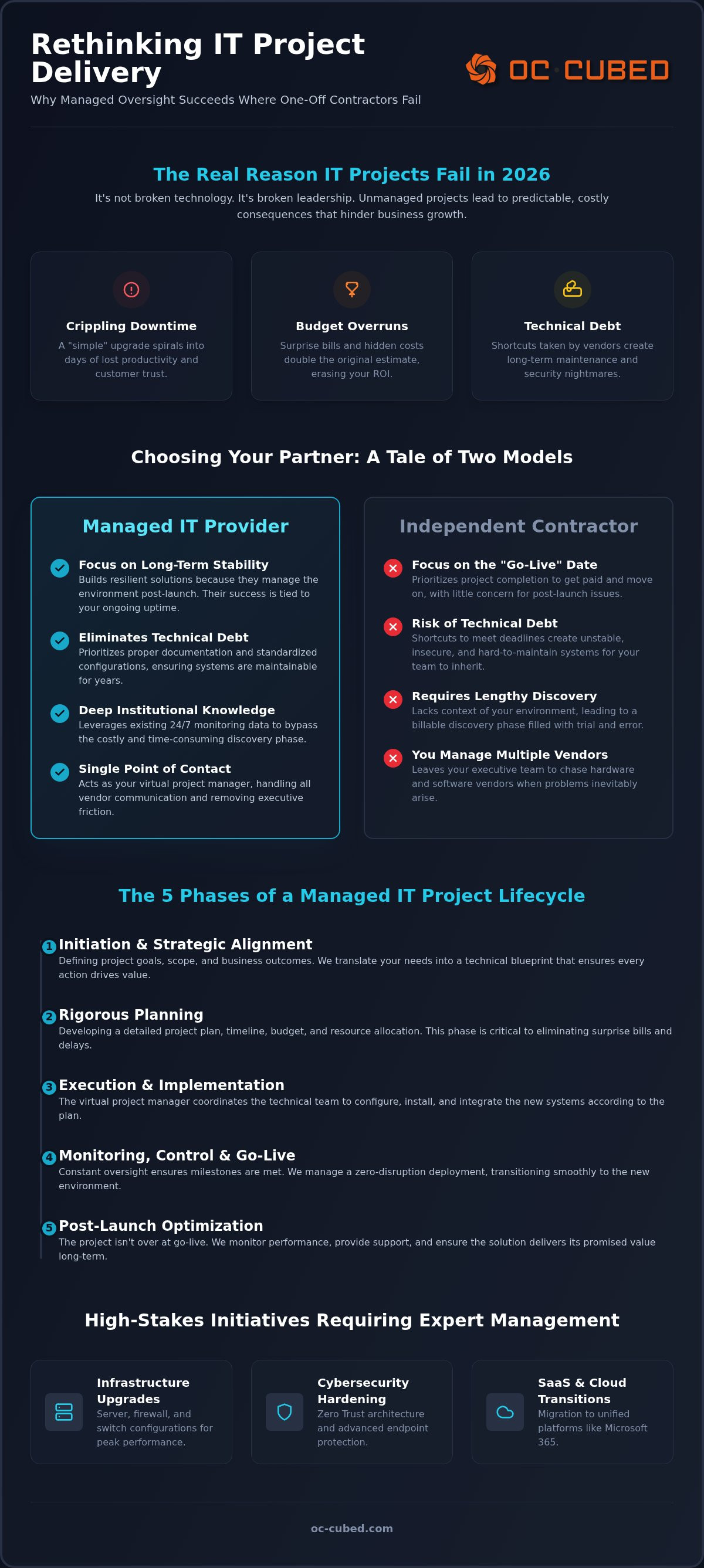
The 5 Phases of a Managed IT Project Lifecycle
Success in technology initiatives isn't accidental. It's the result of a disciplined, five-phase lifecycle that prioritizes stability and clear outcomes. By following a structured approach, managed IT project management ensures that every upgrade or migration is purposeful. This process prevents the common pitfalls of technical debt and scope creep that often haunt unmanaged projects, providing the steady reliability business leaders expect in 2026.
Phase 1 & 2: Setting the Foundation
Initiation begins by aligning the project with your Virtual CIO’s strategic roadmap. We don't implement technology for its own sake. Every project must solve a specific business problem or enable a growth milestone. During the planning phase, we perform detailed scoping to eliminate "surprise IT bills." This involves budgeting for hardware, licensing, and management fees upfront so there are no hidden costs later. We also establish a communication plan that keeps your leadership informed of progress without overwhelming your inbox with technical minutiae. Defining the "definition of success" at this stage ensures all stakeholders are working toward the same objective.
Execution and monitoring happen simultaneously. Our team handles remote implementation with a focus on zero disruption to your daily operations. While the technical work progresses, we use real-time tracking to monitor network performance and security integrity. If a bottleneck appears in your firewall or switch configuration, we see it immediately. This proactive oversight allows us to maintain absolute control over the environment during high-stakes transitions, ensuring the system remains stable as new components are integrated.
Phase 5: The Post-Project Handover
Many projects fail after the "go-live" date because there is no plan for long-term support. In our model, closure involves a formal handover to your monthly managed services retainer. This isn't just a hand-off; it's an optimization phase. We verify that endpoint protection is active across all new nodes and that Microsoft 365 security settings meet current 2026 compliance standards. We update your technical documentation and adjust your monthly reporting metrics to reflect the new infrastructure. This ensures your ongoing support team has the exact data they need to keep the system running at peak performance.
Integrating Virtual Project Management into Your Strategy
Integrating managed IT project management into your long-term strategy provides a level of technical maturity usually reserved for enterprise organizations. It's about moving from reactive fixes to proactive growth. By leveraging IT leadership without full-time hire, you gain the expertise of a seasoned professional who understands how to navigate the complexities of 2026 infrastructure. This model scales effortlessly with your business. You don't need to worry about recruiting or training a project manager as your requirements expand; the virtual leadership model adapts to your current volume and complexity.
We utilize structured, project-based fees to tackle specific technical milestones. This approach is ideal for high-impact initiatives like SOC integration or deploying advanced email security with Proofpoint. You get a fixed cost for a fixed outcome. This eliminates the unpredictability of hourly billing and ensures the project stays focused on the primary objective. As you assess your 2026 IT roadmap, identifying these discrete needs early allows for better resource allocation and less operational friction.
When to Engage a Managed Project Leader
Engaging a leader becomes necessary when your current "break-fix" model starts failing your growth. If you're preparing for a rigorous compliance audit or a major vendor transition, a dedicated project leader is essential. One-off fixes can't handle the multi-layered dependencies of modern security frameworks. You might notice that simple upgrades are taking longer or that your internal team is constantly overwhelmed by technical debt. Starting with a project-based assessment gives you a clear view of your environment's health before you commit to a major overhaul. It provides the data you need to make informed decisions about your next infrastructure investment.
The OC Cubed Approach to Remote Project Leadership
Our approach to remote project leadership centers on proactive threat detection and remediation. We don't just move data; we protect it. We integrate Proofpoint and Microsoft 365 security settings into the core of every project we lead. This ensures your new systems are hardened against threats from day one. Our team takes full accountability for the outcome, managing the vendors and the technical execution so you can focus on your business. We believe that technology should be a quiet enabler of growth, not a source of anxiety. If you're ready to move forward with a secure, professionally managed initiative, contact OC Cubed for a scoped project consultation.
Securing Your Next Technical Milestone
The success of your business depends on technology that works without constant intervention. You've seen how managed IT project management replaces the uncertainty of one-off contractors with a structured, lifecycle-based approach. By aligning your upgrades with a strategic roadmap, you eliminate the surprise costs and downtime that often stall growth. This transition from reactive fixes to proactive leadership ensures your infrastructure actually supports your long-term goals.
Every initiative we lead includes fractional CIO and CISO expertise to ensure your environment is not just functional, but resilient. With proactive 24/7 network monitoring and specialized management of Microsoft 365 and Proofpoint, your team stays protected throughout every phase of the project. You can move forward with the confidence that your technology is a dependable asset rather than a recurring bottleneck. It's time to stop managing vendors and start driving results.
Your growth deserves a partner who values stability and accountability as much as you do. We're ready to help you build a technical foundation that lasts.
Frequently Asked Questions
What is the difference between an IT project and managed services?
Managed services focus on the ongoing maintenance and support of your existing technology to ensure daily uptime. In contrast, an IT project is a discrete initiative with a specific start and end date designed to change or upgrade your infrastructure. While managed services keep the lights on through helpdesk support and monitoring, projects move your business forward through cloud migrations or security overhauls. Both are necessary for a stable 2026 business environment.
How much does managed IT project management cost?
The cost of managed IT project management depends on the complexity and technical requirements of your specific initiative. We utilize structured, project-based fees that are defined during the initial scoping phase to ensure total transparency. These fees cover strategic leadership and technical execution without the unpredictability of hourly billing. By avoiding flat-rate estimates, we protect your budget from the surprise costs that often arise from poorly defined project scopes.
Can an MSP manage a project if they do not provide my daily support?
Yes, an MSP can provide specialized leadership for a single project even if another vendor handles your daily support. This is a common strategy for businesses that need enterprise-grade expertise for high-stakes migrations or security hardening. We work alongside your existing teams to provide the oversight and accountability required for success. Our focus is on the high-level strategy and technical execution that your current provider may not be equipped to manage.
What are the benefits of virtual project management for remote teams?
Virtual project management provides centralized leadership that coordinates distributed teams across various locations. It ensures that every remote engineer stays aligned with your timeline and technical standards through digital collaboration tools. We maintain full visibility into progress without requiring on-site presence, which increases efficiency for modern businesses. This model provides the accountability and structure of a seasoned leader while respecting the flexibility that 2026 remote work environments require.
How do you prevent downtime during a major IT migration?
We prevent downtime through rigorous pre-project testing and phased implementation strategies. Before moving live data, we identify potential bottlenecks in your firewalls or switches to mitigate risks early. We often schedule high-impact changes during low-usage windows and use redundant systems to keep your staff productive. Proactive 24/7 network monitoring allows us to detect and resolve issues in real time, ensuring the transition happens with zero disruption to your operations.
What is a Project-Based IT Management Fee?
A project-based IT management fee is a one-time cost tied to a specific technical goal and a defined scope of work. Unlike a monthly support retainer, this fee covers the professional oversight and technical labor required to complete a single initiative. It includes the leadership of a Virtual Project Manager to ensure milestones are met on time. This model provides the cost transparency business leaders need to tackle discrete goals like SOC integration or email security.
Does managed IT project management include hardware costs?
No, the management fee covers the leadership and technical labor, while hardware and licensing are billed as separate line items. We help you budget for these assets during the planning phase so you have a clear picture of the total investment. Our vendor management service includes assisting you with the selection of firewalls, servers, or switches. We ensure all hardware purchases are compatible with your existing infrastructure and meet your 2026 performance requirements.
How do I know if my business needs a Virtual Project Manager?
Your business likely needs a Virtual Project Manager if your internal team lacks the bandwidth to lead complex upgrades while maintaining daily support. Common signs include recurring technical debt, missed deadlines, or vendors who refuse to take accountability for project failures. If you're planning a high-stakes initiative like a Microsoft 365 tenant consolidation, fractional leadership provides the necessary expertise. It's an efficient way to gain enterprise-grade oversight without the expense of a full-time hire.


