

Your IT provider shouldn't be a reactive helpdesk you call during a crisis. They should be the reason the crisis never happens. If you're currently struggling with slow response times or surprise invoices, you know that the traditional support model is no longer enough. Learning how to choose a managed service provider for 2026 requires moving beyond basic technical help toward a partnership that prioritizes business continuity and security.
You likely want to stop worrying about data breaches and start focusing on your core operations. You deserve a predictable environment where your technology just works and your budget stays flat. This guide will teach you the specific criteria and strategic questions required to select an MSP that eliminates downtime and secures your business growth. We will examine how to identify providers that offer vCIO leadership and proactive protection, giving you the expert guidance you need without the overhead of a full-time executive.
Key Takeaways
- Master the essential criteria for how to choose managed service provider partners who focus on prevention rather than just fixing what's broken.
- Identify the must-have security tools for 2026, including advanced email protection and expert Microsoft 365 tenant maintenance.
- Learn why executive-level guidance from a vCIO is necessary to turn your IT department into a strategic asset for growth.
- Discover how to evaluate service agreements and reporting structures to ensure total transparency and zero surprise invoices.
- Explore the benefits of a remote-first, all-inclusive model that provides high-level support without the cost of on-site staff.
The Shift from Reactive to Proactive: Why Your Choice Matters
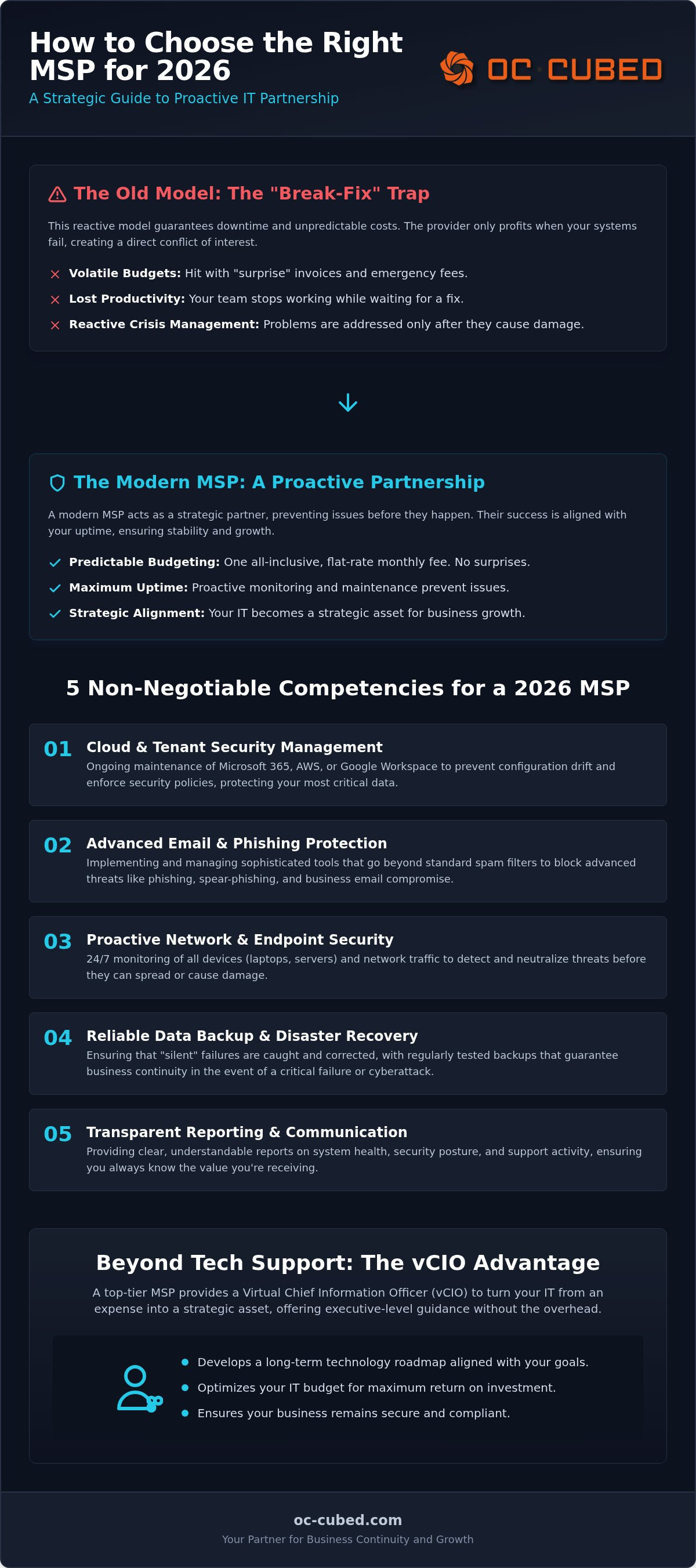
The way businesses handle technology has fundamentally changed. For years, the standard approach was "Break-Fix." You waited for a server to crash or an email system to fail before calling a technician. This model is built on a direct conflict of interest. The provider only makes money when your business is suffering from downtime. As you research how to choose a managed service provider, you must recognize that this reactive cycle is the single greatest threat to your operational stability. In 2026, the speed of business and the complexity of cyber threats make waiting for things to break a dangerous gamble.
A modern Managed Service Provider (MSP) acts as a business enabler. Instead of being a line-item expense that only appears during a crisis, they become a strategic partner. They integrate into your daily operations to remove obstacles before they manifest as downtime. This shift from a cost center to a growth partner is the most critical factor in your selection process. You don't just need a helpdesk; you need an organization that treats your uptime as their primary metric of success.
Moving Beyond the Break-Fix Trap
Waiting for failure is a flawed strategy that guarantees two things: lost productivity and "Surprise IT Bills." When a critical system goes down, your team stops working, but your payroll costs continue. You then face emergency fees from technicians who are incentivized to fix the immediate problem without addressing the underlying cause. This cycle creates a volatile budget that shifts every month.
Proactive management breaks this cycle. By choosing a partner who operates on an all-inclusive monthly retainer, you align your goals with theirs. They want your network to be perfect because every support call they receive costs them time and money. This alignment leads to predictable IT budgeting. You pay one flat fee, and they handle the heavy lifting of keeping your environment stable and secure. It turns your technology from a source of anxiety into a reliable utility.
The Managed Service Advantage
Modern MSPs leverage advanced automation and 24/7 monitoring to maintain your infrastructure. This constant oversight allows for the detection of "silent" failures, such as a backup that stopped running or a firewall that is being probed by attackers. By the time your staff starts their workday, most potential issues have already been identified and remediated. To learn more about the specific structure of these partnerships, see our guide on What Is a Managed Service Provider? A Guide for Leaders.
The efficiency of a remote-first model cannot be overstated. While on-site technicians are limited by travel time and physical availability, remote support teams can respond to multiple issues simultaneously across the country. This model provides several key benefits:
- 24/7 Network Monitoring. Constant vigilance that catches threats before they escalate.
- Rapid Incident Response. Remote tools that allow technicians to access and fix systems in seconds.
- Flat-Rate Pricing. One monthly cost that covers everything from maintenance to support.
- Scalable Infrastructure. Technology that grows alongside your business without requiring more office space.
When you understand how to choose a managed service provider that prioritizes this proactive stance, you gain more than just technical support. You gain the peace of mind that comes from knowing a team of experts is protecting your business around the clock.
5 Non-Negotiable Technical Competencies for a 2026 MSP
Technical excellence is the baseline for any reliable partnership. Many providers claim to offer security, but few actually manage the underlying architecture that keeps a business running. When you're evaluating how to choose a managed service provider, you must look for specific competencies that go beyond basic troubleshooting. In 2026, your partner needs to be an expert in the cloud, the network, and the individual device simultaneously.
A high-tier MSP doesn't just react to problems. They build an environment where problems are structurally prevented. This requires a deep understanding of how different systems interact. If a provider cannot explain their approach to the following five areas, they aren't equipped to protect your growth.
Cloud and Tenant Security Management
Microsoft 365 is the backbone of most modern businesses, yet it's often left unmonitored after the initial setup. Proper maintenance requires more than just adding or removing users. It involves managing configuration drift. Settings that were secure yesterday can change due to platform updates or accidental user changes. A qualified MSP provides ongoing Microsoft 365 Tenant Maintenance to ensure your digital workspace remains locked down. They secure your environment from the inside out, ensuring that global admin roles are restricted and multi-factor authentication is never bypassed.
Advanced Threat Detection
Standard antivirus is no longer sufficient. You need Endpoint Protection that focuses on active threat detection and remediation. This means your provider isn't just looking for known viruses; they're watching for suspicious behavior in real time. If a laptop in your sales department starts encrypting files at 3:00 AM, the system should automatically isolate that device and alert the team.
Email security remains your primary defense against ransomware. Standard filters fail because they can't keep up with sophisticated phishing and social engineering. Proofpoint provides a critical layer for modern inbox defense, stopping threats before they ever reach your employees. If you're looking for a partner who prioritizes these advanced protection layers, you can explore our proactive security services to see how we keep clients safe.
Beyond the cloud and the inbox, your physical infrastructure needs constant care. This includes:
- Network Monitoring and Configuration. Ensuring your data moves quickly and securely across your office or remote sites.
- Firewall and Switch Management. Keeping the "gates" of your business updated against the latest external exploits.
- Helpdesk and NOC Integration. Providing 24/7 visibility into your infrastructure so that hardware failures are caught before they impact your staff.
When you understand how to choose a managed service provider that masters these five areas, you eliminate the technical gaps that lead to breaches and downtime. You move from a state of constant worry to a state of steady reliability.
Strategic IT Leadership: Evaluating the vCIO and vCISO Role
Technical support is only half the equation. A helpdesk can reset a password or fix a printer, but it won't tell you if your current software stack will support your growth plans for the next three years. As you evaluate how to choose a managed service provider, you must look for a partner that provides executive-level leadership. This strategic layer ensures your technology investments actually align with your business goals rather than just keeping the lights on.
Modern MSPs provide this through fractional leadership roles, specifically the Virtual CIO (vCIO) and Virtual CISO (vCISO). These roles give you access to high-level expertise without the six-figure salary of a full-time executive. They transform IT from a reactive cost center into a proactive engine for your company's success.
Leadership vs. Support
The difference between support and leadership is the difference between a mechanic and an architect. A support technician focuses on the immediate task. A vCIO focuses on the future. They manage your technology roadmap, identifying potential bottlenecks 12 to 36 months before they impact your operations. This foresight prevents technical debt, which is the high cost of fixing poor technology decisions made in haste.
When you understand how to choose a managed service provider that includes vCIO services, you gain a partner who handles Vendor Management. They deal with your internet service providers, software vendors, and hardware manufacturers. This frees your internal team to focus on their actual jobs while ensuring every piece of your tech stack works together seamlessly.
Governance and Compliance
Security is no longer just a technical issue; it's a legal and financial one. Modern insurance providers now require specific security controls and governance before they will issue a policy. A vCISO manages this risk. They ensure your business meets compliance standards and maintains proper security documentation. They provide the quiet authority needed to navigate complex regulatory environments, protecting your reputation and your bottom line.
If your current IT setup lacks this strategic oversight, it's a major red flag for your business continuity. You can learn more about identifying these gaps in our guide on 10 Warning Signs Your Business Needs Managed IT Support in 2026. The right partner doesn't just wait for you to ask for help. They show up with a plan, a roadmap, and the professional composure to lead your business forward.
Strategic leadership provides the following benefits:
- Predictable Technology Spend. Accurate budgeting for hardware refreshes and software upgrades.
- Risk Mitigation. Expert oversight of security protocols and insurance requirements.
- Operational Efficiency. Streamlining workflows through better software integration.
- Executive Peace of Mind. Knowing a seasoned professional is handling the long-term tech strategy.
Choosing an MSP without a strategic leadership component is like hiring a construction crew without a blueprint. You might get a building, but it probably won't be the one you needed to grow your business.
The Due Diligence Checklist: Vetting Your Potential Partner
Selecting a partner is a long-term commitment. You aren't just buying a subscription; you're hiring a team to protect your business assets. When researching how to choose a managed service provider, the vetting process must be rigorous. You need to look past the sales pitch and examine the operational reality of how they deliver support. A provider's internal processes determine whether you experience seamless growth or constant friction.
Start with the Service Level Agreement (SLA). This document should clearly define response and resolution times. A response is just an acknowledgement, but a resolution is a fix. You need to know how fast they can actually get your team back to work. Additionally, ask about their approach to Virtual Project Management. Infrastructure upgrades and cloud migrations shouldn't be handled as afterthoughts. They require structured planning to avoid unplanned downtime.
Transparency and Accountability
Reliability is built on visibility. You should receive Monthly Reporting that provides a clear view of your network's health. These reports aren't just fluff; they should detail system uptime, security threats blocked, and patches applied. If a provider is hesitant to show you their reporting format, it's a sign they may lack the tools to monitor your environment properly. Transparency also extends to your bill. Look for an all-inclusive monthly retainer model. This ensures your IT costs are fixed and predictable, removing the fear of surprise invoices for "out-of-scope" work.
Don't take their word for it. Verify their track record by asking for client references in similar industries. A dependable MSP will have a history of steady reliability and satisfied voices. They should be able to demonstrate how they've helped other companies scale across multiple locations without a dip in service quality.
Onboarding and Transition
The first 90 days are the most critical period of any new partnership. A professional MSP has a structured onboarding process to document your entire network. They should secure your credentials, map your infrastructure, and identify immediate risks. This documentation ensures that any technician on their team can support you effectively from day one. It also prevents "brain drain" if your previous IT person leaves.
A seamless handoff requires clear communication between the new provider and your outgoing support model. Whether you're moving from an internal person or another vendor, the transition should be invisible to your employees. The right partner takes control of the technical details so you can stay focused on your business. They show up, solve the transition challenges, and set the stage for long-term protection. This professional composure during the transition is a leading indicator of how they'll handle your account for years to come.
Conclusion: Choosing a Partner for the Long Haul
Choosing the right IT partner is one of the most consequential decisions a business leader can make. It's the difference between a company that's constantly held back by technical friction and one that's empowered to scale. When you understand how to choose a managed service provider, you stop viewing IT as a repair service and start seeing it as a strategic asset. The goal is simple: zero unplanned downtime, absolute data security, and total cost predictability.
The all-inclusive retainer model is the only way to achieve this. It eliminates the conflict of interest inherent in hourly billing. Your provider succeeds only when you succeed. Combined with a remote-first support model, this approach offers the most efficient path to enterprise-grade stability. You get faster resolutions, better monitoring, and the quiet authority of a team that knows exactly how to protect your growth.
Why OC Cubed is the Logical Choice
We've built OC Cubed to be the partner we would want to hire. Our model integrates a 24/7 Network Operations Center (NOC) and a responsive helpdesk with high-level executive leadership. We don't just fix what's broken; we prevent the break from happening in the first place. This commitment to eliminating unplanned downtime is what sets us apart from traditional vendors. We provide the steady reliability you need to focus on your core business goals.
Many organizations struggle to decide if they should build an internal team or partner with an expert. To see how these models compare, read our analysis on Managed IT vs. In-House IT: Which Strategy Wins in 2026?. We believe that for modern, growth-oriented businesses, the fractional executive model provides superior value and security without the overhead of full-time staffing.
Ready to Secure Your Growth?
The complexity of the 2026 threat landscape doesn't allow for hesitation. It's time to stop chasing vendors and start executing your business strategy. A proactive IT assessment is the first step toward reclaiming your peace of mind and securing your infrastructure. We'll audit your network, identify your risks, and show you exactly what a strategic partnership looks like. Here is how you can start the process:
- Request a Consultation. Speak with a vCIO to discuss your three-year technology roadmap.
- Schedule a Network Audit. Identify hidden vulnerabilities and configuration drift in your current environment.
- Review Your Security Stack. Ensure tools like Proofpoint and advanced endpoint protection are active.
- Finalize Your Budget. Move to a flat-rate model that eliminates surprise IT bills and emergency fees.
Don't wait for the next surprise invoice or security alert to rethink your strategy. Take control of your technology today. You deserve a partner who is as invested in your success as you are, providing the protection and momentum your business requires to lead your industry.
Secure Your Operational Future
You now have the roadmap for identifying a partner who prioritizes prevention over repairs. Mastering how to choose a managed service provider means looking for the integration of technical mastery and executive foresight. You need more than a fix; you need a strategy that removes obstacles before they manifest as downtime.
At OC Cubed, we provide 24/7 Network Monitoring and NOC Integration to catch threats before they impact your team. Every partnership includes Virtual CIO/CISO Leadership to ensure your tech stack matches your growth goals. Our all-inclusive monthly pricing removes the friction of surprise bills, letting you focus entirely on your business. We act as your protector and enabler, allowing you to scale with total confidence in your infrastructure.
Your technology should be the engine of your success, not the anchor. We're ready to show you what steady reliability looks like for your organization.
Frequently Asked Questions
What is the average cost of a managed service provider?
Managed service costs vary based on the number of users, devices, and the complexity of your security requirements. Most modern providers move away from hourly billing toward a flat-rate monthly retainer. This model provides budget predictability and ensures your provider is incentivized to maintain your uptime rather than profiting from your technical failures.
What is the difference between a managed service provider and an IT consultant?
An IT consultant typically provides high-level strategy or advice for specific projects over a set period. A managed service provider handles your daily operations and long-term maintenance. While a consultant tells you what you need, an MSP executes the plan and remains responsible for the ongoing health of your environment.
How do I transition from an in-house IT person to an MSP?
The transition begins with a structured 90-day onboarding process where the provider documents your network and secures all credentials. A professional partner coordinates with your outgoing staff to ensure a seamless transfer of knowledge. This process identifies immediate security gaps and sets the foundation for your future technology roadmap.
Does a managed service provider handle hardware repairs?
MSPs focus on the remote configuration, monitoring, and management of your infrastructure rather than physical component repairs. If a device fails, the provider manages the vendor relationship and warranty claims to get the hardware replaced. Their primary role is to ensure the software and network settings on that hardware remain stable and secure.
Can an MSP help with industry-specific compliance like HIPAA or SOC2?
A provider with vCISO leadership manages the governance and technical controls required for modern compliance. They implement the encryption, access logging, and reporting necessary to satisfy auditors and insurance providers. This strategic oversight protects your reputation and ensures you meet the legal requirements of your specific industry.
What is included in a typical monthly IT retainer?
A standard retainer covers remote support, 24/7 network monitoring, and endpoint protection. It also includes Microsoft 365 maintenance and advanced email security tools. When you're learning how to choose a managed service provider, look for retainers that include vCIO leadership to ensure you have executive guidance without extra hourly fees.
How does remote IT support work for my employees?
Employees connect with a helpdesk where technicians use secure tools to access their devices and fix issues in real time. This model is more efficient than waiting for an on-site technician to arrive at your office. Remote support allows for rapid resolution across multiple locations, keeping your team productive regardless of where they're working.
Will an MSP manage my Microsoft 365 and email security?
Proactive providers handle the ongoing maintenance of your Microsoft 365 tenant to prevent configuration drift and unauthorized access. They also implement advanced security layers like Proofpoint to block sophisticated email threats. This management ensures your primary communication tools stay secure and functional without requiring manual oversight from your team.


