

Paying for IT support only when things break feels like a savvy way to save money, but it's actually the most expensive way to run a company. This reactive approach creates a "Break-Fix Tax" that drains your profits through unpredictable invoices and avoidable downtime. Many owners switch to flat-rate IT support for small business because they're tired of being nickeled and dimed for every call while their team sits idle during a technical emergency.
We understand that a fixed, predictable budget is essential for scaling. It's time to look past the common misconceptions. In this guide, we'll show you why a predictable monthly retainer is a strategic insurance policy rather than just another expense. You'll discover how proactive monitoring and maintenance actually save you thousands by aligning your goals with your provider's incentives.
We'll break down the five most common myths about managed services, from hidden costs to the fear of paying for "nothing." You'll learn how a predictable IT budget leads to fewer emergencies and provides the strategic leadership your business needs to grow with confidence.
Key Takeaways
- Recognize the hidden "Break-Fix Tax" and why paying only when things break is actually the most expensive way to manage technology.
- Discover how flat-rate IT support for small business creates budget certainty by replacing unpredictable hourly bills with a single, fixed monthly retainer.
- Learn why proactive maintenance and security threat detection are more cost-effective than waiting for a technical emergency to occur.
- Identify contract red flags to ensure your agreement includes essential services like Microsoft 365 tenant maintenance and endpoint protection.
- Understand the strategic value of a Virtual CIO in guiding your technology investments toward long-term business growth.
The "Break-Fix" Myth: Why Paying Only When Things Break Is a Trap
The break-fix model is simple. You have a problem, you call a technician, and you pay an hourly rate to get it fixed. It seems like a cost-effective strategy because you only pay for what you use. However, this model hides a dangerous conflict of interest. In a break-fix arrangement, your IT provider profits from your misfortune. They make more money when your systems are failing than when they're running smoothly. This creates a reactive cycle that leaves your business vulnerable to repeated issues. When your technician is paid by the hour, their financial success is tied to your technical failure. They have no incentive to find the root cause of an issue if patching it today means another billable call next week. Transitioning to flat-rate IT support for small business removes this friction. It shifts the focus from repair to prevention.
The biggest myth in small business IT is the idea that "If I don't call them, I'm saving money." This mindset ignores the hidden costs that accrue every day. Lost productivity, missed deadlines, and emergency service surcharges quickly erase any perceived savings. Many businesses are realizing that flat-rate IT support for small business is actually a growth strategy. It aligns your goals with your provider's incentives. They work hardest when you don't see them because their profit depends on your systems staying up and running.
The Psychology of the Hourly Billing Trap
Fear often drives IT decisions in an hourly model. Business owners frequently ignore minor glitches like slow login times or intermittent Wi-Fi because they don't want to trigger a minimum service fee. These small frustrations are early warning signs. When left unaddressed, they inevitably snowball into catastrophic system failures that bring operations to a standstill. We define the "Break-Fix Tax" as the cumulative cost of these preventable technical failures. It's the price you pay for choosing reactive repair over proactive care. It's the cost of the work that didn't get done while your team waited for a call back.
The Real Cost of IT Downtime in 2026
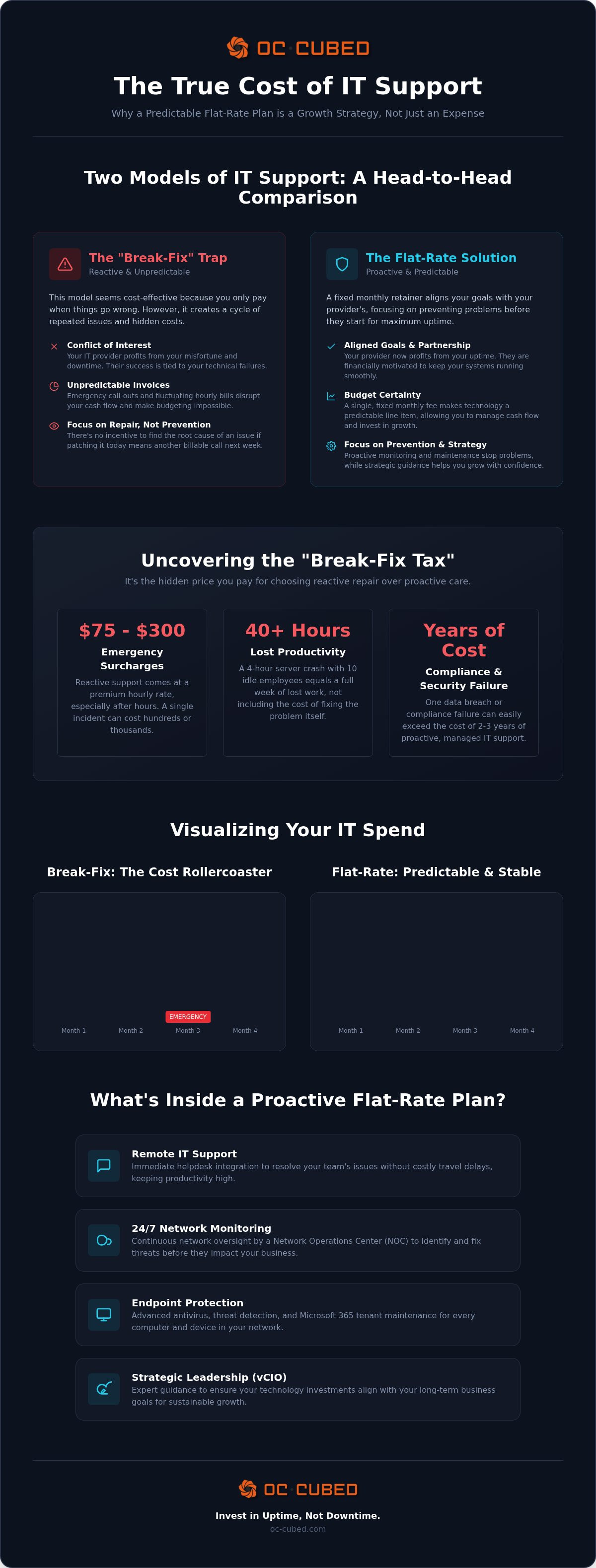
Downtime is more than a nuisance. It's a massive financial drain. In 2026, hourly rates for reactive support range from $75 to $300 per hour. If a server crash leaves ten employees idle for just four hours, the loss in payroll alone is significant. This doesn't even account for lost sales or damaged customer trust. Managed services offer a different path by prioritizing uptime. A single security incident or compliance failure can easily exceed the cost of two or three years of managed support. Choosing "cheap" hourly help is often the most expensive way to run a business. It leaves you unprotected against the high cost of failure.
How Flat-Rate IT Support Creates Predictable IT Costs
Flat-rate IT support for small business replaces the chaos of fluctuating invoices with a single, fixed monthly fee. This model covers a comprehensive bundle of services designed to keep your infrastructure stable. You no longer have to worry about a sudden server failure or a security breach causing a massive, unbudgeted expense. Instead, your technology costs become a predictable line item in your monthly budget. This stability allows you to manage cash flow with precision and allocate resources toward growth rather than repairs. It's the end of the IT spending rollercoaster.
The core of this model is proactive maintenance. In a traditional setup, you pay for a technician's time when something breaks. Under a flat-rate agreement, the provider works hardest when you don't see them. They monitor your systems around the clock to prevent issues from occurring in the first place. This shifts the incentive structure entirely. Both the client and the provider now share the same goal: 100% uptime. Understanding What Is a Managed Service Provider (MSP)? helps clarify why this partnership is so effective for long-term stability.
What’s Included in a Monthly Managed IT Retainer?
A well-structured retainer ensures that every critical component of your digital environment is managed. It provides a layered approach to support and security that keeps your team productive. These plans typically include:
- Remote IT Support: Immediate helpdesk integration to resolve employee issues without travel delays.
- 24/7 NOC Monitoring: Continuous network oversight to identify and remediate threats before they impact your operations.
- Endpoint Protection: Advanced antivirus and threat detection for every device in your network.
- Microsoft 365 Maintenance: Ongoing configuration and security updates to keep your cloud environment optimized.
The "All-Inclusive" Advantage
A comprehensive flat-rate plan eliminates "bill shock" by bundling essential security tools into the monthly fee. This includes enterprise-grade solutions like Proofpoint email security and proactive firewall management. You won't receive a separate invoice every time a security patch is applied or a firewall rule is updated. Everything is covered. This approach is detailed further in our guide on What Is a Managed Service Provider?, which highlights how these bundles protect your bottom line. Monthly reporting justifies your investment by showing exactly what work was performed behind the scenes to keep your business running. If you are ready to stabilize your IT budget, switching to a fixed-fee model is the most effective first step.
Flat-Rate vs. Hourly Billing: A Financial Comparison
Choosing between hourly billing and a fixed retainer is a choice between volatility and stability. Hourly billing follows a "Spike" model. You might pay nothing for three months, but a single server failure or security breach results in a five-figure invoice you didn't plan for. In contrast, flat-rate IT support for small business follows a "Level" model. Your expenses remain consistent every month, regardless of how many support tickets your team opens. This predictability allows you to manage cash flow with confidence. It transforms IT from an unpredictable liability into a managed utility.
A common myth suggests that flat-rate support is more expensive because you pay even when nothing is "broken." This perspective ignores the Total Cost of Ownership (TCO). When you factor in the cost of downtime, emergency surcharges, and lost productivity, the reactive hourly model is almost always the more expensive choice. What is a Managed Service Provider (MSP)? At its core, it's a partner that reduces TCO by preventing the very problems that drive hourly bills higher. Choosing flat-rate IT support for small business ensures your technology budget is used for improvement rather than constant repair.
Predictable IT costs enable long-term strategic planning. When you know exactly what you'll spend on technology each month, you can forecast your growth with accuracy. You aren't just paying for repairs; you're investing in a stable foundation that supports your business goals.
The ROI of Proactive Monitoring
Return on investment in the IT world isn't just about making money; it's about the money you don't lose. Consider a failing hard drive. In a reactive model, that drive crashes during business hours, corrupting data and halting operations for a full day. In a proactive model, our sensors detect the failing hardware at 2 AM. We swap the drive before your team even arrives at the office. This single catch saves thousands in lost data and recovery fees. We define ROI in IT as the total absence of crisis-related expenses.
In-House Staffing vs. Flat-Rate Outsourcing
Building an internal IT department is a massive financial commitment. A typical three-person IT team can cost an average of $192,600 per year in salary alone. For most growing companies, that budget is better spent on core operations. A flat-rate MSP provides a fractional team of experts for a fraction of that cost. You gain "coverage depth" that an individual hire can't match. An MSP doesn't take sick days, go on vacation, or leave you vulnerable when a single person quits. You also gain access to high-level Virtual CIO (vCIO) and vCISO leadership. This strategic guidance ensures your technology supports growth without the six-figure executive salary.
Evaluating an MSP: Red Flags in Flat-Rate IT Contracts
Not all flat-rate contracts are created equal. The most common myth is that "flat-rate" always means "all-inclusive." In reality, some providers hide exclusions in the fine print that lead to surprise invoices. When you evaluate flat-rate IT support for small business, you must look for absolute clarity. A true partner provides a fixed monthly cost that covers your essentials without hidden surcharges. If your contract doesn't explicitly mention Microsoft 365 tenant maintenance or endpoint protection, you're likely looking at a "lite" version of support. This leaves you vulnerable when a real crisis hits. Transparency is a requirement, not a luxury. You should expect monthly reporting that details your system health and any threat remediation performed behind the scenes.
The difference between a vendor and a partner lies in the monitoring schedule. Some providers offer "business hours only" support for a flat fee. This is a significant red flag. Cyber threats don't follow a 9-to-5 schedule. You need proactive 24/7 monitoring to catch issues before they escalate into downtime. Choosing flat-rate IT support for small business should mean your systems are protected every hour of every day. If the provider isn't watching your network at 3 AM, they aren't providing true managed services.
Defining the Scope of Support
A comprehensive agreement acts as a shield for your entire operation. This must include vendor management. Your MSP should be the one talking to your internet service provider or software vendors so you don't have to. Enterprise-grade email security with Proofpoint integration is another essential component for modern protection. While specialized tasks like Virtual Project Management often require separate strategic discussions, the daily maintenance of your cloud environment and security posture must be part of the base retainer. This level of detail prevents "bill shock" and ensures your team stays focused on growth.
The SLA Reality Check
Guaranteed response times are the backbone of a reliable partnership. A Service Level Agreement (SLA) should clearly define how quickly the provider will act when things go wrong. Watch out for firms that are just "rebranded break-fix" shops. They collect a monthly check but only show up when you call them with a problem. A "Security First" provider focuses on threat detection as a constant, ongoing process. They prioritize prevention over repair. You can spot the difference by looking at their focus on remediation. A quality MSP doesn't just fix what's broken; they ensure it doesn't break again.
OC Cubed - Your trusted MSP: The Future of Predictable IT for Small Business
OC Cubed - Your trusted MSP removes the financial anxiety that comes with traditional, reactive IT models. We provide comprehensive flat-rate IT support for small business through our Monthly Managed IT Services Retainer. This isn't just a billing method. It's a commitment to your stability. We take full responsibility for your remote IT support, Microsoft 365 tenant maintenance, and endpoint protection. By aligning our success with your uptime, we eliminate the "Break-Fix Tax" that drains small business profits. You get a single, predictable invoice every month. No surprises. No hidden fees.
Every client gains access to executive-level guidance through our Virtual CIO and CISO services. This strategic leadership isn't reserved for large corporations. We believe every growing business needs a roadmap to navigate 2026's complex regulatory environment. Our Security-First approach integrates enterprise-grade tools like Proofpoint email security and proactive threat remediation. We don't just wait for an alert. We actively monitor your network and configuration to stop breaches before they start. This proactive stance is the antidote to the "nickeled and dimed" experience common with hourly vendors.
Built for Growing Companies
Our remote-first model is designed for speed. We resolve issues faster than local technicians who have to travel to your office. OC Cubed - Your trusted MSP provides national support that scales as your business expands. You can add new users or remote locations without the technical headaches. Our clients describe our team as professional, polite, and available whenever they're needed. We take pride in being a dependable partner that removes obstacles. This allows you to focus on growth while we handle the technical infrastructure.
Get Started with Predictability
The transition from technical chaos to peace of mind starts with a thorough Microsoft 365 tenant and network audit. We identify the gaps in your current security and performance. Then, we move your business into our structured management environment. This process ensures your flat-rate IT support for small business is built on a solid, secure foundation. OC Cubed - Your trusted MSP handles the heavy lifting of vendor management and network monitoring so your team stays productive. It's time to trade your technical emergencies for a strategic partnership.
Stabilize Your Budget and Secure Your Growth
Surprises are for birthdays, not your IT budget. Choosing flat-rate IT support for small business is the most effective way to eliminate the "Break-Fix Tax" that hinders your company's potential. By moving to a predictable monthly retainer with OC Cubed - Your trusted MSP, you trade technical chaos for steady reliability. You gain access to 24/7 proactive network monitoring and enterprise-grade Proofpoint email security without the volatility of hourly billing.
A strategic partnership does more than just keep the lights on. It provides the executive-level Virtual CIO and CISO advisory services required to navigate modern security and compliance requirements. This shift allows you to focus on your core operations while OC Cubed - Your trusted MSP ensures your infrastructure is resilient and scalable. It's time to stop paying for failure and start investing in your long-term success.
Take the first step toward technical peace of mind. We're ready to help you build a more secure, predictable future for your business.
Common Questions About Flat-Rate IT Support
What is flat-rate IT support for small business?
Flat-rate IT support for small business is a managed services model where you pay a fixed monthly fee for a comprehensive bundle of technology services. This fee typically covers proactive network monitoring, security threat detection, and remote helpdesk support. Unlike hourly billing, this model provides budget certainty by eliminating the surprise costs associated with reactive repairs. It aligns your goals with your provider's incentives, as they work to prevent problems before they impact your operations.
Does flat-rate IT support include new hardware costs?
Hardware costs are typically separate from your monthly IT support fee. Your flat-rate retainer covers the management, monitoring, and security of your devices, but the physical equipment remains a capital expense. We provide guidance on hardware selection and vendor management to ensure you get the best value. This allows you to plan for hardware upgrades as part of a strategic roadmap rather than dealing with emergency replacement costs when a critical machine fails.
How does flat-rate support differ from a traditional IT retainer?
Flat-rate support provides unlimited service within a defined scope, whereas traditional retainers often function as pre-paid blocks of hours. In a traditional model, you're still watching the clock and worrying about when your hours will run out. Flat-rate services remove that anxiety. You receive consistent, proactive maintenance and security remediation every month without the risk of additional hourly charges for standard support tasks. It's a shift from buying time to buying results.
Is flat-rate IT support more expensive than break-fix?
Flat-rate IT support for small business often has a higher monthly starting price than reactive break-fix help, but it results in a lower total cost of ownership. Break-fix models hide expensive hidden costs like lost productivity and emergency surcharges. By preventing technical failures before they happen, a flat-rate model saves you thousands in avoidable downtime. It's an investment in stability that protects your bottom line from the volatility of sudden, massive repair invoices.
What happens if I have an IT emergency after hours?
Our proactive network monitoring runs 24/7 to identify and resolve threats before they affect your business. If an emergency occurs outside of standard hours, your Service Level Agreement (SLA) defines the response times and remediation steps. Because we monitor your infrastructure around the clock, we often catch and fix critical issues at 3 AM before your team even starts their day. This continuous oversight provides the steady reliability every business owner needs for peace of mind.
Does flat-rate IT support cover Microsoft 365 management?
Yes, comprehensive flat-rate plans include full Microsoft 365 tenant maintenance and security. We manage your user configurations, license assignments, and security protocols to ensure your cloud environment stays optimized. This also involves proactive monitoring for unusual login activity and ensuring your data protection settings meet current best practices. By bundling this service, we remove the complexity of managing cloud applications while keeping your collaborative tools secure and accessible for your entire team.
How do I know if my business is ready for flat-rate IT services?
You're ready for flat-rate services if your business relies on technology for daily operations and you're tired of unpredictable IT bills. If technical glitches frequently interrupt your team's productivity, you need a proactive partner. Most growing companies with 10 to 50 employees find that the reactive tax is simply too high to ignore. If you want a fixed budget and a strategic roadmap for growth, transitioning to a managed retainer is the next logical step.
Can I cancel a flat-rate IT contract if I am not satisfied?
Most managed service contracts include specific termination clauses that allow you to exit the agreement if performance standards aren't met. We believe in earning your trust every month through results and transparency. Our goal is to provide such high value through proactive maintenance and strategic leadership that you never want to leave. A clear Service Level Agreement ensures both parties understand their responsibilities, providing a professional framework for a successful, long-term partnership focused on your growth.


