

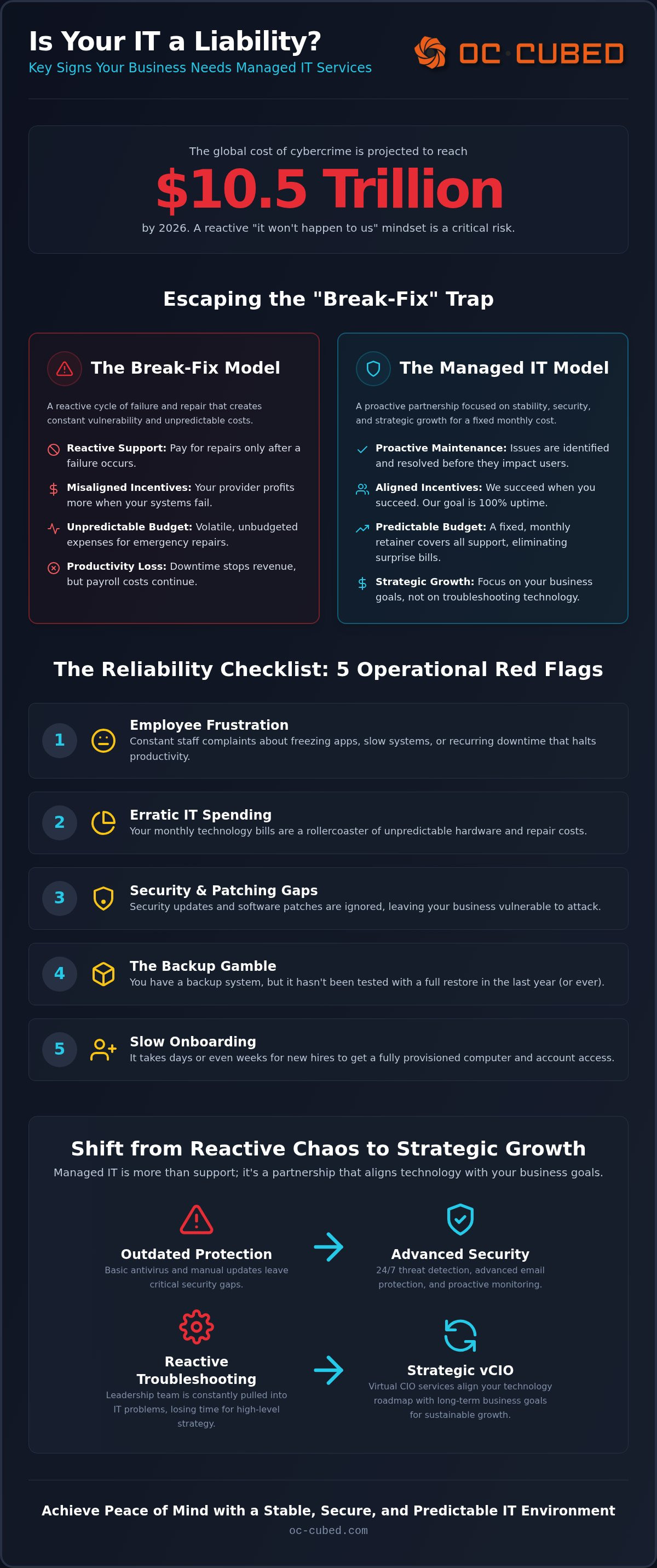
With the global cost of cybercrime projected to reach $10.5 trillion in 2026, the "it won't happen to us" mentality has become a dangerous liability. You've likely felt the frustration of a system crawl right before a major deadline or opened an IT invoice that looks nothing like the one from last month. It's exhausting to manage technology when you should be managing your growth. You deserve the peace of mind that comes with a stable, secure environment.
Identifying the critical signs your business needs managed IT is the first step toward reclaiming your time. Most business owners feel a constant undercurrent of anxiety regarding data loss or the next big system crash. We understand that technology should be an invisible engine for your success, not a source of daily friction. This guide will help you spot the red flags in your current technology stack and learn how to transition from reactive chaos to proactive stability. We'll cover everything from unpredictable billing to the necessity of 24/7 security monitoring so you can budget with confidence and eliminate unplanned downtime for good.
Key Takeaways
- Escape the "break-fix" trap where you only pay for repairs after a failure, ensuring your provider is incentivized to keep you online rather than waiting for a crash.
- Stabilize your budget by moving from fluctuating monthly IT expenses to a fixed, predictable retainer model that eliminates surprise costs.
- Recognize the operational signs your business needs managed IT, such as frequent staff complaints about slow systems or recurring downtime that halts productivity.
- Close critical security gaps by upgrading from basic antivirus to 24/7 threat detection and advanced email protection with Proofpoint.
- Shift from reactive troubleshooting to strategic growth with Virtual CIO services that align your technology with your long-term business goals.
The Hidden Cost of the 'Break-Fix' Trap
The break-fix model is a reactive approach to technology. You pay for repairs only after a failure occurs. It sounds simple, but it's a trap that keeps your business in a state of constant vulnerability. This cycle of failure and repair is one of the primary signs your business needs managed IT. When your technology strategy is purely reactive, you aren't just paying for parts and labor. You're paying with your time, your team's morale, and your company's stability.
The psychological toll on your employees is significant. When systems are unreliable, staff members begin to expect the next crash. They hesitate to start complex tasks, fearing a sudden outage will wipe out their progress. This "waiting for the crash" mentality creates a culture of frustration. It also leads to hidden productivity losses known as micro-downtime. These are the five-minute delays that happen when a computer freezes or a printer refuses to connect. No one reports these small issues, but across twenty employees, they can easily consume forty hours of productive time every month.
Why Incentives Matter in IT Support
Traditional break-fix technicians earn more when your systems fail. Their business model relies on your misfortune. If your network is stable, they don't get paid. This creates a fundamental conflict of interest. In contrast, Managed services models align the provider's goals with yours. We earn our retainer by ensuring your systems stay up and running. If you experience downtime, it costs us time and resources. This shift in incentives is why many leaders are evaluating managed IT vs in-house IT to find the most efficient way to maintain their infrastructure.
The True Price of Reactive Support
Calculating the true price of reactive support is one of the clearest signs your business needs managed IT. The cost of an outage goes far beyond the technician's hourly rate. You must calculate the lost billable hours of every idle employee. If your team cannot work, your revenue stops, but your payroll obligations do not. Frequent IT issues also damage employee retention. Top talent will not stay in an environment where the tools hinder their performance. Beyond the human cost, reactive IT disrupts your financial planning. Surprise repair bills are often large and unbudgeted. They force you to pull funds from growth initiatives to cover emergency maintenance. A managed approach turns these volatile expenses into a predictable monthly cost, allowing for better capital expenditure planning.
The Reliability Checklist: 5 Operational Red Flags
Operational efficiency dies a slow death when technology is managed by accident. You might think your current setup is "good enough," but subtle failures often hide in plain sight. These operational hurdles are clear signs your business needs managed IT to maintain a competitive edge. If your leadership team is constantly pulled into troubleshooting, you're losing the time needed for high-level strategy.
- Employee Frustration: Your staff are the first to notice when a system slows down. If you regularly hear complaints about freezing applications or slow login times, your hardware is likely reaching its limit.
- Erratic IT Spending: If your monthly technology bills look like a rollercoaster, you lack a predictable financial strategy. Managed support turns these fluctuating costs into a stable, fixed monthly expense.
- Patching Gaps: Security updates and software patches are often ignored until a system fails. Consistent maintenance is vital for defense, and the FTC's Cybersecurity for Small Business guide emphasizes that regular updates are a primary line of protection.
- The Backup Gamble: Most businesses have a backup system, but few test it. A backup you haven't performed a test restore on in the last year is simply a file you hope works when a disaster strikes.
- Onboarding Delays: New hires should be productive within hours, not days. If it takes a week to provision a laptop or set up a Microsoft 365 account, your current IT process is stunting your growth.
Monitoring vs. Reporting: The Visibility Gap
Your employees should never be your primary monitoring system. By the time a staff member reports a problem, the damage to productivity is already done. Proactive 24/7 Network Monitoring and Configuration allows technicians to identify and resolve issues before they reach the user's desk. Helpdesk and NOC integration acts as the backbone of proactive visibility, providing a constant watch over your infrastructure to ensure maximum uptime. Establishing a proactive IT partnership allows you to move away from these operational headaches and focus on your core objectives.
Predictability in the IT Budget
A monthly managed IT services retainer stabilizes your cash flow and eliminates the "emergency surge" pricing common in break-fix models. Instead of paying a premium for after-hours repairs or rush technician dispatch, you pay a set fee for continuous care. This model provides financial transparency through monthly reporting, showing you exactly where your investment goes. You gain the ability to plan for the future without the fear of a single hardware failure derailing your entire quarterly budget.
The Security Gap: Signs Your Protection is Outdated
Cybersecurity in 2026 is no longer a matter of installing software and walking away. With the global cost of cybercrime projected to reach $10.5 trillion this year, your defense strategy must be as dynamic as the threats it faces. If your security posture hasn't evolved in the last twenty four months, you're likely operating with significant blind spots. Recognizing the security-related signs your business needs managed IT is essential for protecting your reputation and your bottom line. Forbes experts agree that when internal teams can no longer keep pace with sophisticated threats, it's time to outsource IT operations to specialists who live and breathe data protection.
- Basic Antivirus Reliance: Relying solely on legacy, signature-based antivirus is like using a screen door to stop a flood. Modern threats bypass these simple filters with ease.
- Successful Phishing: If malicious emails are consistently reaching your team's inboxes, your current filtering is inadequate. Human error remains a top risk, but technology should catch most attempts before they require a judgment call.
- Unmanaged Remote Devices: You lack a centralized way to secure laptops and mobile devices used by remote staff. Without control over these endpoints, your network perimeter effectively doesn't exist.
- Compliance Overload: Navigating SOC2, HIPAA, or the updated 2026 COPPA rules is a full-time job. If compliance feels like a guessing game, your business is at risk of heavy fines and legal exposure.
Beyond Basic Antivirus: Modern Endpoint Protection
Legacy antivirus fails against zero-day threats because it only recognizes known malware signatures. We utilize Endpoint Protection and Security Threat Detection and Remediation to monitor system behavior in real time. This allows us to stop suspicious activity the moment it begins, even if the specific virus has never been seen before. We also integrate Proofpoint to secure your communications. This stops threats at the gateway before they ever hit your email server, removing the burden of security from your individual employees.
Microsoft 365 Tenant Health
Many businesses assume Microsoft 365 is secure by default. In reality, default tenant settings are often broad and leave doors open for attackers. Ongoing Microsoft 365 Tenant Maintenance is required to close these gaps and adjust to new vulnerabilities as they emerge. A professional managed service provider doesn't just set up your accounts; they continuously harden your environment against unauthorized access. This proactive oversight ensures your cloud data remains private and your team stays productive without the constant threat of a tenant breach.
Strategic Stagnation: Is Your Tech Stunting Your Growth?
Technology should enable your expansion, not act as a bottleneck. When your IT setup is reactive, every new hire or office expansion feels like a crisis. This lack of scalability is one of the most overlooked signs your business needs managed IT. If you are making major hardware or software purchases based on urgent, immediate needs rather than a documented three year roadmap, you are likely overspending on short term fixes that won't grow with you.
Strategic stagnation often shows up in the leader's calendar. If you spend your afternoons chasing internet service providers or negotiating software licenses, you aren't leading your company. You are acting as an unpaid IT administrator. This distraction carries a heavy opportunity cost. Additionally, operating without a written disaster recovery or business continuity plan is a significant risk. Without a clear protocol for resuming operations after a data loss or system failure, your business remains fragile and unprepared for the unexpected.
The Need for Fractional Executive Leadership
Growing small and medium businesses often reach a point where they need high level guidance but cannot justify a full time executive salary. A Virtual CIO (vCIO) fills this gap. We provide the strategic oversight needed to turn technology into a competitive edge. This service includes everything from budget forecasting to vendor management. We handle the technical negotiations so you can focus on your core mission. Moving from simply "keeping the lights on" to proactive strategy is a hallmark of a mature, successful organization.
Scalability and Project Management
Expansion requires precise execution. Virtual project management ensures that infrastructure upgrades, cloud migrations, and endpoint refreshes stay on schedule and under budget. We manage the moving parts so your team stays productive during transitions. Your technology must be able to support adding ten new employees next month without a total system overhaul. A vCISO provides essential security governance and risk management without the burden of a two hundred thousand dollar annual salary. This level of professional oversight ensures your business stays compliant and ready for what comes next.
Transitioning to Managed IT: Your Path to Predictability
Moving away from the reactive cycle requires a deliberate shift in strategy. The transition begins with a comprehensive initial IT audit. We perform a deep dive into your infrastructure to identify immediate high-risk gaps, such as unverified backups or dormant security vulnerabilities. This audit provides the baseline for your roadmap. It turns the "unknown unknowns" into a prioritized list of actionable improvements. You cannot manage what you have not measured, and this first step ensures your new strategy is built on data rather than guesswork.
Once we understand your environment, we customize a monthly managed IT services retainer specifically for your needs. This is not a one-size-fits-all package. We align our support with your headcount, your cloud footprint, and your growth targets. During the first 30 days of onboarding, our focus is on visibility and stabilization. We deploy monitoring agents, audit your Microsoft 365 tenant, and integrate your systems with our Helpdesk and NOC. By the end of this period, the "reactive chaos" fades. It is replaced by a steady, managed rhythm that transforms IT from a frustrating cost center into a reliable growth enabler.
Choosing the Right Remote Support Partner
In 2026, geographic proximity is less important than technical depth and response speed. National reach and 24/7 network monitoring are now non-negotiable requirements. A "Remote-First" model is the most efficient way to support a modern workforce. It allows for near-instant remediation of software glitches and security alerts without the delay of a technician traveling to your site. When evaluating a partner, look closely at their security stack. A dependable provider should offer a robust portfolio of tools, including Email Security with Proofpoint and advanced Endpoint Protection, to secure your team wherever they work.
Taking the First Step Toward Stability
The many signs your business needs managed IT often point to a single, underlying issue: a lack of professional oversight. Identify the number one technology frustration in your office today. Whether it is slow system performance or the fear of a data breach, that pain point is the starting line for your transformation. Scheduling a consultation to review your current network configuration allows you to see the gaps before they become disasters. Stability is a choice, and it begins with a commitment to proactive care.
Ready to stop reacting? Explore OC Cubed’s Managed IT Services
Secure Your Technological Future
Recognizing the signs your business needs managed IT is the first step toward building a resilient organization. You don't have to accept unpredictable bills or frequent system crashes as the cost of doing business. By moving away from the reactive break-fix model, you regain control over your time and your budget. It is time to stop troubleshooting and start growing.
We provide the steady reliability your team needs to thrive. Our approach combines 24/7 Network Monitoring and Configuration with fractional vCIO/vCISO leadership to ensure your technology supports your long-term goals. We protect your perimeter with bundled security, including Proofpoint and advanced Endpoint Protection, so your data stays safe in a remote world.
Your technology should be an invisible engine for success. We are ready to remove the obstacles that hinder your progress. Let us handle the technical complexity so you can focus on leading your business with confidence.
Frequently Asked Questions
What is the difference between break-fix and managed IT services?
Break-fix is a reactive model where you pay for repairs only after a failure occurs. Managed IT services are proactive, providing continuous oversight for a fixed monthly fee. This shift ensures your provider is incentivized to keep your systems running smoothly rather than waiting for something to break. You move from a cycle of chaos to a state of steady reliability.
How much does managed IT support typically cost for a small business?
Costs are structured as a predictable monthly retainer based on your specific headcount and technology needs. This model eliminates the volatility of hourly "break-fix" bills. Identifying these signs your business needs managed IT early allows you to stabilize your budget and avoid unplanned capital expenditures. You gain financial transparency through monthly reporting, ensuring you always know where your investment goes.
Does managed IT replace my internal IT person?
It can work alongside your existing staff. Managed support often handles "keeping the lights on" tasks like patching and 24/7 monitoring. This partnership frees your internal team to focus on strategic, growth-oriented projects that require deep knowledge of your specific business processes. We act as an extension of your team, providing specialized tools and fractional leadership where needed.
Can a managed service provider help with remote employee security?
We secure remote devices through centralized management and advanced security tools. This includes deploying endpoint protection and remediating threats in real time. We also integrate Proofpoint to stop malicious emails before they reach your staff. This ensures a consistent security posture across all locations, protecting your network perimeter even when your employees are working from home.
What happens if we have an IT emergency after hours?
Our systems monitor your network 24/7 to identify and resolve issues automatically. Helpdesk and NOC integration ensures that critical failures are addressed even when your office is closed. This constant vigilance often resolves potential disasters before your employees even log in for the day. You gain peace of mind knowing that your infrastructure is protected around the clock.
Is managed IT support only for large corporations?
Small businesses often benefit the most because they lack the resources for a full-time, in-house security team. Recognizing the signs your business needs managed IT is critical for SMBs facing the same cyber threats as global corporations. We provide enterprise-grade protection at a scale that fits your growing company, allowing you to compete with larger rivals without the massive overhead.
How does a Virtual CIO help with business growth?
A vCIO acts as a fractional executive to align your technology with your three-year growth plan. They handle complex vendor management and budget forecasting. This leadership ensures you invest in scalable solutions, preventing "emergency" purchases that don't support your long-term expansion. By turning technology into a competitive advantage, a vCIO removes the obstacles that typically stunt business growth.
What specific security tools are included in a managed IT retainer?
Our managed retainer includes a robust stack of defense tools. You receive Endpoint Protection, Security Threat Detection and Remediation, and Email Security with Proofpoint. We also perform continuous Microsoft 365 Tenant Maintenance and firewall management. These tools work together to create a layered defense, ensuring your infrastructure remains hardened against the sophisticated threats of 2026.


