

What if your next IT hire actually costs you double their salary in hidden risks and missed security updates? Deciding between managed IT vs in-house IT is one of the most consequential choices your business will make this year. You likely value the idea of having a dedicated person in the office, but you're also feeling the strain of unpredictable spending and the difficulty of retaining qualified talent. It's frustrating when technology feels like a bottleneck rather than a tool for growth. We understand that you need reliability and peace of mind to focus on your core operations.
We're here to provide a clear, data-driven breakdown of the costs, security risks, and strategic advantages of both models. With the median IT specialist salary now reaching $71,000 and new SEC compliance rules in full effect, the stakes have never been higher. This guide explores how to achieve predictable monthly costs and expert-level protection. We'll show you how to move past daily firefighting and secure a technology roadmap that supports your long-term goals, ensuring your infrastructure is an asset rather than a liability.
Key Takeaways
- Identify the hidden overhead of internal hiring, including benefits and taxes, that often pushes the total cost of an IT manager well beyond their base salary.
- Compare the trade-offs of managed IT vs in-house IT to determine which model provides the necessary scalability and security for your 2026 growth strategy.
- Discover how 24/7 network monitoring and specialized threat detection offer a level of protection that a single internal hire simply cannot sustain.
- Learn how fractional executive leadership, such as a vCIO or CISO, provides the high-level strategic roadmap needed to turn technology into a competitive advantage.
- Understand how a flat-rate monthly retainer model eliminates surprise bills and shifts your IT focus from reactive repairs to proactive infrastructure management.
Defining the Debate: Managed IT vs. In-House IT
The choice between managed IT vs in-house IT often starts with a simple question of control. Business leaders frequently assume that having a technician in the office ensures faster results. However, the reality of 2026 requires more than just physical proximity. In-house IT involves hiring dedicated employees to build and maintain your technology stack. You manage their salary, their training, and their career path. Managed IT is a partnership with an external team of specialists. This model, often referred to as managed services, shifts the burden of operational responsibility to a provider who guarantees outcomes rather than just hours worked.
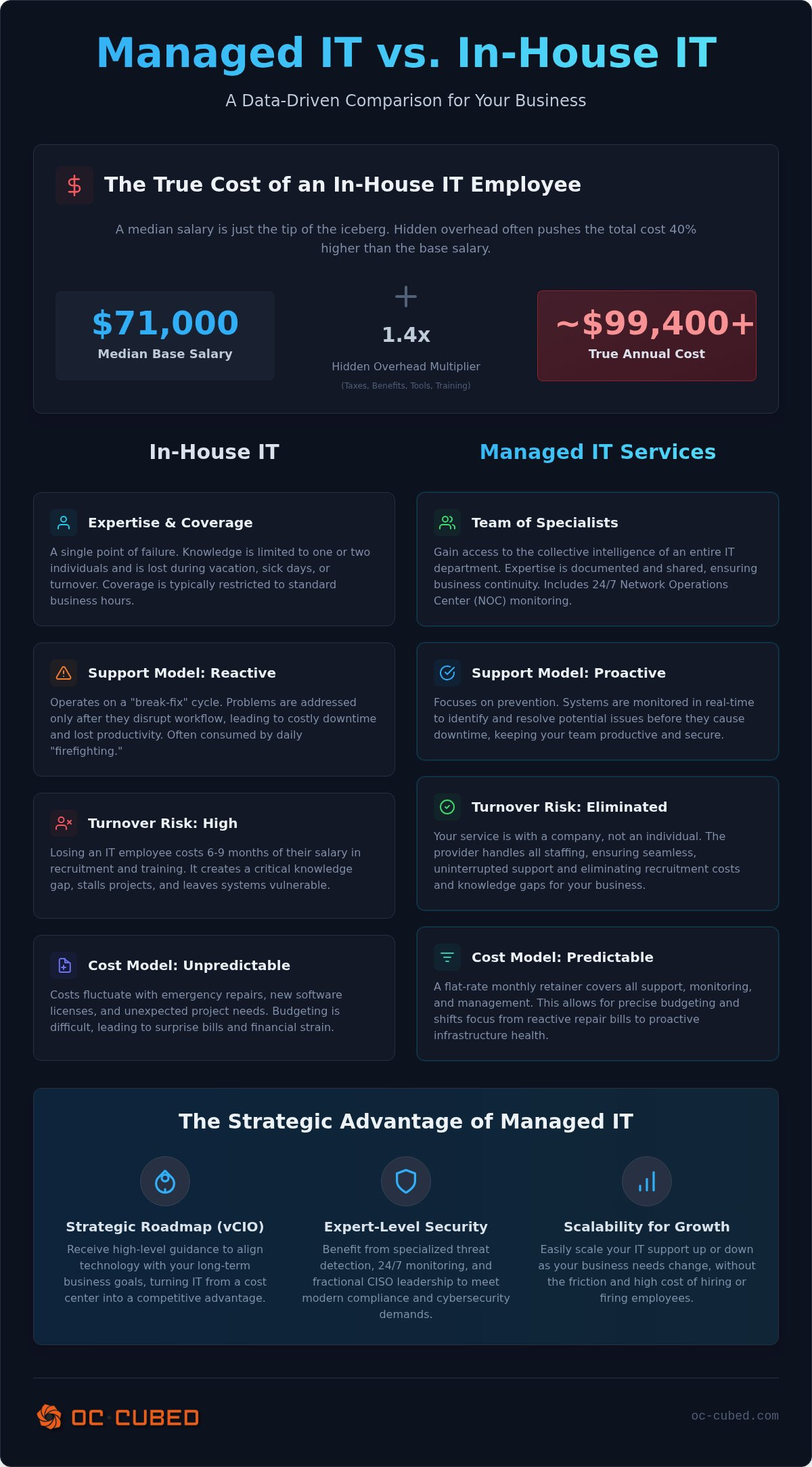
The core difference lies in the philosophy of support. Traditional internal models often fall into a reactive cycle. Problems are addressed only after they disrupt your workflow. Modern managed models are inherently proactive. We monitor systems in real time to prevent failures before they happen. In a year defined by aggressive cybersecurity threats and strict SEC reporting requirements, staying ahead of the curve is no longer optional. It's a requirement for survival.
The Single-Point-of-Failure Risk
Hiring one or two internal IT staff creates a dangerous bottleneck. When your lead technician goes on vacation or decides to move on, your technical knowledge goes with them. This creates a single point of failure that can paralyze your operations. A team-based approach eliminates this anxiety. We provide documented, shared expertise that ensures business continuity. If one person is unavailable, the rest of the team already understands your environment. You gain the collective intelligence of an entire department without the overhead of a massive payroll.
Managed IT: More Than Just a Helpdesk
Many leaders mistake a Managed Service Provider for a simple helpdesk. While troubleshooting is part of the job, the real value lies in the background. We integrate a Network Operations Center (NOC) to provide 24/7 monitoring. This means your firewalls, switches, and servers are watched even when your office is closed. Remote support has evolved significantly. We can now resolve 99% of business IT needs without ever stepping foot in your building. This efficiency allows your team to stay productive while we handle the technical heavy lifting behind the scenes.
The True Cost of In-House IT: Beyond the Salary
Many business owners look at the median IT support salary of $71,000 and believe they've set a firm budget. This figure is just the visible tip of the iceberg. When evaluating managed IT vs in-house IT, you must account for the heavy weight of hidden overhead. Across the United States, the actual cost of a single IT employee often reaches 1.4 times their base salary once you include payroll taxes, health benefits, and 401(k) contributions. You're also providing office space, high-end hardware, and the utilities to keep their station running. These costs exist before your technician even opens their first support ticket.
The financial burden extends to the software your technician needs to be effective. An in-house hire doesn't come with their own enterprise toolset. Your company must purchase and manage licenses for network monitoring, helpdesk ticketing systems, and security software. Technology moves fast. To keep your systems secure in 2026, you must pay for your staff's ongoing certifications and professional development. Without this investment, your internal team's skills will stagnate while external threats evolve. A comprehensive cost-benefit analysis of cloud vs. in-house IT reveals that these operational expenditures often outweigh the perceived simplicity of a local hire.
The Turnover Trap
The most devastating hidden cost of internal IT is turnover. When an IT professional leaves, you don't just lose a person; you lose institutional knowledge. Recruiting and onboarding a replacement typically costs between six and nine months of that position's salary. During the months it takes to find a qualified candidate, your systems are vulnerable and your projects stall. OC Cubed - Your trusted MSP provides stability through documented processes and team depth. You never have to worry about a single person leaving because our entire team understands your environment. This continuity is essential for maintaining predictable monthly IT costs and long-term security.
Scaling Pains and Idle Time
In-house staffing is rigid. It's nearly impossible to hire "half a person" when your business grows. You might find yourself paying for 40 hours of work when you only have 20 hours of tasks, leading to expensive idle time. Conversely, when a major project hits, your single hire may need 60 hours to keep up, leading to burnout and mistakes. A managed model scales instantly with your headcount. You pay for the results you need, ensuring your technology budget always aligns with your actual business size. This flexibility allows you to focus on growth without the friction of constant hiring cycles.
Managed IT Services: The Proactive Strategic Advantage
Managed IT replaces the limitations of a single hire with the collective strength of an entire department. When comparing managed IT vs in-house IT, the most striking difference is the breadth of expertise available to your business. One person cannot master every discipline. Our model provides immediate access to cloud architects, network engineers, and cybersecurity specialists. You gain enterprise-level resources without the enterprise-level payroll. This shift moves your business from a state of constant repair to one of steady reliability.
The Executive Layer: Virtual CIO and CISO
Most small to mid-sized businesses suffer from an "Executive Gap." They have someone to fix laptops, but no one to guide the technology roadmap. Every business needs a fractional CTO or CISO for long-term planning. A vCIO doesn't just manage hardware; they analyze your current IT maturity and identify gaps that could hinder your expansion. We develop a technology roadmap that aligns your digital tools with your specific business goals. This strategic layer handles security governance and vendor management. It takes the technical load off the CEO, ensuring technology investments actually deliver a return.
We also provide 24/7/365 network monitoring and configuration. Our Network Operations Center (NOC) integration means your infrastructure is protected while your team sleeps. We resolve issues before your users even notice a glitch. This proactive maintenance is backed by an advanced security stack. We include Proofpoint email security, endpoint protection, and firewall management as standard components of our service. These tools work together to create a protective shield around your data, preventing breaches before they can disrupt your operations.
Microsoft 365 and Cloud Optimization
Many leaders believe Microsoft 365 is a "set and forget" platform. This assumption is a major security risk. Microsoft 365 tenant maintenance is a continuous security process, not a one-time setup. Security settings, user permissions, and compliance requirements change constantly. The debate of managed IT vs in-house IT often ends here. An MSP provides ongoing tenant maintenance and security threat remediation. We keep your cloud environment optimized and compliant with the latest security standards, preventing the configuration drifts that often lead to data leaks.
Decision Framework: Which Model Fits Your Business?
Choosing between managed IT vs in-house IT requires an honest look at your current operational maturity. Many business owners equate physical presence with control. They feel safer seeing a technician at a nearby desk. In reality, physical oversight is often an illusion that masks a lack of technical transparency. We replace this with rigorous monthly reporting. You gain clear visibility into network health, blocked threats, and system updates. This data provides a level of accountability that internal departments rarely match. You move from wondering what your IT person does to knowing exactly how your infrastructure is performing.
Your industry also dictates your choice. Compliance requirements have become significantly more complex in 2026. If your business must adhere to CMMC 2.0 or new SEC cybersecurity guidelines, you need specialized security leadership. A single internal hire often lacks the time or expertise to manage these audits while handling daily support. We provide the governance and documentation necessary to satisfy regulators and protect your reputation. We don't just fix problems. We ensure your business meets the high standards required for modern commerce.
If you already have a small, trusted team, a hybrid model might be the solution. Co-managed IT allows your internal staff to focus on proprietary workflows and user-facing projects. We handle the heavy lifting like 24/7 monitoring, firewall management, and security remediation. This partnership eliminates burnout and fills the expertise gaps in your existing department. It's the most efficient way to scale without losing the institutional knowledge your current team possesses.
When In-House IT Makes Sense
Internal teams are most effective for organizations with highly specialized, proprietary hardware that requires constant physical adjustments. Large enterprises with over 1,000 employees also benefit from having a massive, dedicated internal department to manage complex internal politics and global infrastructure. If your business model requires a 24/7 desk-side presence for every user at a single location, a local hire is a logical choice. These environments prioritize immediate physical access over the breadth of expertise found in a managed model.
When Managed IT is the Clear Winner
Managed services are the superior choice for growing teams between 20 and 200 employees. These organizations need scalable support that doesn't require a new hiring cycle every time your headcount increases. If you're tired of surprise IT bills and frequent downtime, the flat-rate model offers the financial stability you need. Businesses in regulated sectors find that the built-in security and compliance expertise of an MSP provides a level of protection an internal generalist cannot sustain. You gain a strategic technology roadmap that turns your IT from a cost center into a growth engine.
OC Cubed - Your trusted MSP: Your Strategic Partner for Modern IT
OC Cubed - Your trusted MSP provides the quiet authority and steady reliability your business needs to thrive. The choice of managed IT vs in-house IT is about finding a partner that removes obstacles so you can focus on growth. We act as both your protector and your enabler. Our results-driven approach ensures that your technology is a silent, powerful engine for your success. We deliver a professional, composed baseline of support that gives you the peace of mind to lead with confidence.
We eliminate the anxiety of unpredictable spending with our all-inclusive monthly retainer. This flat-rate model provides enterprise-grade security as a standard feature. Your protection includes Proofpoint email security and comprehensive endpoint remediation. We also include fractional leadership through our Virtual CIO and CISO services. OC Cubed - Your trusted MSP bridges the strategic gap, ensuring your technology roadmap is always ready for the future.
Beyond Support: Driving Business Results
Our monthly reporting replaces physical oversight with hard data. You stay in the driver's seat of your technology strategy without needing to manage the day-to-day minutiae. We also handle vendor management. We act as your single point of contact for all technology-related inquiries. This means your staff no longer spends hours on hold with internet service providers or software support desks. We speak their language and resolve the issues on your behalf.
Our virtual project management ensures that infrastructure upgrades are seamless. We handle the complexity of hardware refreshes and cloud migrations so your team can maintain their momentum. This level of service transforms your IT department from a source of frustration into a streamlined utility. We handle the technical heavy lifting, allowing you to focus on the high-level decisions that drive your business forward.
Ready for Peace of Mind?
The transition to OC Cubed - Your trusted MSP is designed for minimal friction. Whether you are moving from an internal team or a reactive provider, we follow a structured onboarding process. During your first 90 days, we stabilize your environment and close immediate security gaps. Our discovery phase is exhaustive. We look at everything from your firewall configurations to your Microsoft 365 tenant security settings to ensure your data is locked down.
By the end of the first three months, your business will have a fully documented IT environment. This eliminates the risk of tribal knowledge that often plagues internal departments. You gain a level of institutional stability that protects your business regardless of individual staffing changes. We show up, we solve problems, and we let you get back to work. This foundation allows us to move from simple maintenance to long-term strategic growth.
Securing Your Competitive Edge in 2026
The choice between managed IT vs in-house IT is ultimately a decision about where you want your leadership's focus to remain. As we've explored, the shift toward managed services provides a strategic depth that single-person departments cannot match. By choosing OC Cubed - Your trusted MSP, you secure a foundation of steady reliability. You gain access to fractional CIO and CISO leadership that ensures your technology roadmap is built for long-term growth rather than just daily survival.
Our partnership includes 24/7 Network Monitoring and NOC Integration to protect your digital assets while you focus on your core business. This is all delivered through a flat-rate monthly retainer, ensuring you never face the anxiety of surprise bills or hidden overhead. We act as your protector and enabler, removing technical obstacles so your team can maintain its momentum.
Your business deserves a technology partner that speaks with the quiet authority of experience. OC Cubed - Your trusted MSP is ready to help you move forward with confidence and peace of mind.
Frequently Asked Questions
Is managed IT really cheaper than hiring a full-time employee?
Managed IT is significantly more cost-effective for most organizations. While an internal hire's salary is just the starting point, our flat-rate retainer covers an entire team of specialists and enterprise software tools. You eliminate the burden of health benefits, payroll taxes, and office overhead. This model allows you to reallocate those saved funds into growth-focused projects rather than administrative costs, ensuring your budget is spent on results rather than overhead.
Will I lose control over my company data if I use an MSP?
You maintain full ownership and control over your data at all times. We act as the stewards of your infrastructure, providing the specialized tools and reporting you need to see exactly how your information is protected. In the managed IT vs in-house IT debate, transparency is key. Our monthly reports give you more visibility into your digital environment than simply having a technician in the office.
What is a vCIO and why does my business need one?
A vCIO is a fractional executive who provides the strategic leadership usually reserved for large corporations. Your business needs one to ensure your technology investments actually support your long-term expansion. They handle high-level tasks like budget planning, security governance, and infrastructure roadmapping. This leadership prevents you from making expensive technical mistakes and keeps your IT aligned with your business objectives, providing a clear path for future growth.
Can an MSP work with my existing in-house IT person?
Yes, we frequently partner with internal staff through a co-managed IT arrangement. We take over the repetitive, high-stakes tasks like 24/7 network monitoring and security threat remediation. This allows your internal person to focus on the specialized, proprietary software that drives your daily operations. It's a collaborative approach that eliminates employee burnout and provides your team with a deep bench of expert support whenever they need extra help.
How does an MSP handle cybersecurity differently than an internal hire?
We provide a multi-layered security stack that far exceeds the capabilities of most internal generalists. Our approach includes enterprise-grade tools like Proofpoint email security and proactive endpoint protection. Because we operate a 24/7 Network Operations Center, we detect and remediate threats in real time. An internal hire often lacks the specialized certifications and constant monitoring capacity required to defend against sophisticated 2026 cyberattacks effectively.
What happens if I have an emergency after hours?
You receive 24/7 support through our integrated NOC and helpdesk services. Emergencies don't stick to a 9-to-5 schedule, so our team is always available to respond to critical failures or security alerts immediately. This eliminates the risk of downtime when an internal IT person is sick, on vacation, or simply unavailable. You gain the peace of mind that comes from knowing experts are watching your systems every hour of the year.
Do managed IT services include hardware costs?
Managed IT services typically cover the labor, expertise, and management software rather than the physical hardware itself. You still own your laptops, servers, and networking equipment. However, we provide the vendor management and procurement guidance needed to select the most reliable hardware for your needs. We ensure your equipment is properly configured and maintained throughout its lifecycle to maximize your return on investment and minimize technical friction.
How long does it take to transition to a managed IT model?
A typical transition to a managed model usually takes between 30 and 90 days to reach full maturity. We begin with a deep discovery phase to document your environment and stabilize any immediate security gaps. Within the first month, you'll see a shift from reactive repairs to proactive management. This structured onboarding ensures that the managed IT vs in-house IT transition is seamless and provides immediate value to your users.


