

What if your IT infrastructure wasn't a source of uncertainty, but a transparent roadmap for your company's future? Many executives live with a constant, quiet fear of hidden security vulnerabilities or the sudden arrival of a surprise hardware invoice they didn't see coming. It's frustrating to feel "in the dark" about the very systems that keep your business running. You deserve a partner who provides clarity instead of confusion.
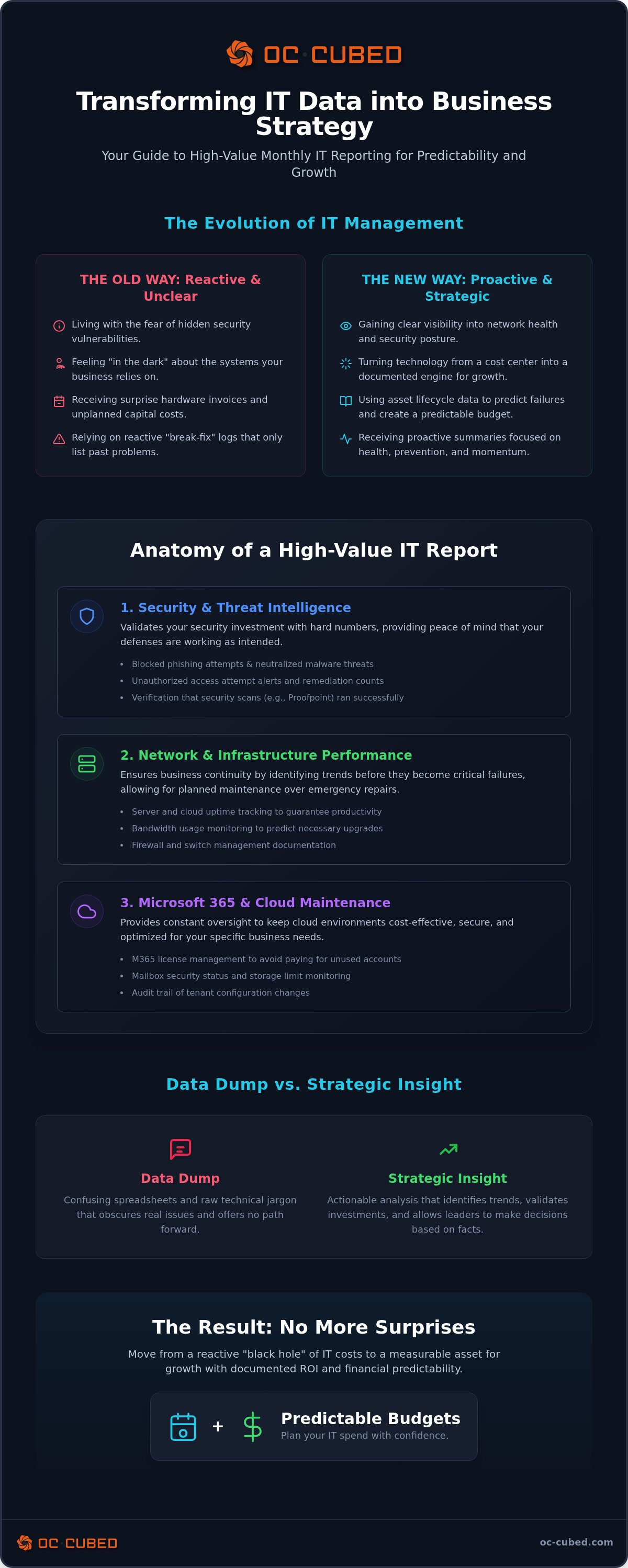
This guide explains how monthly IT reporting services transform raw technical data into a strategic tool for risk mitigation and financial predictability. By moving beyond simple lists of completed tasks, you gain clear visibility into your network health and a predictable budget for the road ahead. You'll learn how to turn your technology spend from a mysterious cost center into a documented engine for growth.
We will show you exactly what should be in your reports in 2026 to ensure your security threats are blocked and your hardware remains current. We'll cover how data-driven insights from endpoint protection and network monitoring feed directly into high-level strategy. This approach gives you the confidence to lead your organization without the fear of technical blind spots.
Key Takeaways
- Understand why modern IT reporting must shift from a list of closed tickets to a proactive strategic summary that drives business growth.
- Discover how monthly IT reporting services provide clear visibility into your network health, security threat remediation, and email protection status.
- Learn to use asset lifecycle data to predict hardware failures and eliminate the frustration of surprise IT capital expenditures.
- Identify the difference between a "data dump" and actionable insights that your vCIO can use to protect your brand and optimize performance.
What Are Monthly IT Reporting Services?
Monthly IT reporting services are the structured delivery of your network's vital signs. They provide a clear window into technical performance, security posture, and hardware lifecycle data. For many businesses, this marks a fundamental shift in how they view technology. You move away from reactive "break-fix" logs that only list problems after they occur. Instead, you receive proactive strategic summaries that focus on health, prevention, and forward momentum.
This documentation is the backbone of effective remote IT management services. It bridges the gap between technical complexity and business leadership. Transparency builds trust. When your provider shares raw data alongside expert analysis, it proves they're managing your environment with care. You shouldn't have to wonder if your backups worked or if your firewall is up to date. The report provides the evidence. It removes the mystery from technology and replaces it with accountability.
The Core Purpose of IT Visibility
Visibility isn't just about knowing things are "up." It's about identifying trends before they turn into critical system failures. If a server's memory usage is creeping up every month, reporting catches it before the crash happens. It allows for planned maintenance instead of expensive emergency repairs. Investing in monthly IT reporting services ensures your security threats are being blocked and your network remains stable. Reports also create a critical paper trail for compliance and insurance audits. They act as proof that your managed cybersecurity services for small business are actually functioning. You can see the exact number of threats blocked by tools like Proofpoint. It validates your security investment with hard numbers rather than vague promises.
Who Benefits Most from Monthly Reports?
Business owners benefit by seeing the direct ROI on their IT spend. They gain the peace of mind that comes from knowing their assets are protected and their data is secure. Technology stops being a black hole for capital and starts being a measurable asset for growth. Operations managers use these reports to track employee uptime and productivity trends. They can spot if aging hardware or slow network speeds are hindering the team's efficiency. Compliance officers get the documentation they need for security governance. It provides a single source of truth for the entire organization, ensuring everyone is aligned on risk and performance. This clarity allows leaders to make decisions based on facts rather than gut feelings.
The Anatomy of a High-Value IT Report
A report shouldn't be a confusing spreadsheet of technical jargon. It should be a clear dashboard of your business's health. High-quality monthly IT reporting services provide the data you need to make informed leadership decisions. This means looking past simple up or down status. You need to examine the specific metrics that indicate long-term stability and risk. A well-constructed report bridges the gap between the server room and the boardroom.
Security and Threat Intelligence
Security is the top priority for any executive. Your report should detail blocked phishing attempts, malware detections at the endpoint, and unauthorized access attempts. We focus on remediation counts. This shows how many threats were caught and neutralized. If a report shows zero threats found, it shouldn't be a blank page. It must verify that the scans actually ran and that tools like Proofpoint are actively filtering traffic. Verification provides the peace of mind that your defenses are working as intended. It validates your investment in protection.
Network and Infrastructure Performance
Business continuity depends on reliable infrastructure. High-value reports track server and cloud uptime to ensure your team stays productive. We also monitor bandwidth usage. This helps us predict when you'll need network upgrades before bottlenecks occur. Documenting firewall and switch management ensures your hardware is configured correctly to prevent performance drops. This level of detail allows you to see the quiet work that keeps your network running smoothly. It turns invisible maintenance into visible value for your operations team.
Microsoft 365 and Cloud Maintenance
Cloud environments require constant oversight to remain cost-effective. Your report should include Microsoft 365 license management for small business to ensure you aren't paying for unused accounts. We track mailbox security and storage limits to prevent workflow interruptions. Monitoring tenant configuration changes provides an audit trail of who accessed what and when. This ensures your cloud environment remains secure and optimized for your specific budget. If you're tired of guessing about your network's health, it might be time to explore a more transparent approach to IT management.
Data Dump vs. Strategic Insight: What to Look For
Raw data is noise. Strategic insight is the signal your business needs to grow. Many providers think they've done their job by emailing a 40-page PDF filled with technical logs that no executive has the time to read. This isn't how monthly IT reporting services should function. A high-value report filters out the clutter. It highlights what actually matters for your security and your budget. You shouldn't have to be a technical expert to understand your own network health.
The most critical part of any report is the executive commentary. This is where your IT partner explains the "why" behind the numbers. If there was a spike in blocked threats, they should explain the source and the solution. Without this context, you're just looking at a spreadsheet. Commentary turns data into a conversation about your business's future. It provides the quiet authority you need to make confident decisions.
Moving Beyond Ticket Counts
Don't get distracted by ticket vanity metrics. High ticket counts are often a warning sign, not a badge of honor. If your team closes 500 tickets in a month, it might mean your infrastructure is failing. Focus on Mean Time to Resolution (MTTR) instead. This metric shows how quickly your provider restores productivity. Identifying recurring issues allows you to address the root cause rather than just treating the symptoms of a deeper problem. This data-driven approach justifies the need for IT vendor risk management services. You'll finally see which software vendors are helping your team and which ones are creating more work.
The Role of Fractional Leadership
Strategic reporting is the foundation of IT leadership without full-time hire. A Virtual CIO (vCIO) uses these monthly findings to build a 12-month technology roadmap. They don't just fix what's broken; they plan for what's next. Findings from your report turn into actionable project management initiatives. This ensures every dollar you spend on technology aligns with your company's growth goals. It moves your IT from a black hole for capital to a strategic asset. You gain the clarity needed to lead without the weight of technical uncertainty.
Using Reports to Eliminate Surprise IT Costs
Surprise IT bills are the enemy of predictable growth. Most executives have experienced the frustration of a sudden, five-figure invoice for a failed server or a batch of emergency laptop replacements. Monthly IT reporting services act as the antidote to these financial shocks. By providing a clear view of your hardware and software environment, reports allow you to move from reactive spending to proactive budgeting. You gain control over your capital expenditures before they become emergencies.
This data-driven approach is essential for a flat-rate managed IT services model. It ensures your provider is aligned with your bottom line. When your IT partner tracks every asset, they can identify "Shadow IT" and unused subscriptions that drain your budget. Cutting these unnecessary costs often helps offset the investment in the support itself. It's about efficiency and the elimination of waste across your entire digital footprint.
Predictive Hardware Replacements
Every piece of hardware has a shelf life. High-quality reports track the age, warranty status, and performance trends of every endpoint and server in your office. Instead of waiting for a laptop to die during a critical presentation, you can plan for a staggered refresh. This keeps your cash flow steady. You replace a few machines every quarter rather than fifty all at once. This strategy prevents the massive productivity loss associated with aging technology. Your team stays equipped with reliable tools, and your finance department stays happy with a predictable line item.
Eliminating Unplanned Downtime
Reports do more than list assets; they correlate monitoring logs with potential failure points in your network. If a firewall is showing signs of thermal stress or a network switch is dropping packets, the data reveals the risk before the outage occurs. Proactive maintenance is always cheaper than emergency recovery. Some industry studies suggest that implementing predictive maintenance can reduce annual IT costs by as much as 20 percent by avoiding the high costs of downtime and rush shipping for replacement parts. You get proof of value from 24/7 monitoring logs that show exactly what was fixed before you even knew it was a problem.
OC Cubed: Reporting That Drives Business Results
OC Cubed operates on an all-inclusive reporting philosophy. We believe you should have access to your own data without hidden fees or restricted views. Our monthly IT reporting services integrate every facet of your digital environment into a single source of truth. This includes helpdesk tickets, NOC performance, and real-time security threat intelligence. By merging these streams, we provide a holistic view of your operations. You stop seeing IT as a series of isolated events and start seeing it as a unified system. This clarity is the foundation of a true partnership.
Our reports are built for executives, not just technicians. They are scannable, actionable, and ready for the boardroom. We translate complex logs into clear narratives about risk and performance. We prioritize what matters to your brand's reputation and your company's growth. Our vCIO and CISO advisory services use this data to identify long-term risks and opportunities. We don't just hand you a document; we provide the leadership needed to act on it. This ensures your technology strategy always supports your primary business objectives. We take pride in removing the technical obstacles that slow down your progress.
Transparency Through Technology
We provide both real-time visibility and comprehensive monthly summaries. You can check your network health at any moment; however, the monthly report provides the necessary context for long-term governance. Our commitment is to prevent security incidents through data-driven oversight. We use these reports to ensure your systems meet industry standards and internal goals. Our reports focus on your business outcomes. We measure success by your uptime and security, not just our technical task list. It's a results-driven approach that prioritizes your peace of mind and the stability of your network.
Getting Started with Proactive IT
Transitioning from the chaos of a break-fix model to managed clarity is a structured process. It begins with a thorough environment assessment. This assessment covers everything from endpoint protection status to Microsoft 365 tenant health, giving you a complete inventory of your digital assets. Your first report will highlight existing vulnerabilities and provide a baseline for your network health. This initial data allows us to build a roadmap for immediate stabilization. You'll see exactly where your infrastructure stands and what steps are needed to reach a state of proactive health. It's the first step toward total clarity and predictable budgeting. We guide you through every phase of this transition with professional care.
Secure Your Business Future with Data-Driven Clarity
Monthly IT reporting services are more than a check-the-box requirement for compliance. They are the lens through which you see the health and trajectory of your entire organization. By transforming technical logs into strategic roadmaps, you gain the clarity needed to lead with confidence. You've seen how proactive reporting prevents unplanned downtime and turns mysterious IT costs into predictable budget items. This transparency ensures your technology investment is always working toward your growth.
Our flat-rate monthly managed IT services retainer keeps your costs consistent while your protection stays strong. We provide 24/7 network monitoring and configuration to neutralize issues before they impact your productivity. Every partnership includes fractional executive leadership. This ensures your technology decisions are guided by seasoned professionals who understand your business goals. You deserve a partner who values results as much as you do.
You don't have to stay in the dark about your network performance. With the right reporting partner, you can move from reactive chaos to steady, reliable growth. We are ready to protect your brand and enable your future success.
Frequently Asked Questions
What is the most important metric in a monthly IT report?
The most important metric is the Mean Time to Resolution (MTTR), which tracks how quickly your team returns to work after a disruption. While ticket volume shows workload, MTTR measures the actual impact on your productivity. A high quality report should also highlight security remediation counts. This tells you exactly how many threats were blocked by tools like Proofpoint. Focus on metrics that correlate directly with your business uptime and operational efficiency.
How much time should I spend reviewing my IT report each month?
You should spend approximately 15 to 20 minutes reviewing your monthly summary if the data is properly synthesized. A professional report shouldn't require hours of your time to decode technical jargon. Instead, focus on the executive commentary provided by your vCIO. This section translates the raw data into business impacts and action items. If you find yourself spending more time, your provider might be sending a "data dump" rather than strategic insights.
Can monthly IT reports help with insurance or regulatory compliance?
Monthly reports are essential for meeting cyber insurance requirements and regulatory compliance standards. They provide a documented paper trail of your security posture, patching history, and threat remediation efforts. Many insurance carriers now require proof that your endpoint protection and multifactor authentication are consistently active. Your report serves as this evidence during an audit. It transforms your daily IT maintenance into a permanent record of governance and brand protection.
Do I still need a monthly report if my IT is 100% in the cloud?
You absolutely need monthly IT reporting services even in a 100 percent cloud environment. Cloud systems like Microsoft 365 still require active management of user permissions, storage limits, and security configurations. A report helps you track mailbox security and identify potential data leaks. It also ensures you aren't overpaying for unused licenses. Monitoring cloud health is just as critical as tracking physical servers to prevent workflow interruptions and unexpected cost spikes.
What is the difference between a technical log and an executive IT report?
A technical log is a raw list of every event or ticket that occurred in your network. An executive IT report is a strategic summary that explains what those events mean for your business. For example, a log might show a server rebooted at midnight. An executive report explains that the reboot was a proactive patch to block a specific vulnerability. Reports provide the "why" behind the technical actions, allowing for better leadership decisions.
How does reporting help prevent cyberattacks?
Reporting helps prevent cyberattacks by identifying trends and vulnerabilities before they are exploited. By reviewing blocked phishing attempts and unauthorized login patterns, your CISO can adjust your security policies in real time. It validates that your email security and endpoint protection are functioning correctly. This data driven governance allows you to stay ahead of evolving threats. You gain the confidence that your defensive layers are actively protecting your company's data and reputation.
Should my monthly IT report include hardware lifecycle information?
Your report should definitely include hardware lifecycle information to help you manage your assets effectively. Tracking the age and warranty status of every laptop and server prevents the productivity loss associated with sudden hardware failure. It allows you to stagger replacements throughout the year. This approach keeps your cash flow steady and ensures your team always has reliable tools. Proactive lifecycle management is a key component of avoiding emergency capital expenditures.
Can I use these reports for my annual budget planning?
You can and should use your monthly reports for annual budget planning. The historical data on hardware aging and cloud storage trends provides a clear roadmap for future spending. By reviewing twelve months of reports, you can accurately predict when infrastructure upgrades will be necessary. This eliminates the guesswork from your financial planning. It allows your leadership team to allocate capital toward growth initiatives rather than unexpected technical repairs.


