

What if the biggest risk in an MSP proposal is work neither side has clearly agreed to do? Comparing providers can be difficult when each proposal describes services differently. Vague exclusions or response commitments can leave important gaps. These MSP contract negotiation tips help you look beyond polished promises and focus on what the agreement actually covers.
Before signing, you should be able to compare proposals against the same criteria, understand who is responsible for each part of support, and know what happens when an issue falls outside the agreed scope. This checklist covers services, response commitments, exclusions, reporting, renewal terms, and exit provisions. Use it to negotiate measurable, reviewable commitments that fit your business and remain workable over time.
Key Takeaways
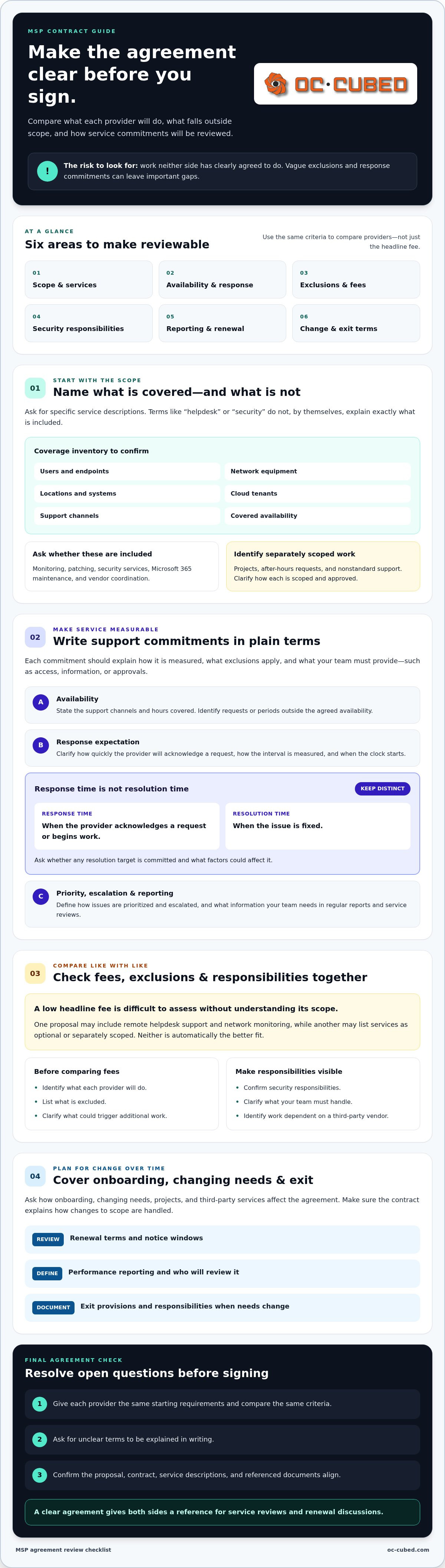
- Use MSP contract negotiation tips to compare providers on scope, exclusions, fees, and security responsibilities.
- Define coverage, availability, escalation, and reporting in writing. Keep response time distinct from resolution time.
- Ask how onboarding, changing needs, projects, and third-party services affect the agreement.
- Review renewal terms, notice windows, and performance reporting before committing.
- Resolve open questions before signing and confirm the proposal, contract, service descriptions, and referenced documents align.
Why MSP Contract Negotiation Matters Before You Sign
An MSP agreement does more than set a recurring fee. It defines which services are included, what your business must handle, how the provider will respond to requests, and what happens when your needs change. Familiar terms such as “helpdesk” or “security” don’t explain exactly what’s covered. Ask for specific service descriptions and make sure the final contract reflects them.
A low headline fee is difficult to assess without understanding its scope. One proposal might include remote helpdesk support and network monitoring, while another lists some services as optional or separately scoped. Neither is automatically the better fit. Before comparing fees, identify what each provider will do, what’s excluded, and what could trigger additional work.
Vague promises can also make service difficult to assess later. If the agreement doesn’t explain responsibilities, escalation paths, or reporting, you may struggle to determine whether a concern falls within scope or how to raise it. Clear terms give both sides a reference for service reviews and renewal discussions. The goal of these MSP contract negotiation tips is to help you compare proposals consistently and negotiate commitments you can verify in practice.
What should an MSP contract make clear?
Check whether the agreement identifies the covered users, devices, locations, systems, and support channels. It should distinguish recurring support from projects, advisory work, and other services that need separate scoping. Ask whether network monitoring, Microsoft 365 maintenance, or security support is included, and what circumstances would place related work outside the agreement. Clarify which actions depend on your team, such as providing access, approving changes, or contacting a third-party vendor.
For a foundation on the provider relationship, see this overview of the Managed Service Provider (MSP). For more context before reviewing contract details, read this managed service provider guide.
Prepare your requirements before comparing providers
Write down your business-critical systems, support needs, security priorities, and planned changes. Set expectations for communication, reporting, escalation, and who can make decisions on your behalf. Giving each provider the same starting point helps expose assumptions before they become contract gaps.
- List essential systems, users, and devices that need coverage.
- Identify support channels and the issues that require escalation.
- Note security priorities and upcoming changes that could affect scope.
- Decide what information you need in regular reports and who will review it.
Bring these requirements into each provider conversation. Ask for unclear terms to be explained in writing, then check that the proposal and contract agree. A specific starting point makes it easier to judge whether each offer fits your business, rather than simply whether the wording sounds reassuring.
MSP Contract Negotiation Checklist: Define Scope and Service Levels
Turn general service promises into terms your team can check. These MSP contract negotiation tips focus on what’s covered, how support works, and how both parties will review commitments. A clear agreement supports an ongoing working relationship, not just a smooth signing process. Harvard Business Review’s discussion of a new approach to contracts offers a useful perspective on contracts as a foundation for collaboration.
Which services and systems are actually covered?
Ask the provider to attach or reference an inventory of supported users, endpoints, network equipment, and cloud tenants. Confirm whether the agreement includes monitoring, patching, security services, Microsoft 365 maintenance, and vendor coordination. Don’t assume a service is included just because it appears in a proposal overview. Identify project work, after-hours requests, and nonstandard support separately, including how each is scoped and approved.
How should support and escalation commitments be written?
Use the checklist below to turn service expectations into practical, reviewable terms. Each commitment should explain how it’s measured, what exclusions apply, and what your team must provide, such as access, information, or approvals.
- Define availability. State the support channels and hours covered. Identify requests or periods that fall outside the agreed availability.
- Set response expectations. Clarify how quickly the provider will acknowledge a request and how that interval is measured, including when the clock starts.
- Separate response from resolution. Response time measures when the provider acknowledges a request or begins work. Resolution time measures when the issue is fixed. Ask whether any resolution target is committed and what factors could affect it.
- Document priority and escalation. Define priority levels and the business impacts that affect classification. Name escalation contacts and communication channels, and specify how often the provider will share status updates.
- Set reporting expectations. Agree on reporting frequency and what reports should show, such as ticket status, recurring issues, or delivery against defined commitments.
- Control scope changes. Specify how either party can request a change, who must approve it, and where the revised scope and related terms will be documented.
Before signing, ask the provider to walk through a sample scenario, such as a critical system issue that requires escalation. This can reveal whether priority rules, contacts, and status updates are clear enough for your team to use.
If you’re refining your requirements, learn about OC Cubed’s support services, including remote IT support, security services, and reporting, and consider how they align with your business priorities.
Compare MSP Proposals on Fees, Security, and Contract Flexibility
Once you’ve defined what your business needs, use the same comparison framework for every proposal. A comparison matrix can reveal differences that a headline fee or polished service summary may hide. These MSP contract negotiation tips focus on what each provider includes, assumes, excludes, and commits to in writing.
- Scope: Record covered services, systems, users, and support channels.
- Assumptions and exclusions: Note what the provider expects your team to manage and what falls outside the agreement.
- Fees: Separate recurring services from onboarding, projects, and documented pass-through charges.
- Term and flexibility: Compare the contract duration, change process, and terms that affect adjustments.
- Security responsibilities: Identify who monitors, communicates, investigates, and takes action.
Ask each provider how onboarding is handled and whether it changes the agreement or creates separate work. Clarify how new users, systems, and other scope changes are requested, approved, and recorded. Ask directly about projects and third-party services: who coordinates them, what’s included, and how related charges or responsibilities are documented.
How can you compare MSP fees without focusing only on the total?
Compare like with like. Separate ongoing services from one-time onboarding, project work, and clearly documented pass-through charges. Ask what could change the recurring fee, how the provider will explain a change, and what notice you’ll receive. For more context on planning and managing IT spending, see predictable IT costs for small businesses.
Which security and data terms deserve negotiation?
Don’t settle for a broad promise to “handle security.” Clarify who is responsible for threat detection, escalation, remediation, and incident communication, including what your team must do and when. Define expectations for access controls and data handling, and specify how the parties will cooperate during an investigation. Ask how subcontractors and third-party tools fit into the arrangement, who manages them, and what responsibilities remain with your business.
Strong negotiation starts with preparation. The Program on Negotiation at Harvard Law School offers practical contract negotiation skills guidance to help clarify priorities before discussions. Bring open questions to each provider and request written answers. The most useful proposal is one whose scope, fee structure, security roles, and change process you can understand and compare, not simply the one with the shortest summary.
Negotiate Renewal, Reporting, and Exit Terms Before Signing
A contract should give you a way to check whether agreed services are being delivered and a clear path if the relationship needs to change. Reporting and review clauses create a shared record of service, open issues, and decisions. They also make renewal discussions more grounded in performance and business needs, rather than assumptions or a last-minute contract review.
What should monthly reporting and service reviews cover?
Ask for reports that help your team understand what’s happening, not just a list of activity. Depending on the services in scope, useful summaries may include support activity, monitoring, security issues, and unresolved follow-up items. Agree on who receives and reviews reports, how often service reviews take place, and how decisions or assigned actions are recorded.
Make recurring problems visible. Define how either party can raise a pattern of unresolved issues, who will assess it, and how corrective actions will be tracked through completion. This gives the provider and your team a practical way to address concerns before they become renewal disputes.
How can a business protect its options at renewal or exit?
Check the renewal date and how much notice is required to cancel or change the agreement. Ask whether the contract renews automatically, whether terms or scope can change at renewal, and when you’ll receive notice of proposed changes. Confirm how to request a scope adjustment during the term and how the parties will document an approved change. Add key dates to a calendar and assign someone to review them.
Plan for an orderly handoff, even if you expect the relationship to continue. The agreement should explain how offboarding works, including the return or transfer of business data, removal of provider access, delivery of relevant documentation, credential transfer where applicable, and cooperation with a successor provider. Clarify what your business must supply or approve to complete those steps, and how third-party tools or services will be handled.
Read carefully for one-sided or ambiguous language, especially around notice, access, data handling, and transition support. Treat unclear terms as questions to resolve, not assumptions to rely on. Contract interpretation depends on the full agreement and circumstances, so ask a qualified attorney to review the legal language before signing.
These MSP contract negotiation tips help keep service reviews, renewal decisions, and a potential transition on a clear footing. Put the agreed reporting process, key dates, responsibilities, and exit steps in writing, then confirm that the contract and referenced documents say the same thing.
Finalize the MSP Agreement With Clear Owners and Next Steps
Before signing, close the gap between negotiation and day-to-day service. Resolve open questions, confirm every agreed term in writing, assign an owner on each side, and schedule the first review. A careful final pass can catch mismatches between what a proposal promises and what the contract requires.
Run a final pre-signature review
Check the agreement alongside the proposal, service descriptions, schedules, and any documents incorporated by reference. Confirm that negotiated changes appear in the final contract or an attached document that clearly forms part of it. If a promise exists only in an email or sales conversation, ask where it belongs in the signed terms.
Verify the start date, onboarding responsibilities, required access, and primary points of contact. Keep a dated copy of the signed agreement and supporting documents, along with notes on assumptions, exclusions, escalation contacts, and the approved process for requesting changes.
- Resolve unanswered scope or responsibility questions.
- Confirm the proposal and contract use consistent service descriptions.
- Assign owners for approvals, access, communication, and follow-up.
- Save the complete signed agreement and related records in a shared, controlled location.
Turn negotiated terms into a working relationship
Signing is a starting point, not the finish line. Schedule the first service review and confirm who receives reports, how the team raises an issue, and which contacts handle escalation. Identify priorities for early support and security discussions, such as critical systems, recurring user needs, or planned technology changes. These steps help both sides act on the agreement instead of relying on memory.
Use these MSP contract negotiation tips to build an arrangement your team can manage and review. Businesses looking for proactive remote support and virtual IT leadership can assess whether OC Cubed’s remote IT support, security services, monthly reporting, and virtual CIO, CTO, or CISO advisory fit their requirements.
Choose Support Terms Your Business Can Rely On
A strong MSP agreement makes expectations clear before work begins. Compare proposals against the same scope and responsibilities, put service and security commitments in writing, and confirm how reporting, renewal, and exit will work. These MSP contract negotiation tips can help you move beyond broad promises and choose an arrangement your team can review and manage.
OC Cubed’s services include remote helpdesk and NOC integration, monthly reporting, and virtual CIO, CTO, and CISO advisory. If you’re evaluating managed IT support, use your business priorities to guide the conversation and clarify what support would fit.
Clear terms create a more confident starting point. With responsibilities understood and review steps agreed, your business can focus on the work ahead.
Frequently Asked Questions
What should I negotiate in an MSP contract?
Negotiate the services covered, responsibilities on both sides, and the process for handling support requests and changes. Clarify which users, devices, systems, and channels are included, along with exclusions and separately scoped work. Define how response and escalation commitments are measured, what reporting you’ll receive, and how security responsibilities are divided. Also review fees, renewal and cancellation terms, and offboarding steps. Strong MSP contract negotiation tips start with specific, written expectations.
Can you negotiate an MSP contract after receiving a proposal?
Yes. A proposal is a useful starting point for questions and negotiation before you sign. Ask the provider to clarify assumptions, exclusions, onboarding, project work, third-party services, and any terms that don’t match your needs. Request changes in writing, then verify they appear in the final agreement or an incorporated document. Don’t rely on a verbal assurance if the contract says something different. Keep a record of agreed revisions and open items.
How do I compare MSP contracts from different providers?
Compare each provider using the same requirements and a comparison matrix. Include covered services and systems, assumptions, exclusions, recurring and one-time charges, contract term, security responsibilities, reporting, and exit provisions. Ask providers to explain how scope changes, projects, onboarding, and third-party services affect the agreement. Similar labels can hide different commitments, so compare the written terms rather than relying on proposal summaries or headline totals alone.
What is the difference between response time and resolution time in an MSP contract?
Response time describes how quickly the provider acknowledges or begins addressing a request. Resolution time describes how long it takes to fix the issue. They’re separate measures, and a response commitment doesn’t automatically promise resolution by a specific deadline. Ask how each is measured, when the clock starts, how priority is assigned, and what dependencies or exclusions may affect the commitment. Make sure the contract uses these terms consistently.
Should an MSP contract include cybersecurity responsibilities?
Yes, the agreement should make security roles clear. Specify who handles threat detection, escalation, remediation, incident communication, and coordination during an investigation. Clarify expectations for access controls and data handling, along with what actions your business must take, such as providing access or approving changes. Address how subcontractors and third-party tools fit into the arrangement. Clear responsibility boundaries help prevent assumptions from delaying action when a security concern arises.
What should happen when an MSP contract ends?
The contract should describe a practical offboarding process. Confirm how business data and documentation will be returned or transferred, how provider access will be removed, and how credentials will be handed over where applicable. Clarify who coordinates with a successor provider, what cooperation is expected, and what your business must do to support the transition. Review cancellation notice requirements and renewal dates early so your team has time to plan rather than react.
Should I have a lawyer review an MSP contract?
Consider having a qualified attorney review the agreement before signing, especially if terms are unclear, one-sided, or important to your business’s security, data, renewal, or exit options. An attorney can assess the legal language and explain how provisions may affect your organization. Bring the proposal, service schedules, referenced documents, and negotiated changes to the review. Don’t assume that a sales explanation changes the meaning of the final written agreement.


