

Security leadership doesn’t have to mean hiring a full-time CISO. Virtual CISO services can provide guidance on compliance, incident response planning, vendor risk, and security priorities. OC Cubed - Your trusted MSP helps organizations establish practical oversight to make informed decisions and strengthen their security programs.
It’s reasonable to want clear ownership of security risks without adding a full-time executive role. A virtual CISO can connect security work to business needs, coordinate planning, and give leaders a clearer view of what needs attention.
This article explains how virtual CISO support works, what it can cover across compliance and third-party risk, and how on-demand leadership can address changing priorities. You’ll also learn what to consider when choosing an engagement and how ongoing support can keep security efforts organized.
Key Takeaways
- Use virtual security leadership to connect risk priorities with practical, ongoing security work.
- Map compliance needs to the relevant framework, then identify gaps and organize the steps needed to address them.
- Build an incident response plan that clarifies roles, decision-making, communication, and recovery steps before an event occurs.
- Assess vendors based on the information and systems they can access, the risks they introduce, and the safeguards they maintain.
- Set a regular cadence for security updates and adjust support as priorities change, such as during a compliance review or incident.
Why Go Virtual for Your CISO Needs?
A virtual CISO helps an organization set security priorities without adding a full-time executive role. Virtual CISO services in DC can provide assessment, planning, tool oversight, and ongoing guidance as security needs change.
Security Program Development
A security program should reflect an organization’s assets, threats, partners, regulatory obligations, and available resources. A virtual CISO can assess these areas, identify gaps, and set a practical sequence of improvements. For example, an assessment may prioritize access controls before the organization considers new security tools. The National Institute of Standards and Technology identifies NIST SP 800-171 as a framework used to assess security controls.
Look for a plan that turns findings into assigned actions, policies, and procedures. It should explain how progress will be reviewed and how the program can adapt when business operations or risks change. This makes security part of regular decision-making, rather than a one-time assessment.
Security Tools and Team Oversight
Start tool procurement with the risks and requirements your organization needs to address. A virtual CISO can compare security products and managed services against those priorities, then guide selection, implementation, and management. Assess how each tool fits existing systems, who will operate it, and which responsibilities remain with internal staff.
Team oversight connects procurement decisions to daily work. A virtual CISO can coordinate security activities, clarify responsibilities, and assess team processes, capabilities, and skills. When comparing vendors, consider service scope, operational fit, and how each option supports your organization’s security goals.
Washington, DC Security Context
Washington, DC organizations face different security demands based on their work, information, and partners. Trade associations, government contractors, and nonprofits are among the organization types that use virtual CISO support in the DC and DMV area. A useful assessment accounts for each organization’s assets, threats, relationships, and regulatory obligations.
For example, a government contractor may assess controls against NIST SP 800-171, while a nonprofit may focus on protecting donor and staff information. These examples do not establish identical requirements for every organization. Virtual CISO services in DC can help connect applicable obligations to specific controls, owners, and review activities.
Costs, Providers, and Service Limitations
There is no single average cost that applies to every virtual CISO engagement in Washington, DC. The price depends on the case and is given after a quote request; key factors include frameworks involved, incident-response retainer needs, and the balance between a one-time assessment and ongoing program work.
Providers serving Washington, DC include cybersecurity consultancies and managed service providers offering virtual CISO leadership. Compare their scope with your needs for strategy, operational coordination, and program oversight. A virtual CISO can advise and coordinate, but the organization still needs internal owners to carry out approved actions. Remote leadership may not suit needs requiring on-site staffing or hands-on support.
Compliance support for HIPAA, PCI DSS, SOC 2, CMMC, and GDPR
A virtual CISO can organize compliance work around the frameworks relevant to your organization. The engagement connects information security priorities with evidence, ownership, and ongoing review.
Compliance Management Components
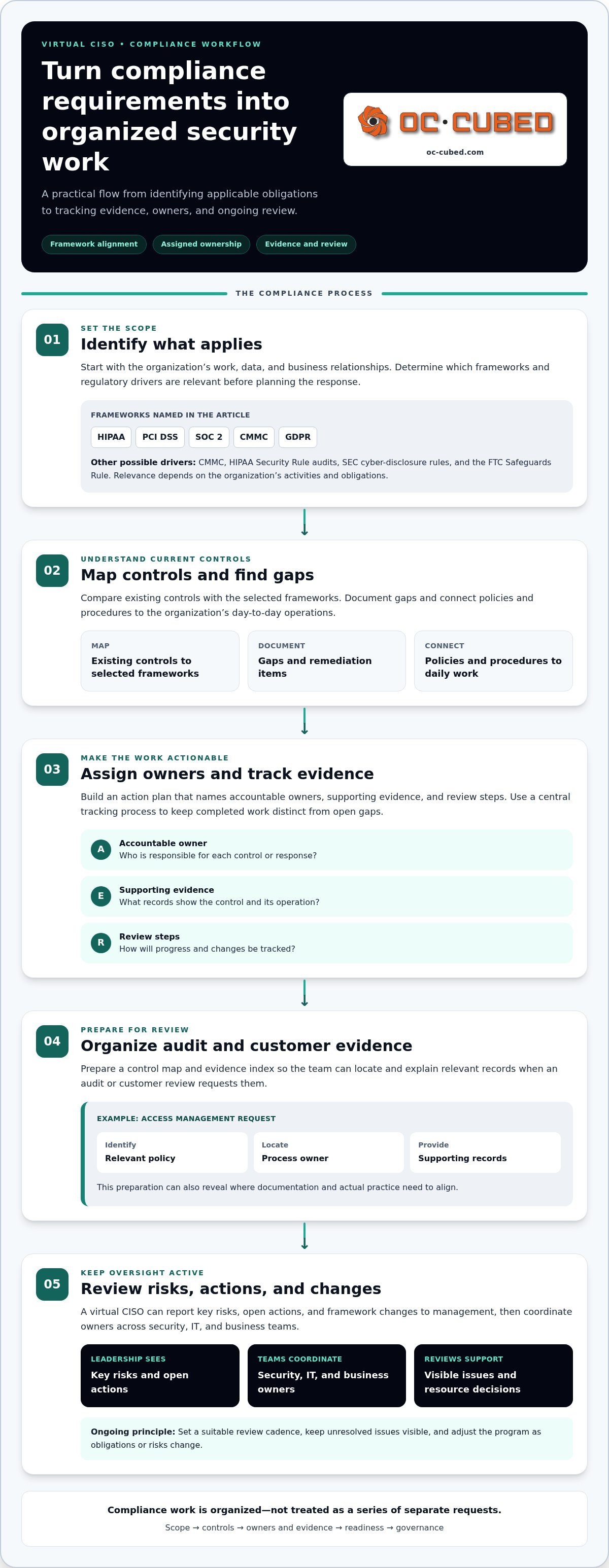
Start by identifying which frameworks and obligations apply to the organization’s work, data, and business relationships. HIPAA, PCI DSS, SOC 2, CMMC, and GDPR can each shape different security priorities. A virtual information security officer can map existing controls to selected frameworks, document gaps, and build a strategic action plan with owners and review steps.
Look for support that connects policies and procedures to daily operations. For example, each control should have an accountable owner, supporting evidence, and a process for tracking changes. This structure helps your organization carry out consistent compliance work instead of treating each request as a separate project.
Compliance Readiness and Audit Preparation
Readiness work turns framework expectations into evidence teams can locate and explain. A virtual CISO can organize policies, control records, risk assessments, and remediation items through a central tracking process. The assessment should distinguish completed work from open gaps, assign owners, and record how each issue will be addressed.
For an audit or customer review, prepare a control map and evidence index before requests arrive. If a reviewer asks about access management, for example, your team can identify the relevant policy, process owner, and supporting records. This also reveals where documentation and actual practice need to align.
Regulatory Compliance Governance
Governance gives leaders a clear way to oversee compliance priorities and decisions. A virtual CISO can report key risks, open actions, and framework changes to management, then coordinate owners across security, IT, and business teams. A suitable review cadence keeps unresolved issues visible and helps leadership direct resources to material gaps.
Regulatory drivers can include CMMC, HIPAA Security Rule audits, SEC cyber-disclosure rules, and the FTC Safeguards Rule. Their relevance depends on an organization’s activities and obligations. A compliance assessment should document which drivers apply, who owns each response, and how leadership receives updates.
For HIPAA, PCI DSS, SOC 2, CMMC, or GDPR work, define the engagement around the frameworks in scope and the support required. A contract and service-level agreement should specify deliverables, responsibilities, reporting cadence, communication channels, and how scope changes are handled. It should also clarify how assessment findings become tracked actions.
Useful virtual CISO support coordinates compliance planning, evidence preparation, and management oversight, but internal teams still need to provide accurate records and complete assigned actions. Organizations considering virtual CISO support can use these elements to frame a focused discussion about compliance priorities.
Incident response planning
A response plan turns security controls into clear decisions during an incident. Virtual security leadership can help develop the plan, exercise it with teams, and improve reporting before an event disrupts operations.
Build an actionable response plan
Start by defining how employees report a suspected incident and who receives the report. The plan should assign decision-making roles across leadership, IT, communications, and legal teams. It should also explain how to assess the scope, prioritize containment, preserve relevant evidence, and coordinate recovery. For example, a suspected account takeover needs a clear path from the initial report to access review and business updates.
Document decision points, not just technical tasks. Specify who can isolate a device, approve a service interruption, and communicate with affected stakeholders. A CISO can align those choices with business priorities, existing controls, and your organization’s reporting process.
Test the plan with tabletop exercises
A tabletop exercise lets teams rehearse an incident without changing live systems. Choose a scenario that reflects your organization’s environment, such as a compromised email account or an unavailable business application. Give participants updates as the situation develops, then ask them to make decisions using the written plan. The exercise can reveal unclear handoffs and missing contact paths.
Record each decision, question, and delay during the discussion. Afterward, assign an owner to every improvement, such as updating an escalation list or clarifying approval authority. Revisit the plan when systems, vendors, or team responsibilities change so the exercise remains relevant to current operations.
Train teams and establish reporting
Employees need simple instructions for recognizing and reporting suspicious activity. Training can use examples such as an unexpected sign-in prompt, a suspicious attachment, or an unusual request to transfer information. Explain where reports go, what details to include, and why employees should report promptly rather than investigate on their own.
Managers and technical teams need role-specific practice. IT staff might rehearse isolating affected equipment, while managers practice escalation and internal updates. A consistent reporting path helps responders collect useful details, identify patterns, and decide whether an event needs broader investigation.
Get incident and advisory support
During an incident, an advisor can help leadership organize facts, assess business impact, set priorities, and coordinate technical responders. Keep confirmed observations distinct from assumptions. For example, teams can track affected systems, actions taken, pending decisions, and the next communication point in a shared incident log.
Advisory support can also help after containment. Review what worked, where reporting stalled, and which controls need attention. Turn those findings into assigned actions, then update the plan and training materials. This follow-through helps your organization learn from an incident and strengthen its response process.
Vendor and third-party risk management
A vendor can introduce cybersecurity risk through its access, services, or connection to business operations. Security leadership helps executives assess those exposures and decide which actions deserve attention first.
Assess vendor exposure and business impact
Begin with an inventory of vendors, their services, and the information or systems each can access. A payroll provider, for example, may handle sensitive employee information, while a cloud platform may support essential workflows. Record each relationship’s business purpose, access level, dependencies, and existing safeguards.
Then assess what could go wrong, how likely it is, and the potential cost to your organization. Consider service disruption, unauthorized access, and reliance on a vendor for critical operations. This gives executives a risk-based view instead of treating every vendor as equally important. Prioritize follow-up according to exposure and business impact.
Connect risk decisions to NIST CSF 2.0
NIST CSF 2.0 can serve as a reference point for connecting cybersecurity work to governance and risk strategy. A virtual CISO can use it to organize discussions about who oversees vendor risk, how risks are assessed, and how the organization responds. The framework supports structured decision-making; it does not replace an organization’s own assessment of its vendors and obligations.
For each significant relationship, document the risk, its business impact, the accountable person, and the planned response. For example, leadership might require a vendor access review or define a continuity option for a service the organization depends on. Keep the reasoning visible so executives understand why one exposure needs action before another.
Manage third-party risk over time
Vendor risk management should follow the relationship from selection through ongoing use and renewal. Before engaging a provider, identify the service’s purpose, access needs, and impact if it becomes unavailable. During the relationship, track changes such as new data access, a changed service scope, or a new dependency. These can alter the original risk assessment.
Set a review process that assigns an owner and records follow-up. A vendor with access to sensitive systems may need closer oversight than one providing a low-impact service. Use a consistent method to evaluate evidence, document decisions, and escalate unresolved concerns. Vendor management can coordinate this process with IT and business owners.
Give executives decision-ready advice
A virtual CISO translates vendor findings into options executives can act on. A briefing can explain the exposure, potential business consequences, available responses, and the trade-offs behind each choice. This connects security advice to operating priorities instead of presenting technical findings without context.
Link vendor decisions to your organization’s response plan. If a critical provider becomes unavailable, leaders need to know who assesses the impact, who makes business decisions, and how updates reach affected teams. Review those responsibilities alongside vendor dependencies, then track gaps as assigned security actions. This makes third-party risk part of ongoing governance.
On-demand virtual CISO support
On-demand security leadership gives executives guidance as priorities shift, from routine planning to a breach or compliance deadline. Its value comes from matching support to the decisions your organization needs to make.
On-Demand Advisory Support
A virtual CISO advises management and boards on cyber risk, security posture, and plans to address priority gaps. Executive briefings can help leadership review security posture and initiatives. Weekly operational check-ins help security and IT teams coordinate assigned work. Annual planning sessions review program direction and priorities.
Support can increase around an incident, renewal, or compliance deadline, then ease when the organization is stable. For example, leadership may need closer guidance during a breach response, followed by a return to the regular briefing cadence. Define who receives urgent updates and how decisions reach the executive team.
When choosing virtual CISO support, consider whether the engagement can address urgent needs as well as provide steady guidance for managing initiatives and improving security posture.
Getting Started with vCISO Services
Businesses can get started by identifying current risks, key obligations, and desired outcomes, then defining the engagement’s scope and responsibilities. Set initial priorities around the organization’s most important systems, vendors, and business processes. Agree on reporting, decision owners, and how the virtual CISO will work with management and security teams.
Ask for a clear outline of the first 30, 60, and 90 days. A useful plan should show what happens during initial assessment, which findings become priorities, and how progress will be reported. It should also separate advisory work from tasks assigned to internal staff or other service providers.
On-demand guidance works best when leadership can act on clear recommendations. Establish a routine for monthly executive briefings, weekly operational check-ins, and annual strategic planning. Then document how the cadence changes during a breach, renewal, or compliance deadline. This gives the organization a practical way to prioritize work without losing sight of longer-term security goals.
OC Cubed - Your trusted MSP: Remote IT Support
OC Cubed - Your trusted MSP provides Remote IT Support for businesses that need practical help managing everyday technology and security priorities. It’s a natural next step when your team needs technical support alongside security planning.
Remote IT Support can work alongside Microsoft 365 Tenant Maintenance, Endpoint Protection / Antivirus, and Security Threat Detection and Remediation. Together, these offerings address user support, tenant upkeep, endpoint protection, and security issues that need attention. The right starting point depends on the systems and concerns affecting your organization.
If your team needs dependable remote IT support or help strengthening these areas, contact OC Cubed - Your trusted MSP to discuss your needs.
Turn Security Priorities Into Your Next Step
A useful next step is to choose one security decision that needs clearer ownership. It could be assigning responsibility for a recurring risk review, aligning technical work with leadership priorities, or deciding how security concerns reach decision-makers. A focused starting point makes it easier to build momentum while keeping business needs in view.
For organizations considering virtual CISO services in DC, OC Cubed - Your trusted MSP connects security direction with practical IT support. Its Remote IT Support, Microsoft 365 Tenant Maintenance, and Security Threat Detection and Remediation offerings can help address operational needs alongside broader security priorities. The right conversation begins with your organization’s goals and the support your team needs to move forward.
With clear ownership and steady progress, your team can make security decisions with greater confidence and stay focused on the work ahead.
Frequently Asked Questions
What do virtual CISO services include?
Virtual CISO services in DC can include security strategy, risk oversight, compliance planning, policy guidance, and executive reporting. The scope depends on the organization’s priorities and internal capacity. For example, a business with a small IT team might use a virtual CISO to establish who reviews security decisions and how unresolved risks reach senior leaders. Clear deliverables connect advice to accountable actions.
How do virtual CISO services compare with hiring a full-time CISO?
A full-time CISO is an internal executive role, while a virtual CISO provides leadership through an external engagement. The virtual model can suit organizations that need strategic direction without a dedicated full-time position. Compare the engagement’s scope, leadership access, team responsibilities, and implementation support. A virtual role may not replace internal owners responsible for carrying out security decisions and managing daily operations.
What cybersecurity regulations apply to DC businesses and government contractors?
Applicable requirements depend on an organization’s work, data, contracts, and business relationships. Potential governance drivers include CMMC, HIPAA Security Rule audits, SEC cyber-disclosure rules, and the FTC Safeguards Rule. A contractor should assess obligations tied to its contracts, while a healthcare organization should consider relevant HIPAA requirements. These rules and frameworks do not apply in the same way to every business.
Can a virtual CISO help with NIST, CMMC, HIPAA, or SOC 2 compliance?
Yes. A virtual CISO can help map current controls to a relevant framework, identify gaps, organize evidence, and track remediation. The National Institute of Standards and Technology identifies NIST SP 800-171 as a framework used to assess security controls. For example, an organization can assign owners to missing evidence and track actions toward its selected NIST, CMMC, HIPAA, or SOC 2 objectives.
How do you choose a virtual CISO provider in Washington, DC?
Choose a provider whose engagement fits your organization’s risks, leadership needs, and internal capacity. Ask for a clear plan covering assessment, deliverables, reporting, responsibilities, and the first 30, 60, and 90 days. Virtual CISO services in DC should align recommendations with the organization’s priorities. OC Cubed - Your trusted MSP offers Virtual CIO / CTO / CISO leadership and Monthly Reporting to support strategic oversight.
What is the average cost of virtual CISO services in Washington, DC?
Costs depend on the frameworks involved, incident-response retainer needs, and the balance between a one-time assessment and ongoing program work.

Article by
Peter Irizarry
Peter Irizarry founded OC Cubed, LLC in 2023 to help small to mid-sized businesses stop worrying about downtime and cybersecurity threats. A frequent speaker on SMB digital transformation, Peter is passionate about translating complex IT roadmaps into plain-English business growth strategies. He resides in North Texas with his family.


