

When no one owns technology strategy, risks, or next steps, important decisions can stall. If a full-time CIO is more leadership than your business needs right now, fractional CIO searches point to a practical question: could part-time guidance provide the direction you're missing? The value is not advice alone. It's turning technology choices into accountable business priorities.
It's reasonable to want clearer oversight without adding a full-time executive role. Fractional CIO leadership can connect IT investments, security risks, vendors, and projects to business goals, while operational IT support keeps essential work moving. The roles are complementary: one sets direction and strengthens accountability; the other supports day-to-day technology needs.
This article explains what fractional CIO leadership can do, when it may fit, and how it differs from a virtual CIO. You'll also see how vendor management and virtual project management can support execution, and how OC Cubed - Your trusted MSP's Virtual CIO/CTO/CISO service works alongside managed IT support. The aim is to clarify what needs attention, why it matters, and who is responsible for moving it forward.
Key Takeaways
- Look for unclear IT ownership, competing priorities, vendor friction, or uncertain risk decisions as signs that part-time executive technology leadership may help.
- Set expectations for strategy, governance, risk oversight, vendor accountability, and project direction around your business priorities.
- Compare fractional CIO, full-time CIO, vCIO, and managed IT support by the leadership depth and operational responsibilities your organization needs.
- Use a practical framework to define outcomes, map risks and owners, rank initiatives, and review progress.
- See how Virtual CIO/CTO/CISO leadership can work alongside vendor management, virtual project management, and monthly reporting.
When Does a Business Need Fractional CIO Leadership?
A fractional CIO provides part-time executive technology leadership. The role does not replace a helpdesk or the people resolving individual support requests. Instead, it helps leaders decide how technology should support business goals, which risks deserve attention, and who is accountable for moving priorities forward. The Chief Information Officer (CIO) role centers on guiding an organization’s technology direction; a fractional arrangement provides that perspective without making it a full-time executive position.
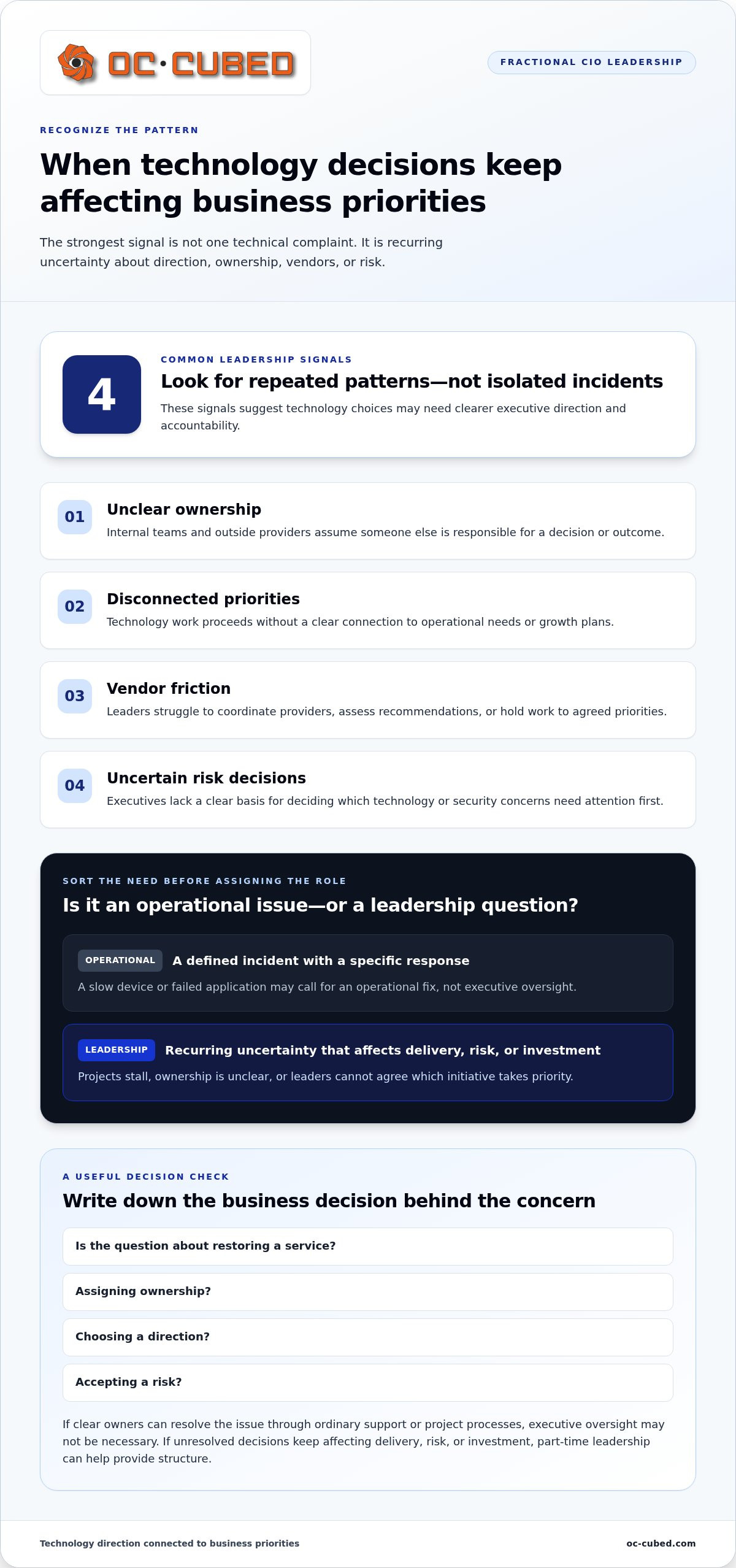
To assess whether this leadership could help, look at the pattern behind technology complaints, not just the complaints themselves. A slow device or failed application may call for an operational fix. Repeated disagreement about which systems to invest in, who owns a project, or whether a risk is acceptable points to a leadership question.
Fractional CIO leadership is most useful when technology decisions repeatedly affect business priorities, but no one has clear authority to connect the two.
Common signals include:
- Unclear ownership: Internal teams and outside providers assume someone else is responsible for a decision or outcome.
- Disconnected priorities: Technology work proceeds without a clear connection to operational needs or growth plans.
- Vendor friction: Leaders struggle to coordinate providers, assess recommendations, or hold work to agreed priorities.
- Uncertain risk decisions: Executives lack a clear basis for deciding which technology or security concerns need attention first.
These symptoms do not automatically mean the business needs executive guidance. The cause might be a defined support issue, a temporary project delay, or a missing process. Ask whether the problem keeps returning because the organization lacks direction, decision-making authority, or clear accountability.
What business problems can a fractional CIO address?
Strategic leadership connects technology decisions to operational goals, growth plans, and the level of risk the business is prepared to accept. It can clarify who owns decisions across internal teams and external vendors, then align recommendations and project work with business priorities. For example, if a project keeps stalling because teams disagree on its purpose, an executive-level review can clarify the business outcome and identify the decision owner. That is different from resolving an individual technical support request.
How can you tell whether the need is strategic?
An isolated technical fault usually has a defined incident and a specific response. A strategic need tends to show up as recurring uncertainty: projects stall, no one can explain how IT performance is assessed, or leaders cannot agree which initiative takes priority. Before seeking a solution, write down the business decision behind the concern. Is the question about restoring a service, assigning ownership, choosing a direction, or accepting a risk? That distinction helps prevent an executive engagement from becoming a substitute for routine operations.
Assess the leadership gap rather than assume every technology challenge calls for a CIO. If clear owners can resolve the issue through ordinary support or project processes, executive oversight may not be necessary. If the same unresolved decisions keep affecting delivery, risk, or investment, part-time leadership can provide structure for moving forward.
What Does a Fractional CIO Actually Lead?
A fractional CIO turns business priorities into technology decisions, clear ownership, and regular review. The role is not a fixed checklist. One organization may need help setting investment priorities; another may need stronger oversight of vendors, risk, or stalled projects. The work should reflect the decisions leaders need to make, not strategy for its own sake.
Think of the role as a connection point between business leadership and the people responsible for technology. The CIO helps clarify why an initiative matters, who is accountable, what risks need attention, and how progress will be assessed. That applies whether the work is handled by an internal team, external providers, or both.
How does a fractional CIO shape technology strategy?
Strategy begins with business objectives, such as supporting growth, improving operations, or reducing exposure to disruption. The CIO can assess current technology priorities against those aims, identify dependencies, and help leaders decide what should happen first. A roadmap records decisions and ownership so teams can act with shared direction. For more on this leadership model, see the IT leadership without a full-time hire guide.
An IT roadmap is a decision tool that connects business goals to technology priorities, owners, and review points. It supports informed sequencing, but it is not a promise that every initiative will deliver a particular result on a set timeline. Priorities can change as business needs, risks, or available resources shift.
How do governance, vendors, and projects fit?
Governance clarifies decision rights and review processes. A fractional CIO can help leaders see who is responsible for key technology decisions and how risks are considered, without turning every concern into a technical deep dive. Security governance fits here: leadership establishes visibility and accountability around risk, while operational teams handle specific controls and response work.
Vendor accountability is another part of the operating picture. The CIO can help clarify expectations, compare provider work with business priorities, and surface gaps that need a decision. This does not mean taking over every vendor task. It means giving leaders a clearer view of whether external support is contributing to the outcomes the business needs.
Projects need similar structure. Virtual Project Management provides remote leadership for IT initiatives by helping coordinate responsibilities, track progress, and keep decisions visible. For example, if a project is delayed because teams are waiting on different approvals, project leadership can make the dependency and owner explicit. The CIO keeps the work connected to broader priorities rather than treating delivery as an isolated technical exercise.
OC Cubed provides Virtual CIO/CTO/CISO leadership alongside managed IT operations, including vendor management and virtual project management. Connecting direction with execution helps keep technology decisions grounded in business needs.
Fractional CIO vs. Full-Time CIO, vCIO, and Managed IT
These labels describe different arrangements, but the title alone does not tell you who sets priorities, who owns decisions, or who handles daily IT operations. Compare responsibilities and decision authority first. A business may need executive direction, operational coverage, or both. Treat them as connected functions, not interchangeable job titles.
| Model | Leadership depth | Continuity | Internal ownership | Operational responsibilities |
|---|---|---|---|---|
| Fractional CIO | Part-time executive guidance and strategic oversight | Ongoing, with scope shaped to business needs | Works with designated business and IT owners | Guides priorities and oversight, not necessarily daily support |
| Full-time CIO | Dedicated executive leadership | Embedded in the organization’s ongoing leadership | Usually holds an internal executive role | May oversee internal technology teams and operations |
| vCIO | Virtual technology guidance; responsibilities vary by provider | Often structured as a continuing service | May work with the organization’s leaders and providers | Can combine planning with operational management |
| Managed IT support | Operational technology services rather than executive leadership | Ongoing support under the service arrangement | Business retains ownership of its goals and decisions | May include helpdesk, monitoring, and technical maintenance |
When does fractional leadership make more sense than a full-time role?
Consider whether the organization needs regular executive decisions or a dedicated internal executive with continuing responsibility across the business. Fractional leadership can suit a company that needs direction and oversight but does not require a full-time CIO role. A full-time position may fit when leadership needs are constant and closely tied to internal management. Scope and working arrangements should reflect actual priorities, decision rights, and organizational capacity, not assumed staffing thresholds.
Needs can change, too. A business may need focused guidance during a major planning period, then a different level of involvement as priorities shift. An interim CIO typically fills a temporary leadership gap, such as during a transition, with an endpoint or handoff in view. A fractional engagement is generally ongoing part-time leadership. The distinction is purpose and expected continuity, not simply the title used.
How is a fractional CIO different from a vCIO or MSP?
Role labels vary, so examine accountability and authority. A fractional CIO typically works as part-time executive leadership, shaping decisions around business needs. A vCIO may be a virtual advisory or leadership service, sometimes connected to an MSP’s operational offering. Managed IT support focuses on services such as helpdesk, monitoring, and technical maintenance. The managed service provider guide explains that operational context.
These functions can complement each other. Leaders set direction and oversee priorities; operational teams handle the agreed support work. For organizations searching fractional CIO Washington DC, compare how each model assigns decision-making, continuity, and daily responsibilities rather than choosing by label alone. OC Cubed provides Virtual CIO/CTO/CISO leadership alongside managed IT services, connecting executive guidance with operational support.
How to Set Priorities for a Fractional CIO Engagement
A useful engagement starts with decisions, not a broad list of technology tasks. Leaders can prepare by connecting business outcomes to risks, owners, and initiatives. This focuses executive guidance where it can shape direction, while leaving individual support requests with operational IT.
- Define business outcomes. Name the goals technology should support, such as smoother operations, planned growth, or reduced exposure to disruption. Be specific about what leaders need to decide.
- List risks. Capture concerns that could affect service, security, project delivery, or spending. Separate known issues from uncertainties that require assessment.
- Map owners. Identify who makes each decision and who carries out the work, including internal teams and external vendors. Note where ownership is missing or overlapping.
- Prioritize initiatives. Compare each item by business impact, risk, dependencies, and available capacity. Address urgent operational concerns through the appropriate support process, while reserving executive attention for decisions that shape longer-term direction.
- Review progress. Record what changed, what remains blocked, and whether business needs have shifted. Use that review to confirm, adjust, or defer priorities.
This sequence helps keep immediate incidents from consuming every leadership discussion. A service interruption may need prompt operational response; a recurring question about whether to replace a system, assign a project owner, or accept a risk calls for a broader decision. Both matter, but they need different owners and review paths.
Which questions help define the right scope?
Ask which business goals technology should support and which decisions currently lack an owner. Identify where vendor oversight, project direction, security risk review, or operational support needs attention. Then distinguish work requiring executive judgment from issues that belong in day-to-day support. These questions shape an engagement around actual decision needs rather than an assumed checklist of CIO duties.
How can leaders make progress visible?
Keep a simple record of priorities, accountable owners, dependencies, and measures tied to business outcomes. For example, a project measure might track whether a key dependency is resolved, while a risk review records which decision remains open. Monthly reporting gives leaders a regular view of IT activity and progress. The IT monthly reporting guide offers more context on what reporting can communicate.
Use documented priorities as a shared reference for leadership, IT teams, and providers. That keeps decisions visible and makes it easier to explain why work is moving, waiting, or changing direction.
How OC Cubed Connects Virtual CIO Leadership With IT Operations
Executive guidance is most useful when it connects to the technology work happening across the business. OC Cubed provides Virtual CIO/CTO/CISO leadership without a full-time technology hire, alongside managed IT services. This connects priority-setting with support for the systems, people, and providers involved in carrying out the work. The service mix can reflect the organization’s priorities rather than assuming every business needs the same combination.
Leadership can clarify what needs attention and why, while operational support handles defined technology work. This distinction gives business leaders a clearer view of decisions, ownership, and activity. It also keeps strategy connected to the environment it is meant to guide.
How do strategy and managed IT support work together?
Virtual CIO leadership can guide technology priorities and oversight. Operational services support the environment those decisions affect. For example, Microsoft 365 Tenant Maintenance supports ongoing administration, while Security Threat Detection and Remediation addresses security concerns. Helpdesk and NOC Integration brings support and network operations into the operating picture, and Network Monitoring and Configuration includes 24/7 monitoring. Together, these functions give leaders context for decisions, with the service scope shaped around the organization’s needs.
Other services support execution and visibility. Vendor Management helps coordinate provider relationships, Virtual Project Management supports IT project work, and Monthly Reporting gives leaders information about IT activity. These services do not replace executive judgment; they help make decisions more actionable and progress easier to review.
- Leadership: Connect technology priorities to business goals and provide oversight.
- Operations: Support users, systems, and network activity through defined IT services.
- Execution: Coordinate vendors and projects so responsibilities and progress remain visible.
The right mix depends on the organization’s needs and priorities. An issue requiring an executive decision may benefit from leadership oversight, while a routine support request belongs with operational IT. Keeping those roles connected helps prevent strategic plans from becoming detached from day-to-day work.
What is a practical next step for business leaders?
Prepare a concise picture of what the business is trying to achieve, which technology concerns are creating friction, and where ownership remains unclear. Include relevant vendor or project questions, along with risks that could affect operations. This gives a leadership discussion a useful starting point: decisions to clarify, work to coordinate, and support needs to address. Organizations exploring fractional CIO Washington DC support can use the same preparation to make priorities and expectations concrete.
OC Cubed focuses on helping businesses prevent unplanned downtime, security incidents, and surprise IT costs. The aim is practical oversight paired with services that support the technology environment, not a promise that every risk or disruption can be eliminated. A clear view of goals and concerns helps shape a conversation around what matters most to the business.
Turn the Next Technology Decision Into a Clear Priority
The value of technology leadership is not measured by the number of plans or projects on a list. It shows in clearer decisions, accountable owners, and priorities tied to what the business needs next. If you’re considering fractional CIO Washington DC support, start with one unresolved technology decision. Identify who owns it, what business outcome it affects, and what information would help leadership move forward. That step can reveal whether the next need is executive direction, operational support, or both.
OC Cubed pairs Virtual CIO/CTO/CISO leadership with practical IT operations. Helpdesk and NOC Integration includes unlimited ticket support, while Network Monitoring and Configuration includes 24/7 monitoring. These services support a connected view of leadership priorities and IT activity, with the engagement shaped around the organization’s needs.
Clear ownership creates room for confident progress. The next decision can be a better one.
Frequently Asked Questions
Is a fractional CIO the same as a virtual CIO?
Not necessarily. “Fractional” usually describes part-time executive involvement, while “virtual” often describes how leadership is delivered. Providers may use the terms differently, so focus on what the role is accountable for. For example, does the leader help decide which systems support a planned expansion, or mainly advise on services connected to an IT provider? Clarify decision authority, responsibilities, and how the leader works with those managing daily technology.
Can a small business benefit from a fractional CIO?
Yes, if business leaders need technology guidance but do not need a full-time executive. A small business preparing to open a new location, for example, may need to coordinate systems, providers, and security decisions without adding a permanent leadership position. The useful question is whether executive oversight would improve decisions or ownership. The engagement should fit the business’s actual needs, while operational services continue to address support requests and technology maintenance.
What does a fractional CIO do day to day?
A fractional CIO’s work varies with the organization’s priorities. It may involve advising leaders on a proposed technology change, reviewing a vendor’s recommendation, or helping a project sponsor resolve a decision that is holding up delivery. The role focuses on direction and accountability, not functioning as a general helpdesk technician. To understand the day-to-day scope, identify which decisions the leader will influence and how those decisions connect to the organization’s goals.
How is a fractional CIO different from an MSP?
A fractional CIO guides executive decisions about technology; an MSP provides managed IT services according to its offering. For instance, Remote IT Support or Helpdesk and NOC Integration addresses operational support, while executive leadership can help determine which business priorities those services should support. An organization may use both. Before deciding what it needs, list the outcomes it expects: strategic direction, technical operations, or coordinated support for both.
When should a business hire a fractional CIO?
Consider fractional leadership when an important technology decision keeps returning without a clear owner or next step. A vendor proposal that leaders cannot assess, a project awaiting executive direction, or uncertainty about which risk to address first may signal a need for oversight. First, write down the decision, its business impact, and who currently owns it. If the issue is a single technical fault with a clear resolver, it may not require executive leadership.
Does a fractional CIO replace an internal IT team?
No, not by default. A fractional CIO can guide internal employees, external providers, or both, while technical staff continue to manage operational work. For example, an internal administrator might maintain accounts while an executive technology leader advises on a broader platform decision. Write down who approves priorities, who coordinates vendors, and who resolves user issues. Clear boundaries help prevent duplicate work and make it easier to know where a decision belongs.
How do you measure the value of fractional CIO leadership?
Measure progress against the decisions and business priorities the engagement is meant to support. If the focus is a delayed project, track whether ownership and dependencies are clear and whether the next decision is made. If the concern is vendor oversight, document open issues and agreed responsibilities. Monthly reporting helps make IT activity visible. Use measures that fit the work, and avoid assuming one metric or financial result applies to every organization.


