

A strong MSP service level agreement should define the services covered, response and resolution targets, how performance is measured, and what happens when commitments are missed. Understanding your MSP service level agreement also means reviewing responsibilities, reporting, data protection, contract changes, and exit terms. These details shape how the relationship works when your needs change or expectations are not met.
You should be able to understand the commitments made by the provider managing your IT. Targets matter only when the agreement explains how they are tracked, how issues are escalated, and what remedies apply. This guide covers service measures and performance reports, legal and termination terms that may affect your options, and practical considerations for negotiating service levels, payments, and an exit. Use it to assess whether the agreement reflects your business needs and sets clear expectations for both parties.
Key Takeaways
- Separate response targets from resolution targets, and make sure priorities reflect the business impact of each issue.
- Use regular SLA reports to see whether commitments are being met and where recurring delays need attention.
- Clarify covered systems, support hours, escalation steps, and how outages or third-party delays are handled.
- Review contract changes, liability, termination conditions, and exit costs before signing.
- Negotiate realistic service targets and remedies that match your operational needs, then document the agreed terms.
Response and resolution time targets
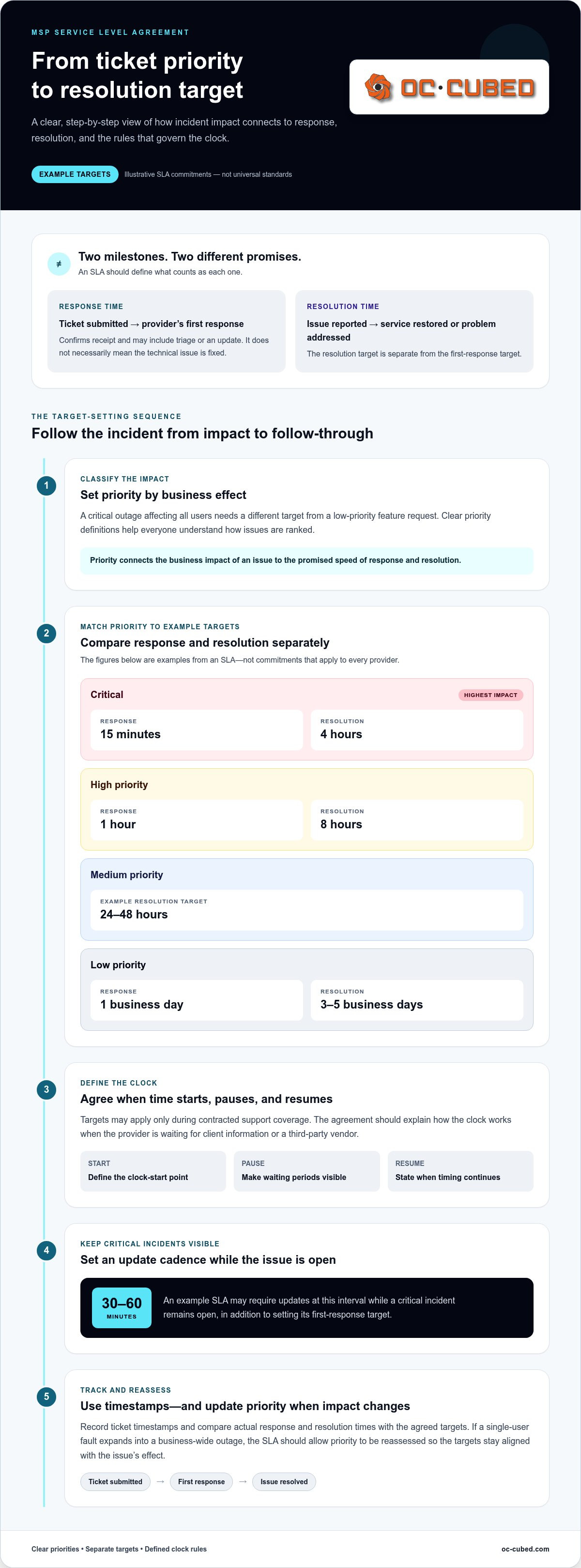
An MSP service level agreement should set separate response and resolution targets for each ticket priority. For example, a critical incident might have a 15-minute response target and a 4-hour resolution target.
Targets by Ticket Priority
Ticket priority connects the business impact of an issue to the speed of the promised response and resolution. A critical outage affecting all users needs a different target from a low-priority feature request. An example SLA may set a 1-hour response for high-priority issues, while a low-priority ticket may receive a response within 1 business day. Clear priority definitions help your organization understand how issues are ranked.
Response and Resolution Metrics
Response time measures the interval between submitting a ticket and the provider’s first response; resolution time measures how long the issue takes to resolve. An SLA can record both measures by priority, then compare actual ticket timestamps with the agreed targets. For example, a report could show whether critical issues received a response within 15 minutes and resolution within 4 hours. Separate metrics make missed targets easier to identify.
Response Time Versus Resolution Time
A response confirms that the ticket has been received and may include triage or an update; it doesn’t necessarily mean the technical issue is fixed. Resolution means the service has been restored or the reported problem has otherwise been addressed. This distinction matters during a network outage: an initial reply within 30 minutes may meet the response target, while restoration follows a separate resolution goal. The SLA should explain what counts as each milestone.
Use priority examples to see how targets can differ. A managed IT SLA may set critical-issue response at 15 minutes and resolution at 4 hours. For high-priority issues, example targets are a 1-hour response and an 8-hour resolution. A medium-priority issue may have a resolution target of 24 to 48 hours. Low-priority tickets may allow 1 business day for response and 3 to 5 business days for resolution. These are examples, not universal commitments.
Check the clock rules attached to each promise. A target may apply only during contracted support coverage, while a routine request may have an initial response target of 1 business day. The agreement should define when the clock starts, pauses, and resumes, including delays while the provider awaits client information or a third-party vendor. Otherwise, two parties may calculate the same ticket differently.
For critical incidents, look for an update schedule as well as the first-response target. An SLA may require updates every 30 to 60 minutes while the incident remains open. Confirm that ticket priority can be reassessed when impact changes, such as a single-user fault expanding into a business-wide outage. That keeps the response and resolution promises aligned with the issue’s actual effect.
SLA performance reporting and monthly KPIs
Monitor an MSP SLA by comparing ticket records with contract targets, then reviewing missed commitments and patterns. Track downtime, response times, and incident resolution rates, and use the findings to address performance gaps.
Baseline Performance and KPI Selection
A baseline is a record of current service performance used to choose relevant key performance indicators (KPIs). Reviewing 6-12 months of ticket data can show how often incidents occur, how long resolution takes, and where downtime affects operations. This gives your organization a starting point for setting targets that reflect actual service needs, rather than selecting metrics that look impressive but reveal little.
Choose KPIs that connect directly to the managed services and business impact named in the contract. Response time, resolution time, ticket-resolution rates, and downtime each reveal a different aspect of service quality. For example, frequent tickets resolved quickly may still indicate a recurring system issue. Pair ticket counts with incident types to distinguish routine workload from operational risks that need attention.
SLA Performance Tracking
SLA tracking compares ticket and system records with service targets over time. Automation tools can capture timestamps and calculate response times, downtime, and resolution rates, reducing reliance on manual summaries. This helps your organization see whether missed targets cluster around a particular priority, service, or period. That pattern is more useful than a single monthly total because it shows where performance management should focus.
Monitoring also depends on consistent definitions. A ticketing process should record when an incident begins, when a response occurs, and when it is resolved. If a ticket is waiting for client information or a third-party vendor, the report should make that delay visible. Measuring the same things in each reporting period helps distinguish a one-time disruption from an ongoing service issue.
Reporting and Performance Management
Reports turn SLA records into a shared view of service delivery for the MSP and its customer. Weekly or monthly reports can show target adherence, unresolved tickets, downtime, and changes in incident volume. A monthly view helps leaders spot operational patterns, while a weekly view can surface urgent issues sooner. Choose a reporting period that matches how quickly your organization needs to act.
Use each report to connect a missed target with a follow-up action. If several incidents exceed their resolution targets, for example, record the cause, owner, and next review point. Quarterly business reviews can also examine SLA records and recurring trends. This creates a management cycle: review the evidence, agree on corrective steps, and check whether the next report shows progress.
Make reports useful to both technical and business readers. The service team may need ticket-level details, while leadership may focus on downtime and its operational impact. Include a concise summary with the supporting records, and explain any changes in measurement or scope. Consistent reporting makes comparisons fair and gives contract discussions a shared factual basis.
- Response and resolution: Compare ticket timestamps with the relevant SLA targets.
- Downtime: Record outages and their effect on business operations.
- Resolution rates: Review completed incidents and open tickets together.
- Follow-up: Assign an owner and next action for missed commitments.
If clearer reporting would help your team manage service commitments, explore monthly IT reporting as part of a practical SLA review.
How SLAs support accountability and business continuity
An SLA sets measurable service commitments and explains how performance is evaluated. A managed services agreement defines the broader relationship, including covered services, responsibilities, fees, duration, renewal, and termination. Support policies cover operational rules, such as how users report issues. Together, these documents clarify expectations, service scope, and accountability.
Support Hours and Availability
Support hours define when response targets apply, while uptime measures whether covered systems remain available. This distinction matters because 24/7 monitoring doesn’t automatically mean 24/7 technician assistance. The agreement should say whether support targets apply during business hours or around the clock, including weekends and holidays. For comparison, 99.9% uptime corresponds to about 8.76 hours of downtime per year; 99.99% corresponds to roughly 52 minutes per year.
Uptime terms should also explain scheduled maintenance and unexpected outages. A planned maintenance window, for example, may be measured differently from an unplanned outage, depending on the contract. A critical system’s uptime target should reflect its role in operations, not just a general percentage. Clear definitions help both parties interpret availability records consistently.
Customer Obligations and Support Limits
Customer obligations identify the actions needed to keep service delivery moving. A response or resolution may be delayed while the provider waits for access, approval, or information. The agreement should explain how users report problems, who can authorize changes, and how quickly the customer team should respond. For example, a ticket awaiting required account access should record that dependency.
Scope limits matter, too. The agreement should identify covered hardware, software, systems, and duties, along with exclusions and third-party dependencies. If a vendor controls part of a system, define how the MSP communicates about and escalates incidents. These details help distinguish a missed service commitment from work outside the agreed scope.
An SLA supports accountability by linking a service promise to a measurable target and a defined review process. The agreement should explain how unresolved issues are escalated, who updates the customer team, and what happens when a target is missed. For a business-wide outage, named contacts and clear communication roles reduce confusion. If a delay depends on a third-party vendor or customer information, the document should explain how that affects expectations.
Business continuity also depends on recovery expectations, not uptime alone. For key data, an example recovery point objective is under 1 hour; for critical services, an example recovery time objective is under 4 hours. These measures address how much data the organization may need to restore and how quickly a service should return. Keep them distinct from response targets, which measure the initial acknowledgement of an incident.
Termination and transition terms determine how the relationship can end and what follows. An MSP contract may allow termination for contract breaches, unsatisfactory service, or significant changes in business needs. Some agreements provide 30 to 90 days for the provider to address problems before termination. Review early-termination clauses, required notice, and any associated fees or penalties before signing.
Plan the exit process in the same document. Define how the organization receives its data, credentials, system records, and other required materials, and who supports the transition. Some contracts allow an exit through a predefined buyout fee. If service repeatedly falls short, document each instance against the agreed terms. A clear record supports a fact-based review of remedies, transition responsibilities, and exit costs.
Legal clauses, liability, and termination
Remedies depend on the contract: an SLA may tie missed targets to service credits of 5% to 20% of monthly fees. Red flags include unclear scope, undefined change approvals, or termination terms that omit notice and exit responsibilities.
Payment and Agreement Changes
Payment terms define when charges are due and how they relate to the covered services. This matters because your organization needs to understand what happens if services or business needs change. The agreement should explain its duration, renewal process, payment schedule, and any conditions that affect charges. Contract proposals may use initial terms of 12 months, 24 months, or 36 months.
Changes should follow a written process that identifies who can approve amendments and when they take effect. Adding a system to the service scope, for example, should document revised responsibilities and any payment impact. Clear approval steps prevent informal requests from becoming disputed commitments. Keep signed changes with the main agreement so both parties can refer to the same terms.
Termination Clauses and Exit
Termination clauses define when either party may end the agreement and what notice or cure process applies. They matter because an organization needs a workable path if service falls short or its needs shift. A contract may permit termination for breach, unsatisfactory service, or significant business changes. One example allows 30 to 90 days for the provider to address problems before the agreement ends.
Review early-termination clauses for required notice, fees, and transition duties. Some contracts allow a customer to exit by paying a predefined buyout fee. The document should also explain how data, credentials, and system records are returned, and who supports the handoff. Record service failures against specific contract commitments to support a clear exit discussion.
Remedies for Missed Targets
Remedies define what happens after a measurable SLA commitment is missed. They matter because a target without a stated response to non-compliance can leave both parties uncertain. An agreement may tie service credits to missed targets using a range of 5% to 20% of monthly fees. It should state how the credit is calculated, which targets qualify, and how a customer claims it.
Service credits are one possible remedy, not an automatic result of every delay. The contract should distinguish a missed target from a delay caused by waiting for a third-party vendor or client information. It can also define escalation steps and a review process for recurring failures. This makes the remedy specific and measurable, rather than a general promise to improve.
Risks and Red Flags
Red flags are terms that leave important responsibilities, remedies, or exit conditions unclear. Ambiguity can weaken accountability when a dispute arises. Look for vague service scope, no approval process for changes, undefined liability, and termination language that omits notice or transition duties. A contract that promises service levels without explaining how they are measured also makes performance difficult to evaluate.
Review liability and indemnification language alongside data-protection duties. The agreement should define how sensitive data is protected and what happens if a breach occurs. It should also address third-party claims that may arise in legal disputes. Before signing, compare each commitment with its remedy, identify who approves changes, and confirm that the termination terms explain the practical steps for ending the relationship.
Negotiating service levels, payments, or an exit
A managed services agreement works best when its commitments match your organization’s operating needs. Use negotiations to align service targets, payment terms, and exit conditions before they become contract obligations. An MSP may offer standard terms, but you can discuss how the scope, measures, and review process fit your priorities. Put every agreed change in writing.
Start with the business impact of each service. Identify which systems interrupt core operations when unavailable, who needs support, and when coverage matters. Then connect those needs to priority definitions, response and resolution targets, uptime measures, and reporting. A critical service used across the organization may justify a tighter target than a routine request. Do not negotiate a target without considering how it is measured and when support is provided.
Set realistic goals. A service provider should not promise “five 9s” if that uptime level is not achievable for the covered environment. Ask how the managed service provider measures uptime, excludes scheduled maintenance, and reports downtime. If a target depends on a third-party vendor or customer action, define how those dependencies affect the commitment. The clause should make the promise testable using records both parties can review.
Payment terms should correspond to the documented scope and service obligations. Clarify what recurring charges cover, how added services affect the agreement, and when payment is due. If service credits apply after a missed target, define the qualifying event, calculation method, claim process, and timing. The clause should also state whether a credit is the sole remedy or applies alongside other remedies in the contract.
Negotiate the exit before a dispute arises. Review termination conditions, required notice, early-exit charges, and transition responsibilities. If the managed service ends, specify how the provider returns business data, credentials, and system records. Document who supports the handoff and how open incidents are handled. These terms help protect continuity if the relationship changes.
Keep a specific record of negotiations. Document the meeting date, participants, each proposed change, and the final decision. For example, record whether a revised response target applies only during contracted support coverage or also on weekends and holidays. Attach approved changes to the agreement, identify who authorized them, and set a review point for assessing performance against the revised terms.
Use a written agenda to keep discussions focused:
- Service levels: Match priorities and targets to business impact.
- Measurement: Define how uptime, downtime, and ticket outcomes are recorded.
- Payments: Tie charges and credits to clearly described services and events.
- Exit: Record notice, transition duties, data return, and applicable fees.
Prepare to negotiate service levels with a clear view of your operational priorities.
OC Cubed - Your trusted MSP: Remote IT Support
OC Cubed - Your trusted MSP helps businesses put clear, dependable IT support behind their service expectations. Its Remote IT Support can address day-to-day technology issues, while Microsoft 365 Tenant Maintenance supports the upkeep of your Microsoft 365 environment. Security Threat Detection and Remediation and Endpoint Protection / Antivirus help businesses manage security risks.
OC Cubed provides remote IT support, helpdesk and NOC integration, network monitoring, and security services for businesses. Clear scope, responsibilities, and performance expectations help both sides understand how the relationship should work. Use the principles in this guide to frame a conversation about your operational priorities and the support your organization needs.
Contact OC Cubed - Your trusted MSP to discuss your IT support needs.
Put Your IT Commitments to Work
Understanding your MSP service level agreement is an ongoing management practice, not just a signing-day task. As your organization changes, revisit whether the IT relationship still supports its priorities. Clear commitments can guide useful conversations about service, accountability, and future needs.
When you need support putting those priorities into practice, OC Cubed - Your trusted MSP offers Remote IT Support, Microsoft 365 Tenant Maintenance, and Security Threat Detection and Remediation. These services can help address day-to-day support needs, maintain your Microsoft 365 environment, and manage security threats.
Take the next step by discussing how OC Cubed’s IT support can align with your organization’s goals.
A thoughtful agreement gives your team a clearer foundation for moving forward with confidence.
Frequently Asked Questions
What should a managed services agreement include?
A managed services agreement should define the services, responsibilities, payment terms, contract duration, renewal, and termination conditions. It should also identify the systems covered and explain how service orders or project work relate to the ongoing arrangement. For example, a business planning a cloud migration can use a separate statement of work to define project deliverables and timelines without confusing them with routine managed support.
What Are SLAs and Why Do They Matter?
A service level agreement (SLA) documents measurable service commitments and explains how performance will be evaluated. It matters because both parties can refer to shared expectations instead of relying on informal assumptions. For example, an organization can use its SLA to distinguish a covered service failure from a request outside the provider’s scope. This clarity supports focused discussions about performance and operational needs.
Am I Bound to My Contract with My MSP?
Yes. Signing an MSP agreement binds the parties to its terms and conditions. Before signing, review the full contract, including referenced schedules, statements of work, renewal language, and any incorporated SLA. For example, a service target in an attachment may apply alongside payment or termination terms in the main agreement. Keep the signed version and approved amendments together so your team can identify the current commitments.
How Does an SLA Work in Real Life?
An SLA guides how a service issue is classified, handled, measured, and reviewed. For example, a new employee unable to access a business system may submit a ticket, while a manager tracks its progress and reviews the eventual report. If the issue reveals a broader access-control gap, the organization can discuss that pattern during a service review rather than treating each ticket as an isolated event.
How are SLAs used by managed service providers?
Managed service providers use SLAs to organize service delivery and assess whether their work meets agreed commitments. They can use ticket records to identify recurring issues, then assign follow-up work to the appropriate technical or management team. For example, repeated incidents involving one application may prompt a review of its support process. The SLA also gives the provider and customer a shared reference for service-planning discussions.
How long does a managed IT services contract last?
Managed IT service contracts can last from a few months to several years. Proposals may use an initial term of 12 months, 24 months, or 36 months. The right term affects how long the organization commits before renewal or termination options apply. Read the renewal language with the initial term, and note when notice must be given to prevent an unwanted extension.
What happens if your MSP misses SLA targets?
The contract determines the remedy when an MSP misses an SLA target. Depending on its terms, the response may include a service credit or another defined corrective process. Record the affected service, incident details, and relevant ticket history, then follow the contract’s claim and escalation procedure. Also review whether the target qualifies for a remedy and whether an agreed exception affected how the service was measured.
What is an SLA?
An SLA, or service level agreement, is a document that sets service commitments and explains how the parties measure performance. It may stand alone or form part of a broader managed services agreement. Understanding your MSP service level agreement means seeing how its targets connect to actual services, reporting, and remedies. For instance, a target has practical value only when the agreement defines which service it covers.

Article by
Peter Irizarry
Peter Irizarry founded OC Cubed, LLC in 2023 to help small to mid-sized businesses stop worrying about downtime and cybersecurity threats. A frequent speaker on SMB digital transformation, Peter is passionate about translating complex IT roadmaps into plain-English business growth strategies. He resides in North Texas with his family.


