

The strongest MSP contract isn’t the longest; it’s the one that clearly defines responsibilities and costs. To understand what should be in an MSP contract, look for written details about covered services, each party’s responsibilities, fees, contract duration, renewal, and termination. The agreement should also explain how service commitments and project work are documented.
It’s reasonable to focus on the monthly fee, but the details behind it matter just as much. Clear client and provider contacts, covered locations, payment terms, start and end dates, and renewal rules help prevent misunderstandings before support begins. This guide explains what a managed services agreement covers, how it differs from an MSA, SLA, and SOW, and what to review in its scope, fees, service terms, and exit process. Use it as a practical framework for understanding the agreement and spotting clauses that affect day-to-day IT support.
Key Takeaways
- Understand how renewal, cancellation notice, early termination fees, and data ownership affect your options when an agreement ends.
- Clarify which IT services and systems are covered, how support requests are handled, and who is responsible for security, recovery, and transition tasks.
- Distinguish the agreement’s purpose from an MSA, SLA, and SOW so the scope, service commitments, and project details are clear.
- Review the recurring fee alongside exclusions, extra charges, payment timing, and late-payment terms to understand the full cost structure.
- Make sure the contract accurately identifies business contacts, covered locations, term dates, and renewal terms; connect support needs with relevant services such as OC Cubed’s remote IT support.
1. Rules of Termination: What Does the Process of Termination Look Like?
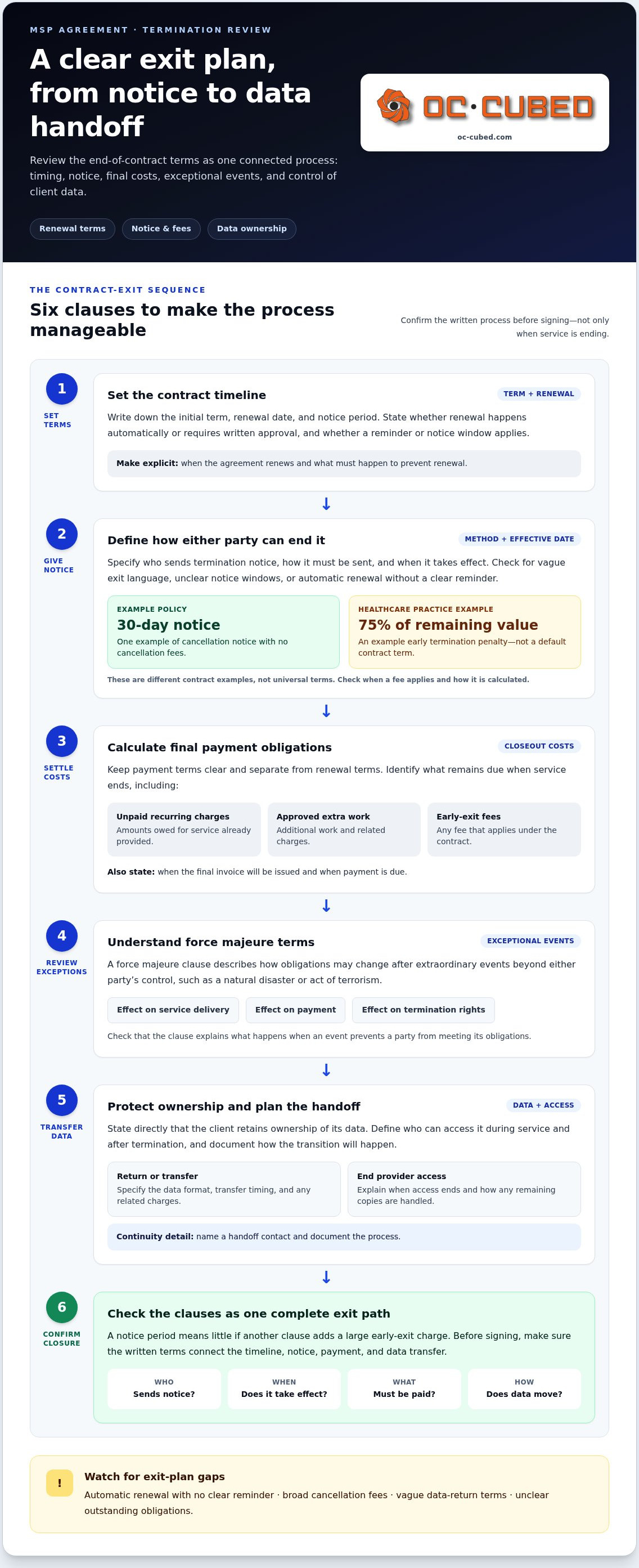
Before signing, define how the agreement renews, how either party can end it, and what happens to client data. Document the initial term, renewal date, notice period, and method for sending termination notice. For example, state whether the contract renews automatically or requires written approval. Clear terms give both parties a practical timeline and reduce disputes about whether the agreement remains active.
Read the cancellation terms closely. A 30-day cancellation notice is one example of a policy without cancellation fees. By contrast, a healthcare practice example describes an early termination penalty of 75% of the remaining contract value. These are different contract examples, not default terms. Check how the agreement defines early termination, when a fee applies, and how any amount is calculated. A fee based on remaining value can create a substantial commitment even when services stop.
Watch for automatic renewal without a clear reminder or notice window, broad cancellation fees, and vague data-return terms. Also review any termination clause that lets a party exit without explaining the process or settling outstanding obligations. These gaps can leave a business facing unexpected charges, continued service commitments, or uncertainty about access to its records.
Payment terms should explain what remains due when the agreement ends. Identify unpaid recurring charges, approved extra work, and any fees for ending the agreement early. State when final invoices will be issued and when payment is due. Keep these terms separate from renewal language: a contract can renew automatically while payment obligations from the previous service period remain outstanding.
A force majeure clause defines how contractual obligations may change after extraordinary events beyond either party’s control, such as a natural disaster or act of terrorism. Check how the clause affects service delivery, payment, and termination rights. It should explain what happens when an event prevents a party from meeting its obligations, rather than leaving the response open to interpretation.
Data ownership needs direct wording. The client should retain ownership of its data, and the agreement should clarify who can access it during service and after termination. Specify how data will be returned or transferred, provider access ended, and remaining copies handled. Put the transfer format, timing, and any related charges in writing. A named handoff contact and documented process help maintain continuity when the relationship ends.
Before signing, compare the termination, payment, renewal, and force majeure clauses as a set. A 30-day notice period means little if a separate clause imposes a large early-exit charge. Confirm that the written process explains who sends notice, when it takes effect, what must be paid, and how data moves. Clear terms make the end of the relationship manageable, not a new source of uncertainty.
2. What is a Managed Service Provider Agreement?
A managed services agreement defines the ongoing relationship between a business and its IT service provider. It sets out covered services, shared responsibilities, fees, duration, renewal, and termination. For day-to-day operations, it should also identify supported systems and tasks outside the provider’s scope. A written scope prevents assumptions, such as believing that every application or location receives support.
Make responsibilities specific. The provider’s duties might cover named systems, security protocols, and support request handling. The business’s duties might include maintaining agreed equipment standards, sharing access details, and notifying the provider about material changes. Document minimum standards for patches, operating systems, hardware, and applications. If an older system falls outside those standards, explain how that affects coverage.
Service-level terms translate the scope into practical expectations. They should define support hours, issue priorities, response targets, escalation steps, and any resolution commitments. An illustrative target is a 30-minute initial response during contracted coverage for a critical business-wide outage affecting a covered core system. Other examples include one hour for a high-priority disruption, four business hours for a normal-priority issue, and one business day for a routine request. These are examples, not universal service standards.
Define the difference between response and resolution. Response describes when the provider acknowledges or begins assessing a request; resolution describes when the issue is fixed or an agreed workaround is in place. The agreement should explain how employees submit tickets, what information to provide, and how unresolved issues are escalated. A sample SLA might set a four-hour response for non-critical issues, but the contract must specify the applicable hours and priority.
Support availability also needs precise wording. Continuous monitoring does not automatically mean every support request receives 24/7 technician assistance. State whether requests outside normal hours are accepted, how urgent incidents are routed, and which service commitments apply then. For security events, document the breach notification process, investigation responsibilities, and coordination steps. The agreement should also clarify backup ownership, restoration responsibilities, recovery expectations, and the client’s role in supplying access or decisions.
Finally, define transition duties before an incident or contract change occurs. Clarify who provides data, system records, credentials, and configuration details during handoff, and how access is removed when appropriate. A business reviewing its security coverage can also explore security threat detection and remediation as part of its managed IT approach.
3. Managed services agreement, MSA, SLA, and SOW differences
A managed services agreement describes the ongoing relationship, while related documents may spell out its details. The MSA sets overarching terms such as payment rules, confidentiality, liability, and dispute procedures. The SLA defines measurable service commitments and how performance is assessed. A statement of work, or SOW, describes specific services or project work, including scope, deliverables, responsibilities, pricing, and timelines. Check how the documents fit together and which terms prevail if they conflict.
Consider a business adding a new location. The MSA may establish the general relationship, while an SOW records the setup tasks, deliverables, and pricing for that location. The SLA can explain which service targets apply after onboarding. Before work begins under an MSA, the SOW should document the agreed project. This structure separates continuing managed services from a particular implementation or change.
Scalability depends on clear change procedures. The agreement should explain how adding users, locations, devices, or applications changes the covered scope and billing. It should also outline offboarding steps when an employee leaves, including access removal and responsibility for company equipment. For example, define who submits a user change, what information is needed, and when service records are updated. This prevents informal requests from silently expanding or reducing the work.
Give inclusions and exclusions equal attention. Name the covered systems, support tasks, and security measures, then identify work handled separately. Reporting should show how the provider measures performance against agreed KPIs, records service activity, and communicates unresolved issues. Define escalation paths and remedies for missed commitments, such as a corrective action process or another remedy agreed by both parties. A measurable target is useful only when both sides understand how it is tracked.
For HIPAA, PCI DSS, or CCPA, identify which requirements apply to the business and its data. Then document each party’s security responsibilities, relevant controls, reporting process, and evidence needed to demonstrate those controls. Don’t rely on the name of a framework alone; connect specific provider tasks to the systems and information in scope.
A template can organize these terms, but it should be adapted to the business’s services, systems, and operating needs. Review confidentiality clauses alongside data access and reporting terms so protections match the work being performed. Confirm that each document uses consistent definitions for covered services, performance measurements, and billing. This alignment makes the managed services agreement easier to apply when services change or a project is added.
4. Pricing, payment frequency, and additional fees
A clear pricing section links the recurring charge to defined services, covered users, systems, and locations. It should explain billing frequency, invoice date, payment method, and how scope changes are handled. For example, if a business adds users or a location, the agreement should state how billing changes and when revised charges begin. This makes the financial relationship easier to manage as operations change.
Separate included work from work billed outside the monthly fee. The agreement should outline excluded services, additional project work, out-of-hours support, on-site visits, and third-party costs where applicable. For each category, describe the approval process, how charges are calculated, and how the work appears on an invoice. If an upgrade or migration requires a separate SOW, document its scope, deliverables, timeline, and pricing before work starts.
Service-level and billing terms should align. If support hours differ by issue priority, state which service commitments apply during each period and whether work outside normal operating hours carries a separate charge. Define when a request becomes billable work, who approves it, and how the provider records time or deliverables. A monthly report can link completed work and service performance to the charges on the corresponding invoice.
Payment timing needs exact wording. One sample payment clause makes the monthly service payment due by the first day of the month for that month of service. Another sample clause applies interest when service or item charges remain unpaid for fifteen (15) days, at 12% per annum. These are example terms, not universal requirements. The agreement should state the actual due date, any applicable late-payment process, and how disputed invoice items are handled.
Also read what happens after a missed payment. A sample MSA clause gives five (5) business days’ notice of late payment before on-site and remote service are put on hold. The document should explain how notice is delivered, which services may pause, and what happens to urgent issues during a suspension. Keep these consequences distinct from termination fees, so a payment delay does not create confusion about whether the contract has ended.
Renewal can change the financial terms, so the agreement should state when pricing may be revised and how notice will be given. Identify whether renewal changes the recurring fee, service scope, or additional-charge schedule. Compare the renewal clause with the billing section and any attached SOW. This final review helps confirm that the invoice reflects agreed work, not an unclear scope change or unapproved charge.
5. Client details, contacts, locations, payment terms, and contract duration
A services contract starts with accurate client details. Record the business’s full legal name, primary contact, contact information, and covered locations. Include the managed service provider’s corresponding business and service contacts. Listing only a general mailbox can slow approvals or incident escalation. Name who can authorize changes, report issues, and receive notices so each party knows where operational decisions belong.
Specify locations clearly. Identify every office or site included, then connect each to its covered systems and services. If a business adds a branch, the agreement should explain how to update the location list and assess any scope or billing change. Don’t assume a newly acquired office receives the same support automatically. A written change process keeps expectations aligned as the business footprint shifts.
Set out the contract’s start date, end date, initial term, and renewal method. Managed IT services agreements may use an initial term of 12 months, 24 months, or 36 months. These are possible structures, not a required standard. State whether renewal happens automatically or requires written consent, and explain how renewal affects the service scope and pricing. A dental practice example describes negotiating a 90-day trial period, illustrating another term businesses may discuss.
Payment terms should identify the billing contact, invoice recipient, payment method, due date, and process for disputing charges. Keep these details consistent with the pricing section and any attached service documents. If billing responsibility changes, specify how the new contact is recorded and when notices take effect. This prevents an invoice or renewal notice from going to someone who no longer manages the account.
Contact roles also affect issue resolution. Identify who can report a service issue, approve changes, and make decisions during an escalation. For example, a named business contact can route a critical incident to the right internal decision-maker, while a separate finance contact receives invoices. Clear roles prevent the provider from assuming that every employee can authorize extra work or contractual changes.
Before signing, compare the client name, locations, contacts, dates, and payment details across the main agreement and its attachments. Correct mismatches before they cause confusion about service coverage or liability. Keep an updated copy when an authorized contact or location changes. The takeaway is simple: precise administrative details make a contract usable, not merely complete.
OC Cubed - Your trusted MSP: Remote IT Support
OC Cubed - Your trusted MSP helps businesses put managed IT support into practice through remote IT support and related security services. If your agreement needs clear ownership for Microsoft 365 maintenance, endpoint protection, or security threat detection and remediation, align those responsibilities with the support your business needs. Defined coverage, escalation paths, and reporting make it easier to understand how ongoing support fits your operations.
Turn to OC Cubed when your business needs remote IT assistance or a coordinated approach to maintaining systems and reducing security risks. The right agreement should clearly define those responsibilities, including the systems covered and how support requests are handled.
Contact OC Cubed, your trusted MSP, to discuss your business’s IT support needs.
Put Your MSP Agreement to Work
Knowing what should be in an MSP contract gives you a foundation for clearer decisions, but its value comes from putting it to use. Treat the signed agreement as a working reference for budget discussions, internal planning, and changes in business priorities. Give the right people access to the current version so expectations stay consistent across teams.
As your organization changes, use its priorities to guide conversations about support and future needs. A contract should help decision-makers connect IT responsibilities with the work the business depends on. That makes it easier to raise concerns early, align stakeholders, and keep the relationship focused on practical outcomes.
OC Cubed, your trusted MSP, helps businesses align ongoing IT support with their operational needs. Contact OC Cubed when you’re ready to discuss how its remote support can fit your organization.
Clear decisions start with shared understanding. Keep moving forward with confidence.
Frequently Asked Questions
What is a Managed Service Provider Agreement?
It’s the written framework for managing an ongoing IT support relationship. Beyond defining services, it can establish a process for recording changes, approving new work, and resolving operational disagreements. For example, if a business adopts a new application, the agreement’s change process can establish who assesses it, how support coverage is decided, and where the updated scope is documented.
How long does a managed IT services contract last?
The contract lasts for its stated initial term, followed by any renewal period described in the agreement. The appropriate length depends on the business’s planning needs, the services involved, and the flexibility required if operations change. A company preparing for a major technology transition may weigh its commitment differently from one seeking continuity for established systems. Read the renewal language alongside the notice and exit terms.
Checklist: What Should Be in an MSP Contract?
Use a review checklist that follows the agreement from setup through daily operations: confirm the parties and authorized contacts; match covered systems and locations to actual business needs; identify excluded work; document security, data access, and incident handling; and compare service targets with reporting methods. Then review invoice approval, change control, renewal, and exit procedures. Make sure attachments use the same definitions as the main agreement.
Confidentiality: How Is Your MSP Protecting Your Information?
Look for written confidentiality terms explaining who may access business information, why access is allowed, and how the information is protected. The agreement should address permitted use, disclosure restrictions, incident notification, and information handling when work ends. For example, clarify whether subcontractors can access records and what protections apply to them. Also define how data is returned or securely disposed of after its business purpose ends.
How can I ensure my IT provider is held accountable under the contract?
Make performance observable. Assign each service target a measurement method, reporting owner, and review process. For example, a monthly service report can distinguish open issues from resolved requests and show recurring causes that need follow-up. Establish a process for raising missed commitments, recording the provider’s response, and agreeing on corrective actions. Keep meeting notes and approved changes with the contract documents so expectations remain traceable.
Liability: Who Is Liable for What?
Liability depends on how the contract allocates responsibilities, limits, exclusions, indemnification terms, and remedies. Read those clauses together rather than treating a general liability cap as the whole answer. For example, compare responsibility for protecting credentials with responsibility for reporting a suspected breach. Confirm that the agreement explains how claims are raised, what notice is required, and which losses or circumstances the clauses address.
MSA vs SOW vs SLA: What’s the Difference?
An MSA sets shared terms for the business relationship; an SOW describes specific purchased work; an SLA defines service performance commitments. For example, in a network change project, the MSA governs general terms, the SOW records project deliverables, and the SLA covers applicable ongoing support measures. Check how the documents interact, especially if an SOW changes the scope or an SLA contains an exception.
Rules of Termination: What Does the Process of Termination Look Like?
Termination follows the notice, payment, and transition steps written into the agreement. In addition to sending notice correctly, assign an internal owner to coordinate the exit. That person can track outstanding invoices, collect essential system records, arrange access changes, and validate transferred data before closing accounts. A written handoff record helps show what was delivered, which access was removed, and what unresolved work remains when service ends.

Article by
Peter Irizarry
Peter Irizarry founded OC Cubed, LLC in 2023 to help small to mid-sized businesses stop worrying about downtime and cybersecurity threats. A frequent speaker on SMB digital transformation, Peter is passionate about translating complex IT roadmaps into plain-English business growth strategies. He resides in North Texas with his family.


