

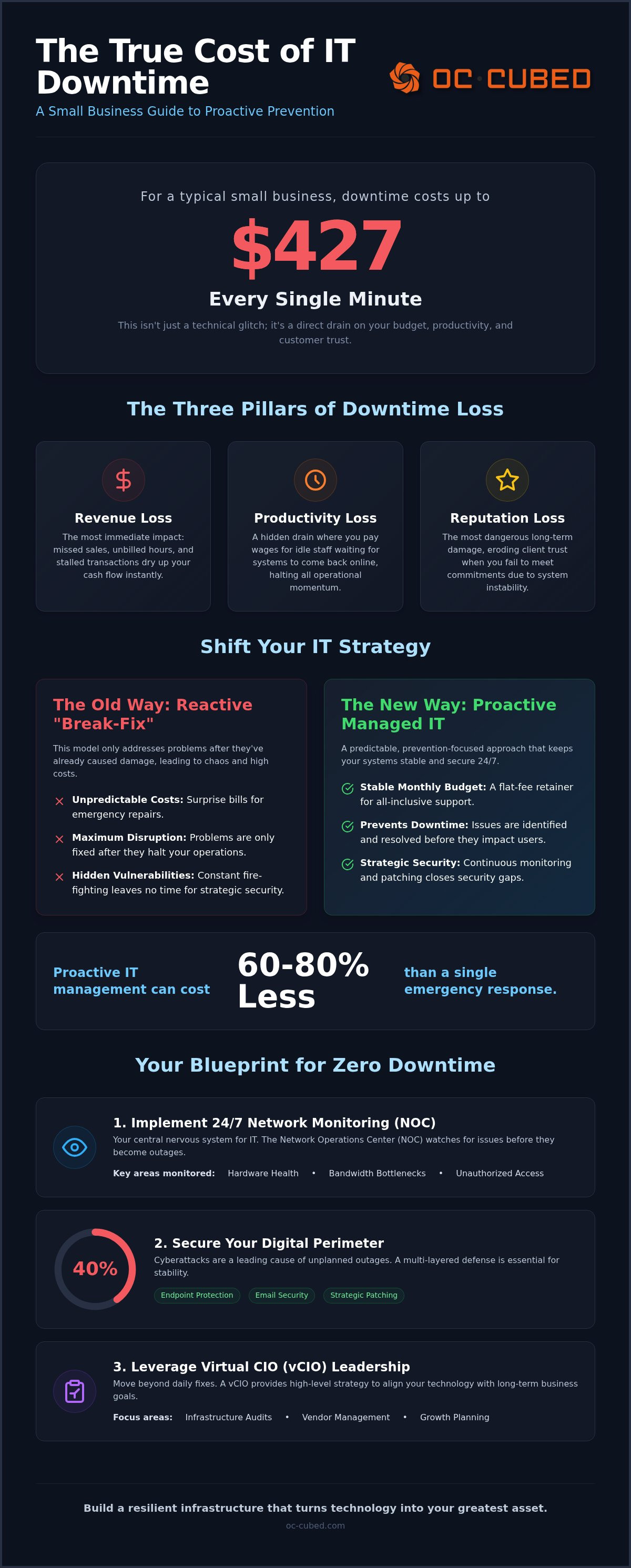
For a typical small business in 2026, IT downtime can cost as much as $427 every single minute. That is not just a technical glitch. It is a direct drain on your monthly budget and your team's ability to perform. If you have ever watched your staff sit idle while waiting for a server to reboot, you know that reactive fixes are far too expensive. Unexpected bills and hidden security vulnerabilities should not be the cost of doing business.
We understand that you want a stable, predictable environment where technology just works. Mastering how to prevent IT downtime small business operations suffer from is the first step toward reclaiming your peace of mind. This guide provides the exact steps to eliminate technical disruptions and build a resilient infrastructure that keeps your operations running around the clock. We will cover everything from remote network monitoring to strategic vCIO oversight. You will learn how to transform your technology from a source of constant anxiety into a high-ROI engine for growth.
Key Takeaways
- Shift from a reactive "break-fix" model to a predictable managed IT retainer to stabilize your monthly budget and eliminate surprise repair costs.
- Utilize 24/7 network monitoring and NOC integration to identify and remediate technical glitches before they impact employee productivity.
- Build a multi-layered digital perimeter using endpoint protection and email security to defend against the cyberattacks that cause 40% of unplanned outages.
- Leverage Virtual CIO leadership to audit your infrastructure for single points of failure and align your technology with your long-term business goals.
- Learn the exact steps for how to prevent IT downtime small business operations suffer from by building a resilient, proactively maintained infrastructure.
The Real Cost of IT Downtime for Modern Small Businesses
IT downtime occurs whenever your critical systems are unavailable to support business operations. It is not just a technical glitch; it is a full stop for your company. When your network fails, your revenue streams dry up instantly. Your staff remains on the clock, but their productivity vanishes. This gap between operational costs and zero output creates a financial vacuum that many small firms struggle to survive. Understanding how to prevent IT downtime small business owners deal with starts with recognizing that technology is no longer a background tool. It is the foundation of your service delivery.
The "Three Pillars of Loss" categorize the damage into revenue, productivity, and reputation. Revenue loss is the most visible, consisting of missed sales and unbilled hours. Productivity loss is often a hidden drain, as you continue to pay wages while employees wait for a reboot. Reputation loss is the most dangerous. It represents the long-term erosion of client trust that occurs when you cannot meet your commitments. Most businesses experience these losses because they rely on a "break-fix" model. This reactive approach ensures that you only address problems after they have already caused damage. Transitioning to remote IT management services shifts your focus from recovery to prevention. It allows for constant surveillance that identifies failures before they halt your workflow.
Calculating Your Hourly Downtime Cost
To understand the true ROI of proactive IT, you must calculate what an outage actually costs your specific business. Use this formula: (Lost Revenue + Wages Paid During Outage + Recovery Costs). In 2026, industry data shows that for a typical SMB, IT downtime can cost anywhere from $137 to $427 per minute [verify]. These numbers add up to thousands of dollars in less than an hour. Effective Business continuity planning serves as a strategic investment that ensures your technology spend protects your bottom line rather than draining it.
The Long-Term Impact on Customer Trust
Digital reliability is now a core part of your brand identity. When your systems fail, you signal to your clients that your business is unstable. Small businesses are particularly vulnerable to this reputational damage. Unlike large corporations, a small firm rarely has the marketing budget to buy back the trust lost during a service failure. System instability also creates security vulnerabilities. A network that crashes frequently is often a network with unpatched software and weak defenses. This instability increases the risk of data breaches, which can lead to permanent business closure. High uptime is not just a technical goal; it is a commitment to your customers that you are a dependable partner.
Implementing Proactive Monitoring and NOC Integration
A Network Operations Center (NOC) acts as your central nervous system. It provides 24/7 surveillance of every server, switch, and endpoint in your environment. Most small businesses wait for a screen to go dark before calling for help. Proactive monitoring changes that dynamic. By integrating NOC services, you move from reactive alerts to automated remediation. This means the system identifies a failing hard drive or a memory leak and fixes it before you even notice a slowdown. It's the most reliable method for mastering how to prevent IT downtime small business owners face daily.
Strategic patching is a critical component of this surveillance. Unpatched software is a massive liability. Keeping systems updated prevents a majority of common technical failures by closing known vulnerabilities. This process ensures your Microsoft 365 tenant and local hardware remain secure. Proper Cybersecurity for Small Business starts with these basic hygiene steps. When you automate these updates, you eliminate human error. Proactive IT management often costs 60-80% less than reactive emergency responses because you avoid the chaos of a total system collapse.
What 24/7 Network Monitoring Actually Watches
Effective monitoring goes beyond checking if a device is "on." It analyzes the performance metrics that signal an impending crash. Our team focuses on three critical areas:
- Hardware health: We track temperature, fan speeds, and disk usage to predict server or switch failure before it happens.
- Bandwidth bottlenecks: Identifying traffic spikes allows us to resolve the congestion that slows down your operations.
- Unauthorized access attempts: We monitor for unusual login patterns that indicate the early stages of a security breach.
Real-time switch management and firewall oversight ensure that your network traffic flows without interruption. This level of detail keeps your infrastructure stable and your team productive.
Helpdesk and NOC Integration: The Feedback Loop
Integration creates a seamless flow of information between the monitoring team and the support desk. When the NOC detects an anomaly, the helpdesk already has the diagnostic data needed to resolve it. This synergy significantly reduces your "Mean Time to Repair" (MTTR). Instead of starting from scratch when you call, our team uses remote diagnostic tools to apply a fix immediately. This provides a single point of accountability for your entire infrastructure. You don't have to manage multiple vendors or guess who is responsible for a fix. A unified approach is the most effective way to understand how to prevent IT downtime small business systems encounter. If you are ready to stabilize your network, consider our Network Monitoring and Configuration services to get started.
Securing Your Digital Perimeter: Cybersecurity as Prevention
Cybersecurity incidents are currently the leading cause of unplanned downtime. Ransomware alone accounts for 40% of these events. For a small business, a single breach can paralyze operations for days. We view security not just as a compliance checkbox, but as a critical uptime strategy. A "Defense in Depth" approach creates multiple layers of protection. This includes firewalls, email filtering, and endpoint security. These tools work in unison to stop threats before they disrupt your workflow.
Many owners overlook Microsoft 365 tenant maintenance as a specific risk. Account takeovers can lock your team out of essential files and communication channels instantly. We provide active management of these cloud environments to prevent unauthorized access. Additionally, our email security with Proofpoint intercepts sophisticated phishing attempts before they reach an employee's inbox. This proactive stance is essential for mastering how to prevent IT downtime small business systems encounter in 2026.
Endpoint Protection vs. Standard Antivirus
Traditional antivirus relies on static signatures. Modern threats evolve faster than those databases can update. We implement Endpoint Detection and Response (EDR) to monitor behavior in real-time. This provides 24/7 threat detection and remediation. If a device acts suspiciously, the system isolates it immediately. This containment prevents a single infected laptop from taking down your entire network. It provides the quiet authority of knowing your endpoints are guarded against zero-day exploits.
Managed Firewall and Switch Management
Your firewall is the gatekeeper of your network. It requires regular firmware updates to defend against new exploit methods. Without managed oversight, these updates often lag. This leaves the gate wide open for intruders. Switch management is equally vital. A misconfigured switch can create internal network loops. These loops crash your connectivity just as effectively as an outside attack. Remote configuration allows us to maintain a secure perimeter and resolve internal traffic issues without delay. This integrated approach ensures your digital borders remain firm. It is a fundamental part of how to prevent IT downtime small business operations need to stay online and profitable.
The Strategic Approach: Virtual CIO and Vendor Management
Technical tools are only one part of a resilient infrastructure. You can install the most advanced monitoring software available, but it cannot fix a fundamentally flawed strategy. High-level planning is the foundation of how to prevent IT downtime small business operations struggle with as they scale. A Virtual CIO (vCIO) steps in to provide this missing layer of executive insight. They transform your IT from a reactive expense into a strategic asset that supports your long-term vision.
Strategic roadmapping ensures you are never surprised by hardware failure or software obsolescence. Your vCIO analyzes your current environment and identifies where your infrastructure is lagging behind your business goals. By looking three to five years ahead, they help you avoid the "emergency" purchases that often lead to rushed, unstable configurations. This is the most effective way to master how to prevent IT downtime small business owners face when their legacy systems finally reach their breaking point.
Fractional Leadership for Small Business
You gain access to executive-level IT direction without the burden of a full-time C-suite salary. This fractional leadership aligns your technology investments with your actual growth targets. Your vCIO takes the lead on business continuity planning, ensuring your team knows exactly what to do if a disaster occurs. This level of preparation turns potential catastrophes into manageable events. It provides the quiet confidence that your business can survive any technical challenge.
Streamlining Vendor Relations
Third-party service failures are a common source of unplanned outages. When your internet connection drops or a cloud service lags, your team shouldn't waste hours on hold with support. Vendor management means we handle those conversations for you. We act as your single point of contact, letting you focus on running your business while we resolve the issue with the service provider. We also work to consolidate your technology stack. Reducing the number of disparate systems in your office naturally reduces the number of potential points of failure.
Monthly reporting provides the data needed to make these strategic decisions. We track the performance and age of every piece of equipment on your network. This allows us to identify and phase out "at-risk" legacy hardware before it has the chance to fail. We manage your software licenses to ensure you never face a service interruption due to an expired subscription. Predictive replacement is far cheaper and much less stressful than emergency recovery.
How to Transition to a Zero-Downtime Managed IT Model
Moving from a reactive "break-fix" mindset to a proactive managed model is the most effective way to secure your company's future. This transition replaces chaos with a structured, predictable system. Asking what is a managed service provider is the first question every leader should ask. A true partner doesn't just fix what is broken; they build a resilient environment that prevents failures from occurring in the first place. This shift is the definitive answer to how to prevent IT downtime small business owners must master to remain competitive.
The transition follows a logical, three-step process designed to stabilize your infrastructure immediately:
- Step 1: Audit for "single points of failure." We identify the specific hardware or software dependencies that could take down your entire operation if they fail.
- Step 2: Implement 24/7 monitoring and endpoint protection. We deploy real-time surveillance and advanced security layers to catch threats and glitches before they impact your workflow.
- Step 3: Establish a virtual project management plan. We create a roadmap for necessary upgrades, ensuring that your technology evolves alongside your business needs without causing disruption.
Eliminating Surprise IT Bills
A managed services retainer transforms your IT spending from an unpredictable capital expenditure (CapEx) into a steady, manageable operational expenditure (OpEx). You no longer have to worry about an emergency bill ruining your monthly budget. Flat-rate support aligns our interests with yours. Because we provide "all-you-can-eat" remote support, we're incentivized to keep your network running perfectly. If you stay online, we both win. This model provides the peace of mind that comes from knowing your technology costs are fixed and your uptime is guaranteed.
Your Next Steps Toward Reliability
Achieving a zero-downtime environment requires a deliberate start. You don't have to overhaul everything overnight, but you do need to begin with a clear understanding of your current risks. These steps will move you toward a more stable future:
- Schedule a comprehensive network assessment. Uncover the hidden vulnerabilities in your current setup.
- Prioritize the remediation of critical security gaps. Close the doors to ransomware and unauthorized access first.
- Contact OC Cubed - Your trusted MSP for a tailored proactive support plan. Let our team design a strategy that fits your unique business goals.
Reliability is not an accident. It is the result of a confident, results-driven strategy. By following this guide on how to prevent IT downtime small business systems can finally achieve the stability they need to grow.
Build a Resilient Foundation for Growth
Transitioning to a proactive model is the only way to eliminate the high costs and stress of sudden system failures. You have seen that downtime is not an inevitable part of doing business. It is a manageable risk that requires the right combination of 24/7 monitoring, multi-layered cybersecurity, and strategic leadership. By layering enterprise-grade tools like Proofpoint and advanced endpoint protection with fractional C-suite guidance, you protect your bottom line and your brand's reputation. Mastering how to prevent IT downtime small business operations suffer from allows you to focus entirely on your growth goals without the fear of a network crash.
Our all-inclusive monthly retainer ensures your budget remains predictable while your infrastructure stays secure. This approach provides the quiet authority of an expert team watching over your network around the clock. You don't have to navigate these technical challenges alone or settle for reactive fixes. OC Cubed - Your trusted MSP provides the steady reliability your business deserves so you can move forward with confidence.
Frequently Asked Questions
What is the most common cause of IT downtime for small businesses?
Cybersecurity breaches, specifically ransomware attacks, are the leading cause of unplanned outages in 2026. These incidents account for roughly 40% of all downtime events. Other frequent culprits include hardware failure, human error, and ISP outages. Proactive patching and employee training are the most effective ways to mitigate these risks. Maintaining a secure environment is the foundation of how to prevent IT downtime small business owners must prioritize to stay operational.
How much does IT downtime actually cost a small company?
Small businesses typically lose between $5,000 and $50,000 per hour depending on their specific industry. For a standard SMB, this averages out to roughly $137 to $427 per minute. These figures include lost revenue, employee wages paid during idle time, and the cost of emergency repairs. The true cost also involves long term reputational damage and the loss of customer trust that follows a major service interruption.
Can remote IT support really fix network outages?
Remote IT support resolves over 90% of technical issues without requiring a physical visit. Most outages stem from software glitches, misconfigured settings, or security threats that our team can address through secure remote access. If a hardware failure occurs, we use remote diagnostics to identify the exact part needed. This speeds up the repair process significantly and ensures your business returns to full capacity as quickly as possible.
What is the difference between a NOC and a helpdesk?
A Network Operations Center (NOC) focuses on the health of your infrastructure, while a helpdesk supports your people. The NOC works in the background to monitor servers and switches for stability. The helpdesk is your direct line for user issues, such as password resets or software errors. Integrating these two functions ensures that your network stays stable and your employees remain productive without the need to manage multiple vendors.
How does Microsoft 365 tenant maintenance prevent downtime?
Managed maintenance ensures your cloud environment is secure and optimized for performance. We monitor security logs to prevent account takeovers and manage software licenses to avoid service interruptions. Misconfigured tenant settings are a common point of failure that can lead to data loss or connectivity issues. Regular audits of your Microsoft 365 environment keep your team connected and your sensitive business data protected from evolving threats.
Is a Virtual CIO necessary for a business with fewer than 50 employees?
Strategic leadership is essential for any business planning to grow. Even with fewer than 50 employees, you need a roadmap to avoid expensive technical debt and security gaps. A Virtual CIO provides executive level guidance on technology investments and business continuity. This prevents the "emergency" purchasing cycles that often lead to unstable systems. It is a key part of how to prevent IT downtime small business operations face during rapid scaling.
What happens if our internet goes down while using remote IT support?
We act as your advocate by managing your relationship with the Internet Service Provider (ISP). If your primary connection fails, we work directly with the vendor to resolve the outage. We also help implement redundant connections, such as cellular backup, to keep your critical systems online. This ensures that even a local ISP failure does not result in a complete stop for your business operations or client services.
How often should a small business update its disaster recovery plan?
You should review and update your disaster recovery plan at least once a year. It is also vital to refresh the plan after any major change to your infrastructure, such as migrating to a new cloud platform or adding a satellite office. Regular testing ensures your backups are functional and your team knows their roles during an incident. This consistent oversight is what separates a resilient business from one that struggles to recover.


