

A breach shouldn’t give an attacker a clear path across your entire network. Network segmentation for security divides a network into smaller zones and controls the traffic allowed between them. This separation can limit access to sensitive systems and make it harder for threats to move laterally.
It’s reasonable to expect a firewall or endpoint protection to help defend business systems. Segmentation adds another layer of control: if one device or zone is compromised, access to other areas can still be restricted. The goal isn’t to make every system unreachable. It’s to give users and devices access to the resources they need while limiting unnecessary connections.
This article explains how network segmentation works, how it differs from microsegmentation, and what goals guide a sound design. It also explores how separating sensitive data, business systems, and operational technology can help contain threats and improve visibility into network traffic. You’ll get a clearer picture of where segmentation can strengthen security and what to consider when planning it for your organization.
Key Takeaways
- Separate guest Wi-Fi from corporate systems and use access controls to limit users and devices to the resources they need.
- Use network segmentation to set boundaries between zones, and microsegmentation to control traffic between individual workloads.
- Isolate sensitive data and critical systems to help contain malware and restrict attackers’ lateral movement.
- Monitor traffic between segments and review access rules to spot unusual activity and remove unnecessary permissions.
- OC Cubed’s network monitoring and configuration can help businesses manage network visibility and security controls.
What Is Network Segmentation and Why Does It Matter?
Network segmentation divides a network into smaller zones and controls the traffic between them. This approach to network segmentation for security can limit access to devices, applications, and sensitive data.
For a small or midsize business, cost depends on the project and is provided after a quote request. Key factors include existing equipment, the number of zones, and ongoing rule management.
Guest Wireless and User-Group Access
A guest wireless network gives visitors internet access through a segment separated from corporate systems. A visitor’s device should not reach employee files, business applications, or management interfaces simply because it joined the Wi-Fi.
Access can also vary by user group. Employees may need business applications, while contractors may need access to only a specific system. Separating these groups and restricting their connections reduces unnecessary exposure if a device is compromised.
Internal Segmentation and Dynamic Access
Internal segmentation divides systems within an organization’s network into zones based on function or sensitivity. A business might separate employee devices, servers, databases, and management systems instead of treating them as one trusted network.
Dynamic access adjusts permissions as users, devices, and trust conditions change. Identity and access management can assign roles that determine which resources each user can reach. This is useful when employees change roles or connect remotely, because access can reflect current responsibilities rather than remaining in place indefinitely.
Firewalls and Access Control Lists
A firewall filters traffic between network zones, while an access control list defines which connections are allowed or blocked. Rules can let a business application reach a server while denying unrelated traffic from the same zone.
These controls make segmentation enforceable. For example, a firewall can allow required application traffic between an employee segment and a server segment while blocking other connections. Physical segmentation can use firewalls and network hardware; logical segmentation can use VLANs and network addressing. Both approaches need rules that match business functions.
Deny-by-default rules block access unless a connection is explicitly permitted. The design allows only the users, devices, applications, ports, or protocols that need to communicate between zones. For example, a database may accept requests from an approved application server but not directly from guest Wi-Fi.
Identity and access management supports this model by linking permissions to user roles. A firewall or network access control can then enforce which devices and users can reach each zone. Regular review is important: obsolete or overly broad rules can weaken boundaries, even when the original network design was sound.
Network segmentation versus microsegmentation
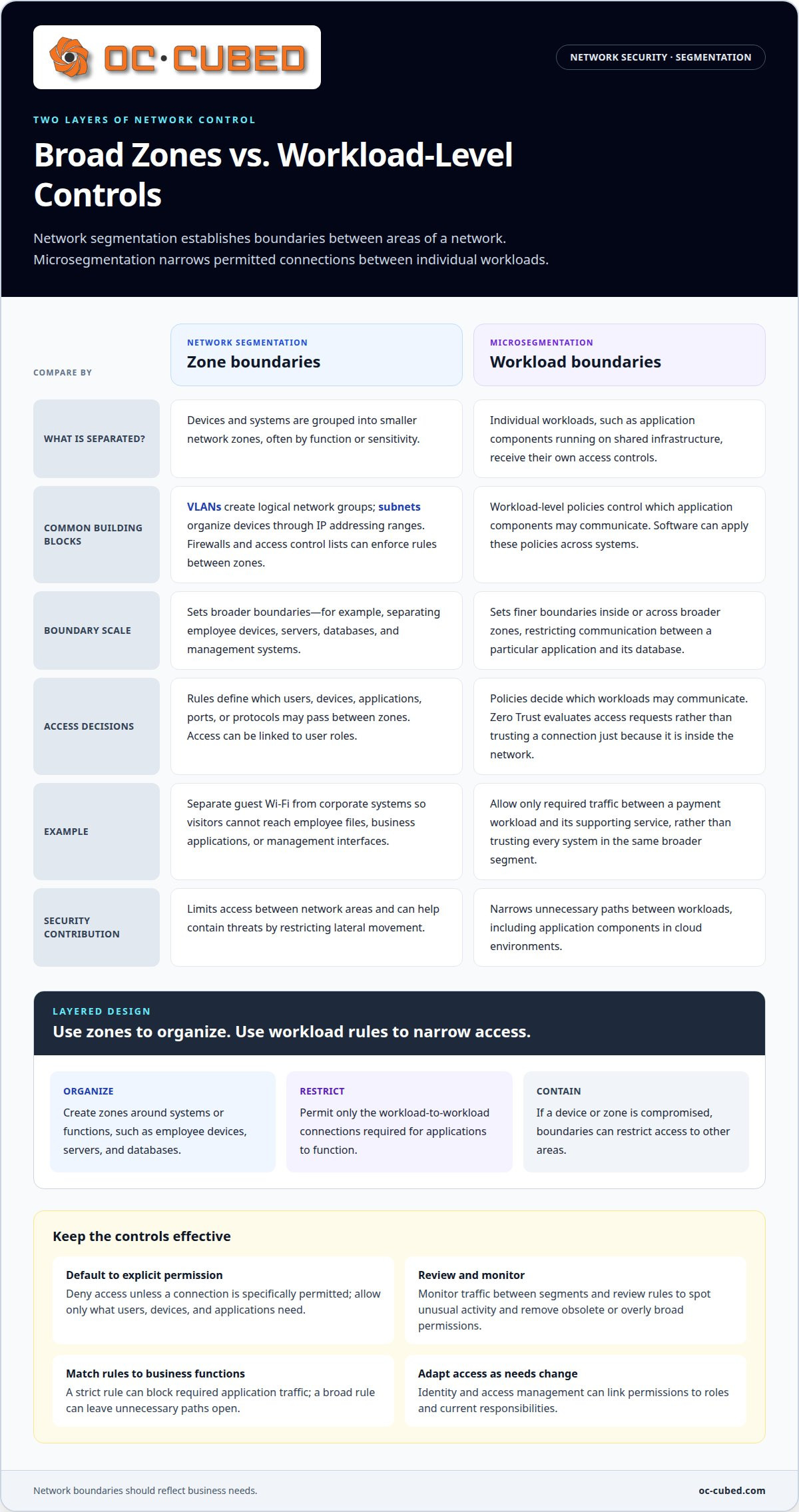
VLANs and subnets group devices into broader network zones, while microsegmentation sets controls between individual workloads. The right distinction depends on how precisely an organization needs to restrict network traffic.
VLANs, Subnets, and Microsegmentation
A VLAN creates a logical network group, and a subnet organizes devices through an IP addressing range. Microsegmentation applies policies to individual workloads, such as separate application components running on shared infrastructure.
These approaches provide different levels of separation. A VLAN might group employee devices, while subnets separate server functions; microsegmentation can then restrict communication between a particular application and its database. This finer control can help limit threats without treating every system in a broader segment as equally trusted.
For example, a company could place its application servers in one subnet, then allow only required traffic between a payment workload and its supporting service. This layered design clarifies the boundary: broad zones organize the network, while workload-level rules narrow permitted connections.
Zero Trust and Microperimeters
Zero Trust treats each access request as something to evaluate, rather than trusting users or devices solely because they are inside an internal network. A microperimeter applies that principle around a specific workload or application.
NIST SP 800-207 is a resource on Zero Trust Architecture. In practice, an organization can use identity, device context, and resource needs to decide whether a connection should be allowed. A user who can reach an employee portal, for example, does not automatically need access to a database or administrative system.
Microperimeters make access decisions more precise than a single perimeter around an office network. They can reduce unnecessary paths between systems, including in cloud environments where application components may communicate across different locations. The security policy follows the protected workload rather than relying only on a fixed internal boundary.
Automated Microsegmentation
Automated microsegmentation uses software to apply workload-level access policies across systems. Automation can help keep policies consistent as applications and their connections change.
For example, a business may define which application services need to communicate, then apply those permissions to the relevant workloads. The resulting rules should still reflect approved business needs. A strict policy that blocks required application traffic can disrupt work; a broad policy can leave unnecessary paths open.
Automation does not remove the need for oversight. Network teams still need visibility into traffic, clear policy ownership, and review of changes that affect business systems. Network monitoring and configuration can support that visibility by helping teams observe network activity and manage network settings.
Security benefits and reduced lateral movement
A segmented architecture creates boundaries that restrict traffic between systems. If an attacker compromises an employee device, rules can prevent it from reaching unrelated servers or databases. This reduces lateral movement, meaning an intruder has fewer paths from one system to another. Containment depends on the boundaries and permitted connections working as intended.
Professionals test segmentation by checking whether approved connections work and prohibited paths remain blocked. They monitor traffic across separate subnets, review logs of allowed and denied connections, and look for unexpected flows or large data transfers.
That visibility helps teams detect activity that might otherwise blend into ordinary network traffic. For example, a workstation sending unusual amounts of data to a server outside its normal role can prompt investigation. Monitoring should cover relevant firewalls, routers, and critical devices so events across zones can be reviewed together.
Segmentation can also reduce the spread of malware across business systems. For example, separating an operational technology (OT) network from corporate IT limits the routes available to threats entering through an IT system. Industrial control systems separated from one another can have narrower communication paths than systems sharing one unrestricted network.
Performance can improve when segmentation reduces unnecessary traffic between network areas. Separating services such as videoconferencing from other business systems can help manage traffic flows and reduce congestion. The effect depends on network design: overly broad rules permit excess communication, while poorly chosen boundaries can disrupt legitimate application traffic.
For compliance work, a distinct zone can isolate credit card information and help organizations monitor related traffic for PCI DSS. Segmentation can also reduce the number of systems considered within a regulatory audit. It supports control and visibility, but the network design still needs to reflect the organization’s applicable requirements.
Similar planning applies to sensitive health and customer information. A business handling health data may separate the systems that store it from general employee devices, then restrict which applications can connect. GDPR and HIPAA are examples of requirements organizations may need to consider when protecting sensitive data. Segmentation can support access limits, but it does not establish compliance by itself.
Monitoring provides an ongoing check after the initial design. When a permitted connection changes or a new application needs access, professionals can review the rule’s purpose and its effect on adjacent zones. Documented firewall changes and regular reviews help keep access aligned with business needs instead of allowing old permissions to accumulate.
Effective segmentation combines boundaries, access rules, and monitoring. A virtual network zone can restrict communication, while traffic logs show whether those controls behave as expected. Reviewing both approved and denied connections helps teams identify gaps, investigate anomalies, and adjust protections as systems and business workflows change.
Network segmentation goals and protected data
Segmentation defines which systems can communicate, prioritizing critical assets and sensitive information. Its design should reflect the data, applications, and operational environments that need protection.
Protecting Critical Assets
A high-security zone isolates critical assets from systems with broader access. CISA recommends establishing a segmented high-security zone for high-value assets and/or operational technology system components.
This boundary can reduce the paths available to threats and help contain their spread. For example, a business can place sensitive financial records or an industrial control system in a restricted zone, then allow only necessary connections. The goal is to protect important systems without disrupting approved work that depends on them.
Protecting a customer database starts with identifying what it stores and which applications need access. A customer record system, for example, may need connections from an approved business application, but not from guest devices or unrelated workstations. Access policies should reflect these distinct roles and keep unnecessary routes closed.
Database segmentation should account for applicable requirements, including PCI-DSS, HIPAA, GDPR, HiTRUST, and FINRA. These frameworks and rules can affect how sensitive customer information is isolated and accessed. The organization’s data types and business activities shape the relevant boundaries; one network zone may not suit every database or environment.
Protecting Key Hosts
Protecting key hosts means restricting their logical connectivity to the ports and protocols essential to their functions. A database server, for example, can accept traffic from its approved application server while blocking unrelated services.
This reduces exposure if another system is compromised. Professionals map each host’s required connections, then define access rules around those needs. Keeping permitted paths narrow helps protect critical assets and limit movement between systems.
Segmentation goals should also account for operational technology and information technology. Separating OT from corporate IT can reduce risks to industrial systems associated with connected business networks, including threats that begin with phishing. Individual industrial control systems may need their own boundaries, based on their roles and required communications.
In cloud and hybrid environments, boundaries can apply to applications and data hosted outside a local network. A sensitive database, for instance, can be separated from public-facing application components, with only approved traffic allowed between them. The same principle applies across physical and virtual infrastructure: access follows business need, not simply network location.
Clear zones also support investigations. If an alert identifies unusual activity near a protected host, network records can show which connections were permitted or denied. Teams can then focus on the affected segment, review its access paths, and adjust controls as business requirements change.
Network segmentation and security
Segmentation adds boundaries, but poor design can leave devices exposed or interrupt essential connections. Common risks include unclear zone design, misconfigured rules, limited visibility, and weak ongoing management.
Common Segmentation Mistakes
A common mistake is creating zones without mapping the business systems and connections they support. For example, separating an application server from its database without allowing required traffic can disrupt service.
Another mistake is leaving broad firewall rules in place after a project changes. Organizations may also overlook logging between segments, making unexpected connections harder to detect. Documenting each rule’s purpose and reviewing changes helps keep boundaries aligned with current needs.
Security Risks from Segmentation
Segmentation can create a false sense of security if attackers can still move between zones through permissive rules or overlooked connections. A compromised device may retain access to critical systems when the intended boundaries aren’t enforced.
Misconfiguration can also block legitimate business traffic or leave isolated environments without useful monitoring. The risk depends on how zones, device access, and allowed flows are designed and maintained.
Design complexity is one challenge. An organization with endpoints, servers, databases, and operational technology needs boundaries that reflect how those systems work together. If the architecture misses a required connection, staff may add broad exceptions to restore access. Those shortcuts can weaken separation and create paths attackers may exploit.
Visibility matters, too. A firewall rule can permit traffic without clarifying its business purpose. If a device begins communicating with an unexpected destination, limited logs may make the change harder to spot. Forwarding router, switch, and firewall events to a central monitoring system helps connect activity across separate zones.
Unsegmented networks can generate more traffic, making threat actors harder to detect. Reported figures indicate that 90% of organizations are exposed to at least one attack path, while 80% have paths exposing critical assets. These figures underline why organizations need to identify which devices and connections create paths to sensitive systems.
Changes require discipline. When an application, user group, or device needs a new connection, teams should document the reason, review the affected rules, and manage the change through an established process. Regular reviews can uncover obsolete or overly permissive access that accumulated as environments evolved.
Segmentation works best as a maintained security control, not a one-time network project. Network monitoring and security threat detection can help teams observe unusual flows and investigate activity across zones. Pairing these capabilities with documented rules gives organizations a clearer view of whether boundaries still match business operations.
OC Cubed - Your trusted MSP: Network Monitoring and Configuration
OC Cubed - Your trusted MSP helps businesses manage network visibility and configuration as segmentation boundaries evolve. Network Monitoring and Configuration supports ongoing oversight of network activity and settings, helping teams identify changes that may affect communication between zones.
Turn to OC Cubed when firewall and switch rules need consistent management, network activity needs closer attention, or security events require follow-up. Security Threat Detection and Remediation can help address identified threats, while Remote IT Support provides assistance with business technology remotely. These capabilities complement segmentation by supporting the systems and controls around it.
For a network design that needs ongoing management, contact OC Cubed - Your trusted MSP.
Make Your Network Boundaries Work Over Time
Segmentation is most useful when its design keeps pace with the business. New applications, changing roles, and updated workflows can all affect which connections are necessary. Treat network segmentation for security as an ongoing part of managing access, not a one-time configuration. Clear ownership and regular review help keep security controls aligned with how people and systems work.
OC Cubed - Your trusted MSP can support that broader IT picture through Remote IT Support, Microsoft 365 Tenant Maintenance, and Security Threat Detection and Remediation. These offerings address related operational and security needs alongside network management. The next step is to discuss how your network operates today and where stronger controls can support your priorities.
With a considered plan and ongoing attention, your organization can build a more controlled foundation for growth.
Frequently Asked Questions
What is network segmentation and how does it improve security?
Network segmentation separates connected systems into controlled areas so access can be limited by business need. For example, a retailer could keep point-of-sale devices apart from office computers and restrict which systems can exchange data. This can reduce the routes an intruder can use after compromising a device. It also gives security teams clearer boundaries to investigate when activity appears unusual.
How do professionals design a secure network segmentation strategy?
Professionals begin by mapping business applications, data flows, users, devices, and dependencies. They identify which systems handle sensitive information and which connections each service needs to function. A payroll application, for instance, may need access to employee records but not unrelated engineering systems. The design then sets zones and access policies around those needs, accounting for cloud services, remote users, and operational requirements.
What steps do professionals take to implement network segmentation?
Implementation typically moves from discovery to design, configuration, testing, and ongoing review. Professionals document assets and required connections, establish network zones, and apply routing and security policies. They then test business workflows alongside blocked paths so necessary applications remain usable. A change plan helps manage dependencies and reduce disruption. After deployment, logs and monitoring help identify unexpected traffic and guide future adjustments.
How do professionals configure firewalls and access control lists to enforce segmentation policies?
Professionals translate approved communication needs into firewall rules and access control lists. Each rule specifies relevant source and destination systems, permitted services, and the action to take. For example, a rule might allow an application server to reach a database service while denying other traffic. Teams document each rule’s purpose, test it against real workflows, and review changes to remove obsolete or overly broad permissions.
What tools and technologies are used for network segmentation?
Common technologies include VLANs, subnets, routers, Layer 3 switches, firewalls, and access control lists. Network access control can help govern which devices connect, while identity and access management assigns user permissions. Cloud environments may use platform-native network controls to separate applications and services. Monitoring and centralized log analysis help teams observe traffic across zones and investigate events without treating each device as an isolated source.
What compliance standards require network segmentation, such as PCI DSS, HIPAA, and NIST?
Requirements depend on the organization, data, and applicable standard. PCI DSS, HIPAA, and GDPR address protection and access to sensitive information; segmentation can help isolate systems and control connections. NIST Special Publication 800-53 includes control SC-7, Boundary Protection, and NIST SP 800-207 covers Zero Trust Architecture. Segmentation supports security planning, but organizations must assess their specific obligations and apply controls appropriate to their scope.
How does network segmentation limit ransomware and lateral movement?
Segmentation can restrict ransomware’s ability to move from an infected device to other systems. If a workstation is compromised, rules may prevent it from reaching backups, servers, or administrative interfaces. This can contain the affected area and give responders clearer boundaries for investigation. Protection depends on correctly configured access policies, endpoint defenses, and monitoring that can surface suspicious connections or unusual data transfers.
How much does network segmentation cost for a small or midsize business?
The cost depends on the project and is provided after a quote request. Key factors include existing equipment, the number of zones, and ongoing rule management.

Article by
Peter Irizarry
Peter Irizarry founded OC Cubed, LLC in 2023 to help small to mid-sized businesses stop worrying about downtime and cybersecurity threats. A frequent speaker on SMB digital transformation, Peter is passionate about translating complex IT roadmaps into plain-English business growth strategies. He resides in North Texas with his family.


