

An IT compliance checklist for financial services should link your organization’s risks to controls that protect customer data, systems, and operations. First identify the cybersecurity and privacy requirements that apply to your institution. Then assess access controls, vendor security, incident response, backups, and recovery. A useful checklist turns requirements into clear actions that teams can review and document.
Compliance can feel like a moving target when your services, customers, and technology create different risks. The practical goal is a repeatable process: determine which requirements apply, document how controls work, and update them when your business or its risks change. This guide covers assessing customer, product, transaction, and geographic risks; governing data and vendors; identifying relevant cybersecurity requirements; and planning backup and recovery measures. Use it to spot gaps and prioritize safeguards that support reliable, accountable operations.
Key Takeaways
- Map customer, product, transaction, and geographic risks to the safeguards and requirements relevant to your business.
- Set clear rules for how sensitive data is accessed, handled, retained, and shared with vendors.
- Identify applicable federal and state cybersecurity requirements, then connect them to practical controls and incident response steps.
- Make backup and recovery plans part of business continuity, with defined responsibilities and regular testing.
- Use ongoing IT support to strengthen endpoint protection, detect and remediate threats, and maintain Microsoft 365 environments.
Assessing customer, product, transaction, and geographic risks
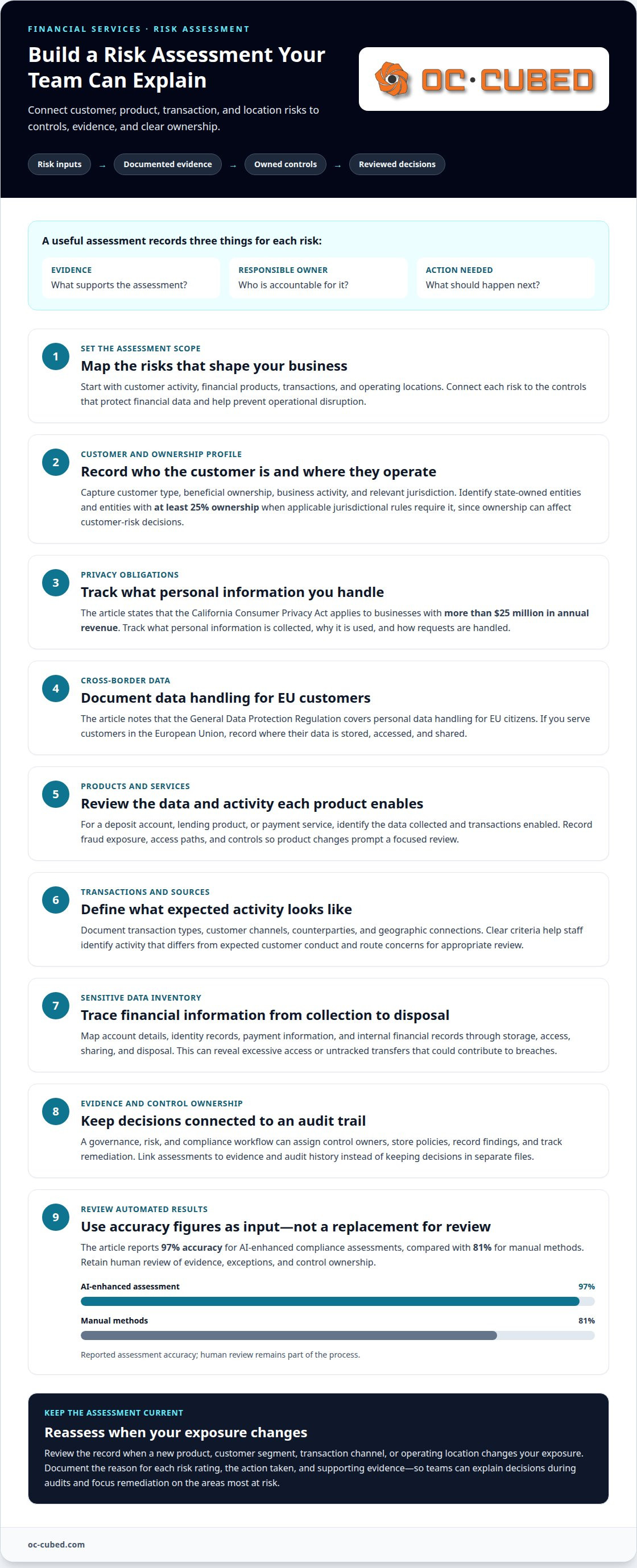
Start with a documented risk assessment that connects customer activity, financial products, transactions, and locations to controls. For each risk, record the evidence, responsible owner, and action needed. This creates a useful audit record and helps prioritize weaknesses that could expose financial data or disrupt operations.
- Profile customers and ownership. Record customer type, beneficial ownership, business activity, and relevant jurisdiction. Identify state-owned entities and entities with at least 25 percent ownership when applicable jurisdictional rules require it, since ownership can affect customer-risk decisions.
- Map customer privacy obligations. The California Consumer Privacy Act applies to businesses with more than $25 million in annual revenue, according to the California State Legislature. Track which personal information is collected, why it is used, and how requests are handled.
- Include cross-border data in the assessment. The General Data Protection Regulation covers personal data handling for EU citizens. If an institution serves customers in the European Union, document where their data is stored, accessed, and shared.
- Rate each product and service. For a deposit account, lending product, or payment service, identify the data collected and the transactions it enables. Record fraud exposure, access paths, and controls so product changes trigger a focused review.
- Review transaction patterns and sources. Document transaction types, customer channels, counterparties, and geographic connections. Clear criteria help staff identify activity that differs from expected customer conduct and route concerns for appropriate review.
- Inventory sensitive financial data. Trace account details, identity records, payment information, and internal financial records from collection through storage, access, sharing, and disposal. This map shows where excessive access or an untracked transfer could contribute to breaches.
- Use a GRC workflow to connect risks with evidence. A governance, risk, and compliance platform can assign control owners, store policies, record findings, and track remediation actions. Link each assessment to evidence and audit history, rather than keeping decisions in separate files.
- Evaluate automated assessment results carefully. AI-enhanced compliance assessments are reported at 97% accuracy, compared with 81% for manual methods. Treat an automated result as an input, and retain human review of evidence, exceptions, and control ownership.
Reassess the record when a new product, customer segment, transaction channel, or operating location changes your exposure. Document the reason for each risk rating and the action taken, alongside supporting evidence. This helps teams explain decisions during audits and focus remediation on the financial data and processes most at risk.
Data governance and vendor management
Centralized governance gives financial institutions a consistent view of sensitive information, control ownership, and unresolved risks. Start with an inventory of each data category, its business purpose, the systems that use it, access groups, and internal owners. For example, map customer account records to the applications that collect, store, and share them. This inventory supports consistent practices and clear audit documentation.
How often should financial services firms conduct risk assessments, penetration tests, and disaster recovery exercises? Set and document a schedule based on risk, applicable regulatory requirements, and significant changes. Repeat assessments after changes to systems, vendors, or services. Conduct regular penetration testing and vulnerability scanning, and schedule recovery exercises to test whether critical services and data can be restored.
Use a central register to connect each obligation with its control, owner, evidence, and review status. A governance, risk, and compliance workflow can flag overdue actions and keep policy versions, approvals, and audit records together. When a control fails, document the finding, assign remediation, and retain evidence of how the issue was addressed. This helps teams act on gaps instead of relying on scattered spreadsheets or email threads.
- Classify information. Label records by sensitivity and business purpose, then define who can access or change them.
- Set handling rules. Document approved collection, use, sharing, storage, and disposal practices for each data category.
- Review access. Compare user permissions with current job responsibilities, and remove access that no longer supports a business need.
- Track changes. Record system updates, policy approvals, exceptions, and remediation decisions in a shared audit trail.
How should financial firms meet data retention, records management, and secure disposal requirements? Maintain a records schedule based on applicable legal, regulatory, and business obligations, and document retention periods by record type. Restrict access to retained records, preserve required evidence, and securely dispose of information when its retention period ends.
Third-party access needs the same discipline. Assess each vendor’s security before onboarding, including the data it handles, access it receives, and services your operations depend on. Record the assessment, approval, contract requirements, and process for reporting and addressing security concerns. Revisit the risk when a vendor changes its service or access. For vendor reviews that need coordinated ownership and follow-through, vendor management support can help organize the work.
Connect governance to operational controls. A payment processor, cloud platform, or records provider may hold critical data or support an essential process. Identify the internal owner, document dependencies, and track corrective actions to keep vendor and data risks visible throughout the relationship.
Which Cybersecurity Regulations Apply to Financial Services?
Applicable requirements depend on the institution’s activities, data, customers, and payment systems. Map each regulatory or industry framework to the systems it affects, then record the control owner and evidence. This keeps policies practical and helps financial institutions identify overlapping duties without treating every framework as identical.
For firms covered by amended SEC Regulation S-P, the U.S. Securities and Exchange Commission says affected customers must be notified within 30 days when a breach involves customer information. Written incident response programs can address how to detect, respond to, and recover from incidents, and review what happened afterward. These steps help answer what happened, how the firm acted, and what changes follow.
For SEC-registered firms and broker-dealers, the requirements described for amended SEC Regulation S-P include customer breach notification and written incident response procedures. These procedures address detection, response, recovery, and post-incident analysis, giving employees defined actions to follow when customer information is involved.
- Map SOX controls to financial reporting. The Sarbanes-Oxley Act (SOX) addresses fraudulent corporate financial reporting through internal controls and procedures. Identify systems that create or change reporting data, document who can access them, and retain evidence of relevant approvals and changes.
- Apply PCI DSS to payment environments. PCI DSS requirement 10 calls for continuous tracking and monitoring of access to network resources and payment data. Requirement 11.4 calls for intrusion detection or prevention techniques, helping teams identify and respond to network intrusions.
- Control account access. Track user logins to systems containing sensitive data, and use multifactor authentication as an access control. Review permissions against employee responsibilities, remove unnecessary access, and preserve records that show who accessed critical systems.
- Connect each control to its frameworks. A single login-monitoring control may support SOX, the Gramm-Leach-Bliley Act, and PCI DSS. Keep a crosswalk that names the control, applicable framework, system, owner, evidence, and review status.
- Include information security safeguards. The Gramm-Leach-Bliley Act Safeguards Rule applies to non-banking financial institutions in the United States, with updates taking effect in June 2023. Its information security program is designed to protect the security and confidentiality of consumer information.
Use a crosswalk to identify gaps, not just shared language. One access policy may cover multiple systems, for example, but evidence must still show that each system is monitored. Assign clear responsibilities, align policies with actual controls, and record exceptions and remediation for audits. Review the mapping when a new payment channel, reporting system, or customer-data process changes the control environment.
State cybersecurity requirements, including New York rules
State rules add requirements based on where a financial institution operates, whom it serves, and which activities it conducts. Build a jurisdiction register and connect each applicable rule to its owner, control, evidence, and reporting process. This makes state obligations visible alongside federal requirements without assuming every institution faces the same rules.
- Map New York cybersecurity obligations. New York’s SHIELD Act and 23 NYCRR 500 set cybersecurity and data-protection requirements. Identify covered entities, systems holding customer information, and the policies supporting those protections.
- Plan the New York certification process. Covered companies must file an annual certification detailing their compliance efforts under the New York DFS cybersecurity regulation. Keep supporting records for each control, exception, and remediation decision.
- Schedule penetration testing. NYDFS requires annual penetration testing for covered entities. Record the test scope, findings, responsible owners, and response actions so results lead to tracked improvements.
- Track incident reporting duties. Firms must report material cybersecurity incidents to regulators within prescribed timeframes. Establish a response process that identifies escalation owners, preserves incident records, and supports timely reporting.
- Apply the California privacy framework where relevant. The California Consumer Privacy Act is a state law relevant to financial services. Map its requirements to customer data practices and the processes used to respond to consumer rights requests.
The Bank Secrecy Act (BSA) and Anti-Money Laundering (AML) requirements call for defined controls, records, and independent testing. The Federal Financial Institutions Examination Council recommends independent AML program testing every 12 to 18 months, or more often when the institution’s risk profile requires it. An acquisition or money laundering incident may call for more frequent testing.
- Document AML and KYC controls. Establish procedures for customer identification, transaction monitoring, escalation, and review. Financial institutions should not disclose to clients that they are filing a suspicious activity report.
- Maintain required financial crime reports. File currency transaction reports for amounts exceeding $10,000, and use a 30-day period to aggregate cash activity when identifying possible structuring. The BSA also requires an annual report of certain foreign financial accounts to the Treasury Department using FinCEN Form 114.
- Address SOX responsibilities. SOX applies to publicly traded companies and their accounting firms. Its described requirements include annual internal and external audits, so establish evidence trails for financial reporting controls and audit findings.
For each state or federal requirement, record the applicable period, control owner, evidence location, and response path. Review the register when products, customer locations, or regulatory obligations change. This helps teams implement updates, preserve records, and strengthen controls while keeping the institution’s applicable requirements in view.
Data backup and recovery protocols
A recovery plan should explain how the institution will restore critical services and protect sensitive records after a disruption. Identify essential systems, the data each holds, and the business processes that depend on them. For example, a customer account platform may rely on both application data and network access. Include owners, backup locations, recovery steps, and decision authority in the written plan.
The Gramm-Leach-Bliley Act (GLBA) requires financial institutions to explain information-sharing practices and safeguard sensitive data. Connect those safeguards to backup controls: restrict access to backup copies, protect them from unauthorized changes, and document who can restore information. A written information security program should include monitoring for unusual access and a process for escalating suspected compromise.
- Set backup scope. Identify customer records, transaction systems, configuration files, and other information needed to resume operations.
- Protect backup access. Limit permissions to approved roles and record access or restoration actions for later review.
- Separate recovery dependencies. Document required applications, network connections, credentials, and vendor services so recovery steps address the full service, not just its files.
- Test restoration. Run recovery exercises that confirm teams can retrieve usable data and follow documented steps. Record results, gaps, owners, and corrective actions.
- Maintain ongoing monitoring. Track backup job failures and changes to systems or data. Route exceptions to an owner for timely investigation and resolution.
GDPR mandates data-protection and privacy practices for handling the personal data of EU citizens. If your institution serves those individuals, connect backup and recovery procedures to its personal-data inventory. Document why data is held, who can access it, how it is protected, and how restoration affects the relevant records. Include processes for data requests and privacy incidents in the broader response plan.
Recovery procedures should also explain how teams protect restored information. Confirm that restored records are complete, access permissions remain appropriate, and monitoring is active before returning systems to normal use. If restoration reveals outdated settings or overly broad access, document the corrective action before closing the exercise.
Keep the plan current as applications, data flows, and network dependencies change. An annual review can align the written program with current systems, while exercises show whether instructions work in practice. After each test or incident, record what failed, what worked, and which procedures need revision. These records demonstrate ongoing attention to sensitive data protection and operational recovery.
OC Cubed - Your trusted MSP
OC Cubed - Your trusted MSP helps financial services teams strengthen the IT controls behind their compliance work. Turn to the team when security gaps, inconsistent system maintenance, or limited internal capacity make those controls harder to manage.
Remote IT Support helps address day-to-day technology issues, while Microsoft 365 Tenant Maintenance supports consistent management of that environment. Security Threat Detection and Remediation and Endpoint Protection / Antivirus help protect systems and respond to identified threats. These services support your security program; your organization remains responsible for determining which regulations apply and maintaining required compliance records.
Discuss your IT compliance priorities with OC Cubed - Your trusted MSP.
Turn compliance into a steady operating practice
Use an IT compliance checklist for financial services as a working framework, not a document that sits untouched after an audit. Assign ownership for keeping procedures current, and include review in decisions about new technology, business processes, and customer data. This keeps compliance work connected to how your organization operates.
Choose a practical next step: identify an unresolved control gap, clarify who owns it, and agree on the evidence that will show progress. Make follow-through part of regular management conversations. Consistent attention helps teams respond when requirements or business operations shift.
OC Cubed can support the ongoing IT work behind your compliance efforts. Contact the team to discuss your organization’s needs and priorities.
Build a clear, resilient approach, one well-owned improvement at a time.
Frequently Asked Questions
What is Regulatory Compliance?
Regulatory compliance means meeting the laws, rules, and standards that apply to an organization’s activities. For a financial firm, that means translating each applicable obligation into a policy, assigned control, and evidence trail. An IT compliance checklist for financial services helps connect requirements to systems and owners. For example, map customer-data access rules to account platforms, staff permissions, and review records.
What challenges should you anticipate during implementation?
Common challenges include incomplete system inventories, unclear control ownership, inconsistent records, and requirements spread across teams. A new policy may also be difficult to apply to older applications or vendor-managed systems. Assign owners to systems and controls, then document dependencies and missing evidence. A control may exist in policy, for example, but lack proof that staff follow it consistently.
Why Do Financial Institutions Face Stricter Compliance Standards?
Financial institutions handle sensitive personal and account information, support payments, and manage services customers rely on. Their technology controls therefore affect both privacy and operations. Requirements can vary by activity, customer location, and regulatory status, creating overlapping obligations. A firm serving consumers across state lines may need to coordinate privacy, cybersecurity, and financial-reporting controls rather than treating compliance as a standalone IT task.
Which IT regulations apply to U.S. financial services firms, including GLBA, SEC, FINRA, and NYDFS rules?
Applicable rules depend on the firm’s services, registration, location, and data. GLBA is relevant to financial institutions; SEC and FINRA requirements depend on the firm’s regulatory role and activities. New York’s 23 NYCRR 500 applies to covered entities, while PCI DSS matters when payment card data is involved. Build a scope register that records each framework, affected system, accountable owner, and required evidence.
What are the GLBA Safeguards Rule requirements for financial institutions?
The Gramm-Leach-Bliley Act requires financial institutions to explain information-sharing practices and safeguard sensitive data. A practical program connects those responsibilities to how customer information is accessed, handled, and protected. Document control ownership, review exceptions, and retain evidence showing how safeguards operate. Regular security awareness training can help employees recognize security risks in their daily work.
What are the NYDFS 23 NYCRR 500 cybersecurity compliance requirements and deadlines?
For covered companies, the New York DFS cybersecurity regulation requires an annual certification detailing compliance efforts. NYDFS also requires annual penetration testing for covered entities. Firms must report material cybersecurity incidents to regulators within prescribed timeframes. Track certification evidence, test findings, corrective actions, and incident escalation responsibilities together. Because requirements depend on coverage and circumstances, maintain a documented schedule tied to the firm’s obligations and incident response process.
What IT controls should a financial services compliance checklist cover for access, encryption, logging, and vulnerability management?
Address identity verification, multifactor authentication, role-based permissions, encryption safeguards, access logging, and vulnerability management. Give each employee an individual account, limit permissions to work needs, and remove access when responsibilities change. Record logins to sensitive systems and review unusual activity. Schedule vulnerability scanning and penetration testing, document findings, and track remediation. Assess encryption across sensitive data flows, but do not treat it as proof that every risk is addressed.
What are the requirements for third-party risk management and vendor due diligence in financial services?
Assess a vendor’s security before onboarding, especially when it handles sensitive information or supports a critical process. Record the data shared, access granted, service dependencies, assessment results, and approval decision. Document security responsibilities and incident communication procedures. Maintain a vendor inventory and revisit assessments when services, access, or data handling change. This gives internal teams a clear record of risk decisions and follow-up actions.

Article by
Peter Irizarry
Peter Irizarry founded OC Cubed, LLC in 2023 to help small to mid-sized businesses stop worrying about downtime and cybersecurity threats. A frequent speaker on SMB digital transformation, Peter is passionate about translating complex IT roadmaps into plain-English business growth strategies. He resides in North Texas with his family.


