

Insurance is not a substitute for security. Cyber liability insurance isn’t mandatory for U.S. businesses, and insurers set their own IT requirements. Common cyber liability insurance IT requirements include multi-factor authentication, endpoint protection, secure backups, and a documented incident response plan.
It makes sense to want coverage that can help with breach response, data recovery, legal expenses, or lost income after a cyber incident. But a policy’s protection depends on its terms, and insurance works best alongside practical safeguards, not in place of them.
This article explains what cyber liability insurance may cover, which IT controls insurers commonly assess, and how to decide whether coverage fits your business. You’ll also learn how access controls, updated software, and backups can support both day-to-day security and insurance readiness.
Key Takeaways
- Understand how first-party and third-party coverage address different losses, then review policy terms to see what protection applies to your business.
- Insurers may assess endpoint safeguards across user devices, along with how consistently those protections are maintained.
- Limiting access to the information employees need for their roles can help reduce unnecessary exposure.
- Businesses that rely on digital systems or handle sensitive information may have more to consider when weighing coverage and security readiness.
- Managed IT support can help maintain key safeguards and address gaps in endpoint protection, threat response, and Microsoft 365 administration.
What Is Cyber Liability Insurance?
Cyber liability insurance can help pay costs after an attack or data breach. In the United States, businesses are not required to carry it, and insurers assess each organization’s security controls.
Cyber Liability and Data Breach Coverage
Data breach coverage generally focuses on responding to exposed information, while cyber liability insurance can address a wider range of losses. That distinction matters when an incident disrupts operations or leads to claims from customers, partners, or employees.
First-party coverage may help pay for breach notifications, forensic investigations, data recovery, system repairs, legal expenses, and business interruption losses for the affected business. Third-party coverage may address claims from others affected through their relationship with the business. Policy terms determine which response costs, payments, and legal claims are covered.
The FBI Internet Crime Complaint Center reported 847,376 complaints from the American public in 2021, a 7% increase from 2020, with potential losses exceeding $6.9 billion. Those figures show why organizations consider how an attack could affect both their systems and their business relationships.
Coverage needs vary with a business’s industry, revenue, data, and reliance on technology. A small firm that stores customer information faces different exposures from a technology company hosting services or processing data for clients. Technology companies may need to consider claims tied to network security, privacy, media liability, and technology products or services. Insurers may also assess endpoint detection and response across the systems being insured.
Insurer Security Requirements and Questionnaires
Insurer questionnaires gather information about controls that may affect risk and coverage. Businesses are commonly asked about multi-factor authentication, endpoint protection, software updates, vulnerability management, incident response plans, and how they protect and restore data.
Insurers often ask about backup security and testing. Offline backups can help restore systems after an attack, and insurers scrutinize whether backups are tested and securely stored. Immutable backups may also be relevant, but requirements vary by policy. Insurers may also require employee security awareness training and regular phishing training or tests.
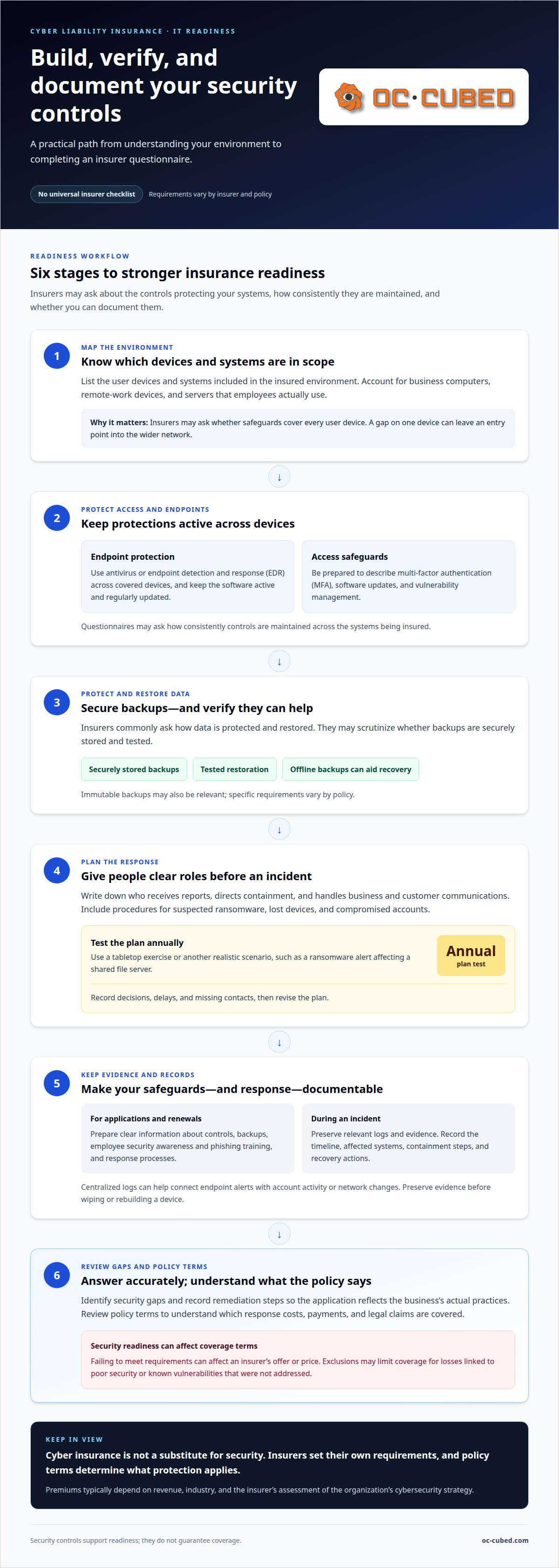
Questionnaires may ask whether safeguards cover every user device and whether the business can document them. Prepare clear information about security controls, backups, training, and response processes for an application or renewal.
Premiums typically depend on revenue, industry, and the insurer’s assessment of the organization’s cybersecurity strategy.
Failing to meet security requirements can affect an insurer’s offer or price. Policy exclusions may also limit coverage for losses linked to poor security or known vulnerabilities that were not addressed. Before applying or renewing, document existing controls, identify gaps, and record remediation steps so the application reflects the business’s actual security practices.
Antivirus and endpoint detection and response
Insurers commonly assess whether endpoint protection covers every device included in the policy. Antivirus helps block or detect known malicious files, while endpoint detection and response (EDR) can help identify suspicious activity across computers and other endpoints. A gap on one device can leave an entry point into the wider network.
Coverage should match the systems employees actually use. Include business computers, remote-work devices, and servers in the protection plan when they are part of the insured environment. Keep antivirus or EDR software active and regularly updated. An outdated tool may miss newer threats, while an unprotected laptop can expose shared files or business accounts.
EDR tools collect endpoint activity and help flag behavior that may signal an attack, such as an unexpected program changing files. Security teams can investigate alerts, identify affected devices, and take steps to contain the threat. This visibility matters during ransomware incidents, when activity on one endpoint may spread through connected systems.
A practical response starts with triage. Identify the alert, determine which device and user accounts are involved, and assess whether the activity reached other systems. Then isolate affected devices where appropriate, preserve relevant logs, and remove malicious activity. Documenting these actions can help explain the incident and support a later insurance claim.
A written incident response plan gives employees and technical teams defined roles during a breach. It should specify who receives reports, who directs containment, and who handles business and customer communications. Include procedures for suspected ransomware, lost devices, and compromised accounts. A clear sequence helps teams avoid conflicting actions while an investigation is underway.
Test the plan annually through a tabletop exercise or another realistic scenario. For example, teams can rehearse a ransomware alert affecting a shared file server. Record decisions, delays, and missing contacts, then revise the plan. Insurers may ask whether a documented response plan exists and whether the organization tests it.
Threat investigations also depend on useful records. Centralized logs can help connect an endpoint alert to account activity or network changes. Preserve relevant evidence before wiping or rebuilding a device, since premature cleanup can remove clues. Record the incident timeline, affected systems, containment steps, and recovery actions for internal review and insurance documentation.
For businesses reviewing endpoint safeguards, endpoint protection and antivirus support can help maintain coverage across business devices. A managed approach can also connect alerts with threat detection and remediation, so response does not stop at identifying suspicious activity.
Identity and access management
Identity and access management assigns user identities and controls which business systems each person can reach. Cyber insurers commonly assess access controls, multi-factor authentication, and privileged account protections when reviewing an organization’s security.
Restricting Access to Sensitive Information
Access restrictions limit who can view or change sensitive information, such as payroll records or customer files. Assign permissions by job role, then remove access when an employee changes roles or leaves. This reduces the number of accounts that could expose data during a cyberattack.
For example, employees handling invoices may need billing software but not human resources records. Separate permissions for file storage, email, and business applications help contain the impact if one account is affected. Insurers may ask how access is assigned and removed across the organization’s infrastructure.
Least-Privilege Access and Data Classification
Least privilege means giving each user only the digital rights required for their current duties. Data classification groups information by sensitivity, helping an organization apply stronger restrictions to confidential files than to routine documents. Together, these practices clarify which employees need access and which data requires tighter control.
A practical approach is to classify records, map each group to business roles, and grant only the permissions needed. For instance, a project team can access its working files without broad access to finance folders. This limits unnecessary exposure and can reduce the scope of an investigation after an incident.
Permissions need ongoing review, not just initial setup. When an employee changes responsibilities, update their access to match the new role. Remove former employees’ accounts and review shared accounts, which can make it harder to identify who performed an action. Documenting these changes gives the organization a clearer view of access across its systems.
Privileged access management focuses on accounts with elevated rights, such as administrator accounts that can change settings or manage users. Keep these accounts separate from everyday user accounts, restrict who can use them, and monitor their activity. An attacker who gains administrative access may be able to affect more systems and data.
Insurers scrutinize privileged access management as part of cybersecurity readiness. They may ask how administrator accounts are controlled and whether access follows job responsibilities. Clear records can help explain safeguards during an application or renewal. If an incident causes financial losses, access logs may also help establish which accounts and systems were affected.
Identity controls work alongside technical safeguards, rather than replacing them. For example, role-based permissions can limit what a compromised employee account can reach, while monitoring can help identify unusual account activity. Aligning access rules with data sensitivity gives insurers a clearer picture of how the business limits unauthorized access.
Multi-factor authentication
Multi-factor authentication (MFA) uses more than one authentication method to control access to business systems. Insurers commonly ask whether MFA is enforced for remote access, email, and privileged accounts. These are key entry points, so consistent enforcement can help reduce the risk of compromised credentials being used on their own.
Common cyber insurance requirements include MFA, endpoint protection across user devices, and secure, tested backups. Each control addresses a different risk: MFA helps protect account access, endpoint tools help identify threats on devices, and backups support system recovery after an attack.
A password is one authentication method. MFA adds another, so a stolen password alone may not be enough to access an account. For example, an employee signing in to email remotely may need to provide a password and a separate verification method. That additional step can help mitigate the impact of exposed credentials.
Strong passwords still matter. Use a unique password for each employee and network account, and change passwords regularly. Reusing a password across email and business applications creates a shared point of risk. If one account is compromised, separate credentials can help prevent attackers from using that password to access other systems.
MFA should cover the accounts and access routes that can expose business data. Remote access deserves attention because it connects users outside the office to company systems. Email also matters: an account can contain sensitive messages and provide access to other services. Privileged accounts need protection because their access can affect settings, users, and infrastructure.
Insurers may ask how MFA is enforced, which accounts it covers, and whether exceptions exist. A clear record should describe the systems in scope, such as email, remote connections, and administrator accounts. If an exception is necessary for a specific workflow, document the reason and the alternative safeguards used. This helps keep application answers aligned with actual practice.
MFA also supports incident investigations. If suspicious access occurs, sign-in and verification records can help teams determine which account was targeted and when. Investigators can then review related activity, identify affected systems, and assess whether unauthorized access led to data exposure or financial losses.
Review MFA when employees change roles, new systems are introduced, or remote access changes. A new business application may create an additional login path that needs protection. Regular reviews help keep controls aligned with how employees work, rather than relying on an old setup that no longer reflects current access.
Insurers also scrutinize multi-factor authentication, tested and securely stored backups, privileged access management, and employee security awareness training. Businesses should install and regularly update antivirus or endpoint detection and response software on all user devices. Identity and access management assigns and manages user identities so access to data reflects users’ organizational roles.
This guidance covers access management as well as sign-in verification, and calls for endpoint software across all user devices. Both installation and regular updates are part of the stated endpoint practice. Tested and securely stored backups, privileged access management, and employee security awareness training are also among the controls insurers scrutinize.
Businesses that need cyber liability insurance
Cyber liability insurance is not mandatory for U.S. businesses, so the decision depends on exposure and potential disruption. A company that stores customer records, accepts online payments, or relies on cloud systems should assess how an incident could affect operations, clients, and revenue. Reviewing cyber liability insurance IT requirements can help connect those risks with the safeguards insurers assess.
Start with the information the organization holds. A clinic managing patient records, an online retailer processing payment details, and a firm storing employee files face different exposures. Consider what could happen if data became unavailable, was disclosed without authorization, or was used to make fraudulent payments.
Reliance on technology matters too. A service company whose staff cannot access scheduling or customer records may lose the ability to serve clients during an outage. A software provider could face customer claims if an incident disrupted services or exposed data. The organization’s size alone does not show the full extent of its cyber risk.
Third-party relationships can increase exposure. A business may share information with a contractor or depend on a cloud service provider to deliver its work. If a vendor-related incident affects the business or its customers, the resulting costs and claims may differ from those of a direct attack. Include these dependencies in a risk assessment.
Contract terms can also influence the decision. A customer or business partner may require a supplier to carry cyber insurance and provide proof of coverage. Review the agreement’s requested limits and covered risks alongside the services provided and the data involved. Insurance requirements should reflect the relationship, not simply repeat a standard amount.
Compare potential losses with the policy’s actual scope. First-party coverage may address the insured business’s response and interruption costs, while third-party coverage may address claims from affected parties. Cyber insurance policies differ in covered events, limits, exclusions, and response services. Understand which incidents could leave the business paying costs itself.
Security readiness belongs in the assessment. Insurers review cybersecurity strategy when evaluating risk and making an offer. Known vulnerabilities left unaddressed or poor security processes can affect coverage, and policies may exclude related losses. Identify technical gaps and response weaknesses before treating a policy as the entire risk plan. Cyber liability insurance IT requirements can help frame which safeguards to review.
Coverage can be more useful when its terms match the business’s data, services, and recovery needs. For a small organization, an interruption to one essential system may be central. A technology company may also need to consider customer claims tied to its products or services. Map likely impacts first, then review how the policy responds.
Assess your organization’s cyber risk and coverage needs.
OC Cubed - Your trusted MSP
OC Cubed - Your trusted MSP helps businesses strengthen the IT safeguards insurers commonly assess. Its support can include endpoint protection, security threat detection and remediation, Microsoft 365 tenant maintenance, and remote IT support.
Turn to OC Cubed when your business needs help maintaining endpoint controls, addressing security gaps, or keeping Microsoft 365 systems managed. These measures support day-to-day security and can help your team document the controls behind an insurance application or renewal. Cyber insurance remains separate from IT security, so match policy terms to your business needs.
Contact OC Cubed to discuss your business’s IT security needs.
Keep Your Coverage Readiness Moving
A plan for meeting cyber liability insurance IT requirements should evolve with your business. New systems, staff changes, and vendors can shift your exposure, so treat security readiness as ongoing work rather than a one-time application task. This helps keep safeguards aligned with how your organization actually operates.
OC Cubed can help connect day-to-day IT management with your business’s security priorities. Use that support to strengthen the systems your team depends on and keep moving toward a more prepared, resilient operation.
Take the next step by discussing your IT needs with OC Cubed and developing a plan to support your business.
Frequently Asked Questions
How can I help prevent a data breach at my business?
Reduce common entry points by keeping operating systems, applications, and firmware updated, and setting firewall rules for network traffic. Give employees only the access their roles require, and train them to recognize phishing attempts. Make it easy to report suspicious messages or activity. For example, an employee who quickly reports an unexpected sign-in prompt can help security staff investigate before the account is used to reach more systems.
What network security and patch management standards do insurers expect?
Insurers assess the controls in place rather than applying one universal checklist to every organization. Be prepared to describe how your business updates operating systems, applications, and firmware, manages known vulnerabilities, and controls network traffic with firewalls. Centralized logs can help connect activity across systems during an investigation. Keep records of update and remediation processes so your application explains how your business identifies and addresses security gaps.
What incident response plan and breach notification procedures must businesses have?
A useful response plan identifies who receives incident reports, who leads investigation and containment, and who handles communications. Record suspected breach details, including the date, time, and duration if known, and preserve relevant evidence. Most U.S. states require companies to notify individuals when a breach may have compromised personal information. Notification duties depend on the circumstances and applicable rules, so include a process for assessing affected information and coordinating response communications.
How do cyber insurance IT requirements vary by industry, company size, and coverage limits?
Insurers assess an organization’s cybersecurity strategy, revenue, industry, data, and dependence on technology. A small business relying on one cloud service may prioritize continuity and access safeguards, while a technology company may face exposure tied to customer services and data. Coverage limits also shape the protection sought and the insurer’s assessment. Compare the policy’s scope with potential losses, including response costs, interruption, and claims from others.

Article by
Peter Irizarry
Peter Irizarry founded OC Cubed, LLC in 2023 to help small to mid-sized businesses stop worrying about downtime and cybersecurity threats. A frequent speaker on SMB digital transformation, Peter is passionate about translating complex IT roadmaps into plain-English business growth strategies. He resides in North Texas with his family.


