

A network outage can disrupt work before the whole business appears offline. Network downtime is a period when employees or systems can’t access the network services they need. The business impact of network downtime can include stalled transactions, lost productivity, delayed work, recovery effort, and weakened customer trust. The cost depends on which systems are affected and how long the disruption lasts.
An outage may seem like a brief technical issue. But when staff can’t reach files, communicate with customers, or complete transactions, even a short disruption can affect daily operations and the customer experience.
This article explains how downtime affects operations, customer confidence, and costs, and why its effects vary by organization. It also covers how network monitoring, redundant systems, and backup internet connections can help businesses maintain continuity when a primary connection or system fails.
Key Takeaways
- Map the work, systems, and transactions that depend on your network so you can see where an outage would interrupt operations.
- Consider how service interruptions affect customer confidence, not just immediate sales or employee productivity.
- Assess downtime costs across lost revenue, stalled work, recovery effort, and less visible effects such as delayed commitments.
- Explore backup internet and redundant systems to help keep critical operations running when a connection or system fails.
- Use network monitoring and remote IT support to identify problems and strengthen your organization’s readiness to respond.
How does downtime impact a business?
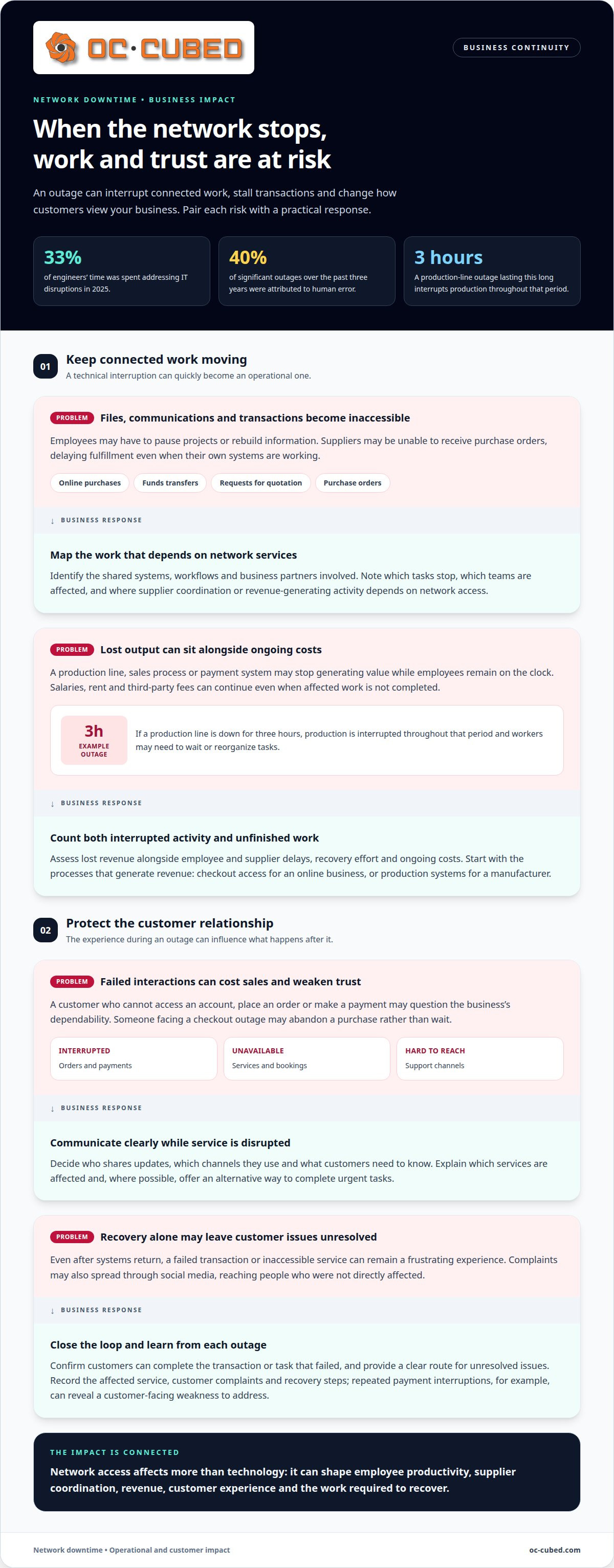
Network downtime can block access to the files, communications, and transactions employees need to keep work moving. Its effects extend beyond screens, disrupting operations, supplier coordination, and revenue-generating activity.
Employee and Supplier Productivity Losses
Network failures can prevent employees and suppliers from completing connected tasks, reducing productivity. The business impact of network downtime depends partly on which workflows rely on shared systems. Without access to files, an employee may have to pause a project; a supplier may be unable to process a purchase order. Those delays can affect connected teams and business partners.
For example, a network-service outage can interrupt online purchases, electronic funds transfers, requests for quotation, and purchase orders. If a supplier can’t receive an order, fulfillment may be delayed even when its own systems are working. Employees may then spend time following up, rescheduling work, or rebuilding information instead of completing planned tasks.
Lost time can also shift attention away from productive work. Engineers reported spending 33% of their time addressing IT disruptions in 2025. Human error accounted for 40% of significant outages over the past three years. Together, these facts underline why clear work processes and careful network changes matter: disruptions can consume staff time and make avoidable interruptions more likely.
Lost Revenue and Productivity
Lost revenue and productivity reflect both interrupted business activity and work employees can’t complete. A production line, sales process, or payment system may stop generating value while staff remain on the clock. Considering both effects gives businesses a clearer picture of how an outage affects daily performance.
If the line is down for 3 hours, production is interrupted throughout that period, and workers may have to wait or reorganize tasks. The example shows why the effect depends on the operation, not just the length of a network problem.
Revenue can also be lost when customers can’t place orders or complete payments. Employees may miss deadlines or spend time recovering stalled work. Salaries, rent, and third-party fees can continue during downtime, even when affected work isn’t completed. This combination can make an outage operationally costly, especially when teams depend on network access for each transaction.
To assess the impact, identify which revenue-generating processes rely on network services, then consider what happens when each process stops. A business taking online orders may focus on checkout access; a manufacturer may focus on production systems. This distinction helps leaders assess lost revenue alongside employee and supplier delays, rather than viewing downtime as a technical interruption alone.
Reputational damage and customer trust
An outage can shape customers’ view of a business, especially when they can’t access a service or complete a transaction. Their experience during a disruption can influence repeat business, recommendations, and revenue after systems return.
Customer Dissatisfaction and Lost Trust
Customers may become dissatisfied or lose trust when an outage prevents them from getting the service they expect. Someone who can’t access an account, place an order, or make a payment may question whether the business is dependable. Each failed interaction can weaken the relationship, even if the technical problem is temporary.
For example, a customer facing an online checkout outage may abandon a purchase rather than wait. If the same issue affects support channels, customers may also struggle to find out what happened or when service will resume. A clear, timely update helps them understand the disruption and what steps they can take.
Customer Experience and Revenue Impacts
Customer experience and revenue are connected: interrupted service can reduce sales while damaging a business’s reputation. When customers can’t order, access services, or make payments, the business loses opportunities at the moment they’re ready to act. A difficult transaction can also affect whether they return.
For instance, an online retailer whose checkout stops working may lose an immediate sale. If a service business’s booking system is unavailable, customers may be unable to schedule. In either case, the outage affects revenue and gives customers a reason to consider another option.
Reputational effects can extend beyond the initial transaction. Customers and employees of trading partners may post complaints about lengthy downtime on social media, spreading news of the disruption. A post about a failed payment or inaccessible service can reach people who weren’t directly affected and shape their expectations before they interact with the business.
That’s why response matters alongside recovery. A proactive communication plan should identify who shares updates, which channels they use, and what customers need to know. For example, a business might use its website and customer email to explain which services are affected and offer an alternative way to complete urgent tasks.
Once service returns, follow a consistent process. Confirm that customers can complete the transaction or task that failed, and provide a clear contact route for unresolved issues. A retailer could review abandoned orders and make it easy for affected customers to resume checkout without starting over.
Businesses can learn from each outage by recording the affected service, customer complaints, and recovery steps. If a payment interruption repeatedly affects checkout, that pattern points to a customer-facing weakness worth addressing. Tracking these details helps teams prioritize improvements based on customer experience, not just technical restoration.
Trust grows through dependable service and clear communication. A business can’t prevent every disruption, but it can prepare customers for what to expect, reduce confusion during an outage, and follow up afterward. These steps give customers a clearer experience while the business restores normal operations.
Direct and indirect downtime costs
Downtime costs vary by company size, industry, affected systems, and outage duration. Small and midsized businesses face different losses from large enterprises. Common causes include human error, hardware wear, DDoS attacks, malware, and ransomware.
To estimate the financial impact, multiply outage duration by the combined hourly losses from revenue, productivity, recovery, and intangible costs. Include immediate expenses as well as costs that continue while affected work remains unfinished.
Downtime Costs by Business Size and Industry
Downtime costs by business size and industry are the financial losses tied to an organization’s scale and operations. Comparing relevant figures helps leaders identify which interruptions deserve the closest attention.
These examples show why sector-specific workflows matter alongside company size.
Calculating the Financial Impact
Calculating the financial impact means estimating all losses associated with an outage, not just missed sales. This gives decision-makers a more complete basis for prioritizing recovery and prevention.
Start with revenue lost during the outage, then estimate employee productivity losses and recovery costs. Add indirect effects, such as unfinished work, delayed commitments, or reputational harm. Multiply the combined hourly estimate by the outage duration, taking care not to count the same loss in multiple categories.
Reported figures vary by measure and organization. These figures describe different measures, not a single universal rate.
Scale, system dependence, and interrupted activity all shape the total.
Causes also affect the calculation. Human error accounted for 40% of significant outages over the past three years. Routers, switches, and servers can fail through wear and tear, while DDoS attacks, malware, and ransomware can disrupt operations. Network monitoring can help identify faults and performance changes before they cause wider failures.
Backup internet and business continuity
Backup internet can keep essential work connected when a primary provider fails; data backups help restore information after loss. Estimate their return by comparing the outage losses they could help avoid with the costs of implementing and maintaining these safeguards.
Keep essential operations connected
A backup internet connection provides an alternative when the primary connection becomes unavailable. For example, a business that relies on cloud software for customer orders can switch connections and continue some work. Automatic failover can make the switch when the primary connection falters.
Connectivity alone doesn’t restore lost records or applications. A continuity plan should identify which teams can use the alternate connection, which systems they need, and how they’ll communicate during an outage. This makes the backup useful for real operations rather than an unused technical resource.
Plan for data recovery
Disaster recovery focuses on restoring critical systems and information after an outage or other disruption. A business continuity and disaster recovery plan identifies mission-critical systems, recovery time and recovery point objectives, and the people responsible for crisis roles. These details help teams decide what to restore first and how much lost data operations can tolerate.
Back up critical data and applications on a schedule suited to operational needs, such as daily or hourly. Keep copies both on-site and off-site so a local failure doesn’t leave every copy exposed. Include SaaS backup in the plan: account for data held in cloud software and define how teams will retrieve it if records are deleted or inaccessible.
The consequences of skipping recovery planning can be severe. Hurricane Ian caused business disruptions lasting days or even weeks. Ransomware and distributed denial-of-service attacks can also keep businesses offline for hours or days. A documented recovery plan gives staff a defined response instead of leaving each team to improvise.
Test backups and estimate value
A backup supports recovery only if the business can restore from it. Test backup copies regularly by restoring sample data and checking that essential applications and records work. Update the plan when systems, data needs, or staff responsibilities change. For example, a changed order process may require different records to be prioritized.
To estimate return on investment, compare the expected losses avoided through faster recovery and continued connectivity with the ongoing costs of redundancy, backup storage, testing, and maintenance. Base the estimate on affected systems, likely outage duration, recovery needs, and the business work those systems support. Revisit the assumptions as operations change.
Redundant systems and high availability
Redundant systems provide backup components or paths so operations can continue when a primary resource fails. Businesses can reduce downtime by combining redundancy with monitoring, maintenance, security controls, and tested recovery plans.
Network redundancy means creating alternative routes for data or services. For example, a business can use a backup internet connection if its primary connection falters. Automatic failover switches traffic to the backup, helping employees reach essential systems without waiting for someone to make the change manually.
Redundancy can also apply within the network. Backup hardware, alternative data paths, and high-availability configurations can reduce reliance on a single device or connection. Load balancing distributes incoming traffic across multiple servers, helping prevent one server from becoming overloaded. If one component fails, another may continue handling work.
These safeguards should match the business’s critical operations. A retailer may prioritize payment and order systems, while a manufacturer may focus on network paths serving production. Because industries depend on different systems, identify which functions must remain available and where a single failure could stop them.
Availability figures need context. A provider may promise 99.9% availability in a service-level agreement, but that figure alone doesn’t explain how a business will operate during an outage. Review which systems are covered, how failover works, and what recovery steps employees should take when a disruption affects services beyond the connection.
Prevention also reduces the chance that redundancy will be needed. Useful measures include:
- Monitor network performance to spot unusual patterns and faults early.
- Assess whether infrastructure and hardware can handle current data traffic.
- Update hardware and software, and schedule maintenance during off-peak hours.
- Train employees to follow safe network practices and reduce human error.
- Use firewalls, encryption, and intrusion detection to help address cyber threats.
Power failures call for a separate layer of protection. A UPS system or generator can support network equipment when normal power is interrupted. For example, a business might keep essential switches and servers running long enough to maintain service or shut down safely.
Redundancy works best when teams test it. Simulate a failed connection or device, confirm that failover works, and record any manual steps employees need to take. Network monitoring and configuration can help teams track performance changes, identify faults, and understand network readiness.
OC Cubed - Your trusted MSP: Remote IT Support
OC Cubed - Your trusted MSP helps businesses manage IT issues that can disrupt daily work. Remote IT Support can help address technical problems, while Microsoft 365 Tenant Maintenance supports the upkeep of essential business tools.
Businesses concerned about threats that could interrupt operations can use Security Threat Detection and Remediation and Endpoint Protection / Antivirus to support a more protected IT environment. Email Security with Proofpoint adds protection focused on business email. These services can help address recurring technical issues, security concerns, and system maintenance demands that draw attention away from core work.
To discuss IT support for your business, contact OC Cubed, your trusted MSP, or visit oc-cubed.com.
Turn continuity planning into a business habit
Make network resilience part of routine business planning, not a task reserved for after an outage. Assign responsibility for reviewing critical systems, recording changes, and keeping response procedures current as operations evolve.
A practical next step is to identify one dependency that could interrupt essential work, then decide who is responsible for its continuity plan. This connects the business impact of network downtime to decisions leaders can act on, rather than leaving preparedness as a broad technical goal. Revisit those priorities when workflows or business systems change.
OC Cubed, your trusted MSP, can help businesses address ongoing IT support and security needs. If you’re ready to discuss how your organization can strengthen its approach, get in touch.
Steady planning helps your team move forward with greater clarity and control.
Frequently Asked Questions
What is Network Downtime?
Network downtime is a period when a business network or a service it supports becomes unavailable or unusable. For example, an office may still have power and working computers, but staff can’t access shared files because the network connection has failed. A partial outage may affect one application or location, while a broader failure may interrupt multiple connected business functions.
Why Is The Cost Of IT Downtime Often Underreported?
Downtime costs are often underreported because immediate, visible losses are easier to record than secondary effects. A business may count a failed transaction but overlook staff time spent rescheduling work, investigating the issue, or correcting records afterward. Costs can also sit across separate budgets, such as operations, customer support, and technology, making the full effect harder to capture in one report.
What is the average cost of network downtime per hour for businesses?
Costs vary with the organization’s size, industry, revenue-generating systems, and the work interrupted. A useful planning estimate should reflect your own affected processes, including operational delays and recovery effort, rather than treating an overall average as a precise prediction.
How does network downtime affect revenue, productivity, and customer satisfaction?
Network downtime can interrupt sales, prevent employees from completing dependent tasks, and make customers wait for access or service. These effects can compound: an internal delay may postpone a customer deliverable, while a failed service interaction can weaken confidence. To assess the business impact of network downtime, trace an affected customer journey from the first interrupted step through resolution.
What are the direct and indirect costs of network outages?
Direct costs include lost transactions, recovery work, and expenses tied to restoring affected systems. Indirect costs can include unfinished employee work, missed commitments, customer complaints, and delays for business partners. For a clearer internal estimate, record when the outage starts and ends, which services and teams are affected, the recovery tasks, and any unresolved customer or supplier issues. This creates a useful record for comparing incidents.
What service-level agreements and uptime guarantees cover network downtime?
A service provider may promise 99.9% availability in a service-level agreement, while another may promise 99.99%. Failing to meet the guaranteed uptime can result in financial penalties.

Article by
Peter Irizarry
Peter Irizarry founded OC Cubed, LLC in 2023 to help small to mid-sized businesses stop worrying about downtime and cybersecurity threats. A frequent speaker on SMB digital transformation, Peter is passionate about translating complex IT roadmaps into plain-English business growth strategies. He resides in North Texas with his family.


