

What if your next technology decision had a clear owner, a business reason, and a place on the roadmap? For many small businesses, technology choices happen reactively while vendors and priorities compete for attention. A search for “virtual CIO services small business” often starts with a practical question: who can provide strategic direction without adding a full-time executive?
A virtual CIO connects technology decisions to business priorities. Rather than focusing only on support tickets or system maintenance, this role can guide technology planning, budgeting, vendor oversight, project coordination, and security governance. The goal is to tie technology work to business needs instead of addressing each issue in isolation.
In this guide, you’ll learn what a virtual CIO does, when the role is useful, and how it differs from day-to-day IT support. You’ll also see how strategic leadership works alongside remote IT operations, what practical oversight looks like, and how to prepare for clearer, more accountable technology decisions.
Key Takeaways
- Virtual CIO services help small business leaders turn business goals into clear technology priorities and accountable decisions.
- Strategy, security governance, vendor oversight, and project coordination are core parts of a virtual CIO’s responsibilities.
- Compare virtual CIO leadership with managed IT operations and a full-time CIO to identify which model fits your needs.
- Prepare for strategic IT guidance by ranking business goals, pain points, active projects, and key risks.
- OC Cubed’s virtual CIO, CTO, and CISO advisory services connect technology planning with security governance and project oversight.
What Are Virtual CIO Services for Small Business, and What Do They Own?
Technology decisions can pile up without anyone responsible for seeing how they fit together. One vendor recommends a new platform, an employee flags a recurring problem, and a security concern competes with a project already underway. Each decision may make sense on its own, but without strategic oversight, priorities can become disconnected and accountability unclear.
Virtual CIO services provide executive-level technology leadership without requiring a small business to hire a full-time CIO. A virtual CIO helps leadership decide how technology can support business goals, what needs attention first, and how to oversee the work. The role draws on the broader responsibilities of a Chief Information Officer (CIO), delivered through an advisory relationship shaped around the business’s needs.
What does a virtual CIO do for a small business?
A virtual CIO connects technology choices to objectives such as improving operations, supporting growth, protecting information, or managing risk. Responsibilities can include setting priorities, establishing governance expectations, overseeing technology risks, and providing direction for vendor relationships. The value isn’t simply more technology advice. It’s a clear process for evaluating decisions and keeping them aligned with business needs.
For example, a business considering a new customer management system should look beyond the feature list. A virtual CIO can help assess whether the system supports customer-service goals, how it fits with existing tools, what risks or dependencies need attention, and whether the team has capacity to adopt it. That puts the decision in a broader plan instead of treating it as an isolated purchase.
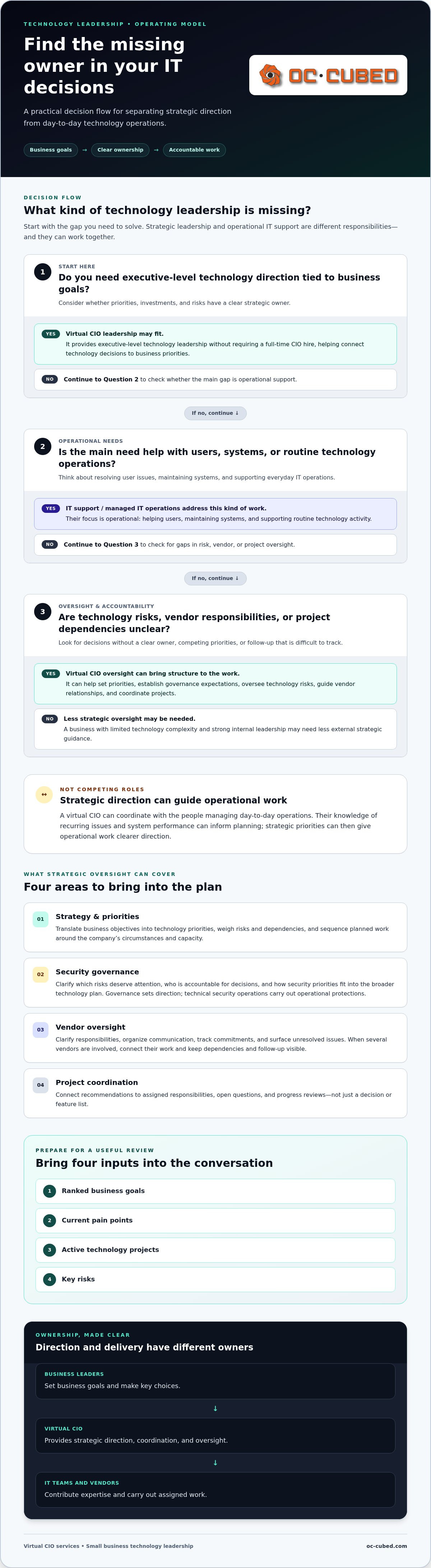
In practice, virtual CIO services help small business leaders establish who guides strategic decisions and how progress is reviewed. The CIO provides direction and oversight. Business leaders still set goals and make key choices, while vendors and IT teams contribute their expertise and carry out assigned work.
What is the difference between a virtual CIO and IT support?
IT support focuses on operational needs: helping users resolve issues, maintaining systems, and supporting routine technology operations. A virtual CIO focuses on strategic questions: which priorities deserve attention, how technology investments support business goals, and how risks and vendors should be overseen. These are different responsibilities, not competing versions of the same service.
The roles can work together. A virtual CIO can coordinate with the people managing ongoing operations and use their knowledge of recurring issues and system performance to inform planning. Strategic priorities, in turn, give operational work clearer direction. For a closer look at how remote teams handle day-to-day technology management, see this remote IT management guide.
Whether this role fits depends on the business’s goals, technology complexity, risk exposure, and internal capacity. A company managing competing technology projects or unclear vendor accountability can benefit from more strategic oversight. A company with limited complexity and strong internal leadership may need less. Start by identifying decisions without a clear owner, then define what guidance would connect them to business priorities.
What Virtual CIO Services Cover: Strategy, Security, Vendors, and Projects
A technology plan matters when it helps the business make and carry out better decisions. A virtual CIO’s scope is easiest to understand through the questions leadership needs answered: Which priorities support business goals? What risks need attention? Who owns each project, vendor commitment, and follow-up? Answering these questions turns advice into visible ownership instead of a list of technology features.
How does a virtual CIO create and guide an IT strategy?
Strategy starts with business objectives, not a predetermined technology checklist. The virtual CIO helps translate those objectives into priorities, weigh risks and dependencies, and sequence planned work around the company’s circumstances and capacity. The role and skills of a Chief Information Officer help explain how this leadership connects technology planning with organizational goals.
For example, if a business wants to improve customer service, leadership can assess whether a proposed system addresses that need, what existing tools it depends on, and what work must happen before adoption. The decision becomes actionable when responsibilities, open questions, and progress are reviewed, not simply when a recommendation is made. Priorities and sequencing should reflect the business’s needs, risks, and resources rather than a fixed template.
How do security governance and vendor oversight fit?
Security governance sets direction: which risks deserve attention, who is accountable for decisions, and how security priorities fit into the broader technology plan. It differs from technical security operations, such as monitoring systems or responding to threats. A virtual CIO can align leadership priorities with the operational IT work that supports them. For more detail on operational protections, explore this managed cybersecurity guide.
Vendor oversight brings structure to relationships that might otherwise operate in separate lanes. It can clarify responsibilities, organize communication, track commitments, and surface unresolved issues for decision-makers. When a project depends on several vendors, someone needs to connect their work, identify dependencies, and keep follow-up visible. That coordination helps leadership understand whether a delay or change affects other priorities.
Project management makes the plan easier to act on. OC Cubed provides virtual project management alongside vendor management, helping organize work and maintain accountability. Monthly reporting gives leaders a way to review technology activity and identify items that need attention or a decision. Reporting is most useful when it connects current work to business priorities rather than presenting technical updates without context.
In practice, virtual CIO services can bring a small business a strategic view of planning, governance, vendor coordination, and project oversight. OC Cubed also provides virtual CIO, CTO, and CISO leadership, connecting technology direction with security governance and remote IT operations. Learn more about OC Cubed’s virtual CIO advisory services.
Virtual CIO vs. Managed IT vs. a Full-Time CIO: Which Model Fits?
These models solve different problems. Managed IT supports technology operations. A virtual CIO guides strategic decisions. A full-time CIO provides dedicated executive leadership from within the organization. Choosing a fit depends on what the business needs owned, how complex its technology work has become, and whether internal leaders have the capacity to oversee it.
| Model | Primary responsibility | Day-to-day involvement | Typical business need |
|---|---|---|---|
| Virtual CIO | Technology strategy, priorities, and oversight | Strategic guidance and reviews, with involvement shaped by business needs | Leadership direction without a full-time CIO role |
| Managed IT | IT operations and ongoing technical support | Operational work such as maintaining systems and addressing support needs | Help running and supporting the business’s technology environment |
| Full-time CIO | Executive ownership of the organization’s technology function | Embedded, ongoing leadership and coordination | Organizations that need dedicated, internal technology leadership |
When does a small business benefit from virtual CIO leadership?
A virtual CIO is worth considering when technology decisions are repeatedly reactive, priorities are unclear, or vendors work without coordinated oversight. Growth, increased risk, and complex projects can also make strategic ownership more important. These are signals to assess, not proof that every small business needs a vCIO. The key question is whether current decision-making keeps technology work aligned with business priorities.
Virtual CIO services can complement managed IT rather than replace it. Operational teams may maintain systems and handle support, while a vCIO helps leadership set priorities for upcoming work. This arrangement suits a business that needs a strategic perspective but doesn’t require a full-time executive dedicated to technology. The right division of responsibilities depends on the work that needs direction and the capacity already in place.
How does a vCIO work alongside an MSP or internal IT team?
The vCIO helps set direction and clarify business priorities. An MSP or internal IT team carries out agreed operational work and shares relevant updates. Clear decision rights reduce duplication: leadership defines business goals, the vCIO advises on technology priorities, and the operations team manages assigned execution. For more on the operational role, see this managed service provider guide.
Before choosing a model, identify what currently lacks an owner. If systems need ongoing support, operational coverage may be the immediate priority. If decisions, vendors, or projects lack strategic coordination, leadership may be the gap. Some businesses need both layers, with a vCIO guiding priorities and managed IT supporting daily operations. Others may have enough internal capacity to cover one or both responsibilities. The goal is a clear division of work, not overlapping roles or unattended tasks.
How to Prepare for Virtual CIO Services: Priorities, Questions, and Next Steps
A useful first conversation doesn’t require a polished technology plan. It requires an honest picture of what the business wants technology to support, what’s getting in the way, and where decisions are stuck. A focused preparation process helps make virtual CIO services more specific and easier to connect to real needs.
What should a business clarify before beginning?
Gather a short set of notes before discussing priorities. Keep the focus on business impact, not every tool the company might want to buy or replace.
- Name the outcomes. Describe what leadership wants technology to support, such as smoother operations, business growth, or stronger oversight of risk.
- List recurring pain points. Note problems that keep resurfacing, decisions waiting for an owner, and technology concerns that disrupt work.
- Map active work and vendors. Record current projects, key vendor relationships, dependencies, and commitments that need coordination or follow-up.
- Clarify decision ownership. Identify who approves technology spending, accepts business risk, makes final decisions, and ensures agreed actions move forward.
Then rank the items. Consider which issue has the greatest business impact, which decisions are time-sensitive, and whether one project depends on another. For instance, a proposed system change may rely on a separate project being completed first. Capturing that dependency helps avoid treating the two requests as unrelated wishlist items.
Bring questions, too. Who sets priorities when urgent support needs compete with planned work? What updates do leaders need to make decisions? Which vendors own each part of a project, and how will outstanding commitments be tracked? Clear answers help define where strategic guidance is needed and where existing teams can take the lead.
How can a business tell whether the work is progressing?
Review progress against priorities the business has agreed to, not a generic checklist. Look at decisions made, the status of active projects, changes in open risks, and actions still awaiting an owner. This makes the review practical: what has moved forward, what’s blocked, and what needs leadership attention?
Useful reporting connects technology activity to business context. A technical update becomes more meaningful when it explains how an issue affects a business priority, project dependency, or risk decision. Monthly reporting can support this review, with the content and approach tailored to the organization’s needs. Planning materials and follow-up should reflect the engagement and current priorities rather than a one-size-fits-all template.
Keep the process lightweight. Revisit priorities when business goals, risks, or project dependencies change. That way, the plan can guide decisions without becoming a document that sits untouched while work moves elsewhere.
How OC Cubed Delivers Virtual CIO Services for Small Business
OC Cubed provides virtual CIO, CTO, and CISO leadership as strategic advisory services for businesses that need clearer technology direction. The work connects business priorities with technology decisions, security governance, vendor relationships, and planned projects. It gives leaders a structured way to assess what needs attention, who owns decisions, and how technology activity supports business needs.
This oversight can bring separate concerns into a coordinated view. A security priority may affect a technology project. A vendor’s work may depend on an internal decision. Virtual project management and vendor management help organize responsibilities, communication, and follow-through, while monthly reporting gives leaders a way to review relevant activity and outstanding needs.
How can strategic leadership connect with ongoing IT support?
Advisory priorities are most useful when they connect with daily operations. Remote IT support, helpdesk and NOC integration, and network monitoring provide operational context for leadership decisions. For example, recurring network concerns can inform which issues deserve attention in broader planning. Strategic direction sets priorities, while operational teams handle the agreed work within their responsibilities.
Microsoft 365 tenant maintenance is another operational IT capability that works alongside executive guidance. Leadership can consider how the environment supports business needs and what oversight is needed, while maintenance remains operational work. OC Cubed’s managed IT services cover these operational capabilities, while virtual CIO guidance addresses strategic direction. Defining the responsibilities for each engagement keeps the two layers coordinated.
What is a practical first step with OC Cubed?
Start with the business questions that need attention. Bring a short overview of current technology priorities, recurring challenges, planned projects, and decisions that are difficult to coordinate. It’s also useful to identify who currently approves spending, manages vendor relationships, and follows up on open work. A complete inventory isn’t necessary. A few well-chosen examples can show where strategic guidance could help.
From there, the discussion can focus on your goals and the type of oversight that fits your needs. OC Cubed’s virtual CIO, CTO, and CISO leadership can work alongside security governance, vendor management, virtual project management, and monthly reporting. The aim is to understand the business context and connect leadership support with ongoing operations.
For businesses considering virtual CIO services, a practical next step is to discuss priorities, challenges, and upcoming work with OC Cubed. You don’t need to arrive with every answer. Begin with what needs clearer direction.
Give Your Next Technology Decision a Clear Owner
The next step doesn’t need to be a major transformation. It can begin with one decision that keeps resurfacing, one project waiting on direction, or one technology priority that has lost sight of its business purpose. Naming the issue and deciding who should guide it can move the conversation from reaction to intentional planning.
Before choosing a path, consider what your business needs technology to make possible over the coming months. Then ask whether current decision-making, oversight, and follow-through are strong enough to support those aims. For leaders exploring virtual CIO services for small business teams, the gap between business goals and technology ownership is a practical place to start.
A focused discussion can clarify which priorities deserve attention and what kind of leadership would support them. You don’t need a perfect plan before taking that step. A clear view of what’s changing, what feels uncertain, and what matters most is enough to begin.
With clearer ownership, technology decisions can become a steadier part of how your business moves forward.
Frequently Asked Questions
What are virtual CIO services for a small business?
Virtual CIO services give a small business executive-level technology leadership without requiring a full-time CIO hire. The vCIO helps business leaders make strategic decisions, set priorities, and oversee technology-related risks. Operational support is different: it handles user issues, routine maintenance, and technical work. A business can use both, giving strategic decisions an accountable guide while day-to-day IT needs receive operational attention.
How is a virtual CIO different from an MSP?
An MSP generally manages ongoing IT operations, while a vCIO guides strategic technology direction. An MSP may support users, monitor systems, or maintain infrastructure. A vCIO helps determine how technology work supports business priorities and what decisions should come next. The roles can be coordinated: the vCIO provides direction, while the MSP handles agreed operational responsibilities. Clear boundaries help prevent duplicated decisions and unattended tasks.
When should a small business consider virtual CIO services?
Consider virtual CIO services when technology choices are mostly reactive, competing requests have no clear priority, or vendors and projects lack coordination. A shift in business plans, a complex risk decision, or several dependent projects can also increase the need for strategic ownership. If internal leaders already provide effective oversight, focus on the specific gaps that remain and whether additional strategic guidance would address them.
Can a virtual CIO work with an internal IT team?
Yes. A virtual CIO can help leadership set technology direction while an internal IT team provides technical input and manages its assigned operational work. For example, the team might identify recurring application bottlenecks, and the vCIO can help leaders assess possible responses against business priorities. Agreeing who recommends, approves, implements, and tracks each decision helps the team and advisor work together without confusion.
How much do virtual CIO services cost?
Fees depend on the engagement’s scope and the business’s needs, so there isn’t one price that applies to every situation. OC Cubed offers virtual CIO/CTO/CISO advisory fees for fractional executive-level technology leadership. Businesses can also engage OC Cubed through a monthly managed IT services retainer or project-based IT management fees for defined work. The responsibilities, level of oversight, and project scope help establish what the engagement covers.
Can a virtual CIO help manage IT vendors and projects?
Yes. A virtual CIO can help clarify vendor responsibilities, organize communication, track follow-up, and bring unresolved decisions to the appropriate business leaders. Virtual project management can also make dependencies, ownership, and next steps visible. For example, when a technology change involves both a vendor and internal staff, clear responsibility for each handoff helps keep work coordinated. The level of oversight should fit the project.
Is a virtual CIO the same as a fractional CIO?
The terms often describe a similar leadership model: a business receives senior technology guidance without employing a full-time executive. Usage can vary, so the title alone doesn’t define the advisor’s responsibilities or involvement. Focus instead on the agreed scope: which decisions the advisor guides, how they work with internal or managed IT teams, and what oversight the business needs. Clear expectations matter more than the label.


